
Pocket Watches · Pocket watch
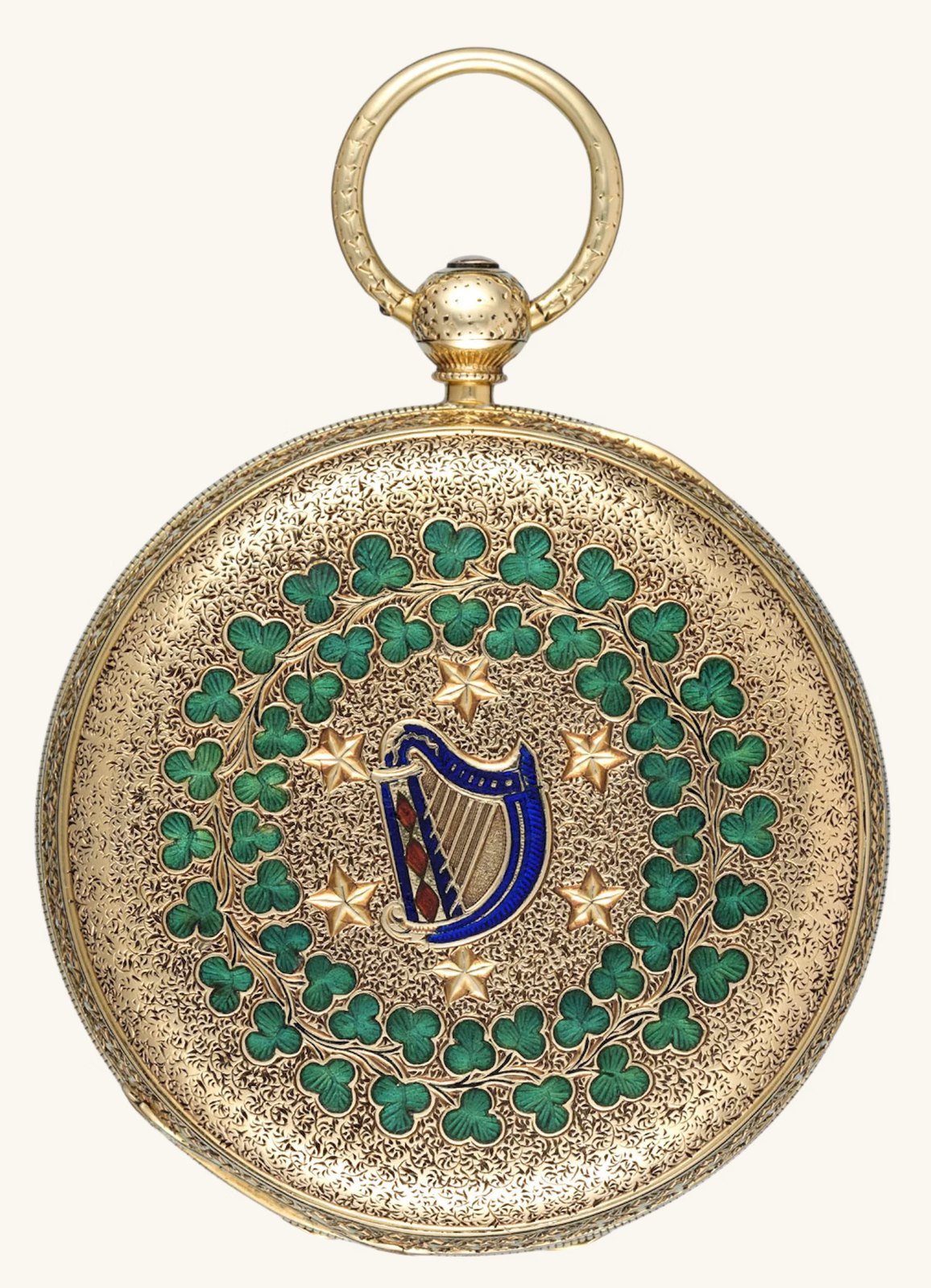
Irish Gold and Enamel Lever, 1863
- Maker / attribution
- Unrecorded in source
- Date
- 1863
- Historical period
- Industrial Revolution (1850 – 1900)
- Country of origin
- Ireland
- Object type
- Pocket watch
- Materials / technique
- gold, enamel
- Dealer
- WatchMuseum.org shop
- Stock no.
- Product 1595
- Credit line
- Dealer listing, WatchMuseum.org shop (product 1595)
- Catalogue title (original)
- Irish Gold and Enamel Lever (English)
View the source record (dealer listing) ↗ (opens another website in a new tab)Suggest a correction
Record summary
Catalogued by WatchMuseum.org shop (stock number Product 1595), this is a pocket watch, made in Ireland, dated 1863. The Atlas places it in the Industrial Revolution period (1850 – 1900) of its Pocket Watches collection. Materials and techniques recorded by the source: gold, enamel. The record is illustrated with 5 photographs.
Assembled from the source record's structured fields. Dates and attributions are given as the source states them; where a field is missing the Atlas leaves it blank rather than estimating.
Catalogue description
Dealer description — WatchMuseum.org shop
Immerse yourself in the rich history and exquisite craftsmanship of the “Irish Gold and Enamel Lever – 1863,” a rare mid-19th century timepiece that epitomizes the elegance and precision of Irish watchmaking. This extraordinary fusee lever watch is encased in a full hunter case made of luxurious 18-carat gold, adorned with intricate shamrock motifs, the cherished emblem of Ireland. The watch boasts a finely crafted gilt three-quarter plate keywind movement, featuring a fusee and chain, Harrison’s maintaining power, and an engraved cock with a polished steel regulator. Its plain three-arm gold balance, blue steel spiral hairspring, and English table roller lever escapement highlight the meticulous attention to detail. The dial is a masterpiece in itself, engraved and decorated with applied gold Roman numerals, blue steel hands, and a subsidiary seconds hand, all encased within a substantial ribbed middle. Both covers of the case are embellished with rows of translucent green enamel shamrocks, with the front cover showcasing a shield-shaped cartouche bearing a heraldic device and the back cover centered by a harp in blue and red enamel. This watch, hallmarked Dublin 1863, carries the maker’s mark “JD” and a corresponding movement number, identifying it as the work of John Donegan, a distinguished Dublin watchmaker active since 1837. With a diameter of 53 mm, this timepiece is not only a functional instrument but also a work of art, reflecting the heritage and craftsmanship of its era. This is a rare mid-19th century Irish fusee lever watch enclosed in a full hunter case made of gold and decorated with shamrocks, the symbol of Ireland. The finely crafted gilt three-quarter plate keywind movement features a fusee and chain, Harrison’s maintaining power, an engraved cock with polished steel regulator, a plain three-arm gold balance with blue steel spiral hairspring, and an English table roller lever escapement. The dial is beautifully engraved and decorated with applied gold Roman numerals and blue steel hands. The dial also features a subsidiary seconds hand. The 18 carat full hunter case is quite substantial, with a ribbed middle and both covers decorated with two rows of shamrocks in translucent green enamel. The front cover has a shield-shaped cartouche with a heraldic device, while the back cover is centered by a harp in blue and red enamel. The maker’s mark “JD” is present, as well as a number corresponding to that on the movement. This is an attractive and rare watch, which appears to have been made locally, as evidenced by the maker’s mark JD on the case and ID stamped on the movement. The watch was crafted by John Donegan, a master watchmaker from Dublin who had two shops and was active in 1837. The watch is hallmarked Dublin 1863, and has a diameter of 53 mm. Signed John Donegan – Dublin Hallmarked Dublin 1863 Diameter 53 mm
Historical context
Industrial Revolution (1850 – 1900)
American interchangeable-parts manufacture; railroad time standards; Swiss and German factory systems.
Machine production with interchangeable parts, pioneered by Waltham (1850s) and adopted by Elgin, Longines, Omega and others, made reliable lever watches widely affordable. Keyless winding became standard, railroad watch standards were introduced (1890s), and Swiss and American industries competed globally.
Read the period in the timelineMore pocket watches from this periodEarlier: Precision & Scientific Horology
Atlas type guide
Pocket watches
The pocket watch was the dominant personal timekeeper from the late seventeenth century until the First World War. Its development tracks the history of the escapement: verge watches with fusees until the late eighteenth century; Thomas Mudge's lever escapement (c. 1755) and the cylinder escapement popularised by George Graham and later by Swiss makers; and the Swiss and English lever watches of the nineteenth century. Lépine's bar-bridge calibre and keyless winding made watches thinner and easier to use.
Industrialisation transformed the trade: American factories such as Waltham (from 1850) and Elgin produced interchangeable parts by machine, and Swiss makers responded with their own mechanisation after the 1876 Philadelphia Exhibition. By 1900 a reliable watch was affordable to millions; the finest makers continued to produce complications and precision watches.
What to look for
- The escapement: verge (crown wheel), cylinder, duplex, English or Swiss lever.
- Key winding (a square arbor in dial or back) or keyless crown winding.
- Signatures and serial numbers on the movement, dial and inside case back.
- Hallmarks, case maker's marks and gold or silver standards stamped in the case.
- Dial material: enamel, silver, gold, later printed metal.
Dating clues
- Verge watches dominate before c. 1800; cylinder watches c. 1770–1900; lever watches after c. 1820.
- Keyless winding: increasingly common after c. 1860.
- Manufacturer serial number lists exist for Waltham, Elgin, Longines, Omega, Patek Philippe and others.
General guidance written by the Atlas editors about this kind of object. It is not a statement about this particular piece; for that, rely on the source record above and on physical examination.
Read next:Verge escapementIdentification Centre
Related records
Pocket Watches · c. 1853
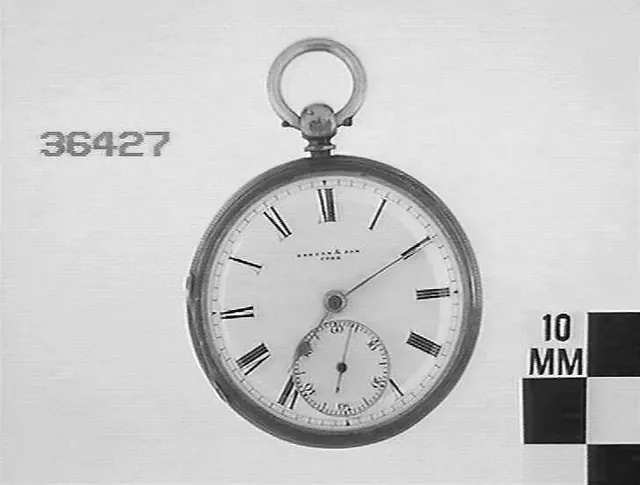
Pocket Watch - Breton & Son, Cork, circa 1858
Museums Victoria, Melbourne
Pocket Watches · 1868
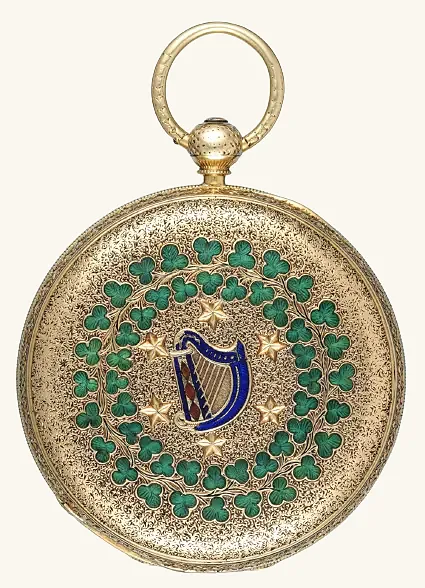
Irish Gold & Enamel Lever, 1868
WatchMuseum.org shop
Pocket Watches · 1852 (hallmarked London)
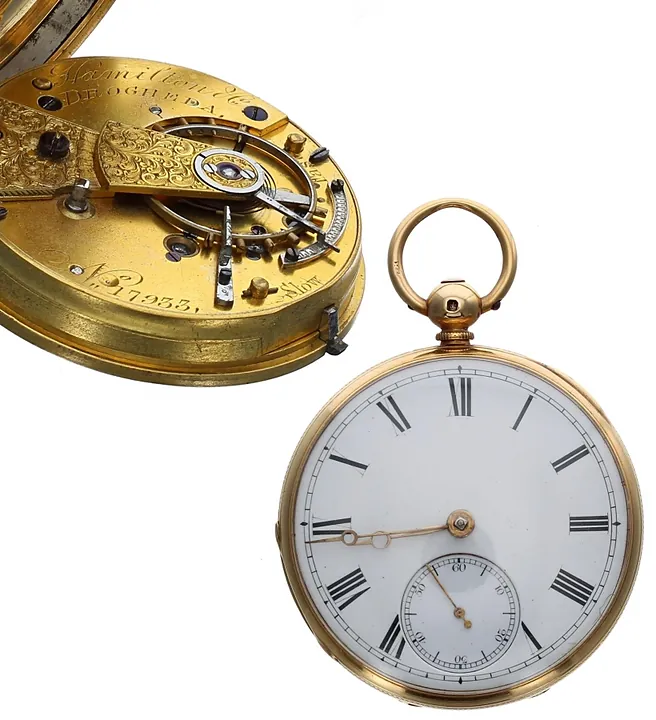
Irish 18ct fusee lever pocket watch by Hamilton & Co. Drogheda, hallmarked London 1852
Gardiner Houlgate (auction house), Corsham
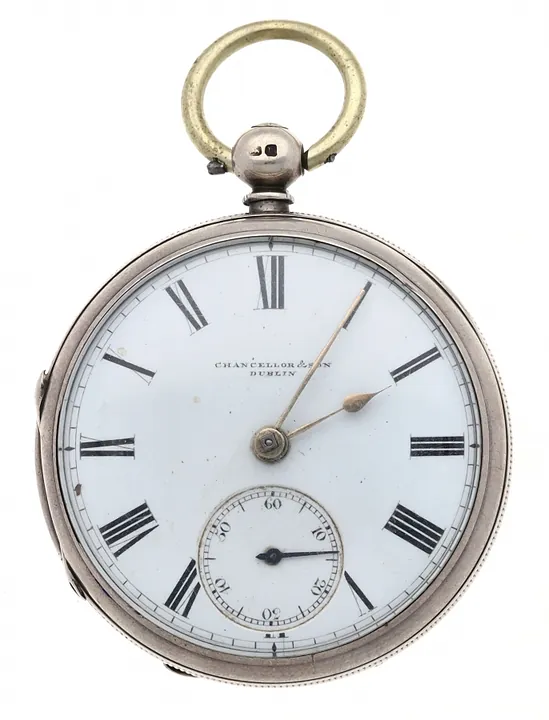
Pocket Watches · 1876 (hallmarked Birmingham)
Victorian silver lever pocket watch by Chancellor & Son, Dublin, hallmarked Birmingham 1876
Gardiner Houlgate (auction house), Corsham
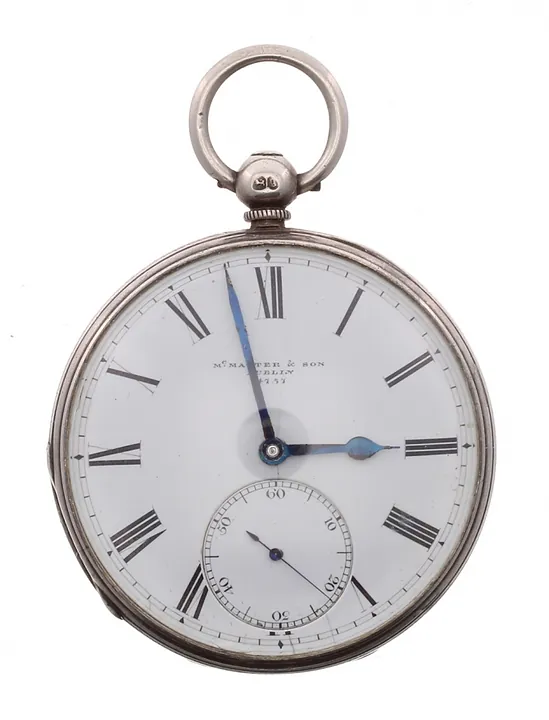
Pocket Watches · 1863 (hallmarked London)
Irish silver fusee lever pocket watch, hallmarked London 1863
Gardiner Houlgate (auction house), Corsham
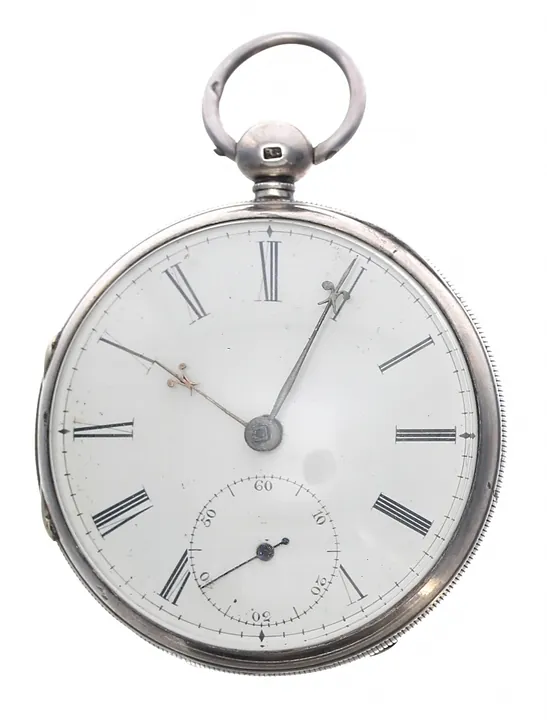
Pocket Watches · 1856 (hallmarked Dublin)
Irish 19th century silver fusee lever pocket watch, hallmarked Dublin 1856
Gardiner Houlgate (auction house), Corsham
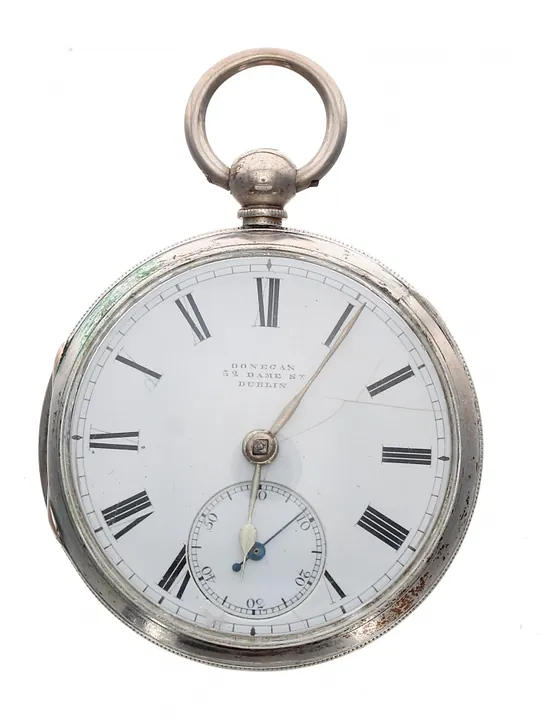
Pocket Watches · 1870 (hallmarked Dublin)
Irish 19th century silver fusee lever pocket watch, hallmarked Dublin 1870
Gardiner Houlgate (auction house), Corsham
Pocket Watches · 1859 (hallmarked Dublin)
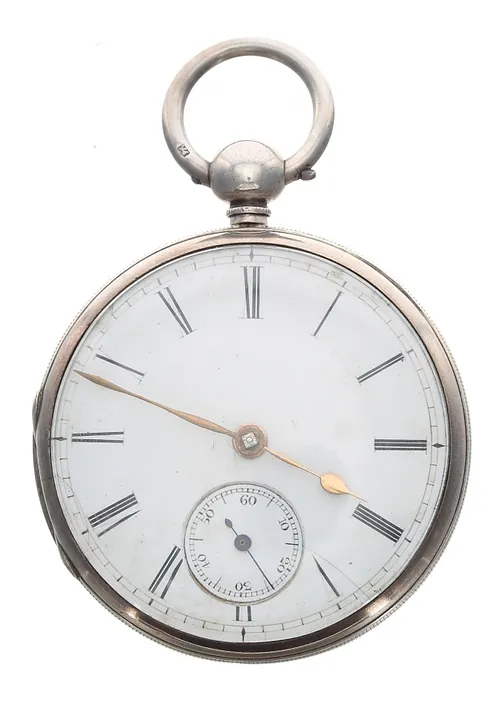
19th century Irish silver fusee lever pocket watch, hallmarked Dublin 1859
Gardiner Houlgate (auction house), Corsham