
Wristwatches · Wristwatch
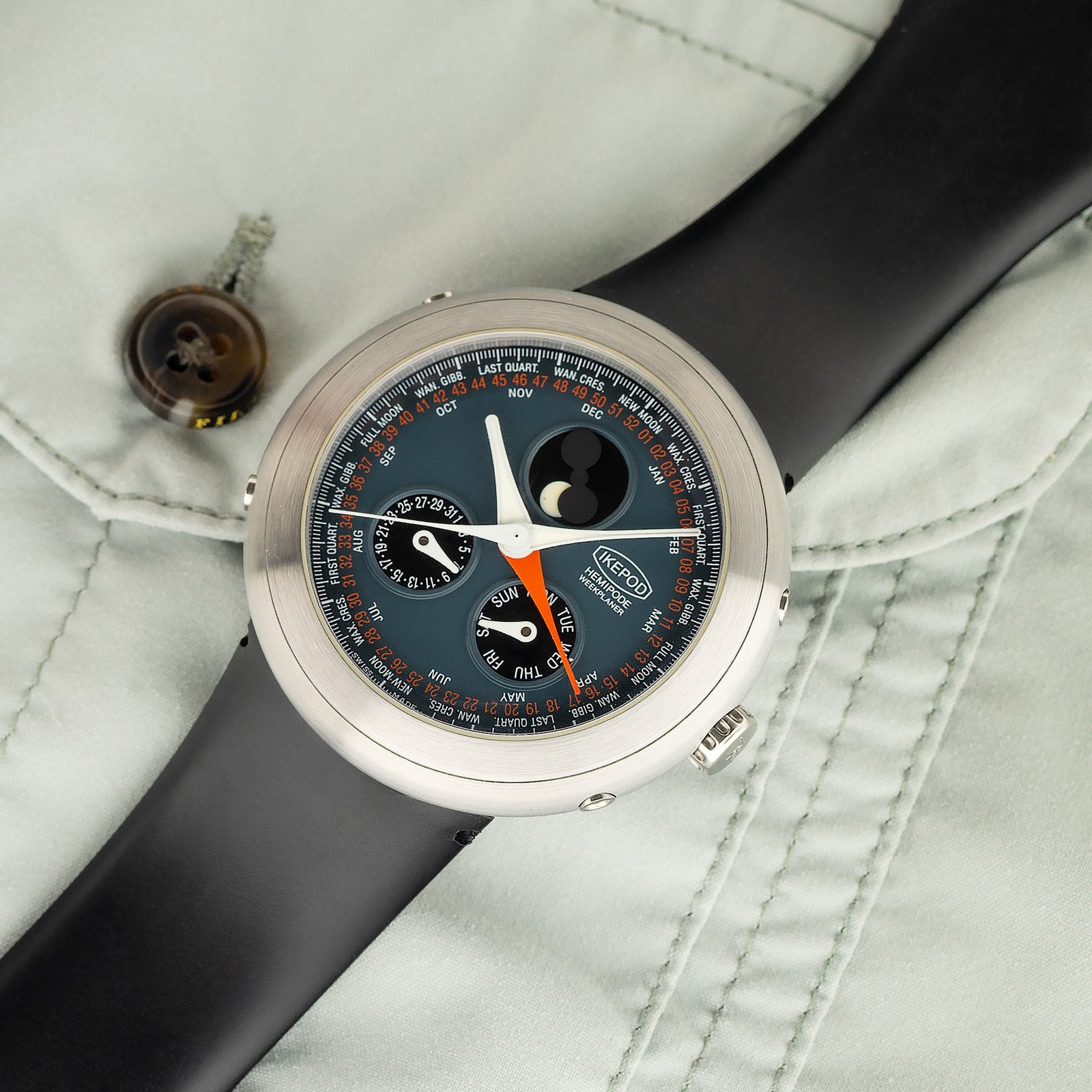
Ikepod Hemipode Weekplanner
- Maker / attribution
- Ikepod (maker)
- Date
- c. 2000s
- Historical period
- Mechanical Renaissance (1990 – 2010)
- Country of origin
- Unrecorded in source
- Object type
- Wristwatch
- Stock no.
- Product 9576472445204
- Credit line
- Dealer listing, Collectors Corner NY (product 9576472445204)
- Catalogue title (original)
- Ikepod Hemipode Weekplanner (English)
View the source record (dealer listing) ↗ (opens another website in a new tab)Suggest a correction
Record summary
Catalogued by Collectors Corner NY (dealer), New York (stock number Product 9576472445204), this is a wristwatch by Ikepod, dated c. 2000s. The Atlas places it in the Mechanical Renaissance period (1990 – 2010) of its Wristwatches collection. The record is illustrated with 5 photographs.
Assembled from the source record's structured fields. Dates and attributions are given as the source states them; where a field is missing the Atlas leaves it blank rather than estimating.
Catalogue description
Dealer description — Collectors Corner NY
Vintage and neo-vintage Ikepod watches are beginning to garner more attention from the collector community and for good reason. The Swiss brand is most known for its round "pod" case shapes which resemble UFOs and stand out for being incredibly unique, imaginative and playful. Designer Marc Newson who co-founded the company in 1994 left a distinct brand identity. Analyzing Ikepod, one can easily draw parallels with the Apple Watch; another Newson design which was arguably his most successful and a product that went on to become the top selling wrist watch in history. This Weekplanner, circa 2000s is one of our favorite Ikepod designs particularly for its moonphase complication which ties well to its outer space design aesthetic. This piece also displays a date, week and month on its blue/grey dial and outer track. Offered in excellent condition, this piece makes for a fantastic and off the beaten path addition to a collection of any level.
Historical context
Mechanical Renaissance (1990 – 2010)
Mechanical watches return as cultural objects; independent watchmaking flourishes.
Mechanical watches returned as cultural and luxury objects. Complications, tourbillons and new materials proliferated; independent watchmakers such as George Daniels, F.P. Journe and Philippe Dufour revived artisanal watchmaking; collecting vintage watches became a major field.
Read the period in the timelineMore wristwatches from this periodEarlier: Quartz Revolution
Atlas type guide
Wristwatches
Bracelet watches were worn by women from the early nineteenth century — Breguet made one for Caroline Murat, Queen of Naples, in 1810–12 — but the wristwatch only became a man's instrument with military use and aviation in the early twentieth century. Between the World Wars it overtook the pocket watch; the 1920s and 1930s brought rectangular Art Deco cases, water-resistant cases and the first automatic winding systems.
After 1945 the wristwatch became a carrier of identity — dress watches, sports and dive watches, chronographs, calendars — produced by Swiss, American, Japanese, German, Soviet and Chinese industries. The quartz revolution after 1969 and the mechanical renaissance since the 1990s, including the rise of independent watchmakers, complete the story.
What to look for
- The reference number (between the lugs or inside the case back) and serial number, the starting point for dating.
- The calibre: its maker and number are often stamped under the dial or on the bridge.
- Originality of dial, hands and crown — refinished ('redial') dials are common.
- Case material marks: 18K/750, 14K/585, stainless steel, gold-filled, plated.
Dating clues
- Wire-lug cases: before c. 1925.
- Water-resistant screw-down cases: from 1926.
- Quartz movements: from 1969; sapphire crystals widespread after c. 1980.
General guidance written by the Atlas editors about this kind of object. It is not a statement about this particular piece; for that, rely on the source record above and on physical examination.
Related records
Wristwatches · mid 2000s
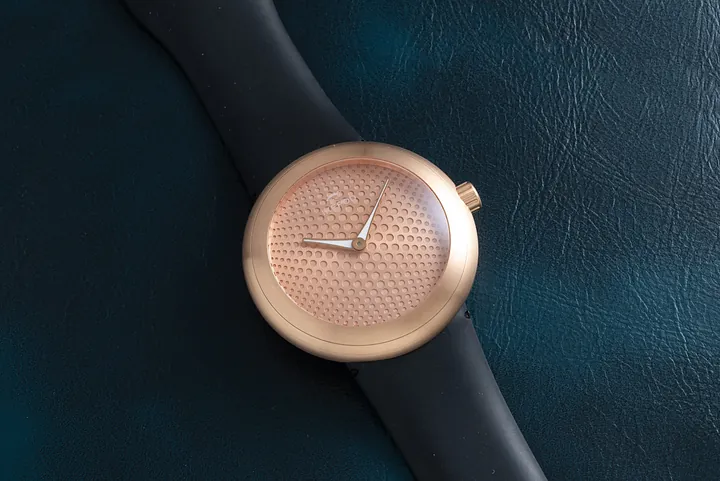
Ikepod Horizon, mid 2000s
Analog/Shift (dealer), New York
Wristwatches · 2018
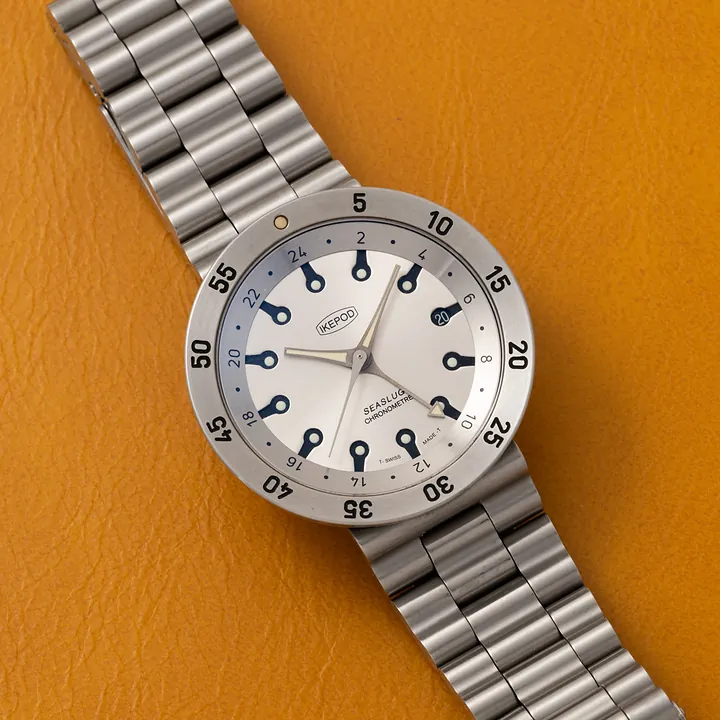
Ikepod Seaslug, 2018
Analog/Shift (dealer), New York
Wristwatches · early 2000s
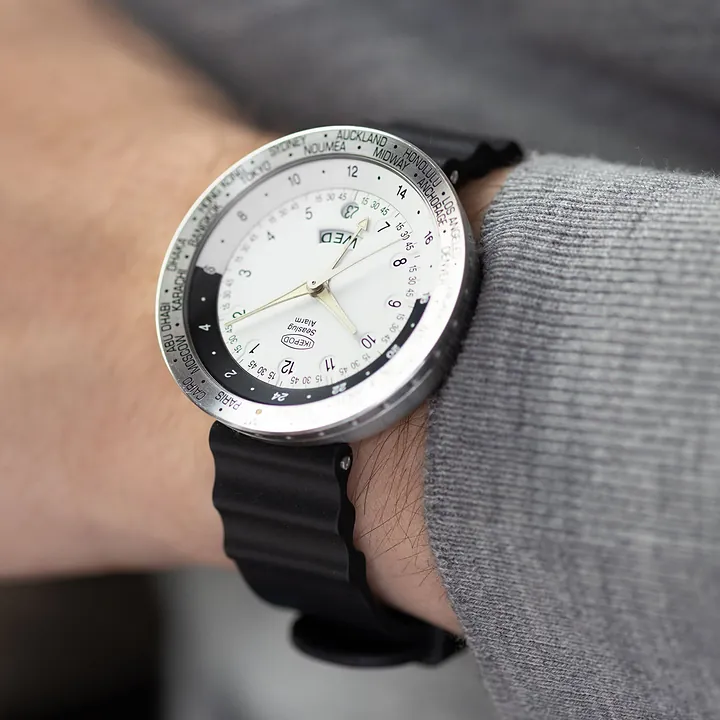
Ikepod Seaslug Alarm day-date World Timer, early 2000s
Bulang & Sons (dealer), Copenhagen
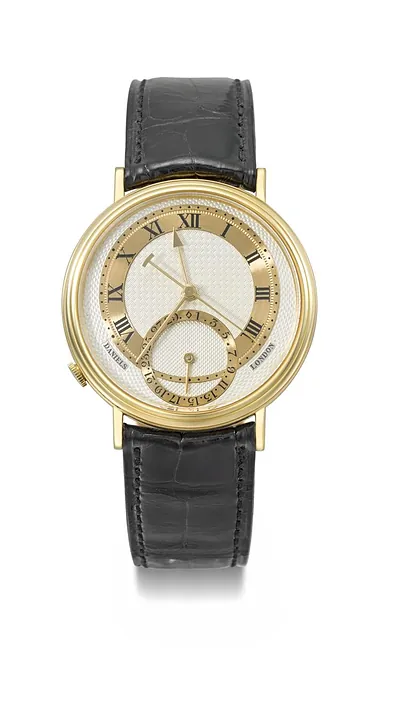
Wristwatches · 1999
'Millennium' co-axial wristwatch by George Daniels and Omega, England, 1999
Science Museum Group, London

Wristwatches · 2008
Wristwatch by Breitling?, 2008
Museum Rotterdam
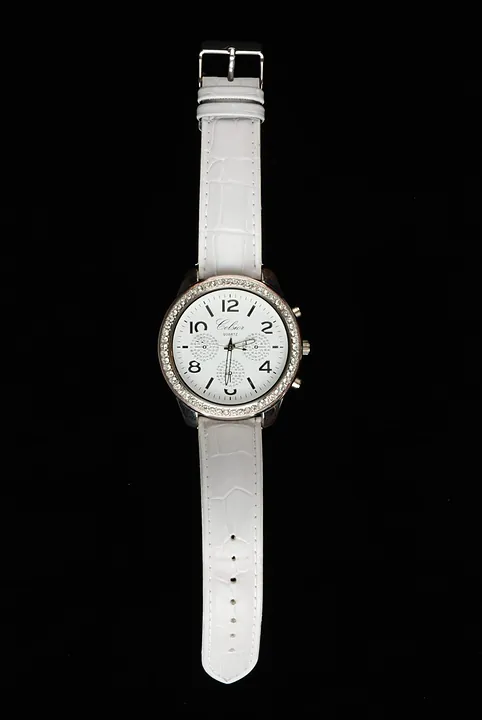
Wristwatches · 2008
Wristwatch by Celsior Quartz, 2008
Museum Rotterdam
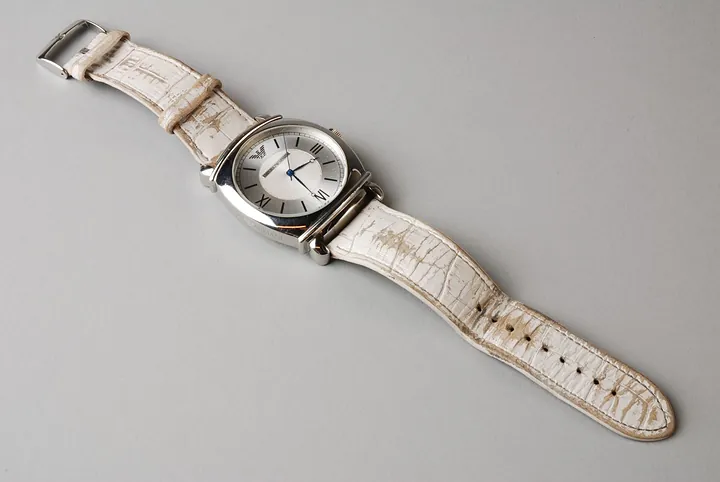
Wristwatches · 2008
Wristwatch possibly by Emporio Armani, 2008
Museum Rotterdam

Wristwatches · c. 1990s
Audemars Piguet Bamboo, c. 1990s
Antiquorum auction archive, Geneva