
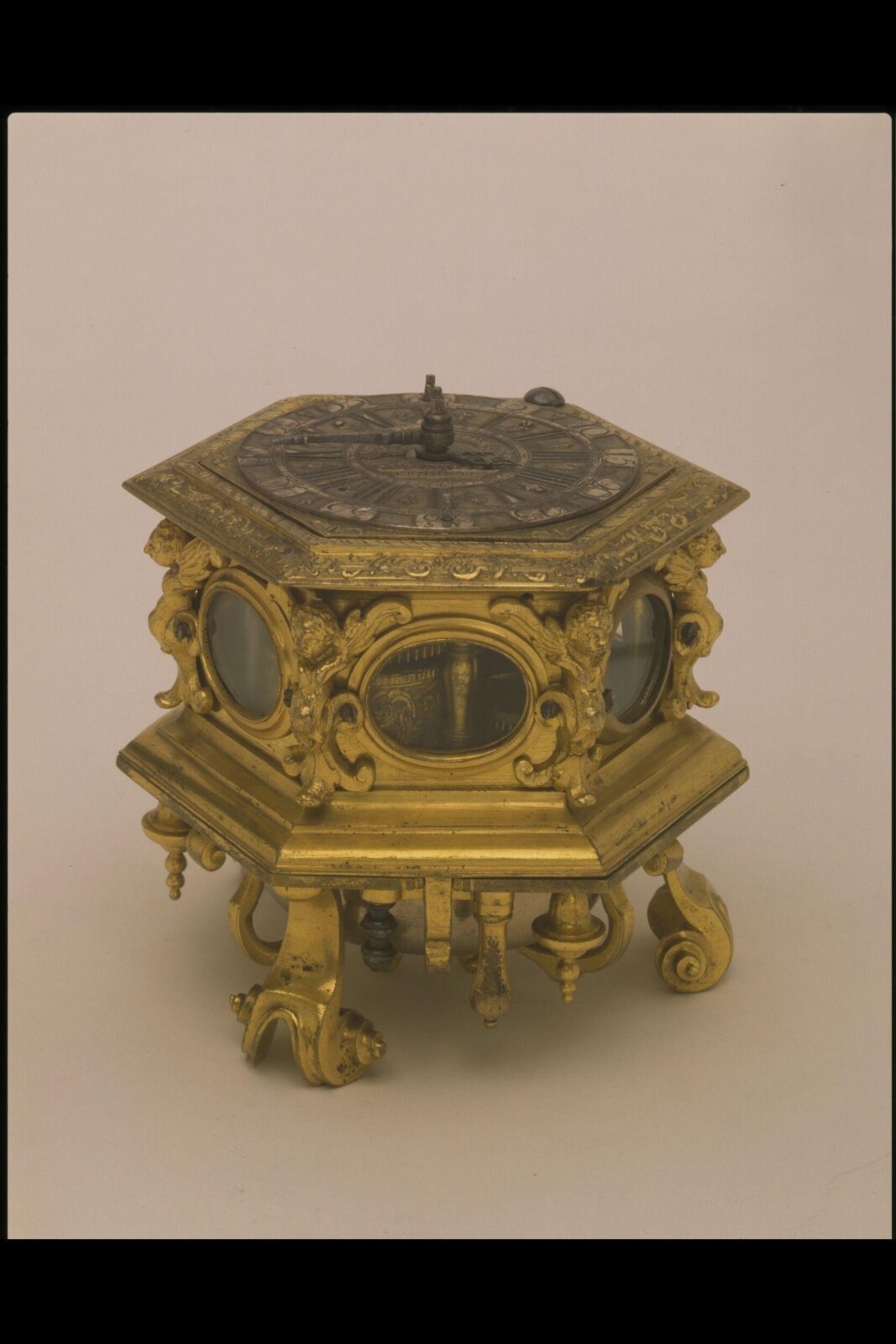
Clocks · Hexagonal repeating table-clock
Hexagonal repeating table-clock by B Firstenfelder, Germany, c. 1700
- Maker / attribution
- B Firstenfelder (made)
- Date
- c. 1700
- Historical period
- Early Modern Horology (1600 – 1750)
- Country of origin
- Germany
- Place
- Germany
- Object type
- Hexagonal repeating table-clock
- Materials / technique
- Brass case, red enamel, steel minute and hour hands.
- Dimensions
- Width: 9.2 cm; Depth: 5.1 cm
- Holding institution
- Victoria and Albert Museum, London
- Accession / object no.
- 178-1866
View the source record ↗ (opens another website in a new tab)Suggest a correction
Record summary
Held and catalogued by Victoria and Albert Museum, London (object number 178-1866), this is a hexagonal repeating table-clock by B Firstenfelder, made in Germany, dated c. 1700. The Atlas places it in the Early Modern Horology period (1600 – 1750) of its Clocks collection. Materials and techniques recorded by the source: Brass case, red enamel, steel minute and hour hands. Recorded dimensions: Width: 9.2 cm; Depth: 5.1 cm. The record is illustrated with 1 photograph.
Assembled from the source record's structured fields. Dates and attributions are given as the source states them; where a field is missing the Atlas leaves it blank rather than estimating.
Catalogue description
Physical description — Victoria and Albert Museum
Case: Brass, the ornate hexagonal case of 5.1 cm side, 9.2 cm across, with oval glazed panels in sides, and with applied groteque figures at the corners. Three scroll feet; inverted finials below remaining three corners. Pins missing. Dial: Silvered champleve horizontal dial, 16.3 cm diameter, signed on central disc: "FIRSTEN FELDR FRIDBERG"; Hours in Roman, minutes numbered every 5 in arabic; above 60, the initials SR (presumable for Schlagen and Repetieren) and below 30 the initials NS (presumably for Nicht schlagen and Schlagen), each relating to a projecting pin. Steel minute and hour hands, the latter pierced. Movement: The hexagonal plates fit tightly with the case, the backplate siged "B. FIRSTEN FELDER FRIDBERG 644". Going train with fusee and chain, verge esacpement, balance with spring and Tompion type regulator. Striking train of rack-type with resting barrel and two engraved bell-hammers striking in quick succession on the same bell for each stroke of the hour. The backplate engraved and with pierced decorative cock and foot and applied piece including the regulator dial, which is numbered 1 to 60 in arabic numerals filled with red enamel.
Brief description — Victoria and Albert Museum
Brass, Germany (Fridberg), ca. 1700, B. Firstenfelder
Inscriptions & marks
FIRSTEN FELDR FRIDBERG
Historical context
Early Modern Horology (1600 – 1750)
Huygens' pendulum and balance spring transform accuracy; English makers develop the anchor and deadbeat escapements.
Huygens's pendulum (1656–57) improved clock accuracy from about a quarter of an hour to under a minute a day. The anchor escapement (c. 1670) and the long seconds pendulum created the longcase clock; London makers such as Fromanteel, Knibb, Tompion and Quare led European clockmaking, and French makers created the Boulle pendule.
Read the period in the timelineMore clocks from this periodEarlier: Renaissance Horology
Atlas type guide
Bracket, table and spring-driven clocks
Spring-driven clocks freed timekeeping from the hanging weight. The coiled mainspring, documented from the fifteenth century, made portable table clocks possible; to even out its declining force, makers used the fusee, a conical pulley connected to the barrel by a gut line or chain. Renaissance table clocks from Augsburg and Nuremberg — drum-shaped, square or tower-shaped in gilt brass — were luxury scientific objects, often with astronomical dials and alarms.
After the pendulum, English makers developed the bracket clock: a wooden case with a carrying handle, a short pendulum with a verge escapement, and often repeating work to sound the hours on demand at night. Later examples use the anchor escapement. In the nineteenth century, 'table clock' became a broad term for spring clocks of every nationality.
What to look for
- A fusee in the movement (cone-shaped pulley) and the type of line — gut or chain.
- Verge escapement with a short bob pendulum, often with a decoratively engraved backplate.
- Repeat cords or buttons that make the clock strike again on demand.
- Gilt-brass engraved cases and horizontal dials on Renaissance pieces.
- Case shapes: inverted bell, bell top, break-arch, lancet or balloon.
Dating clues
- Drum and tower table clocks: c. 1520–1650.
- Ebony veneered English bracket clocks with verge escapements: c. 1670–1800.
- Engraved backplates were usual on English clocks until c. 1800, then generally plain.
General guidance written by the Atlas editors about this kind of object. It is not a statement about this particular piece; for that, rely on the source record above and on physical examination.
Read next:Anchor (recoil) escapement
Related records
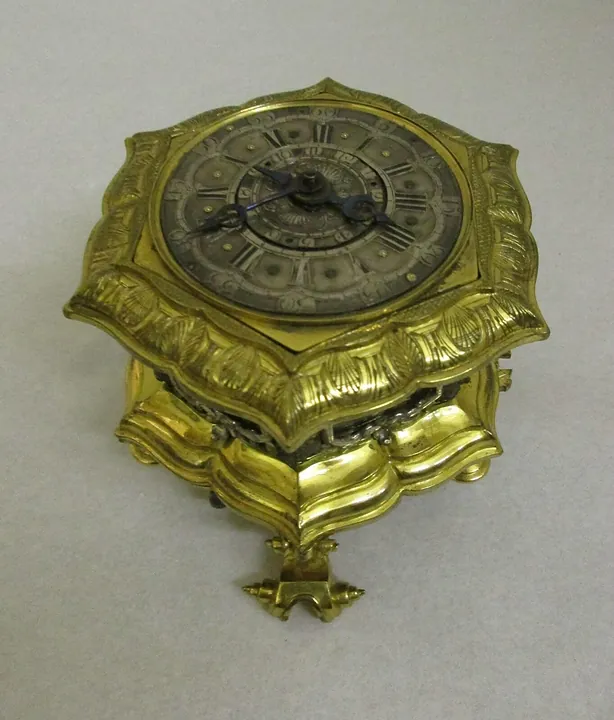
Clocks · 1600–1700
Clock, Germany, 1600–1700
Victoria and Albert Museum, London
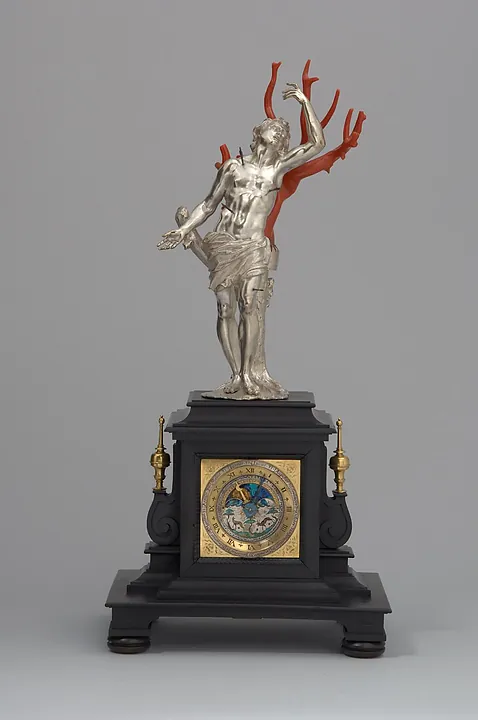
Clocks · 1600–1699
Table clock by Hans Christoph II. Fesenmair, Germany, 1600–1699
Fine Arts Museum Vienna
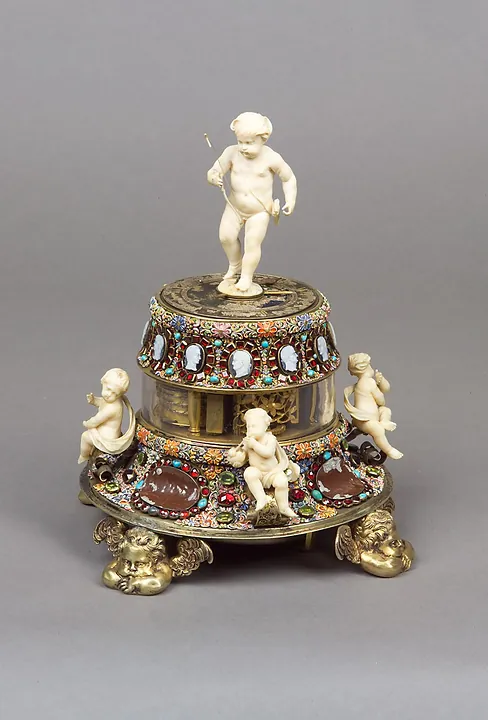
Clocks · 1600–1699
Table clock by Hans Jakob Mair, Germany, 1600–1699
Fine Arts Museum Vienna
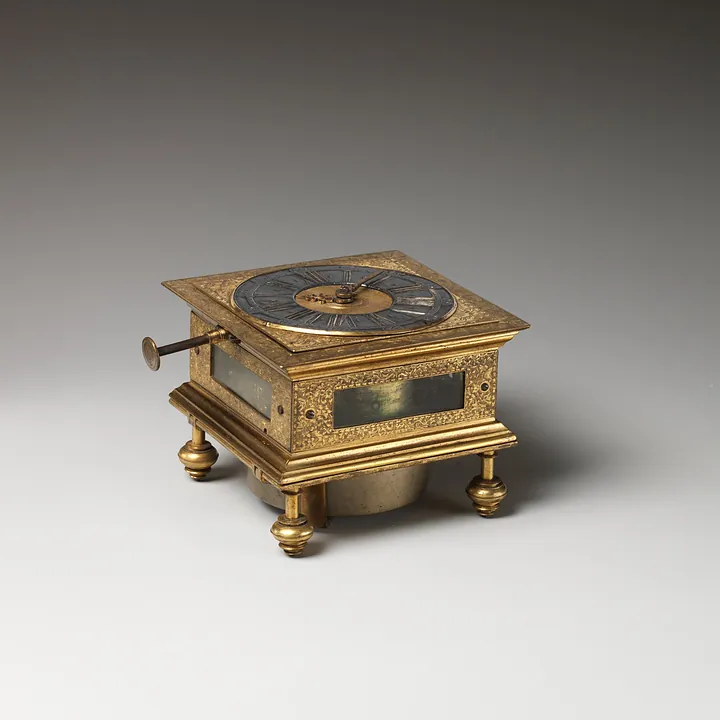
Clocks · 17th century
Table clock by Johann Heinrich Kleinschmidt, Germany, 17th century
The Metropolitan Museum of Art, New York
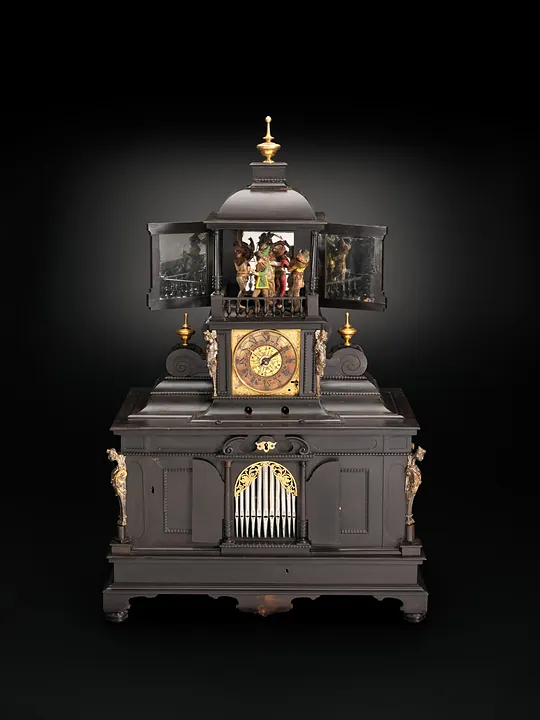
Clocks · c. 1625
Musical clock with spinet and organ by Veit Langenbucher, Germany, c. 1625
The Metropolitan Museum of Art, New York
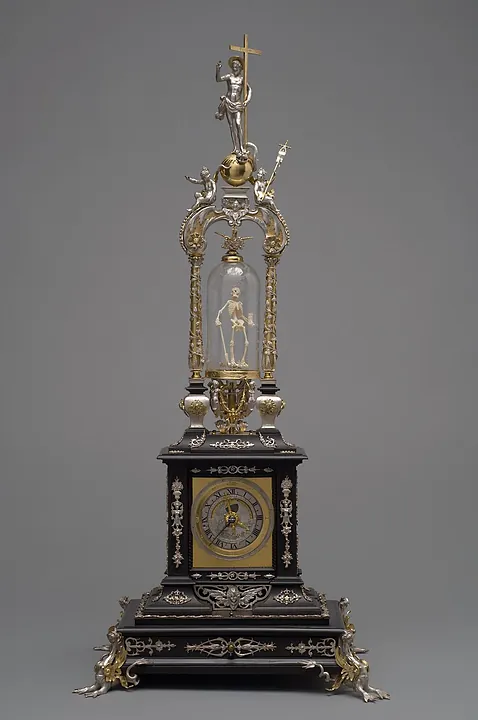
Clocks · 1624–1630
Table clock by Christoph Angermair, Germany, 1624–1630
Fine Arts Museum Vienna
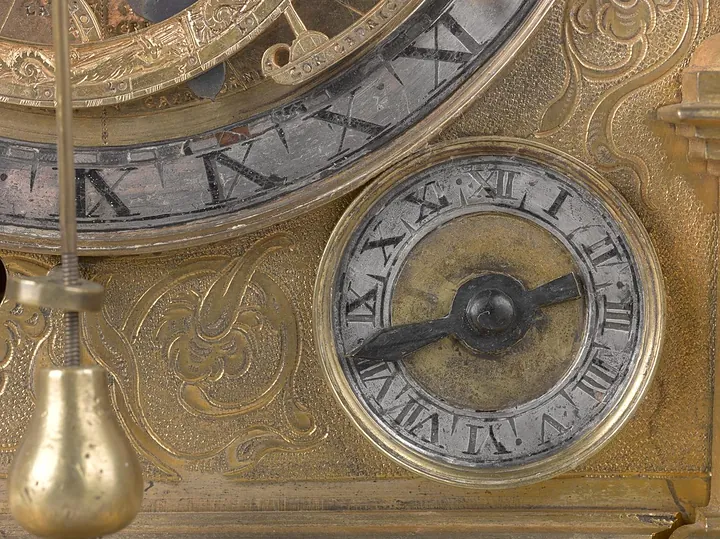
Clocks · 1625–1635
Upright table clock with winding key, by unknown maker, made in Augsburg, Germany, 1625–1635
Science Museum Group, London
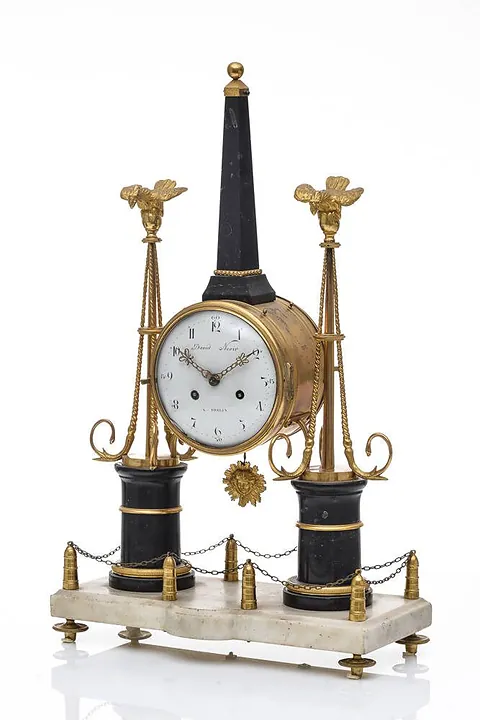
Clocks · 1700–1799
Mantel clock by David Nevir, Germany, 1700–1799
City Museum Berlin