
Wristwatches · Wristwatch
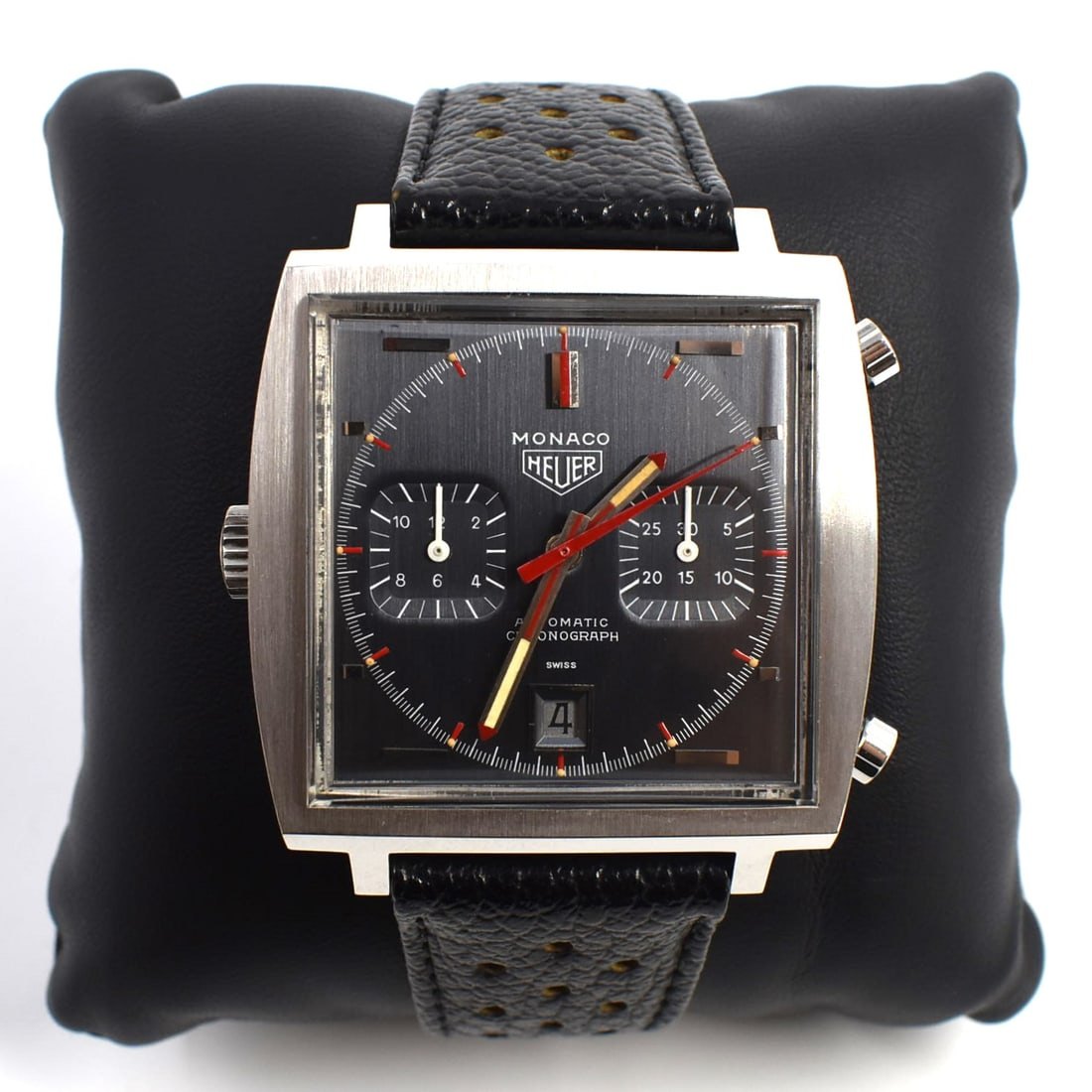
Heuer Monaco Ref. 1133 'Steve McQueen' Automatic Chronograph, circa 1970, with TAG Heuer Service
- Maker / attribution
- TAG Heuer (maker)
- Date
- c. 1970
- Historical period
- Quartz Revolution (1969 – 1990)
- Country of origin
- Switzerland
- Object type
- Wristwatch
- Auction house
- LiveAuctioneers auction archive
- Lot
- Item 216852528
- Credit line
- Auction lot record: lot 61, Fall Decorative Arts, Asian Art & Fine Art, Deker Auctions LLC (2025), via LiveAuctioneers
- Catalogue title (original)
- Heuer Monaco Ref. 1133 'Steve McQueen' Automatic Chronograph, circa 1970, with TAG Heuer Service (English)
View the source record (auction lot) ↗ (opens another website in a new tab)Suggest a correction
Record summary
Catalogued by LiveAuctioneers auction archive (lot Item 216852528), this is a wristwatch by TAG Heuer, made in Switzerland, dated c. 1970. The Atlas places it in the Quartz Revolution period (1969 – 1990) of its Wristwatches collection. The record is illustrated with 4 photographs.
Assembled from the source record's structured fields. Dates and attributions are given as the source states them; where a field is missing the Atlas leaves it blank rather than estimating.
Catalogue description
Lot description — Deker Auctions LLC
An iconic Heuer Monaco 'Steve McQueen' automatic chronograph wristwatch, reference 1133, housed in the distinctive square stainless-steel case with brushed finish, measuring approx. 40mm x 38mm. The black dial displays two silvered subsidiary registers for 30-minute and 12-hour recording, a central chronograph hand in red, and applied indexes, all accented with luminous inserts. Date aperture at 6 o'clock. Signed 'Monaco Heuer' beneath 12 o'clock and 'Automatic Chronograph Swiss' above 6 o'clock. The case back is stamped with the Heuer logo and marked 'Tool No. 033', consistent with early Monaco production. Inside, the watch is powered by the celebrated Caliber 11/12 automatic chronograph movement, a historic joint development by Heuer, Breitling, Hamilton-Buren, and Dubois Depraz, representing one of the world's first automatic chronographs introduced in 1969. The present example bears the reference number '1133' between the lugs ( this watch having just '1133' between the lugs means it is from the first series of Monacos (1969-1972), when Heuer hadn't standardized adding the suffix to the case) , accompanied by its original serial number (withheld for security reasons). The watch is fitted with a perforated black leather strap with Heuer-signed steel buckle, likely contemporary but possibly a later replacement, echoing the original racing-inspired design. Importantly, the watch comes with TAG Heuer USA service paperwork, dated October 2016, detailing a complete movement overhaul, case cleaning, and replacement of gaskets and spring bars (invoice total $939.05). This provides additional assurance of authenticity and mechanical integrity. From a Scarsdale, NY estate Note: For comparative examples, see Phillips 'Racing Pulse,' New York, December 2020; Bonhams London, December 2021, Ref. 1133 lots.
Historical context
Quartz Revolution (1969 – 1990)
Seiko's Astron begins mass quartz timekeeping; traditional industries contract sharply.
Quartz and digital watches transformed the market after 1969. Swiss employment collapsed, Japanese and Hong Kong production soared, and the Swatch (1983) helped the Swiss industry recover; mechanical watches survived as luxury goods.
Read the period in the timelineMore wristwatches from this periodEarlier: Modern Mechanical Horology
Atlas type guide
Chronographs and split-seconds watches
A chronograph is a watch with an additional seconds hand that can be started, stopped and returned to zero independently of the timekeeping. Louis Moinet built an early example in 1816 and Nicolas Rieussec a recording 'chronographe' in 1821; Adolphe Nicole's heart-shaped reset cam (patented 1862) made the modern return-to-zero possible. Split-seconds (rattrapante) chronographs add a second hand that can be stopped for intermediate times; flyback chronographs restart instantly.
Chronographs were essential tools for doctors (pulsometer scales), artillery (telemeter), engineers and sport. In wristwatches, Valjoux, Venus, Lemania and later the automatic chronographs of 1969 (Zenith El Primero, the Chronomatic Calibre 11 group and Seiko 6139) are milestones.
What to look for
- Push-pieces on the case band or a single button in the crown (monopusher).
- Subsidiary registers for minutes and hours; tachymeter, telemeter or pulsometer scales.
- Column wheel versus cam control visible in the movement.
- Calibre markings of specialist makers (Valjoux, Lemania, Venus, Landeron).
Dating clues
- Pocket chronographs with heart cam reset: after 1862.
- Wrist chronographs: from c. 1910; two-button designs from the 1930s.
- Automatic chronographs: from 1969.
General guidance written by the Atlas editors about this kind of object. It is not a statement about this particular piece; for that, rely on the source record above and on physical examination.
Read next:Flyback chronographChronograph
Related records
Wristwatches · c. 2000
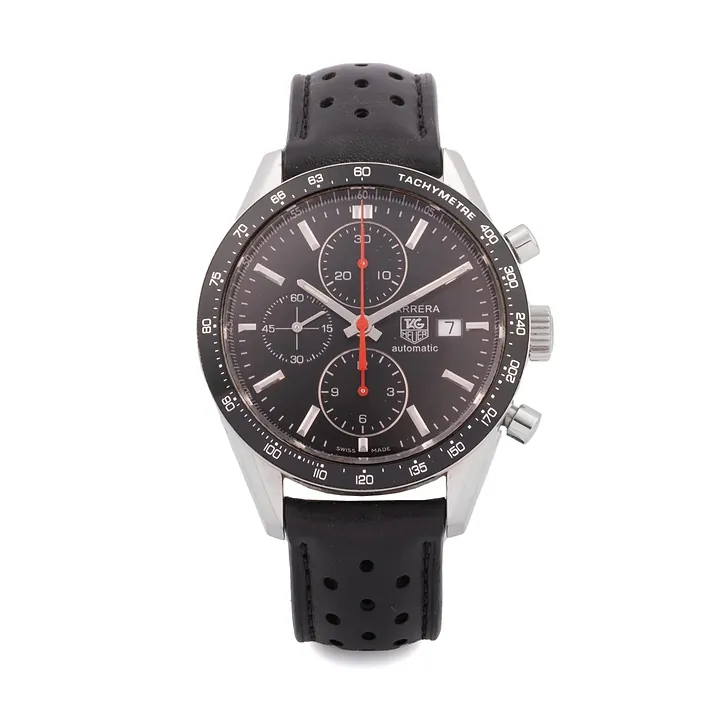
TAG Heuer wristwatch, ref. cv2014-2, c. 2000
Antiquorum auction archive, Geneva
Wristwatches · c. 2010s
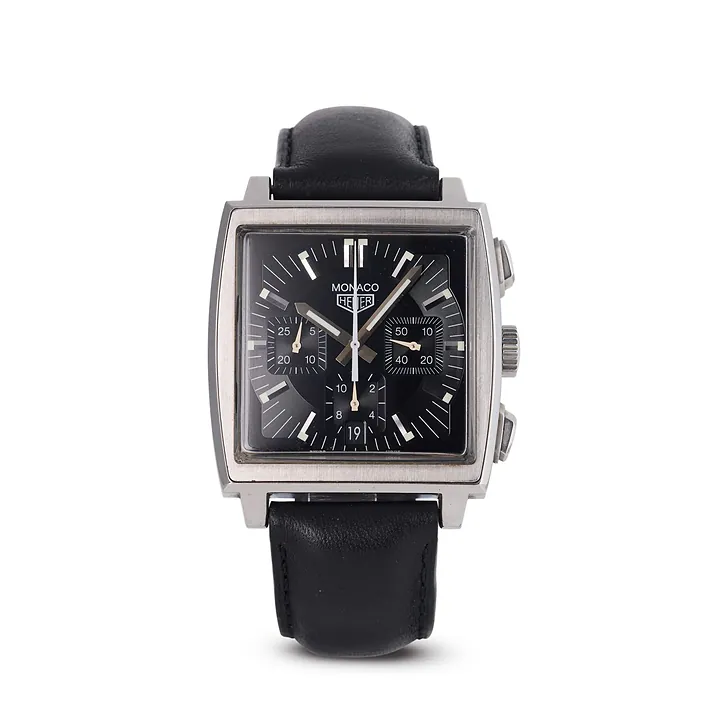
TAG Heuer Monaco, ref. CS2111, c. 2010s
Antiquorum auction archive, Geneva
Wristwatches · c. 2014
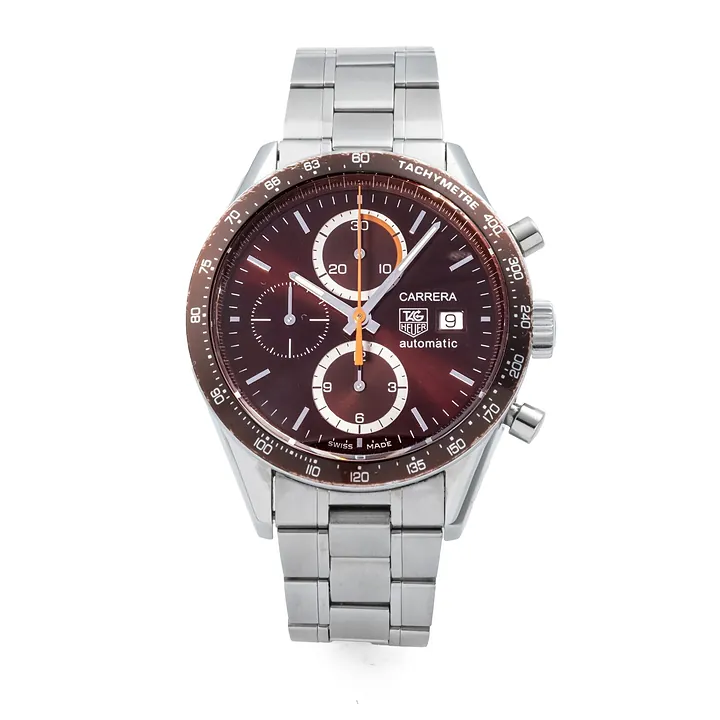
TAG Heuer Carrera 1860, ref. CV2013.BA0794, c. 2014
Antiquorum auction archive, Geneva

Wristwatches · Sold in March 2018
TAG Heuer Carrera, ref. CAR201V, Sold in March 2018
Antiquorum auction archive, Geneva

Wristwatches · 1970
Wristwatch by Heno, Switzerland, 1970
Museum Rotterdam

Wristwatches · 1960–1986
'Tri-Compax' calendar chronograph wristwatch in gold case, by Universal, Geneva, Switzerland, 1960–1986.
Science Museum Group, London

Wristwatches · 1969–1970
Beta 21 Quartz wristwatch movement, made in Switzerland, 1970.
Science Museum Group, London

Wristwatches · c. 1969
Omega Speedmaster Moonwatch, ref. 145022-69st, c. 1969
Antiquorum auction archive, Geneva