
Wristwatches · Wristwatch
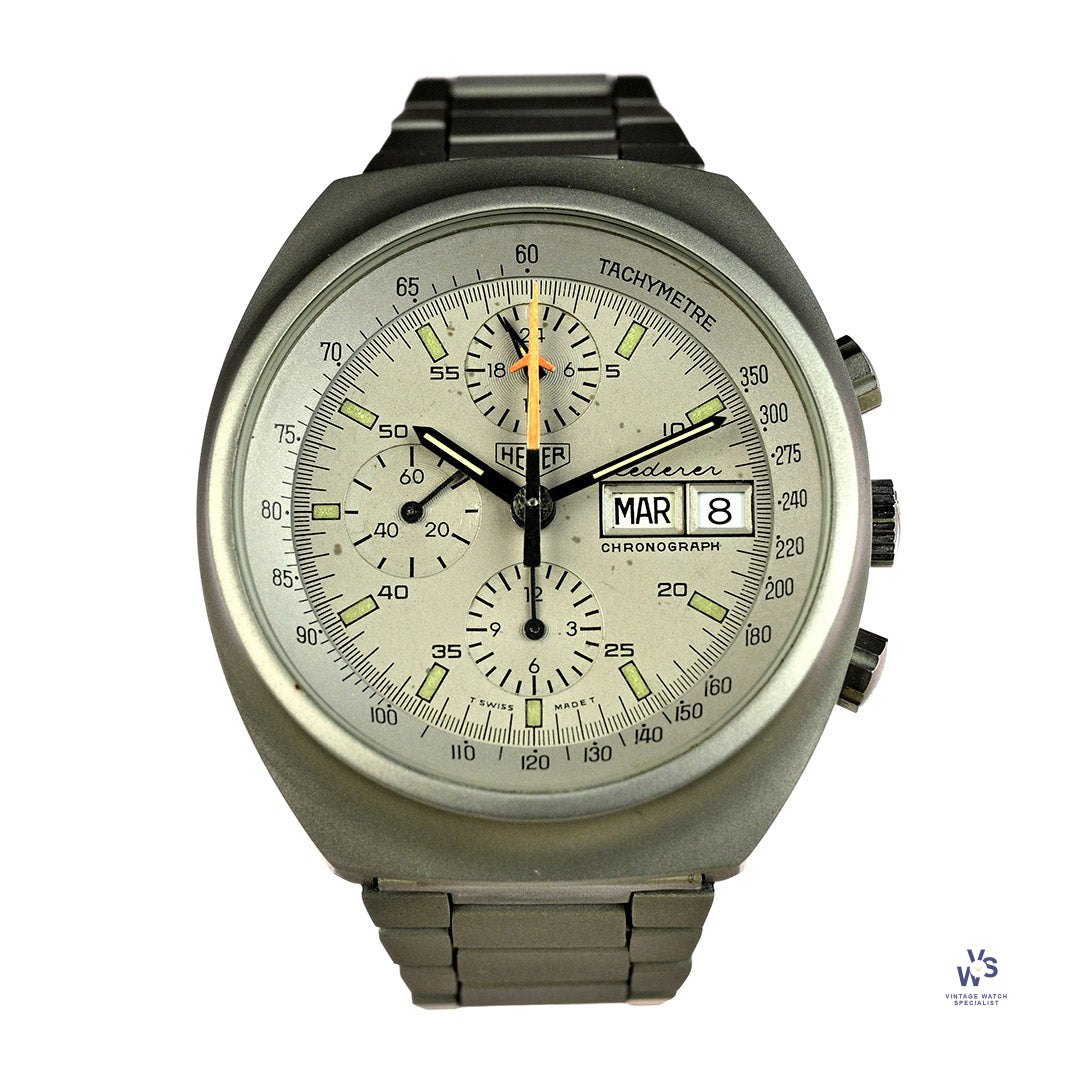
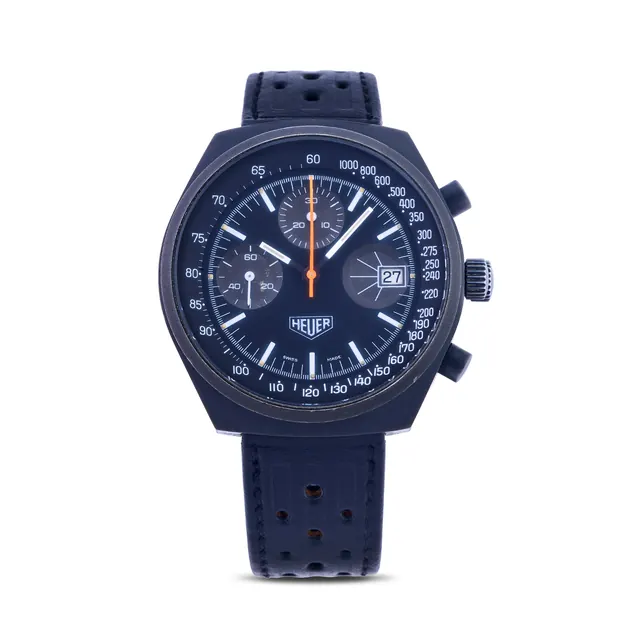
Heuer Chronograph Automatic Day Date Lederer, ref. 510.503, circa 1979
- Maker / attribution
- Heuer (maker)
- Date
- c. 1979
- Historical period
- Quartz Revolution (1969 – 1990)
- Country of origin
- Switzerland
- Object type
- Wristwatch
- Stock no.
- vws3903
- Credit line
- Dealer listing, Vintage Watch Specialist (vws3903)
- Catalogue title (original)
- Heuer Chronograph Automatic Day Date Lederer - Model Ref: 510.503 - c.1979 (English)
View the source record (dealer listing) ↗ (opens another website in a new tab)Suggest a correction
Record summary
Catalogued by Vintage Watch Specialist (dealer), United Kingdom (stock number vws3903), this is a wristwatch by Heuer, made in Switzerland, dated c. 1979. The Atlas places it in the Quartz Revolution period (1969 – 1990) of its Wristwatches collection. The record is illustrated with 6 photographs.
Assembled from the source record's structured fields. Dates and attributions are given as the source states them; where a field is missing the Atlas leaves it blank rather than estimating.
Catalogue description
Dealer description — Vintage Watch Specialist
A rare 1979 Heuer Chronograph Ref: 510.503 with a Lederer-signed dial, day-date display and pewter parkerized finish on itsl original Heuer bracelet The Heuer reference 510.503, launched in the late 1970s, is a robust automatic chronograph powered by the reliable Lemania 5100 movement. Designed with practicality and durability in mind, it features a parkerized stainless steel case that resists glare and wear, making it ideal for professional use. This particular example carries additional intrigue thanks to its rare “Lederer” signed dial, produced for the Chicago department store that retailed select Heuer models in small quantities. Combined with the less commonly seen day-date layout, this is a highly collectible piece for enthusiasts of vintage Heuer and Lemania-powered chronographs. What’s on Offer We are delighted to offer for sale this highly collectible Heuer chronograph, dating from circa 1979 and featuring a rare Lederer (US Department Store) signed dial. The stainless steel case and bracelet have a parkerized pewter-toned finish, giving the watch a purposeful and understated appearance while offering protection against scratches and glare. The pewter dial is complemented by bold black hands with luminous inserts, applied hour markers with original lume, and a striking orange chronograph seconds hand featuring a small airplane icon. This distinctive design element is a hallmark of the Lemania 5100 movement and was intended as a quick visual reference for pilots and professionals using the chronograph under demanding conditions. Around the outer edge of the dial, a tachymetre scale allows the wearer to measure speed over a known distance—an essential tool for professional timing. The three pushers on the right-hand side of the case control the chronograph start/stop, reset, and quickset day-date function, making the watch as practical as it is stylish. The day and date display at 3 o’clock adds to its utility and is a rarer configuration than the standard date-only models. This example is fitted to its original Heuer-signed bracelet and powered by the Lemania 5100 automatic movement, signed LWC (Lemania Watch Company). On the wrist, it wears with true 1970s tool-watch character and presence, making it a fantastic addition for any vintage Heuer collector or enthusiast of historically significant chronographs. NB: Parkerizing (also called phosphating ) is a surface treatment originally developed for military equipment. It involves applying a phosphate coating to steel to improve its resistance to corrosion and reduce glare. On watches like this Heuer, the parkerized finish gives the stainless steel a matte, pewter-like appearance , making it both functional (less reflective for professional use) and distinctive in style .
Historical context
Quartz Revolution (1969 – 1990)
Seiko's Astron begins mass quartz timekeeping; traditional industries contract sharply.
Quartz and digital watches transformed the market after 1969. Swiss employment collapsed, Japanese and Hong Kong production soared, and the Swatch (1983) helped the Swiss industry recover; mechanical watches survived as luxury goods.
Read the period in the timelineMore wristwatches from this periodEarlier: Modern Mechanical Horology
Atlas type guide
Chronographs and split-seconds watches
A chronograph is a watch with an additional seconds hand that can be started, stopped and returned to zero independently of the timekeeping. Louis Moinet built an early example in 1816 and Nicolas Rieussec a recording 'chronographe' in 1821; Adolphe Nicole's heart-shaped reset cam (patented 1862) made the modern return-to-zero possible. Split-seconds (rattrapante) chronographs add a second hand that can be stopped for intermediate times; flyback chronographs restart instantly.
Chronographs were essential tools for doctors (pulsometer scales), artillery (telemeter), engineers and sport. In wristwatches, Valjoux, Venus, Lemania and later the automatic chronographs of 1969 (Zenith El Primero, the Chronomatic Calibre 11 group and Seiko 6139) are milestones.
What to look for
- Push-pieces on the case band or a single button in the crown (monopusher).
- Subsidiary registers for minutes and hours; tachymeter, telemeter or pulsometer scales.
- Column wheel versus cam control visible in the movement.
- Calibre markings of specialist makers (Valjoux, Lemania, Venus, Landeron).
Dating clues
- Pocket chronographs with heart cam reset: after 1862.
- Wrist chronographs: from c. 1910; two-button designs from the 1930s.
- Automatic chronographs: from 1969.
General guidance written by the Atlas editors about this kind of object. It is not a statement about this particular piece; for that, rely on the source record above and on physical examination.
Read next:Flyback chronographChronograph
Related records
Pocket Watches · c. 1960
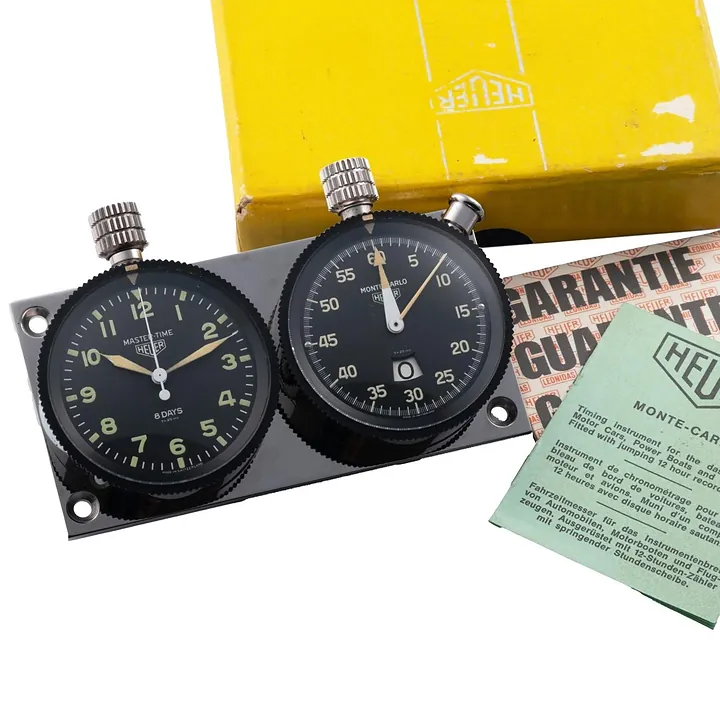
Heuer Racing SET, c. 1960
Antiquorum auction archive, Geneva
Wristwatches · c. 1980
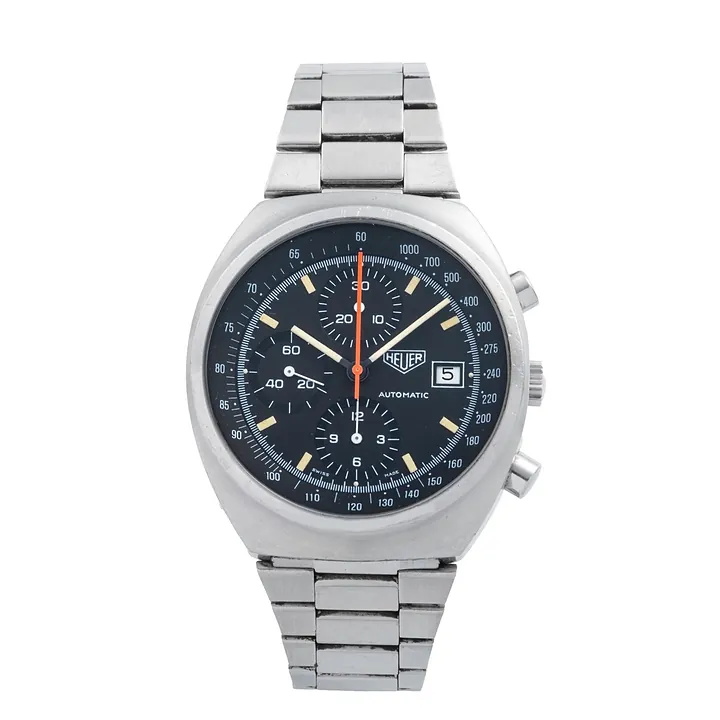
Heuer Pasadena, ref. 750.501-3, c. 1980
Antiquorum auction archive, Geneva
Wristwatches · c. 1970s
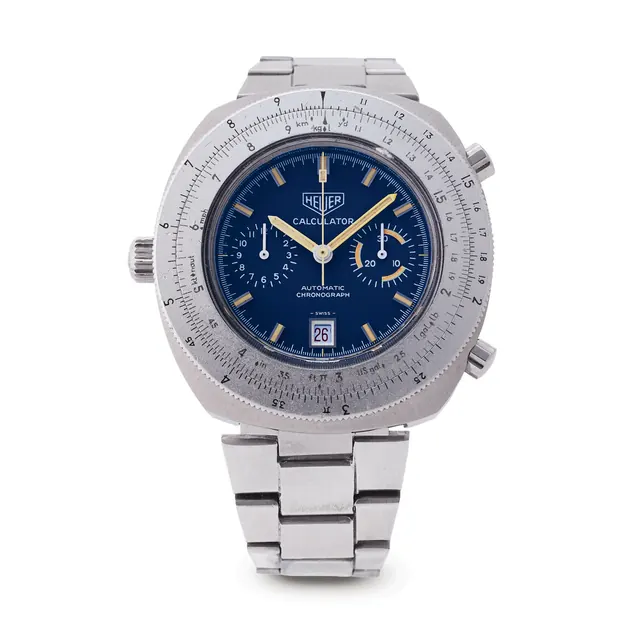
Heuer wristwatch, ref. 110.633, Calculator, circa 1970s
Antiquorum auction archive, Geneva
Wristwatches · c. 1975
Heuer wristwatch, ref. 13/1, circa 1975
Antiquorum auction archive, Geneva

Wristwatches · 1970
Wristwatch by Heno, Switzerland, 1970
Museum Rotterdam

Wristwatches · 1960–1986
'Tri-Compax' calendar chronograph wristwatch in gold case, by Universal, Geneva, Switzerland, 1960–1986.
Science Museum Group, London

Wristwatches · 1969–1970
Beta 21 Quartz wristwatch movement, made in Switzerland, 1970.
Science Museum Group, London

Wristwatches · c. 1969
Omega Speedmaster Moonwatch, ref. 145022-69st, c. 1969
Antiquorum auction archive, Geneva