
Wristwatches · Wristwatch
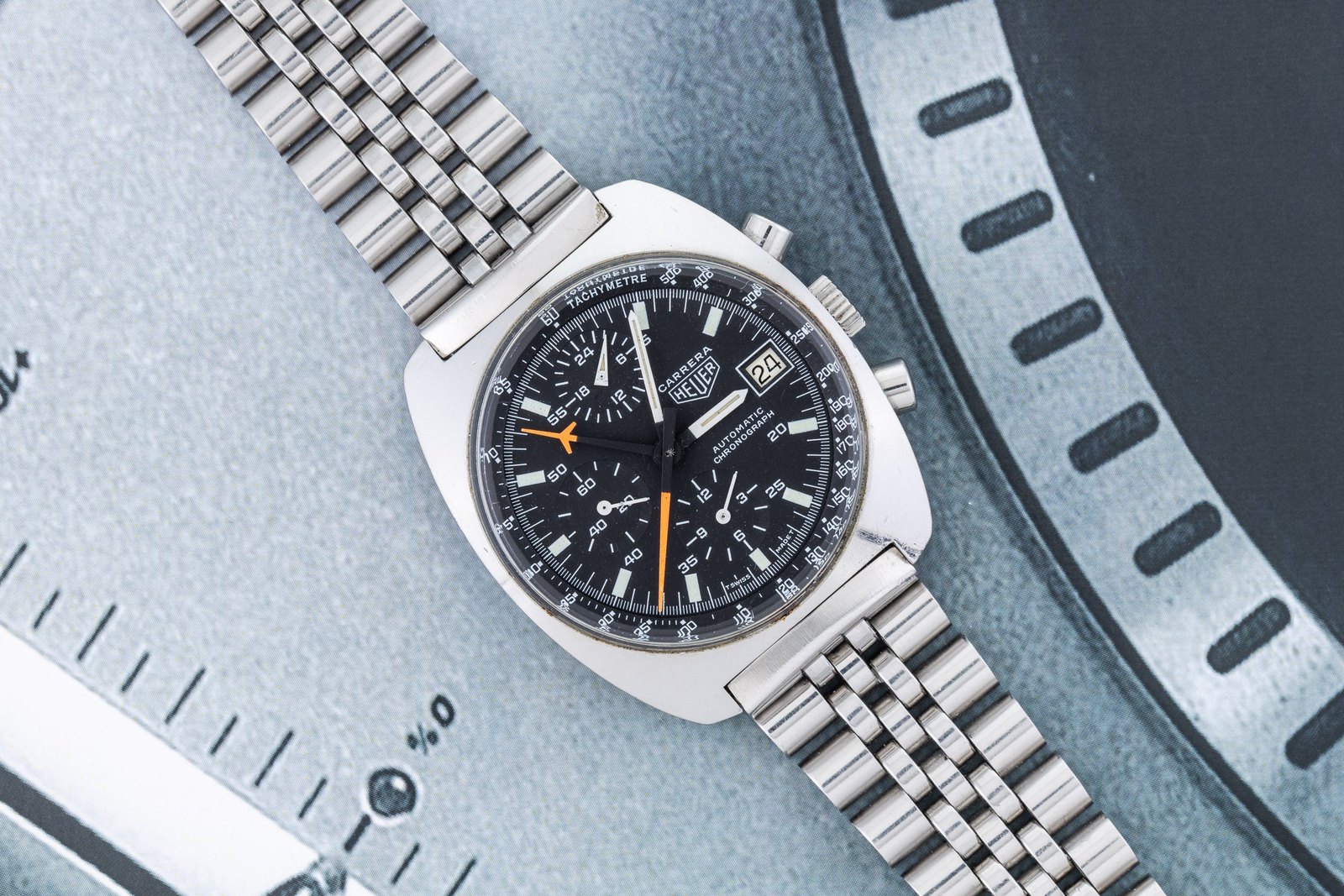
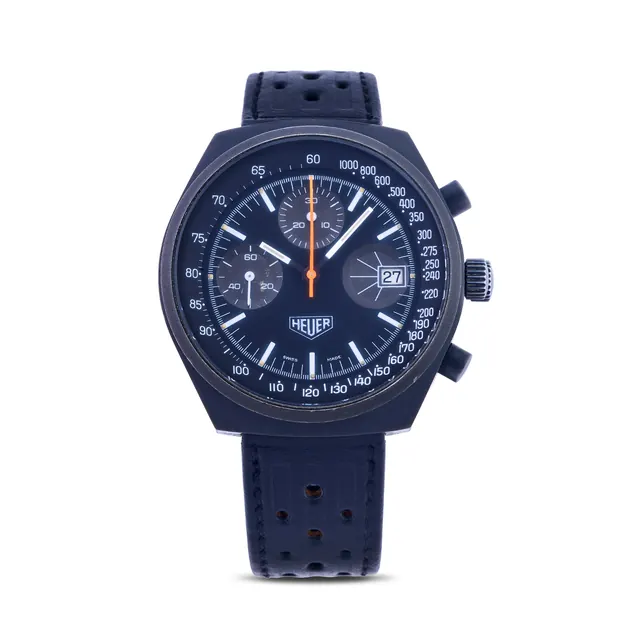
Heuer Carrera Automatic, c. 1984
- Maker / attribution
- Heuer (maker)
- Date
- c. 1984
- Historical period
- Quartz Revolution (1969 – 1990)
- Country of origin
- Switzerland
- Object type
- Wristwatch
- Stock no.
- 40990102
- Credit line
- Dealer listing, Analog/Shift (40990102)
- Catalogue title (original)
- Heuer Carrera Automatic (English)
View the source record (dealer listing) ↗ (opens another website in a new tab)Suggest a correction
Record summary
Catalogued by Analog/Shift (dealer), New York (stock number 40990102), this is a wristwatch by Heuer, made in Switzerland, dated c. 1984. The Atlas places it in the Quartz Revolution period (1969 – 1990) of its Wristwatches collection. The record is illustrated with 6 photographs.
Assembled from the source record's structured fields. Dates and attributions are given as the source states them; where a field is missing the Atlas leaves it blank rather than estimating.
Catalogue description
Dealer description — Analog/Shift
Why We Love It This is about the most 1980s thing we've ever seen. Just look at it! You could be mistaken for confusing it with the dashboard of Porsche's seminal dentist-killer, the 930 Turbo ! This Heuer, a Reference 510.533, is one of the last Heuer models to bear the Heuer name on the dial - before TAG Heuer branding took over. Dating to circa 1984, this automatic chronograph bears the name Carrera - not only sharing nomenclature with the aforementioned Stuttgart-based automobile manufacturer, but bears the name of motorsport chronograph royalty. Featuring a stainless steel cushion case, a crisp black dial with large luminous plots and orange-tipped chronograph hands, this model is powered by the Lemania 5100 central minute-counting chronograph movement, not the Calibre 11/15 models Heuer was producing for themselves since 1969. The result? A very odd, scarcely seen - and dare we say incredible looking - 1980s iteration of one of our all-time favorite chronograph models. Don't sleep on this one! The Story The Carrera was one of Jack Heuer’s most passionate projects, and his design ethos for this watch can be summed up in one word: legibility. Jack wanted a watch that was stylish and functional, a watch that gives you everything you need and nothing you don’t. From the sharp bevels on the case to the artful openness of the dial, it's become a classic. In designing the Carrera, Heuer finally created something that was entirely his, and is without question the chronograph that is most associated with him. He incorporated a tension ring around the edge of the dial, and printed the tachymeter track on it. Heuer's obsession with legibility led to a dial design that was simpler to read than the Omega Speedmaster or the Rolex Daytona (released the same year as the Carrera). What resulted was a chronograph that gave only the most necessary bits of information, with plain baton markers: clean, uncluttered, undeniably attractive.
Historical context
Quartz Revolution (1969 – 1990)
Seiko's Astron begins mass quartz timekeeping; traditional industries contract sharply.
Quartz and digital watches transformed the market after 1969. Swiss employment collapsed, Japanese and Hong Kong production soared, and the Swatch (1983) helped the Swiss industry recover; mechanical watches survived as luxury goods.
Read the period in the timelineMore wristwatches from this periodEarlier: Modern Mechanical Horology
Atlas type guide
Automatic (self-winding) watches
Self-winding watches use the wearer's motion to wind the mainspring. Abraham-Louis Perrelet and Breguet made 'perpétuelle' pocket watches with oscillating weights in the late eighteenth century, but the principle only became practical in the wristwatch. John Harwood patented a bumper automatic in 1923; Rolex's Perpetual rotor (1931) winding in one direction, and later bidirectional rotors (Eterna, Felsa Bidynator), established the modern form. Micro-rotors (Universal Genève, Buren) and peripheral rotors made automatic watches thinner.
What to look for
- A semicircular rotor turning 360° over the movement, or a 'bumper' weight that rebounds between springs.
- 'Automatic', 'Perpetual' or 'Self-winding' on the dial.
- A sealed screw-back case, since automatic watches are wound less often by the crown.
Dating clues
- Bumper automatics: 1923–c. 1955.
- Full rotors: from 1931 (Rolex); widespread after c. 1950.
- Micro-rotors: from 1954–1958.
General guidance written by the Atlas editors about this kind of object. It is not a statement about this particular piece; for that, rely on the source record above and on physical examination.
Related records
Pocket Watches · c. 1960
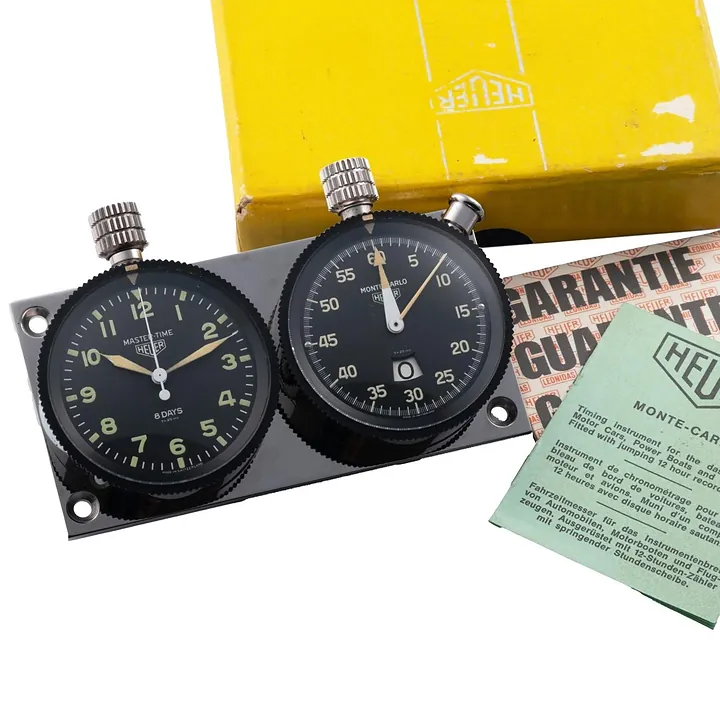
Heuer Racing SET, c. 1960
Antiquorum auction archive, Geneva
Wristwatches · c. 1980
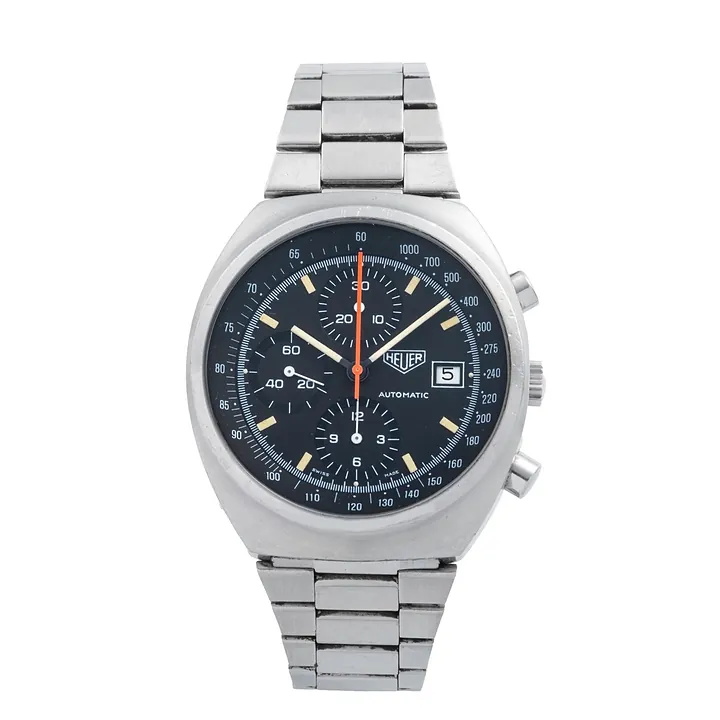
Heuer Pasadena, ref. 750.501-3, c. 1980
Antiquorum auction archive, Geneva
Wristwatches · c. 1970s
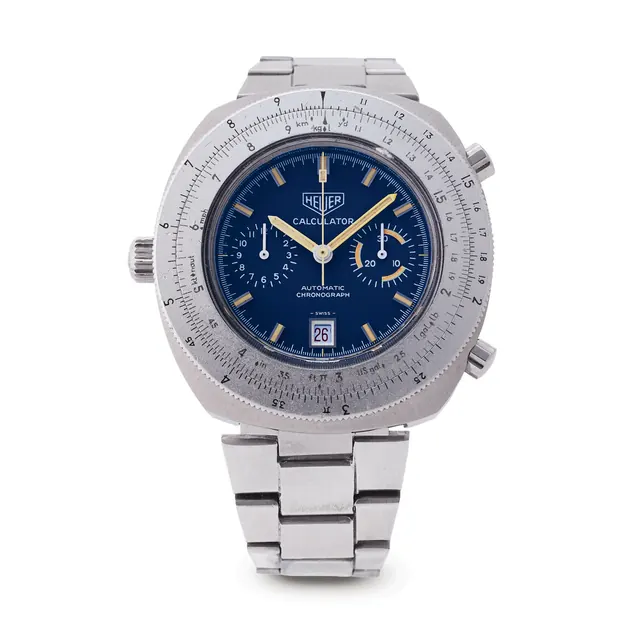
Heuer wristwatch, ref. 110.633, Calculator, circa 1970s
Antiquorum auction archive, Geneva
Wristwatches · c. 1975
Heuer wristwatch, ref. 13/1, circa 1975
Antiquorum auction archive, Geneva

Wristwatches · 1970
Wristwatch by Heno, Switzerland, 1970
Museum Rotterdam

Wristwatches · 1960–1986
'Tri-Compax' calendar chronograph wristwatch in gold case, by Universal, Geneva, Switzerland, 1960–1986.
Science Museum Group, London

Wristwatches · 1969–1970
Beta 21 Quartz wristwatch movement, made in Switzerland, 1970.
Science Museum Group, London

Wristwatches · c. 1969
Omega Speedmaster Moonwatch, ref. 145022-69st, c. 1969
Antiquorum auction archive, Geneva