
Wristwatches · Wristwatch
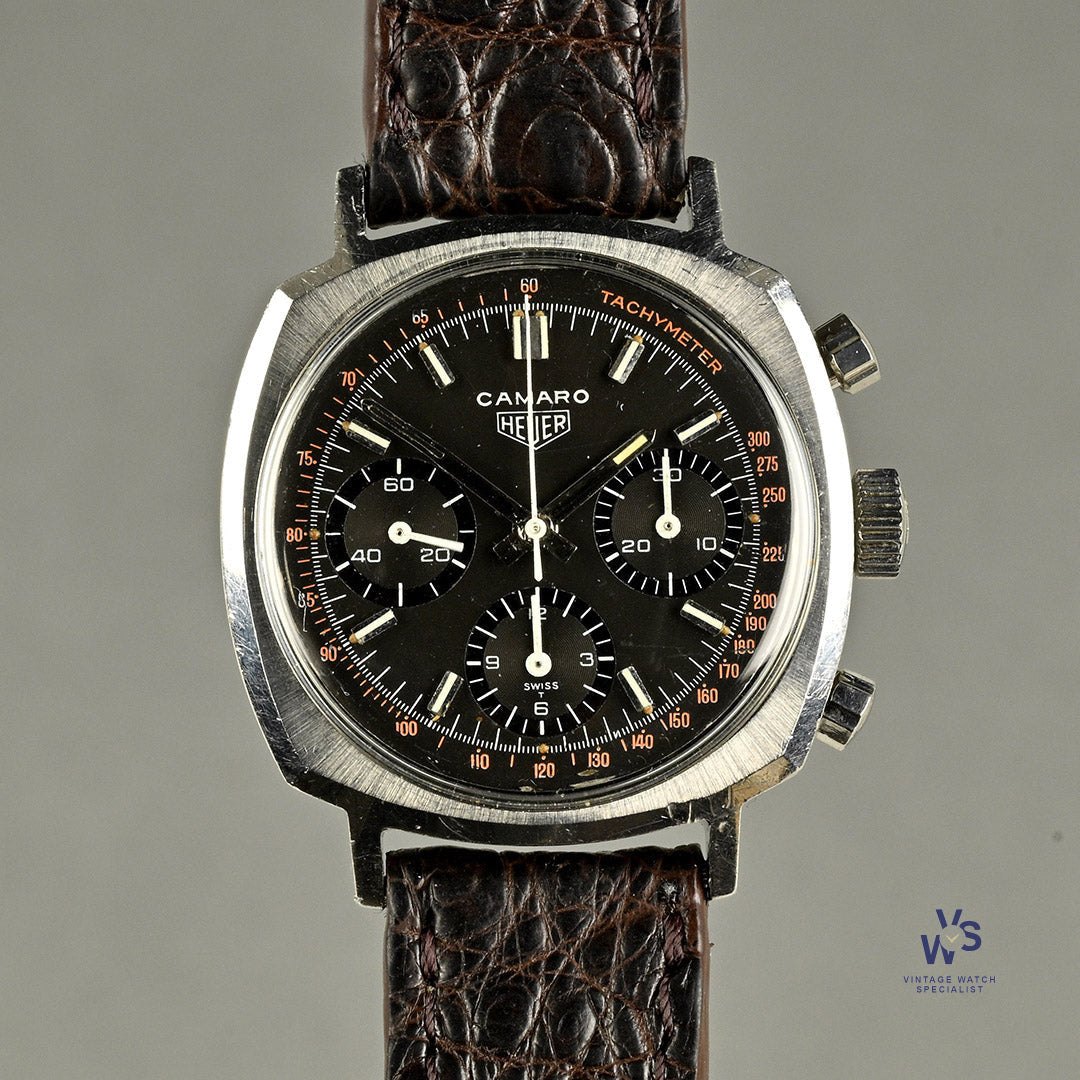
Heuer Camaro 7220 Valjoux 72 Chronograph, circa 1969
- Maker / attribution
- Heuer (maker)
- Date
- c. 1969
- Historical period
- Quartz Revolution (1969 – 1990)
- Country of origin
- Switzerland
- Object type
- Wristwatch
- Dimensions
- Case 37 mm
- Stock no.
- vws4227
- Credit line
- Dealer listing, Vintage Watch Specialist (vws4227)
- Catalogue title (original)
- Heuer Camaro 7220 Valjoux 72 Chronograph c.1969 (English)
View the source record (dealer listing) ↗ (opens another website in a new tab)Suggest a correction
Record summary
Catalogued by Vintage Watch Specialist (dealer), United Kingdom (stock number vws4227), this is a wristwatch by Heuer, made in Switzerland, dated c. 1969. The Atlas places it in the Quartz Revolution period (1969 – 1990) of its Wristwatches collection. Recorded dimensions: Case 37 mm. The record is illustrated with 6 photographs.
Assembled from the source record's structured fields. Dates and attributions are given as the source states them; where a field is missing the Atlas leaves it blank rather than estimating.
Catalogue description
Dealer description — Vintage Watch Specialist
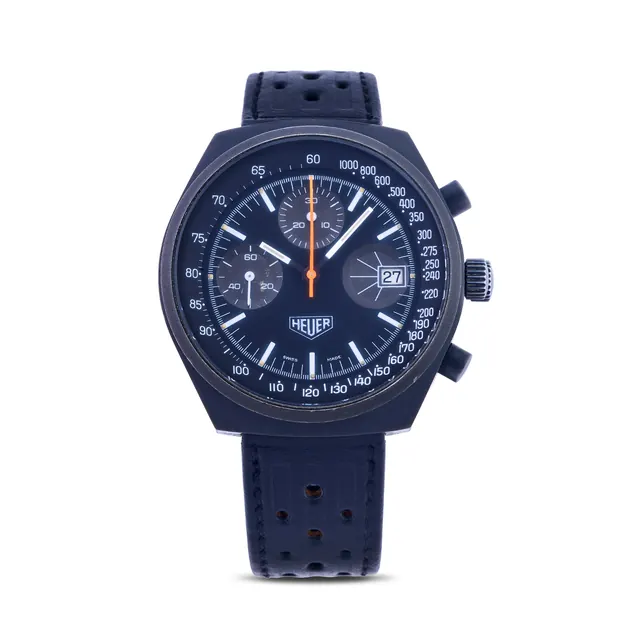
Vintage Heuer Camaro 3 Register Chronograph Black Dial Model Ref: 7220 - Heuer - Leonidas S.A Calibre Valjoux 72 - 17j The Camaro 7220 was undoubtedly the mainstay of the range throughout production. Named after the Chevrolet Camaro, an American muscle car used as the pace car at the Indy 500 in 1967 and 1969, it helped establish Heuer in the US market. The 7220 was the first Camaro model released, running for a short period from c.1968-1972. The '7220' reference number is derived from the Valjoux 72 movement which powered this model. It is instantly distinguishable from other models due to its 3 sub-dial registers. What’s On Offer Here we have a particularly handsome Heuer Camaro Reference 7220 three-register chronograph, dating from approximately 1969, featuring a striking black dial, stainless-steel cushion case and the legendary manually wound Valjoux 72 movement. This is a wonderfully evocative example of Heuer's late-1960s chronograph design, combining purposeful functionality with a distinctive appearance that sets it apart from the company's more familiar Carrera and Autavia models. The 37mm stainless-steel case features the Camaro's characteristic cushion-shaped profile, with beautifully brushed surfaces, polished chamfered edges and short, flat-ended lugs. Measuring approximately 44mm lug-to-lug and 12.5mm thick, it offers a substantial wrist presence while retaining the balanced proportions of a classic vintage chronograph. The radial brushing across the broad bezel is particularly attractive, contrasting beautifully with the polished case edges. On the right-hand side sit the two chronograph pushers, positioned above and below the signed winding crown. The case displays marks of wear consistent with its age, retaining a pleasing vintage appearance. Of course, the real attraction is that fabulous black three-register chronograph dial. A vibrant orange tachymeter scale runs around the outer edge, providing a striking contrast against the black background and finely printed white minute track. The dial features applied baton hour markers with luminous plots, accompanied by dark, luminous-filled main hands and a slender white central chronograph seconds hand. Three recessed subsidiary registers provide the classic Valjoux 72 layout: 3 o'clock: 30-minute chronograph counter 6 o'clock: 12-hour chronograph counter 9 o'clock: Running seconds Each register features crisp white markings and a contrasting white hand, ensuring excellent legibility against the black dial. The CAMARO signature sits proudly above the historic Heuer shield beneath 12 o'clock, providing a wonderful reminder of the watch's motorsport-inspired origins. The dial remains in very good condition, displaying the character expected of a vintage chronograph from this period. Beneath the domed crystal sits one of the most celebrated chronograph movements ever produced. The Valjoux 72 is a 17-jewel, manually wound mechanical chronograph movement featuring traditional column-wheel operation. Renowned for its elegant construction and long association with important Swiss chronographs, the Valjoux 72 remains a particular favourite among collectors of vintage mechanical watches. This example is signed Heuer-Leonidas S.A., reflecting the company's identity during this period. Importantly, the movement has been professionally serviced and is currently recording a rate of approximately +13 seconds per day with an amplitude of 294 degrees on the timegrapher. The watch is fitted with a dark brown leather strap featuring a textured, crocodile-style finish, complementing the stainless-steel case and black dial beautifully. Presented in very good overall condition, this is a particularly appealing example of the Heuer Camaro Reference 7220. With its distinctive cushion case, bold orange tachymeter detailing, beautifully balanced three-register dial and celebrated Valjoux 72 movement, it captures everything that makes vintage Heuer chronographs so desirable. A wonderfully characterful piece of late-1960s motorsport-inspired watchmaking, and a fantastic addition to any serious vintage chronograph collection. Condition Report: Crystal: Excellent Dial: Very Good Bezel: Good Case: Good Movement: Serviced +13s/d 294° Overall: Very Good
Historical context
Quartz Revolution (1969 – 1990)
Seiko's Astron begins mass quartz timekeeping; traditional industries contract sharply.
Quartz and digital watches transformed the market after 1969. Swiss employment collapsed, Japanese and Hong Kong production soared, and the Swatch (1983) helped the Swiss industry recover; mechanical watches survived as luxury goods.
Read the period in the timelineMore wristwatches from this periodEarlier: Modern Mechanical Horology
Atlas type guide
Chronographs and split-seconds watches
A chronograph is a watch with an additional seconds hand that can be started, stopped and returned to zero independently of the timekeeping. Louis Moinet built an early example in 1816 and Nicolas Rieussec a recording 'chronographe' in 1821; Adolphe Nicole's heart-shaped reset cam (patented 1862) made the modern return-to-zero possible. Split-seconds (rattrapante) chronographs add a second hand that can be stopped for intermediate times; flyback chronographs restart instantly.
Chronographs were essential tools for doctors (pulsometer scales), artillery (telemeter), engineers and sport. In wristwatches, Valjoux, Venus, Lemania and later the automatic chronographs of 1969 (Zenith El Primero, the Chronomatic Calibre 11 group and Seiko 6139) are milestones.
What to look for
- Push-pieces on the case band or a single button in the crown (monopusher).
- Subsidiary registers for minutes and hours; tachymeter, telemeter or pulsometer scales.
- Column wheel versus cam control visible in the movement.
- Calibre markings of specialist makers (Valjoux, Lemania, Venus, Landeron).
Dating clues
- Pocket chronographs with heart cam reset: after 1862.
- Wrist chronographs: from c. 1910; two-button designs from the 1930s.
- Automatic chronographs: from 1969.
General guidance written by the Atlas editors about this kind of object. It is not a statement about this particular piece; for that, rely on the source record above and on physical examination.
Read next:Flyback chronographChronograph
Related records
Pocket Watches · c. 1960
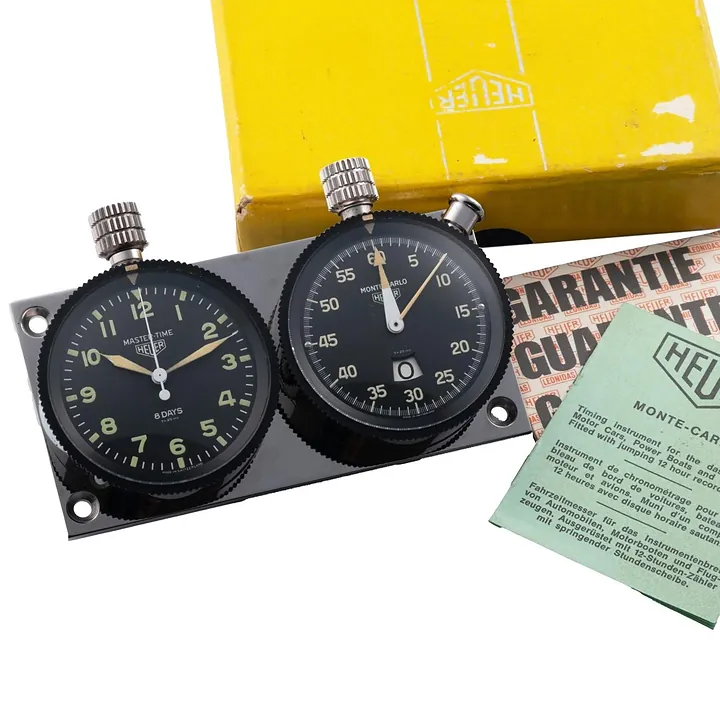
Heuer Racing SET, c. 1960
Antiquorum auction archive, Geneva
Wristwatches · c. 1980
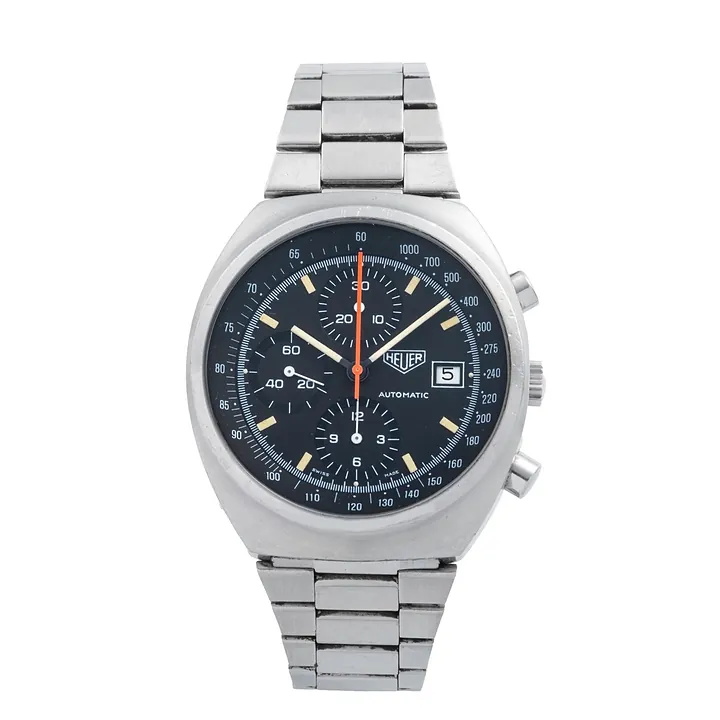
Heuer Pasadena, ref. 750.501-3, c. 1980
Antiquorum auction archive, Geneva
Wristwatches · c. 1970s
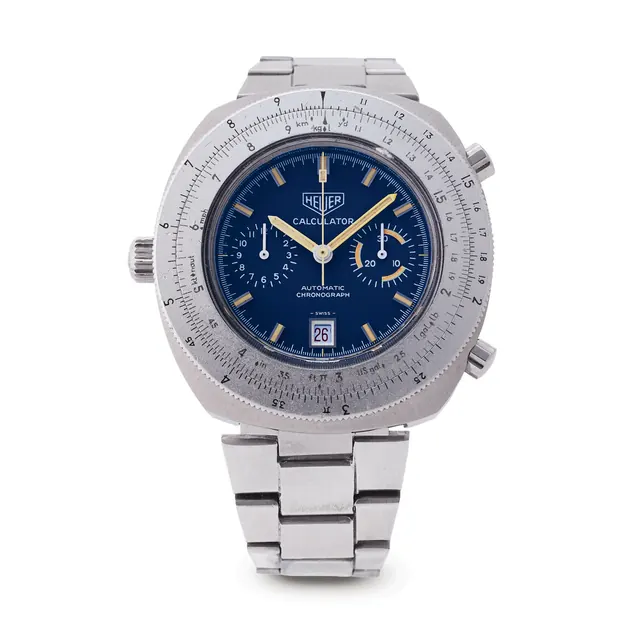
Heuer wristwatch, ref. 110.633, Calculator, circa 1970s
Antiquorum auction archive, Geneva
Wristwatches · c. 1975
Heuer wristwatch, ref. 13/1, circa 1975
Antiquorum auction archive, Geneva

Wristwatches · 1970
Wristwatch by Heno, Switzerland, 1970
Museum Rotterdam

Wristwatches · 1960–1986
'Tri-Compax' calendar chronograph wristwatch in gold case, by Universal, Geneva, Switzerland, 1960–1986.
Science Museum Group, London

Wristwatches · 1969–1970
Beta 21 Quartz wristwatch movement, made in Switzerland, 1970.
Science Museum Group, London

Wristwatches · c. 1969
Omega Speedmaster Moonwatch, ref. 145022-69st, c. 1969
Antiquorum auction archive, Geneva