
Wristwatches · Wristwatch
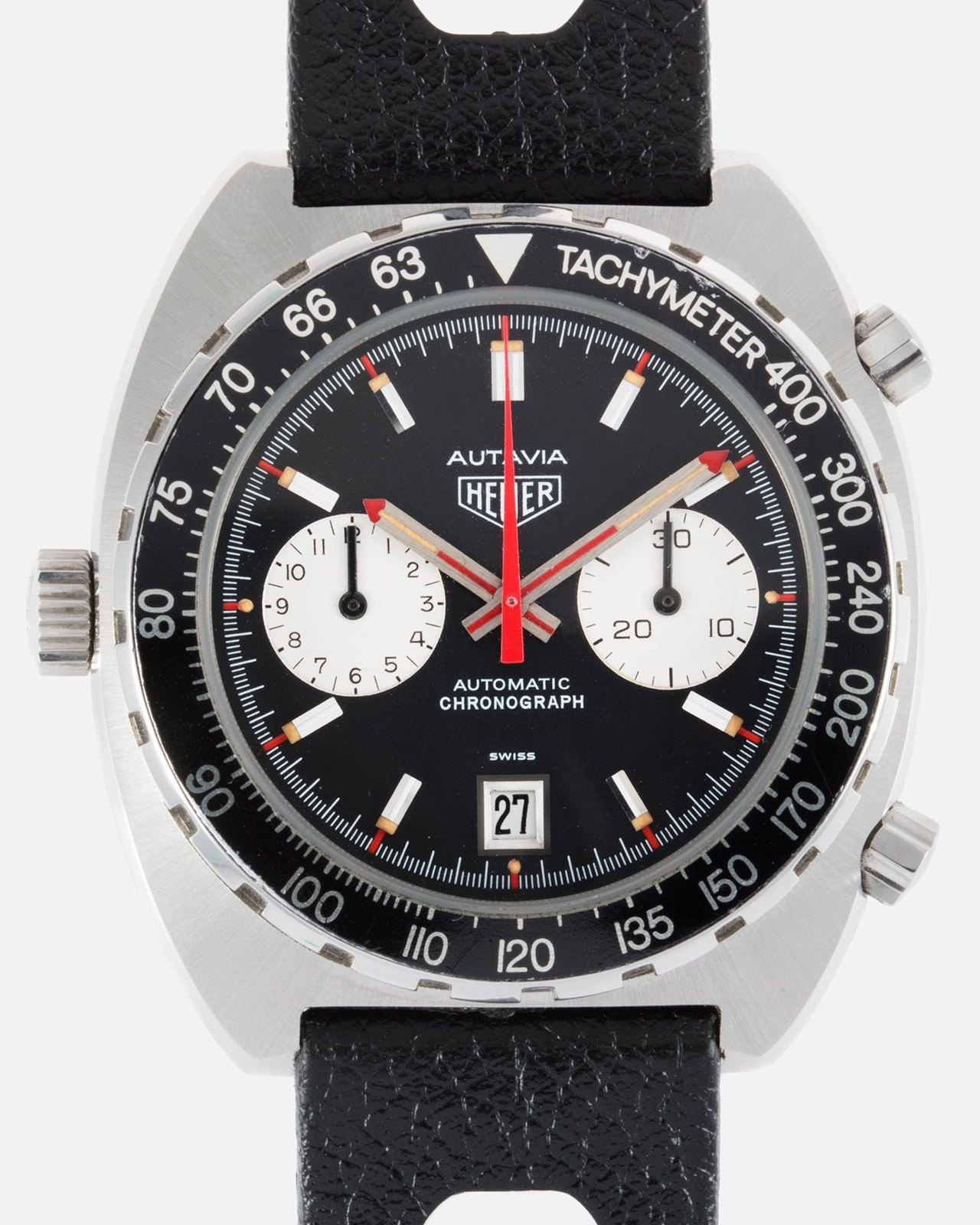
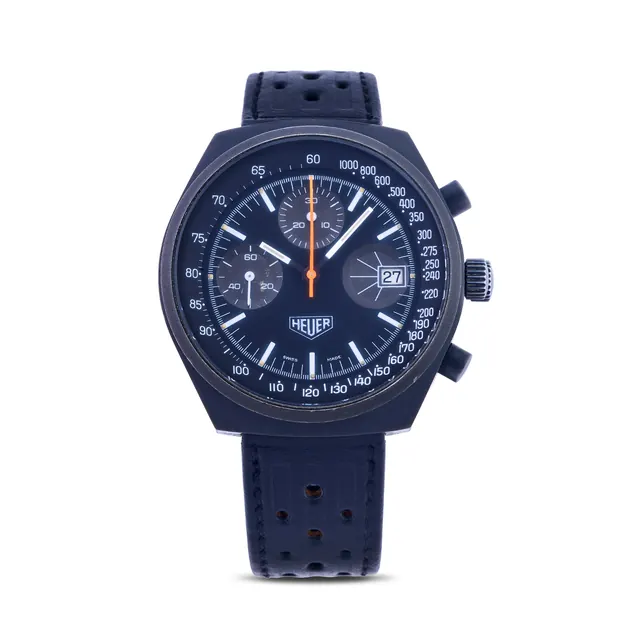
Heuer Autavia 11063V, 1980s
- Maker / attribution
- Heuer (maker)
- Date
- 1980s
- Historical period
- Quartz Revolution (1969 – 1990)
- Country of origin
- Switzerland
- Object type
- Wristwatch
- Dimensions
- Case 14.6 mm
- Stock no.
- Product 1373197566039
- Credit line
- Dealer listing, S.Song Watches (product 1373197566039)
- Catalogue title (original)
- Heuer Autavia 11063V (English)
View the source record (dealer listing) ↗ (opens another website in a new tab)Suggest a correction
Record summary
Catalogued by S.Song Watches (dealer), Seattle (stock number Product 1373197566039), this is a wristwatch by Heuer, made in Switzerland, dated 1980s. The Atlas places it in the Quartz Revolution period (1969 – 1990) of its Wristwatches collection. Recorded dimensions: Case 14.6 mm. The record is illustrated with 6 photographs.
Assembled from the source record's structured fields. Dates and attributions are given as the source states them; where a field is missing the Atlas leaves it blank rather than estimating.
Catalogue description
Dealer description — S.Song Watches
The Heuer Autavia really needs no introduction. What was once seen as a cheap sports chronograph has, in the last 18 months become one of the hottest and most in-demand vintage watch in the market. The Autavia was released in 1962 under the new management of Jack Heuer, where the name was an amalgamation of the words ‘Automotive’ and ‘Aviation’. This was the first line that Jack Heuer released, even before the famed Carrera line, placing significance on the Autavia as the model that marked a new chapter for Heuer. This example is a much later version of the Autavia, the Ref 11063V. Around the 70’s when Heuer introduced their self-winding chronograph calibres, they swapped from their round compressor cases into this larger oval-shaped case. Much heftier and more 70’s in their styling, the cases featured brushed finished on the top and thick chamfers. Not to be confused with the 1163 Viceroy model, this is a later and rarer variant upgraded with a mineral glass. A bit of history about the movement, in the late 60’s, while man was racing into space, watch brands were racing to create the first automatic chronograph movement. The main rivalry was between Zenith, who we now know produced the famous El Primero, Seiko and a consortium led by Heuer, Dubois-Depraz, Buren and Breitling. Dubbed in secrecy as Project 99, this group of movement and watchmakers were developing their chronomatic movement and while debates rage on as to who really was the first to create an automatic chronograph, all brands mentioned above certainly deserves a place in watchmaking history. With such an iconic movement, Heuer used this for all of their chronographs thereafter, including this 11063 which is powered by the Calibre 12, with its unique feature being the winding crown that is located on the left of the case rather than the right. Overall, this is unapologetically a watch of the era and an iconic model for Heuer. At 14.6mm in thickness and 42mm in diameter together with red accents, this is a watch with huge presence, even by modern standards!
Historical context
Quartz Revolution (1969 – 1990)
Seiko's Astron begins mass quartz timekeeping; traditional industries contract sharply.
Quartz and digital watches transformed the market after 1969. Swiss employment collapsed, Japanese and Hong Kong production soared, and the Swatch (1983) helped the Swiss industry recover; mechanical watches survived as luxury goods.
Read the period in the timelineMore wristwatches from this periodEarlier: Modern Mechanical Horology
Atlas type guide
Wristwatches
Bracelet watches were worn by women from the early nineteenth century — Breguet made one for Caroline Murat, Queen of Naples, in 1810–12 — but the wristwatch only became a man's instrument with military use and aviation in the early twentieth century. Between the World Wars it overtook the pocket watch; the 1920s and 1930s brought rectangular Art Deco cases, water-resistant cases and the first automatic winding systems.
After 1945 the wristwatch became a carrier of identity — dress watches, sports and dive watches, chronographs, calendars — produced by Swiss, American, Japanese, German, Soviet and Chinese industries. The quartz revolution after 1969 and the mechanical renaissance since the 1990s, including the rise of independent watchmakers, complete the story.
What to look for
- The reference number (between the lugs or inside the case back) and serial number, the starting point for dating.
- The calibre: its maker and number are often stamped under the dial or on the bridge.
- Originality of dial, hands and crown — refinished ('redial') dials are common.
- Case material marks: 18K/750, 14K/585, stainless steel, gold-filled, plated.
Dating clues
- Wire-lug cases: before c. 1925.
- Water-resistant screw-down cases: from 1926.
- Quartz movements: from 1969; sapphire crystals widespread after c. 1980.
General guidance written by the Atlas editors about this kind of object. It is not a statement about this particular piece; for that, rely on the source record above and on physical examination.
Related records
Pocket Watches · c. 1960
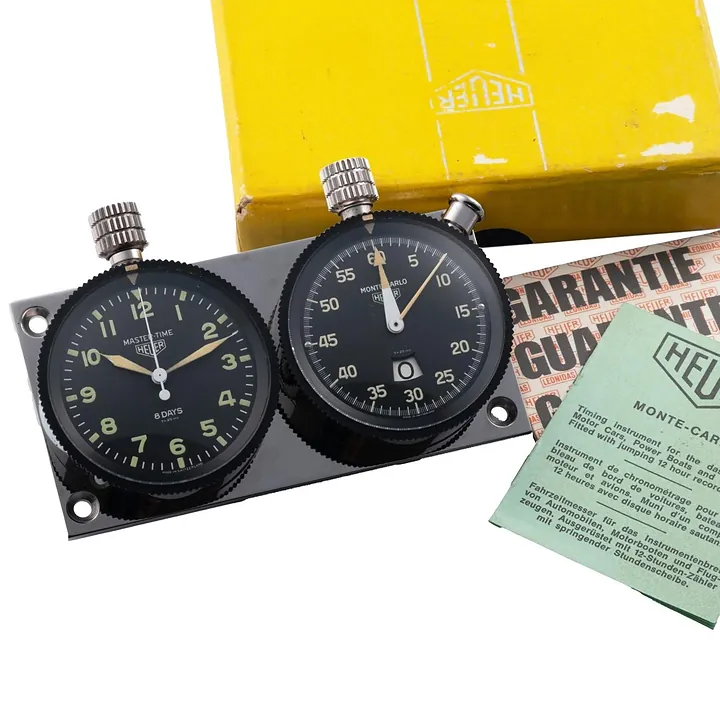
Heuer Racing SET, c. 1960
Antiquorum auction archive, Geneva
Wristwatches · c. 1980
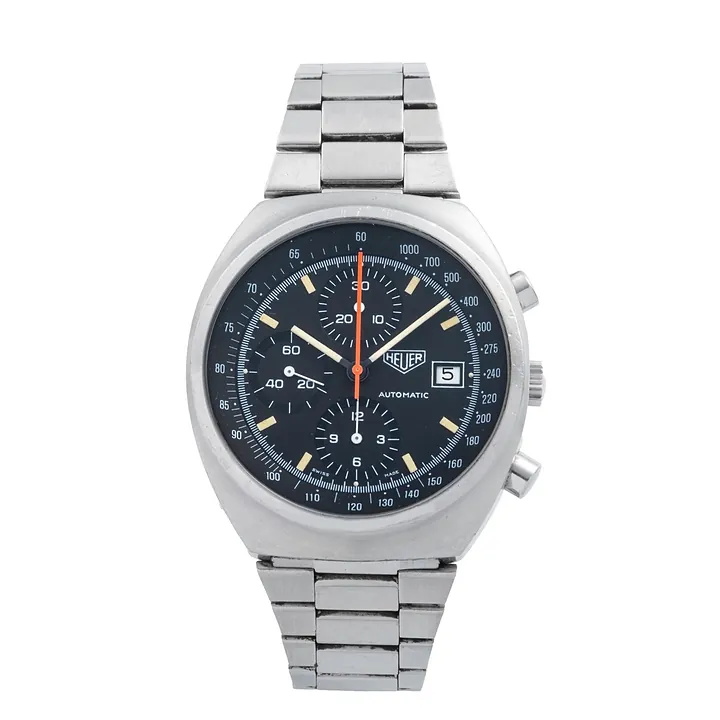
Heuer Pasadena, ref. 750.501-3, c. 1980
Antiquorum auction archive, Geneva
Wristwatches · c. 1970s
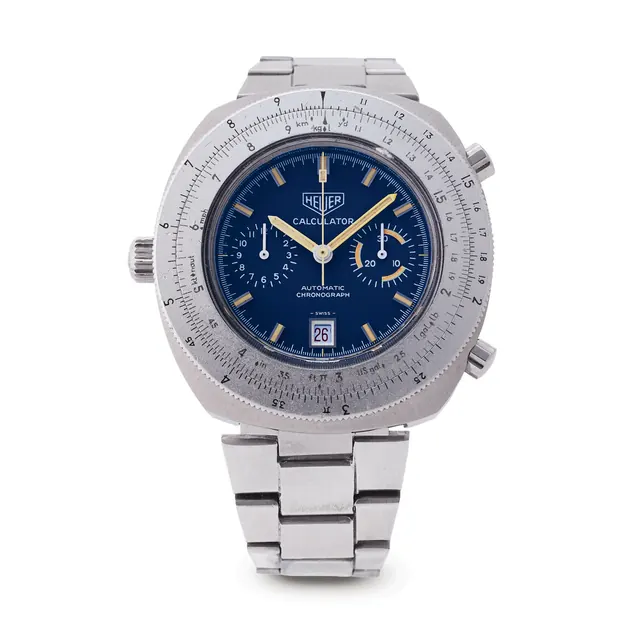
Heuer wristwatch, ref. 110.633, Calculator, circa 1970s
Antiquorum auction archive, Geneva
Wristwatches · c. 1975
Heuer wristwatch, ref. 13/1, circa 1975
Antiquorum auction archive, Geneva

Wristwatches · 1970
Wristwatch by Heno, Switzerland, 1970
Museum Rotterdam

Wristwatches · 1960–1986
'Tri-Compax' calendar chronograph wristwatch in gold case, by Universal, Geneva, Switzerland, 1960–1986.
Science Museum Group, London

Wristwatches · 1969–1970
Beta 21 Quartz wristwatch movement, made in Switzerland, 1970.
Science Museum Group, London

Wristwatches · c. 1969
Omega Speedmaster Moonwatch, ref. 145022-69st, c. 1969
Antiquorum auction archive, Geneva