
Wristwatches · Wristwatch
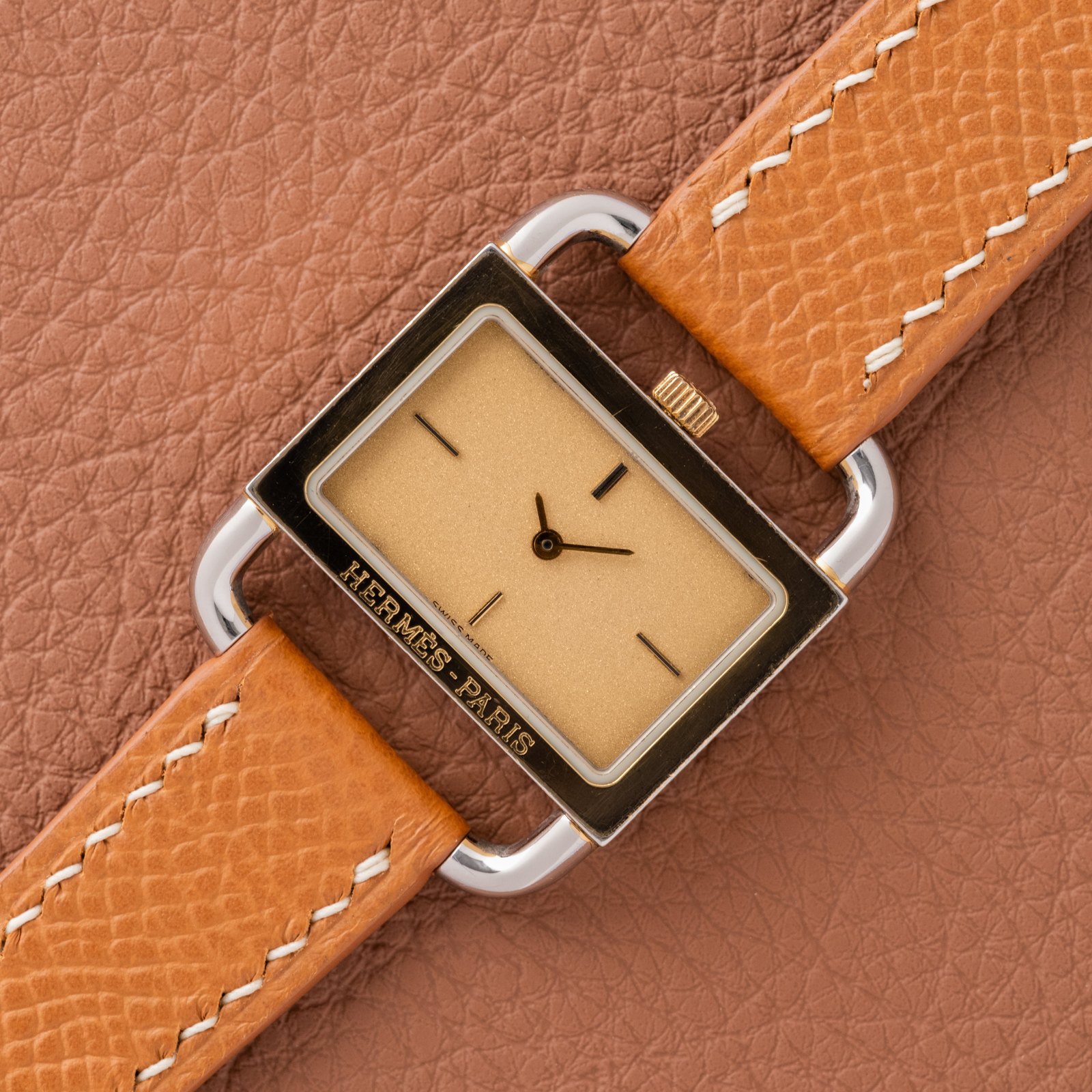
Hermès Etrier Two Tone, 1990s
- Maker / attribution
- Hermes (maker)
- Date
- 1990s
- Historical period
- Mechanical Renaissance (1990 – 2010)
- Country of origin
- Unrecorded in source
- Object type
- Wristwatch
- Dimensions
- Case 31 mm
- Stock no.
- Product 8744015462583
- Credit line
- Dealer listing, Huntington Company (product 8744015462583)
- Catalogue title (original)
- 1990s Hermès Etrier Two Tone - Rare (English)
View the source record (dealer listing) ↗ (opens another website in a new tab)Suggest a correction
Record summary
Catalogued by Huntington Company (dealer) (stock number Product 8744015462583), this is a wristwatch by Hermes, dated 1990s. The Atlas places it in the Mechanical Renaissance period (1990 – 2010) of its Wristwatches collection. Recorded dimensions: Case 31 mm. The record is illustrated with 6 photographs.
Assembled from the source record's structured fields. Dates and attributions are given as the source states them; where a field is missing the Atlas leaves it blank rather than estimating.
Catalogue description
Dealer description — Huntington Company
History and Significance The Hermès Etrier is a reminder that some of the most interesting watches from the fashion houses of the 1990s were designed with an entirely different set of priorities from traditional Swiss dress watches. Rather than beginning with a conventional round case, the Etrier uses an elongated architectural shape that feels closer to a piece of jewelry or an Hermès accessory. The 31mm-wide case has enough presence to make the unusual silhouette immediately noticeable, while the two-tone construction adds definition to the shape. It is unmistakably a product of Hermès, where the form of the object matters just as much as the mechanics inside it. The gold sparkle dial gives this particular example even more personality. Its textured surface changes noticeably under different lighting and provides a warmer backdrop than a conventional silver or white dial. The restrained hour markers and hands prevent the texture from becoming overwhelming, allowing the material itself to provide most of the visual interest. Paired with the two-tone case, the dial creates a distinctly 1990s aesthetic that feels increasingly appealing today. A quartz movement keeps the case practical and allows the focus to remain on the design rather than mechanical complexity. That approach feels especially appropriate for the Etrier, where the case shape, dial texture, and Hermès detailing are the defining elements of the watch. A new H.C. leather strap has been fitted, while the original Hermès buckle remains with the watch and preserves an important piece of the original presentation. The combination creates an unusual neo-vintage Hermès that sits somewhere between traditional watchmaking and the house’s long history of creating beautifully designed objects. Writer's Thoughts The gold sparkle dial is the detail that makes this Etrier particularly memorable. Under softer light the surface can appear relatively restrained, but stronger light reveals the texture and gives the dial considerably more depth. The two-tone case works especially well with that effect because the steel prevents the gold elements from becoming too formal or decorative. At 31mm wide, the unusual case architecture supplies more than enough presence and makes the watch feel substantially different from a conventional round dress watch. The reference is also a good example of why quartz should not automatically be viewed as a disadvantage in design-driven watches from this period. The movement allows the Etrier to remain focused on proportion, shape, and material, which are ultimately the characteristics that give the watch its identity. The new H.C. strap provides a fresh presentation, while the original Hermès buckle maintains an important connection to the original configuration. For an unusual 1990s Hermès, the combination of the sparkle dial and distinctive case shape creates far more character than the simplicity of the movement might initially suggest. Our Promise Every watch is thoroughly vetted, carefully described with complete transparency, and guaranteed authentic. Each piece is offered in honest condition, ensuring collectors receive a timepiece that reflects both originality and integrity. Specifications Brand: Hermès Model: Etrier Reference: Not specified Year: Circa 1990s Case Material: Two-tone stainless steel and gold Case Size: 31mm wide Dial: Gold sparkle dial Movement: Quartz Strap/Bracelet: New H.C. leather strap Buckle/Clasp: Original Hermès buckle Contents: Watch only Condition Case: The two-tone case presents well overall, retaining the distinctive architecture of the Etrier. Light surface wear is present consistent with age and normal use. Dial: The gold sparkle dial presents beautifully, retaining an attractive and even textured appearance throughout. Hands: The hands present well and remain clean and legible against the textured gold dial. Crystal: The crystal presents well overall with minor signs of wear consistent with age and use. Strap/Bracelet: Fitted to a new H.C. leather strap in excellent condition. Buckle/Clasp: The original Hermès buckle remains with the watch and presents well with light surface wear consistent with use.
Historical context
Mechanical Renaissance (1990 – 2010)
Mechanical watches return as cultural objects; independent watchmaking flourishes.
Mechanical watches returned as cultural and luxury objects. Complications, tourbillons and new materials proliferated; independent watchmakers such as George Daniels, F.P. Journe and Philippe Dufour revived artisanal watchmaking; collecting vintage watches became a major field.
Read the period in the timelineMore wristwatches from this periodEarlier: Quartz Revolution
Atlas type guide
Wristwatches
Bracelet watches were worn by women from the early nineteenth century — Breguet made one for Caroline Murat, Queen of Naples, in 1810–12 — but the wristwatch only became a man's instrument with military use and aviation in the early twentieth century. Between the World Wars it overtook the pocket watch; the 1920s and 1930s brought rectangular Art Deco cases, water-resistant cases and the first automatic winding systems.
After 1945 the wristwatch became a carrier of identity — dress watches, sports and dive watches, chronographs, calendars — produced by Swiss, American, Japanese, German, Soviet and Chinese industries. The quartz revolution after 1969 and the mechanical renaissance since the 1990s, including the rise of independent watchmakers, complete the story.
What to look for
- The reference number (between the lugs or inside the case back) and serial number, the starting point for dating.
- The calibre: its maker and number are often stamped under the dial or on the bridge.
- Originality of dial, hands and crown — refinished ('redial') dials are common.
- Case material marks: 18K/750, 14K/585, stainless steel, gold-filled, plated.
Dating clues
- Wire-lug cases: before c. 1925.
- Water-resistant screw-down cases: from 1926.
- Quartz movements: from 1969; sapphire crystals widespread after c. 1980.
General guidance written by the Atlas editors about this kind of object. It is not a statement about this particular piece; for that, rely on the source record above and on physical examination.
Related records
Wristwatches · originally sold on 10 August 2000 (per the lot record)
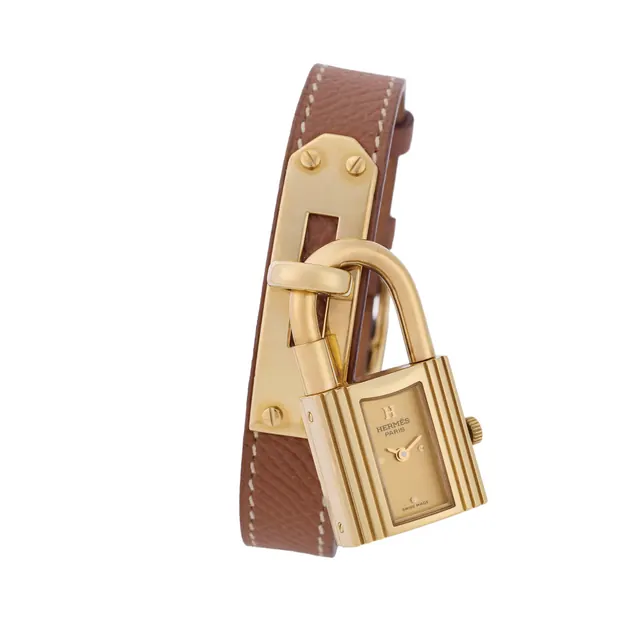
Hermes wristwatch, ref. 3901, Kelly-Cadenas, originally sold on 10 August 2000
Antiquorum auction archive, Geneva
Wristwatches · 1979
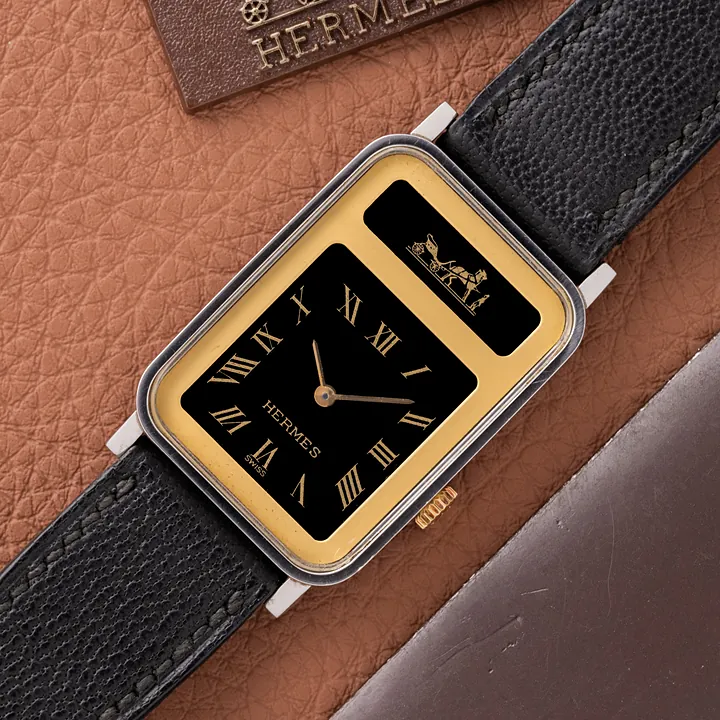
Hermès Calèche Black Tank Manual Wind, 1979
Huntington Company (dealer)
Wristwatches · 1970s
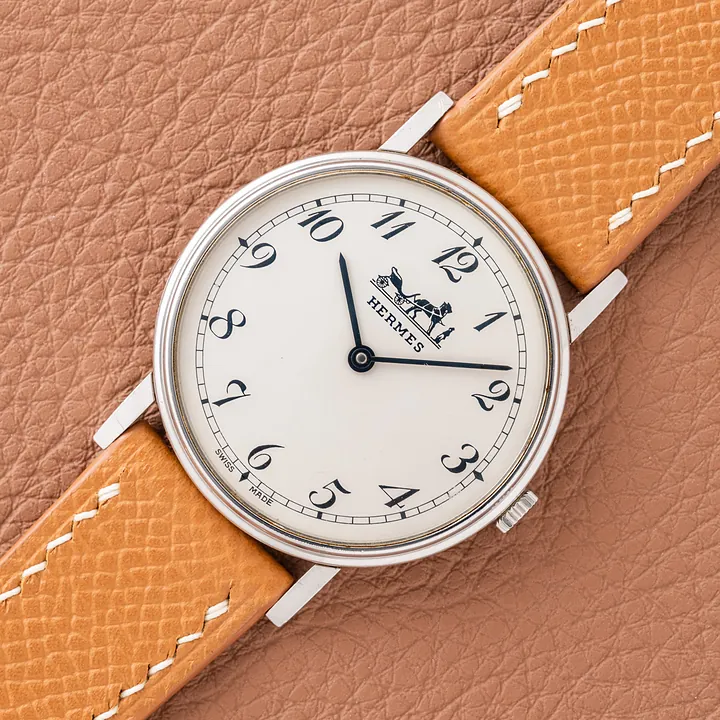
Hermès Rare Ultra Slim Dress Watch, 1970s
Huntington Company (dealer)
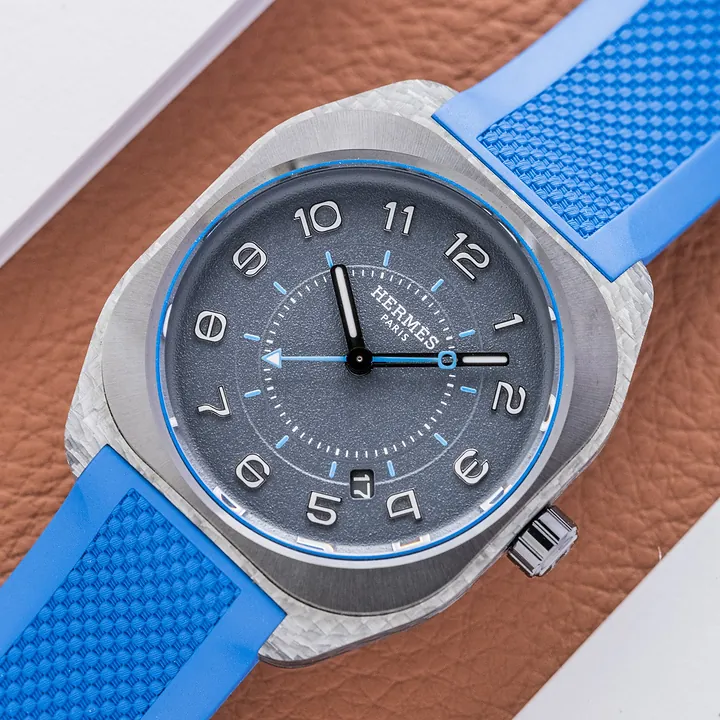
Wristwatches · 2024
Hermès H08 Glass Fiber and Ceramic (Ref. SP1.746a), 2024
Huntington Company (dealer)
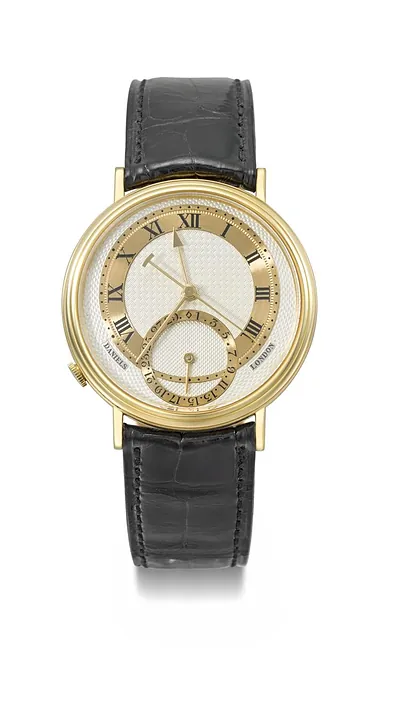
Wristwatches · 1999
'Millennium' co-axial wristwatch by George Daniels and Omega, England, 1999
Science Museum Group, London

Wristwatches · 2008
Wristwatch by Breitling?, 2008
Museum Rotterdam
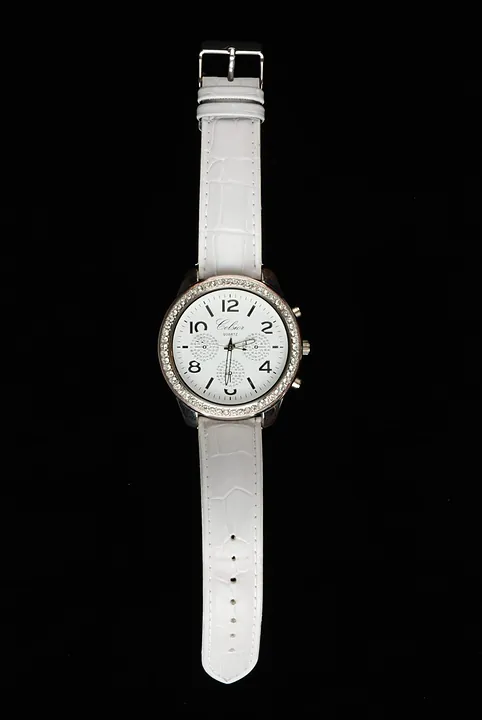
Wristwatches · 2008
Wristwatch by Celsior Quartz, 2008
Museum Rotterdam
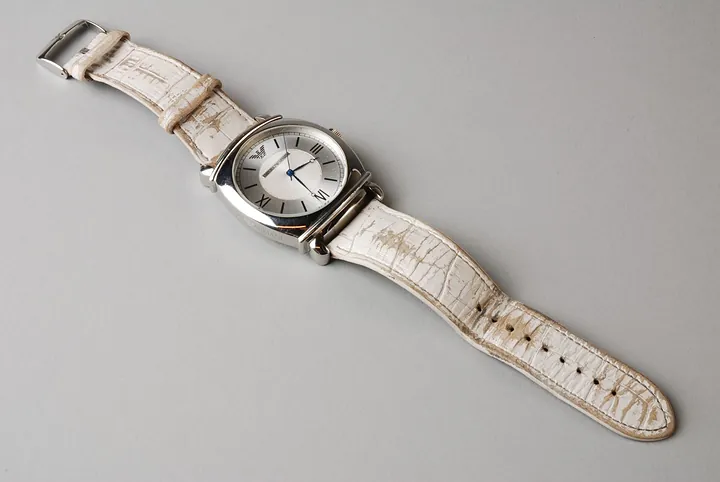
Wristwatches · 2008
Wristwatch possibly by Emporio Armani, 2008
Museum Rotterdam