
Wristwatches · Wristwatch
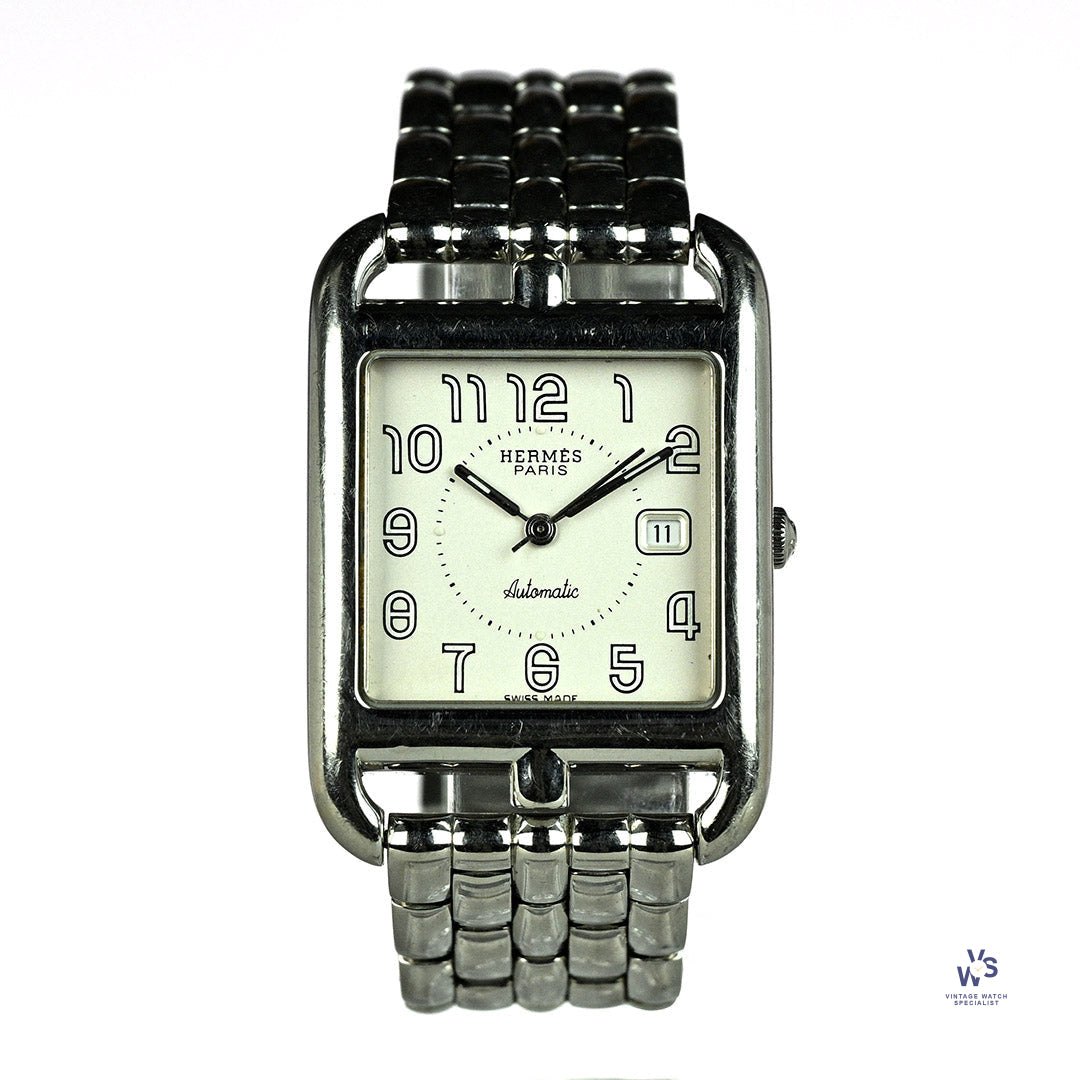
Hermes Cape Cod Automatic, Original Steel Bracelet, circa 2005
- Maker / attribution
- Unrecorded in source
- Date
- c. 2005
- Historical period
- Mechanical Renaissance (1990 – 2010)
- Country of origin
- Unrecorded in source
- Object type
- Wristwatch
- Materials / technique
- steel
- Stock no.
- vws3839
- Credit line
- Dealer listing, Vintage Watch Specialist (vws3839)
- Catalogue title (original)
- Hermes Cape Cod Automatic - Original Steel Bracelet - With Original Box - c.2005 (English)
View the source record (dealer listing) ↗ (opens another website in a new tab)Suggest a correction
Record summary
Catalogued by Vintage Watch Specialist (dealer), United Kingdom (stock number vws3839), this is a wristwatch, dated c. 2005. The Atlas places it in the Mechanical Renaissance period (1990 – 2010) of its Wristwatches collection. Materials and techniques recorded by the source: steel. The record is illustrated with 6 photographs.
Assembled from the source record's structured fields. Dates and attributions are given as the source states them; where a field is missing the Atlas leaves it blank rather than estimating.
Catalogue description
Dealer description — Vintage Watch Specialist
A Charming Hermès Cape Cod in Fantastic Pre-Owned Condition Paired with its Original Bracelet with Hermès Clasp, c.2005 The Hermès Cape Cod watch was introduced in 1991, designed by Henri d’Origny. Originally asked to design a square watch, d’Origny broke convention by placing a square dial within a rectangular case, inspired by the "Chaîne d’ancre" (anchor chain) motif—a signature of Hermès. The Cape Cod blends casual elegance with a playful, timeless design, often paired with the iconic double tour strap. It has become one of Hermès’ most recognisable and enduring watch collections. What's on Offer We are delighted to present this beautifully preserved Hermès Cape Cod Automatic, a model that subtly blends Parisian design heritage with Swiss mechanical precision. Originally introduced in 1991 and inspired by a design sketch from Henri d’Origny, the Cape Cod has become one of Hermès’ most distinctive timepieces — understated, elegant, and unmistakably refined. This particular example features a crisp white dial adorned with Bauhaus-style Arabic numerals, offering exceptional legibility and balanced proportion. The stylised typography is both playful and timeless, a hallmark of Hermès' ability to elevate the everyday. A subtle date aperture at 3 o’clock sits neatly within the dial, adding practicality without disrupting the clean aesthetic. The slim feuille hands and central sweep seconds complete the look with elegant restraint. The case is crafted from stainless steel, offering a rectangular shape with softened curves, typical of the Cape Cod’s signature design. This example is in fantastic pre-owned condition, with light signs of wear consistent with careful use. A delightful timepiece that looks wonderful on the wrist - we love it!
Historical context
Mechanical Renaissance (1990 – 2010)
Mechanical watches return as cultural objects; independent watchmaking flourishes.
Mechanical watches returned as cultural and luxury objects. Complications, tourbillons and new materials proliferated; independent watchmakers such as George Daniels, F.P. Journe and Philippe Dufour revived artisanal watchmaking; collecting vintage watches became a major field.
Read the period in the timelineMore wristwatches from this periodEarlier: Quartz Revolution
Atlas type guide
Automatic (self-winding) watches
Self-winding watches use the wearer's motion to wind the mainspring. Abraham-Louis Perrelet and Breguet made 'perpétuelle' pocket watches with oscillating weights in the late eighteenth century, but the principle only became practical in the wristwatch. John Harwood patented a bumper automatic in 1923; Rolex's Perpetual rotor (1931) winding in one direction, and later bidirectional rotors (Eterna, Felsa Bidynator), established the modern form. Micro-rotors (Universal Genève, Buren) and peripheral rotors made automatic watches thinner.
What to look for
- A semicircular rotor turning 360° over the movement, or a 'bumper' weight that rebounds between springs.
- 'Automatic', 'Perpetual' or 'Self-winding' on the dial.
- A sealed screw-back case, since automatic watches are wound less often by the crown.
Dating clues
- Bumper automatics: 1923–c. 1955.
- Full rotors: from 1931 (Rolex); widespread after c. 1950.
- Micro-rotors: from 1954–1958.
General guidance written by the Atlas editors about this kind of object. It is not a statement about this particular piece; for that, rely on the source record above and on physical examination.
Related records
Wristwatches · 1999
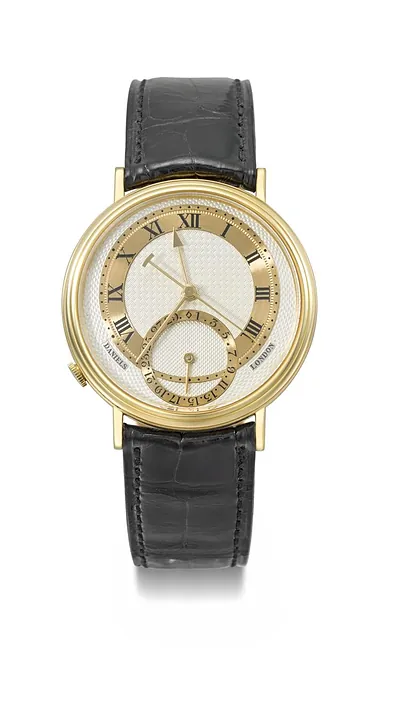
'Millennium' co-axial wristwatch by George Daniels and Omega, England, 1999
Science Museum Group, London

Wristwatches · 2008
Wristwatch by Breitling?, 2008
Museum Rotterdam
Wristwatches · 2008
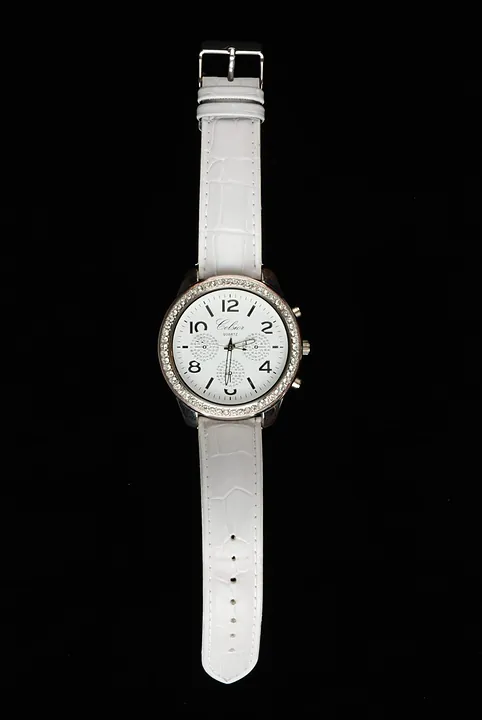
Wristwatch by Celsior Quartz, 2008
Museum Rotterdam
Wristwatches · 2008
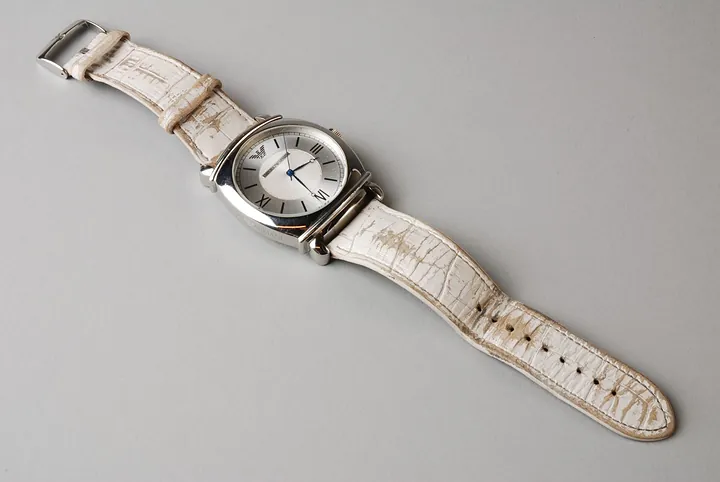
Wristwatch possibly by Emporio Armani, 2008
Museum Rotterdam

Wristwatches · c. 1990s
Audemars Piguet Bamboo, c. 1990s
Antiquorum auction archive, Geneva

Wristwatches · c. 1990
Audemars Piguet Huitieme Perpetual Calendar, ref. 25696PT, c. 1990
Antiquorum auction archive, Geneva

Wristwatches · c. 1990
Breitling Chronomat, ref. b13050.1, c. 1990
Antiquorum auction archive, Geneva
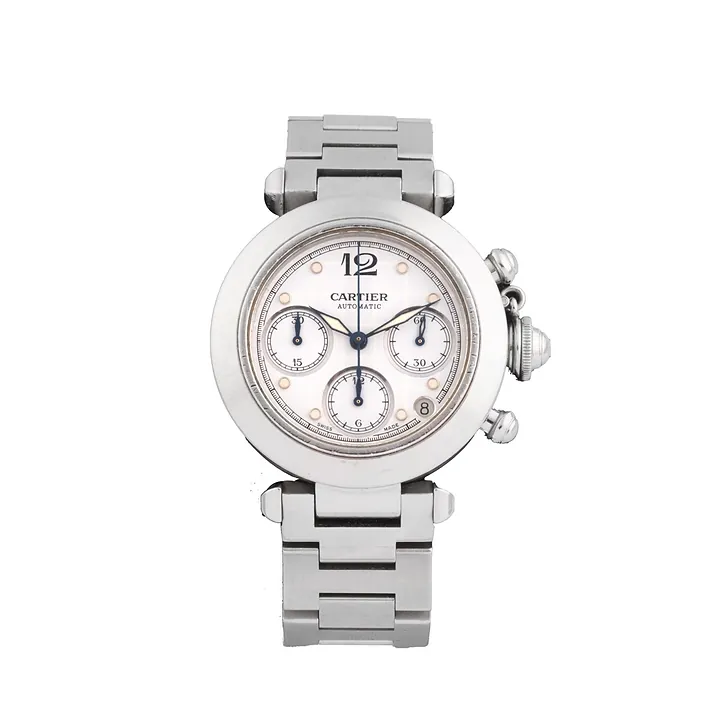
Wristwatches · c. 1990
Cartier Pasha, ref. 2412, c. 1990
Antiquorum auction archive, Geneva