
Wristwatches · Wristwatch
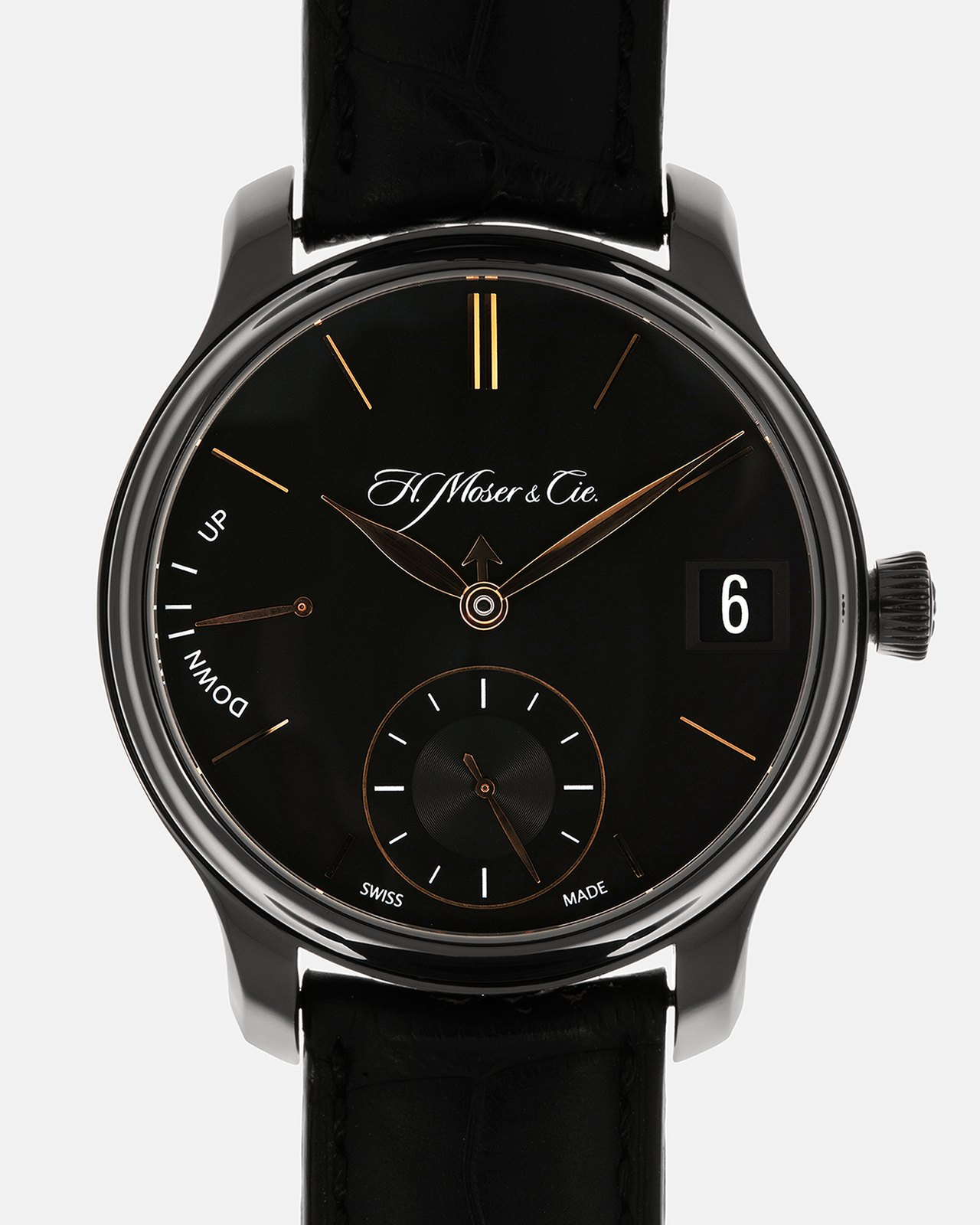
H.Moser & Cie Endeavour Perpetual Black Edition, 2016
- Maker / attribution
- H. Moser & Cie (maker)
- Date
- 2016
- Historical period
- Contemporary Horology (2010 – Present)
- Country of origin
- Switzerland
- Object type
- Wristwatch
- Dimensions
- Case 40.8 mm
- Stock no.
- Product 7569122066519
- Credit line
- Dealer listing, S.Song Watches (product 7569122066519)
- Catalogue title (original)
- H.Moser & Cie Endeavour Perpetual Black Edition (English)
View the source record (dealer listing) ↗ (opens another website in a new tab)Suggest a correction
Record summary
Catalogued by S.Song Watches (dealer), Seattle (stock number Product 7569122066519), this is a wristwatch by H. Moser & Cie, made in Switzerland, dated 2016. The Atlas places it in the Contemporary Horology period (2010 – Present) of its Wristwatches collection. Recorded dimensions: Case 40.8 mm. The record is illustrated with 6 photographs.
Assembled from the source record's structured fields. Dates and attributions are given as the source states them; where a field is missing the Atlas leaves it blank rather than estimating.
Catalogue description
Dealer description — S.Song Watches
H. Moser & Cie is an independent watch brand that has become known as the enfant terrible of the Swiss watchmaking industry. While initially gaining recognition for crafting beautiful and elegant timepieces, the brand has taken a bold turn in recent years by injecting elements of satire into its horological creations. Notable examples include the one-of-a-kind 'Swiss Cheese' watch and the 'Apple' watch. This approach has sparked both admiration and controversy, making H. Moser & Cie a polarising presence in the watchmaking scene. What sets them apart is their willingness to actively critique and comment on the Swiss watch industry, a stance particularly noteworthy given their strong pedigree. Amidst their repertoire of complex timepieces, the Perpetual Calendar 1 remains a flagship for me. Launched in 2005 as the first watch after Moser's revival, it carried a disruptive quality of its own. Notably, it also went on to secure the 2006 Grand Prix d'Horlogerie de Genève (GPHG) award in the ‘complication’ category, solidifying its status as a standout creation from the brand. This is the H. Moser Perpetual Calendar Black Edition, and as you can see from the photos, the watch is a masterclass in minimalist design. Unlike traditional perpetual calendars that try to cram an overwhelming amount of information onto a small dial, Moser focused on the core essentials. From a distance, it almost resembles a simple time-and-date watch, yet up close, all the crucial calendar information is clearly presented in a perfectly intuitive fashion. As we all know, a perpetual calendar watch can track the number of days in each month, including leap years, so you need to know the day, the month, and the position in the leap year cycle. The large date aperture at 3:00 is the most obvious feature, but look closely, and you will see a small arrow hand that indicates the month. Twelve hours in a day, twelve months in a year, with 1 for January and 12 for December. Moser realized that checking the leap year is rarely necessary for regular users, so they moved it onto the movement side instead, which makes practical sense. When this watch was released, it made people rethink what a perpetual calendar could, and arguably should, look like. Moving on to its 40.8mm x 11.1mm DLC-coated grade 5 titanium case, the Endeavour Perpetual Calendar wears exceptionally well on the wrist, in part thanks to the gently curved sapphire case back. This not only enhances overall wearing comfort but also showcases the tasteful interplay of brushed and polished finishes. At first glance, it might look just like any other round watch case, but once you start noticing the subtle details, it becomes clear how thoughtfully the design was executed. Powering the watch from within is Moser’s in-house, manual-winding Cal. HMC 341—a stunning movement when viewed from behind the exhibition case back. Meticulously crafted and thoughtfully finished, it features a case-matching black-finish, a double-barrel construction and boasts a well-designed architectural layout. With a manual winding mechanism, this movement not only exudes visual elegance but also promises a hands-on and engaging experience for the wearer. In its all-black Endeavour guise, the Perpetual Calendar is pure Moser: quiet, confident, deliberately restrained. It does not aim to impress at first glance; it makes sense only once you spend time with it. Stripped of ceremony and reduced to essentials, it is executed with conviction. Love it or question it, H. Moser & Cie continues redefining modern haute horlogerie and proves that true disruption does not need to shout. With only approximately 3,000 pieces produced a year, the brand remains one of the most singular and self-assured independents today.
Historical context
Contemporary Horology (2010 – Present)
Silicon components, connected watches, optical-lattice research clocks and a thriving independent scene.
Smartwatches became the world's best-selling watches, while mechanical watchmaking focuses on craft, innovation (silicon components, new escapements) and independent makers.
Read the period in the timelineMore wristwatches from this periodEarlier: Mechanical Renaissance
Atlas type guide
Calendar, moon-phase and perpetual calendar watches
Calendar complications range from a simple date to the perpetual calendar, which automatically allows for months of different lengths and leap years until 2100. Pocket watches with perpetual calendars were made in the eighteenth and nineteenth centuries; Patek Philippe made the first perpetual calendar wristwatch in 1925, and series production followed in 1941. The annual calendar (Patek Philippe, 1996) needs correction only once a year.
Moon-phase displays use a disc with two moons and 59 teeth advanced daily, approximating the 29.5-day lunation; more precise trains reduce the error to one day in over a century.
What to look for
- Apertures or subsidiary dials for day, date, month and leap year.
- Moon disc under a 'bosom' shaped aperture.
- Recessed correctors on the case band for setting the calendar.
Dating clues
- Triple-date wristwatches: popular c. 1940–1955.
- Perpetual calendar wristwatches: from 1925 (unique) and 1941 (series).
General guidance written by the Atlas editors about this kind of object. It is not a statement about this particular piece; for that, rely on the source record above and on physical examination.
Related records
Wristwatches · originally sold in 2021 (per the lot record)
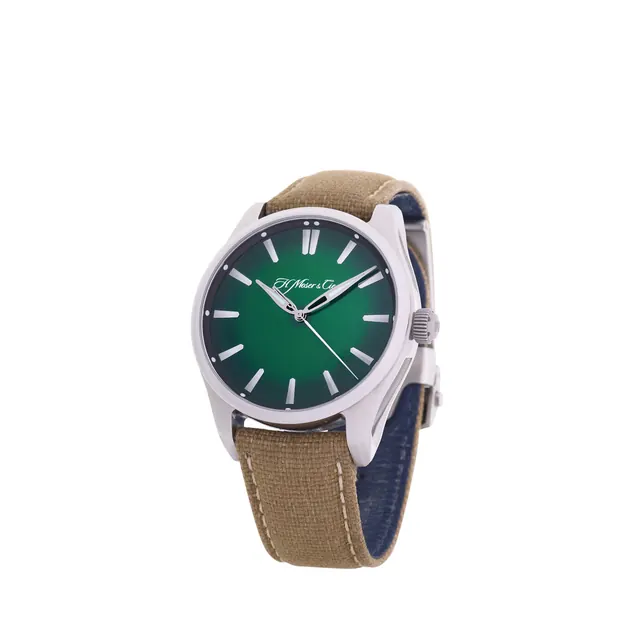
H. Moser & Cie wristwatch, ref. 3200.1202, Pionner, originally sold in 2021
Antiquorum auction archive, Geneva
Wristwatches · c. 2016
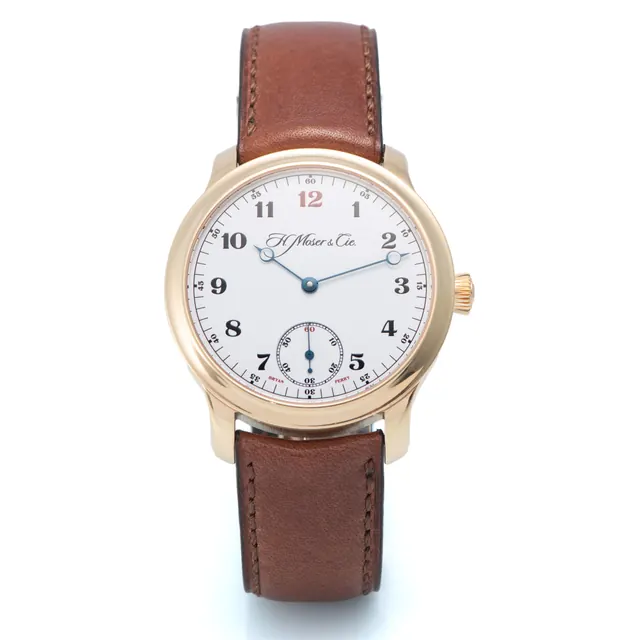
H. Moser & Cie wristwatch, ref. 1321-0116, Endeavour Limited Brian Ferry Edition of 100 Pieces, circa 2016
Antiquorum auction archive, Geneva
Pocket Watches · c. 1910
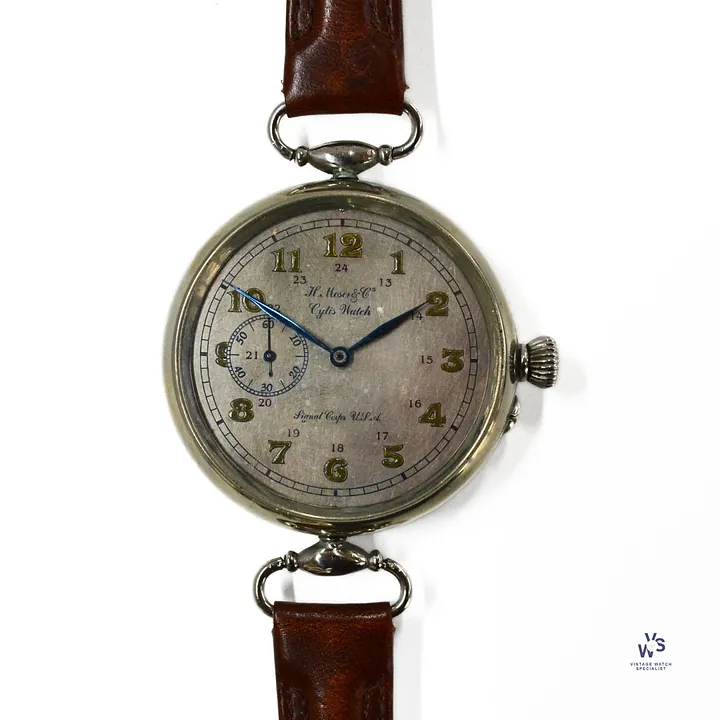
H.Moser & Cie, Cylis Watch, US Signal Corps, Pocket Watch Conversion, circa 1910
Vintage Watch Specialist (dealer), United Kingdom
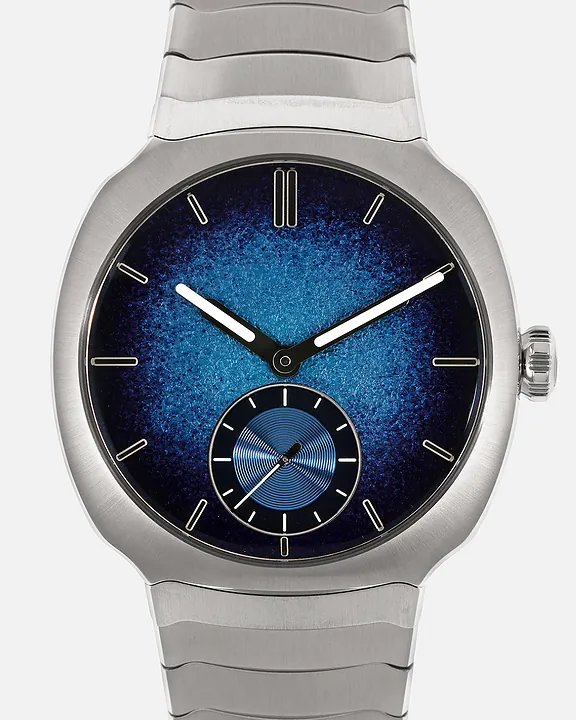
Wristwatches · 2025
H. Moser & Cie Streamliner Small Seconds Blue Enamel 6500-1200, 2025
S.Song Watches (dealer), Seattle

Wristwatches · c. 2010s
Breguet Type XXI, ref. 3810, c. 2010s (Antiquorum Lot 381-24)
Antiquorum auction archive, Geneva

Wristwatches · c. 2010s
Breguet Type XXI, ref. 3810, c. 2010s (Antiquorum Lot 386-229)
Antiquorum auction archive, Geneva

Wristwatches · Sold in September 2010
Breitling Cosmonaute, ref. A 22322, Sold in September 2010
Antiquorum auction archive, Geneva

Wristwatches · c. 2010
Corum Bubble Chrono, ref. 396.150.20, c. 2010
Antiquorum auction archive, Geneva