
Wristwatches · Time-only automatic wristwatch
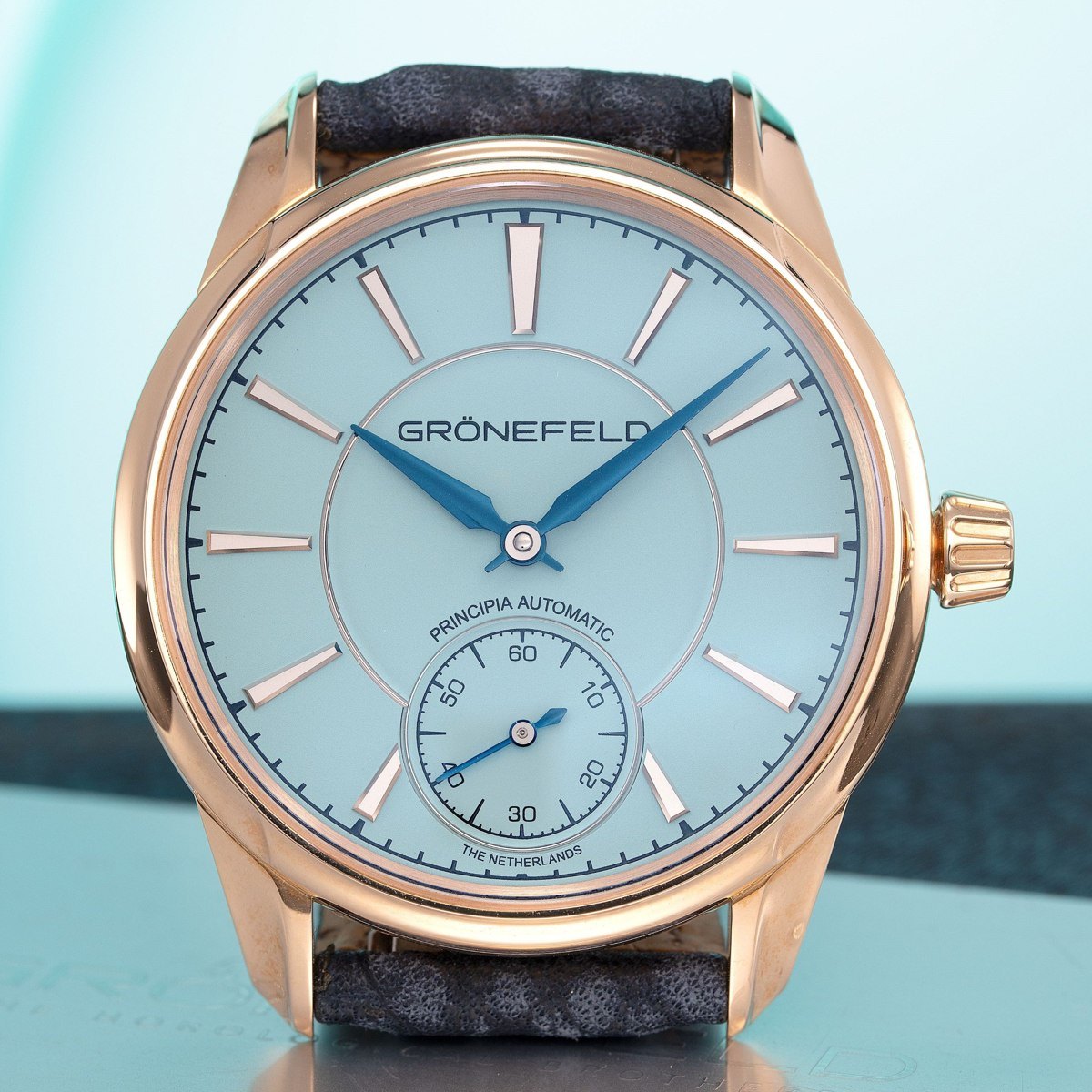
Grönefeld 1941 Principia Automatic Turquoise Dial
- Maker / attribution
- Grönefeld (source attribution)
- Date
- 2023
- Historical period
- Contemporary Horology (2010 – Present)
- Country of origin
- The Netherlands
- Object type
- Time-only automatic wristwatch
- Holding institution
- Phillips
- Accession / object no.
- gr-nefeld-1941-principia-automatic-turquoise-dial-3ce3db2f61
- Credit line
- Phillips
- Catalogue title (original)
- Grönefeld, 1941 Principia Automatic Turquoise Dial | Grönefeld Watch - Phillips (English)
View the source record ↗ (opens another website in a new tab)Suggest a correction
Record summary
Held and catalogued by Phillips (object number gr-nefeld-1941-principia-automatic-turquoise-dial-3ce3db2f61), this is a time-only automatic wristwatch attributed to Grönefeld, made in The Netherlands, dated 2023. The Atlas places it in the Contemporary Horology period (2010 – Present) of its Wristwatches collection. The record is illustrated with 1 photograph.
Assembled from the source record's structured fields. Dates and attributions are given as the source states them; where a field is missing the Atlas leaves it blank rather than estimating.
Catalogue description
Original object description
Housed in an 18K rose gold case measuring 39.5 mm across, the Grönefeld 1941 Principia Automatic is a time-only self-winding model dated by the seller to 2023 and driven by calibre G-06. Its dial is made of solid sterling silver finished in turquoise, accented by polished applied batons, blued hands, an offset subsidiary seconds display above 6 o'clock, and the lower inscription 'THE NETHERLANDS'. The watch is mounted on a blue buffalo leather strap with an 18K rose gold pin buckle, accompanied by its presentation case, Grönefeld letter, outer box, and guarantee card according to dealer documentation.
Original object description
Measuring 39.5 mm in diameter, the 18K rose gold case features shaped lugs, a stepped bezel, and a notched winding crown at the 3 o'clock position. It is paired with a blue buffalo leather band closed with a matching rose gold pin buckle. Photographic documentation provides no clear view of the case back or buckle hallmarks.
Original object description
The turquoise-coloured dial is formed from solid sterling silver and features polished applied baton markers. Blued steel hands indicate the central hours and minutes, complemented by an auxiliary blued seconds hand at the 6 position. Dial inscriptions include 'GRÖNEFELD' below 12, 'PRINCIPIA AUTOMATIC' resting above the small seconds counter, and 'THE NETHERLANDS' printed along the lower 6 o'clock edge.
Original object description
Calibre G-06, a self-winding mechanism associated with the year 2023, supplies the mechanical drive for this watch. Accompanying items comprise the Grönefeld presentation case, outer box, warranty card, and correspondence from the maker, though visual records do not allow direct examination of the internal calibre components.
Historical context
Contemporary Horology (2010 – Present)
Silicon components, connected watches, optical-lattice research clocks and a thriving independent scene.
Smartwatches became the world's best-selling watches, while mechanical watchmaking focuses on craft, innovation (silicon components, new escapements) and independent makers.
Read the period in the timelineMore wristwatches from this periodEarlier: Mechanical Renaissance
Atlas type guide
Automatic (self-winding) watches
Self-winding watches use the wearer's motion to wind the mainspring. Abraham-Louis Perrelet and Breguet made 'perpétuelle' pocket watches with oscillating weights in the late eighteenth century, but the principle only became practical in the wristwatch. John Harwood patented a bumper automatic in 1923; Rolex's Perpetual rotor (1931) winding in one direction, and later bidirectional rotors (Eterna, Felsa Bidynator), established the modern form. Micro-rotors (Universal Genève, Buren) and peripheral rotors made automatic watches thinner.
What to look for
- A semicircular rotor turning 360° over the movement, or a 'bumper' weight that rebounds between springs.
- 'Automatic', 'Perpetual' or 'Self-winding' on the dial.
- A sealed screw-back case, since automatic watches are wound less often by the crown.
Dating clues
- Bumper automatics: 1923–c. 1955.
- Full rotors: from 1931 (Rolex); widespread after c. 1950.
- Micro-rotors: from 1954–1958.
General guidance written by the Atlas editors about this kind of object. It is not a statement about this particular piece; for that, rely on the source record above and on physical examination.
Related records
Wristwatches · 2022
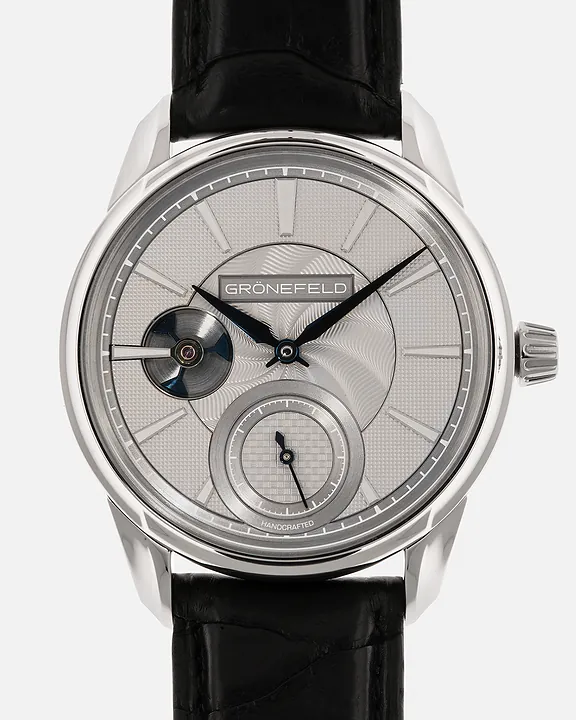
Gronefeld 1941 Remontoire Stainless Steel Piece Unique, 2022
S.Song Watches (dealer), Seattle
Wristwatches · 2010
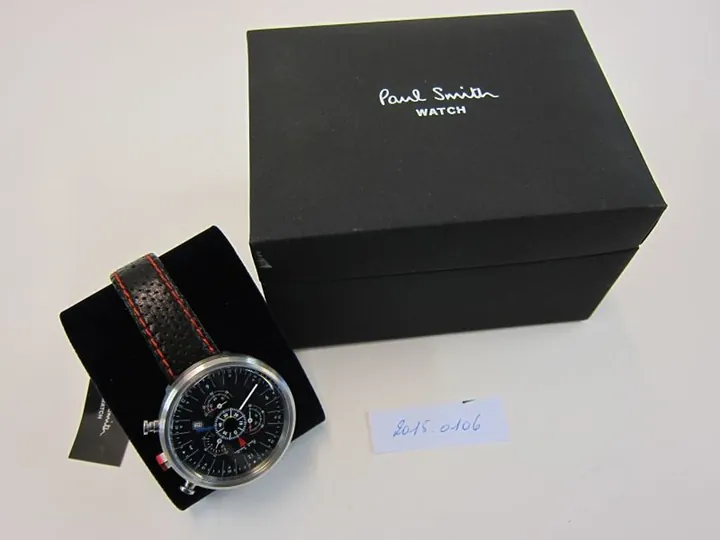
Wristwatch, 2010
Modemuseum Hasselt
Wristwatches · 2018 (Series 4 released in September 2018; '1977' in the source is the model number A1977)
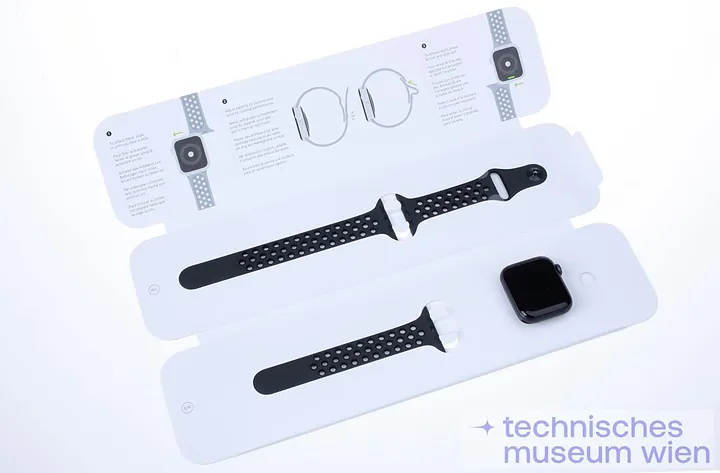
Apple Watch Series 4 (GPS, 40 mm, model A1977), 2018
Vienna Museum of Science and Technology
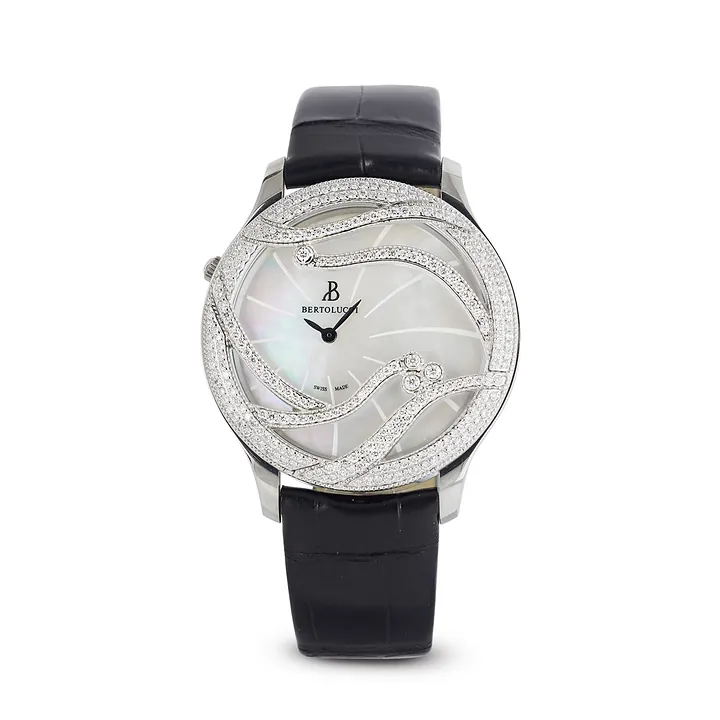
Wristwatches · c. 2010s
Bertolucci Stria III, ref. 11513.50.45.B88.6C1.501, c. 2010s
Antiquorum auction archive, Geneva
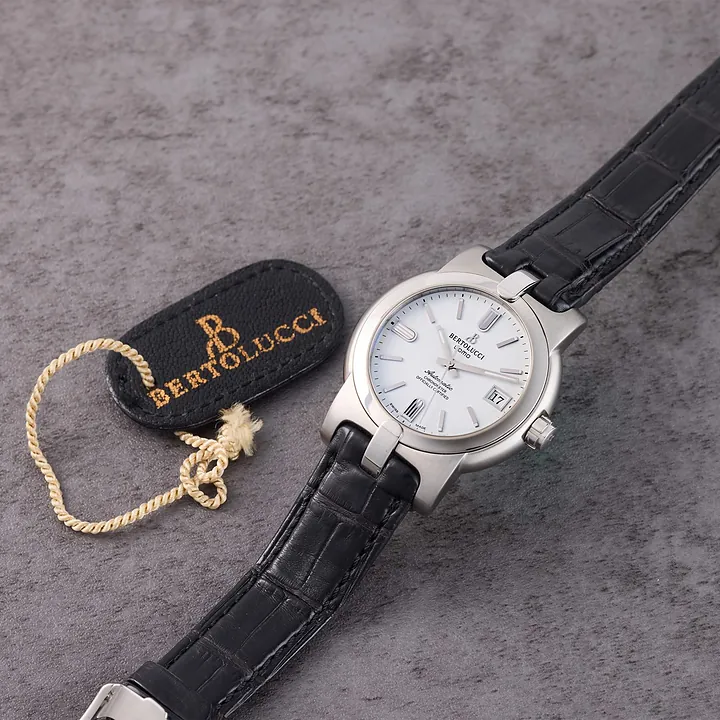
Wristwatches · c. 2010s
Bertolucci Uoma, ref. 824.51.41.10B, c. 2010s
Antiquorum auction archive, Geneva

Wristwatches · c. 2010s
Breguet Type XXI, ref. 3810, c. 2010s (Antiquorum Lot 381-24)
Antiquorum auction archive, Geneva

Wristwatches · c. 2010s
Breguet Type XXI, ref. 3810, c. 2010s (Antiquorum Lot 386-229)
Antiquorum auction archive, Geneva

Wristwatches · Sold in September 2010
Breitling Cosmonaute, ref. A 22322, Sold in September 2010
Antiquorum auction archive, Geneva