
Clocks · Clock
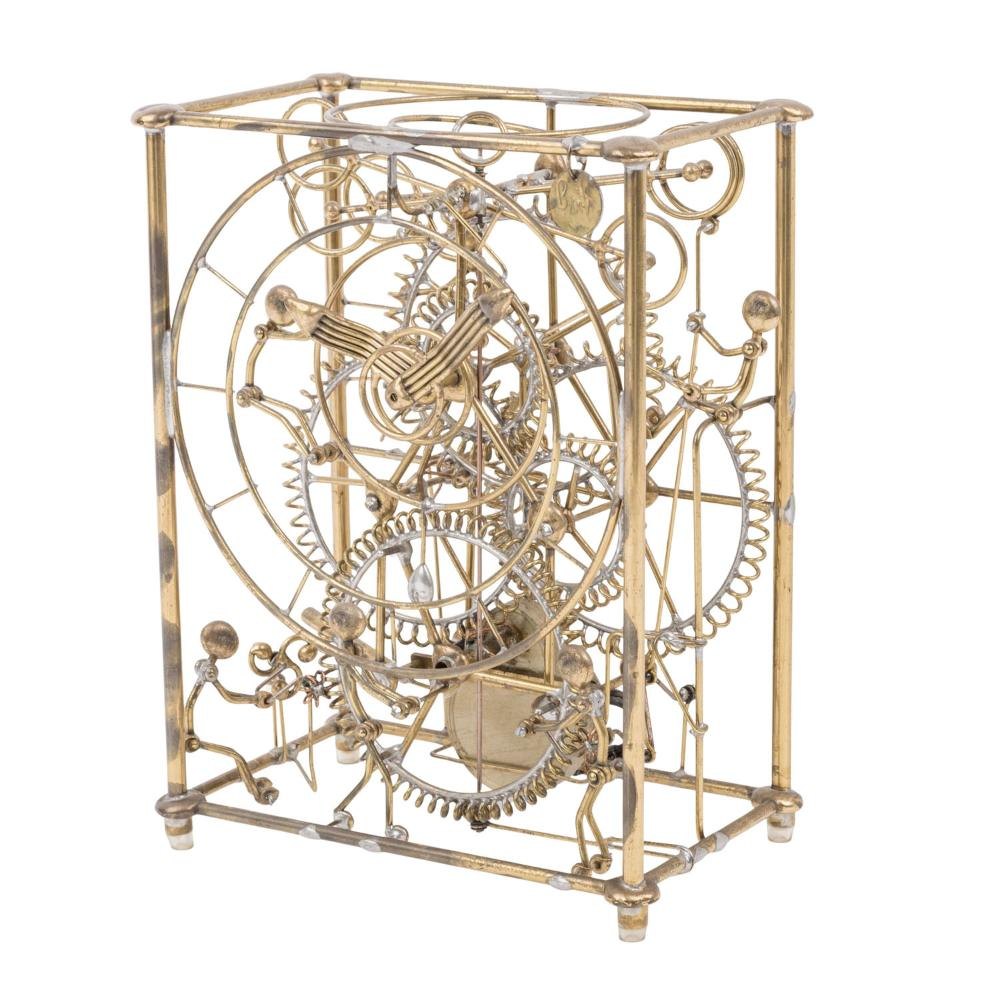
Gordon Bradt, kinetic table clock 'Six Man Clock', Kinetico Studios
- Maker / attribution
- Unrecorded in source
- Date
- 1970s–1980s
- Historical period
- Quartz Revolution (1969 – 1990)
- Country of origin
- United States
- Object type
- Clock
- Materials / technique
- brass
- Auction house
- Invaluable auction listings
- Lot
- Lot 18FB2DAF42
- Credit line
- Auction lot record: lot 835, Contemporary Art and Design - All prices include the buyer's premium!, Auktionshaus Eppli (2026), via Invaluable
- Catalogue title (original)
- BRADT, GORDON (1924) Kinetic Table Clock “Six Man Clock” (English)
View the source record (auction lot) ↗ (opens another website in a new tab)Suggest a correction
Record summary
Catalogued by Invaluable auction listings (lot Lot 18FB2DAF42), this is a clock, made in United States, dated 1970s–1980s. The Atlas places it in the Quartz Revolution period (1969 – 1990) of its Clocks collection. Materials and techniques recorded by the source: brass. The record is illustrated with 4 photographs.
Assembled from the source record's structured fields. Dates and attributions are given as the source states them; where a field is missing the Atlas leaves it blank rather than estimating.
Catalogue description
Lot description — Auktionshaus Eppli
BRADT, GORDON (1924) Kinetic Table Clock "Six Man Clock" Kinetico Studios, USA, 1970s–1980s. Brass, assembled and soldered, with electromechanical movement. Rectangular openwork brass frame raised on four feet. At the center is a complex exposed gear mechanism with a skeletonized dial. The mechanism is animated and continuously driven by six stylized articulated figures engaged in perpetual kinetic motion, creating a dynamic sculptural display. A suspended circular brass plaque in the upper right corner is embossed with the artist's signature, "Bradt." Electrically powered. Dimensions: Approx. 23 × 17 × 11 cm (H × W × D). Condition: The movement shows slight gumming consistent with age and may benefit from servicing. Light patina and minor signs of use. Overall in very good condition. SHIPPING TO THE USA MUST BE ARRANGED BY THE BUYER.
Historical context
Quartz Revolution (1969 – 1990)
Seiko's Astron begins mass quartz timekeeping; traditional industries contract sharply.
Quartz movements and digital displays made accurate clocks cheap and ubiquitous after the early 1970s. LED and LCD clocks, clock radios and radio-controlled clocks appeared, while traditional mechanical clockmaking contracted sharply in Germany, France and Britain.
Read the period in the timelineMore clocks from this periodEarlier: Modern Mechanical Horology
Atlas type guide
Bracket, table and spring-driven clocks
Spring-driven clocks freed timekeeping from the hanging weight. The coiled mainspring, documented from the fifteenth century, made portable table clocks possible; to even out its declining force, makers used the fusee, a conical pulley connected to the barrel by a gut line or chain. Renaissance table clocks from Augsburg and Nuremberg — drum-shaped, square or tower-shaped in gilt brass — were luxury scientific objects, often with astronomical dials and alarms.
After the pendulum, English makers developed the bracket clock: a wooden case with a carrying handle, a short pendulum with a verge escapement, and often repeating work to sound the hours on demand at night. Later examples use the anchor escapement. In the nineteenth century, 'table clock' became a broad term for spring clocks of every nationality.
What to look for
- A fusee in the movement (cone-shaped pulley) and the type of line — gut or chain.
- Verge escapement with a short bob pendulum, often with a decoratively engraved backplate.
- Repeat cords or buttons that make the clock strike again on demand.
- Gilt-brass engraved cases and horizontal dials on Renaissance pieces.
- Case shapes: inverted bell, bell top, break-arch, lancet or balloon.
Dating clues
- Drum and tower table clocks: c. 1520–1650.
- Ebony veneered English bracket clocks with verge escapements: c. 1670–1800.
- Engraved backplates were usual on English clocks until c. 1800, then generally plain.
General guidance written by the Atlas editors about this kind of object. It is not a statement about this particular piece; for that, rely on the source record above and on physical examination.
Related records
Clocks · mid 1980s
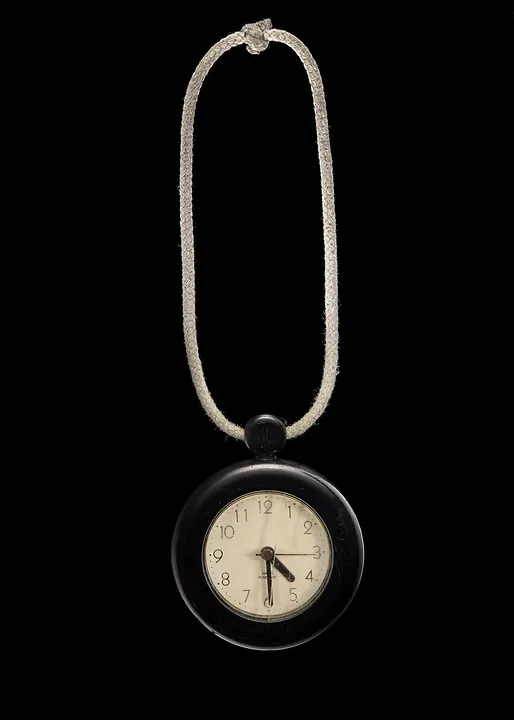
Clock necklace worn by Flavor Flav of Public Enemy, United States, mid-1980s
National Museum of African American History and Culture, Smithsonian Institution, Washington DC
Clocks · 1983
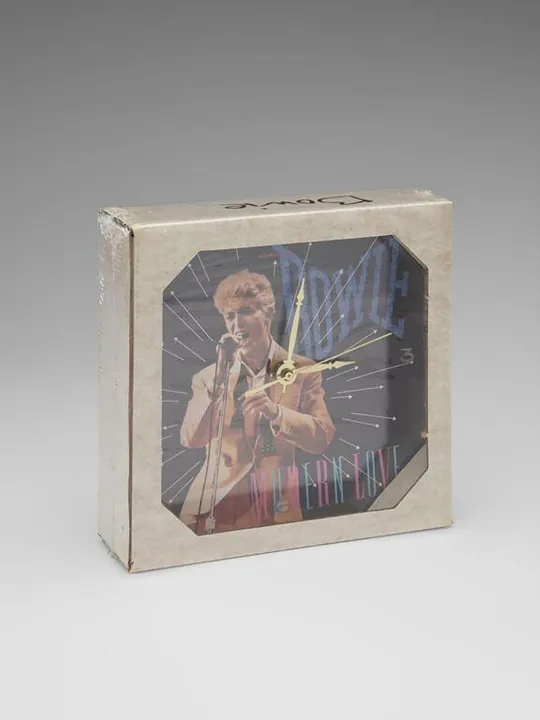
Clock by EMI, United States, 1983
Victoria and Albert Museum, London
Clocks · 1973
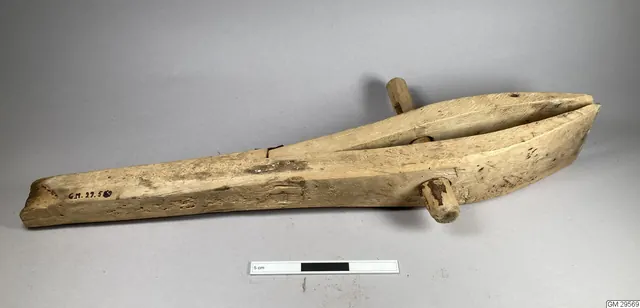
Wall clock by Waterbury Clock Co., United States, 1973
Museum of Gothenburg
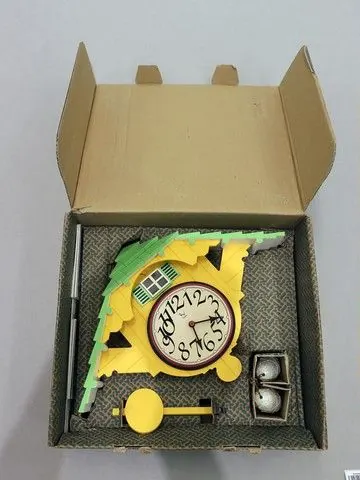
Clocks · 1988
Cuckoo Clock by Robert Venturi
Yale University Art Gallery, New Haven
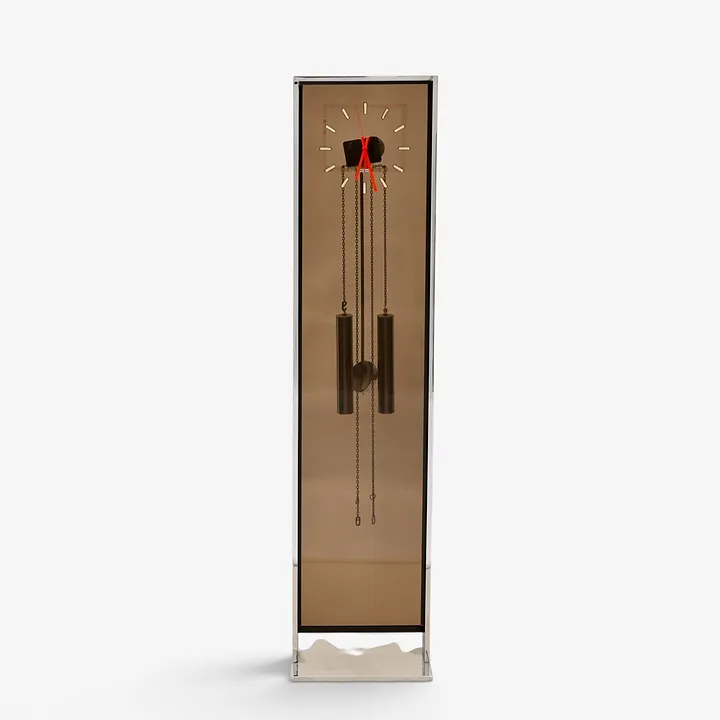
Clocks · c. 1970
George Nelson for Howard Miller Echo lll Floor Clock, circa 1970
LiveAuctioneers auction archive
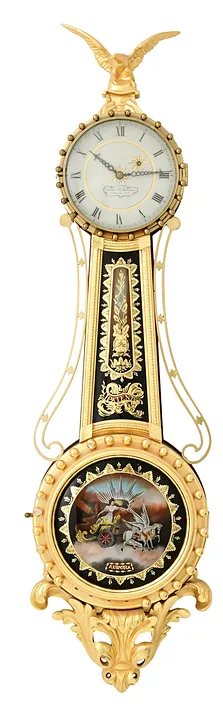
Clocks · c. 1970
Elmer O. Stennes Girandole Banjo Clock, Pembroke, Massachusetts, c. 1970
LiveAuctioneers auction archive
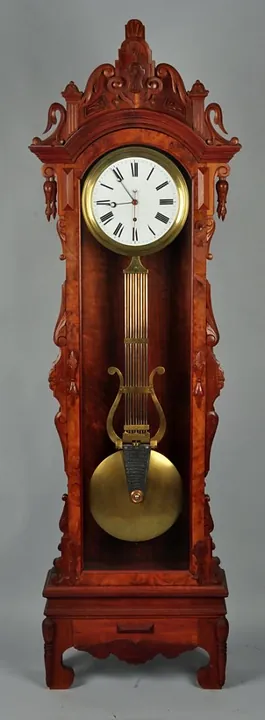
Clocks · c. 1970
American Victorian Period Clock, c. 1970
LiveAuctioneers auction archive
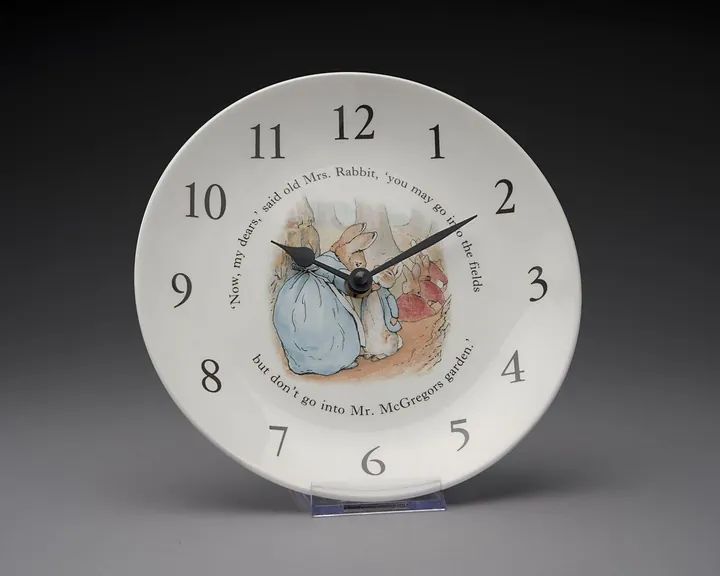
Clocks · late 20th century
Clock, 'Peter Rabbit', Queen's ware, transfer printing, Josiah Wedgwood and Sons, Barlaston, late 20th century (V&A WE.17466-2014)
Victoria and Albert Museum, London