
Clocks · Cuckoo clock
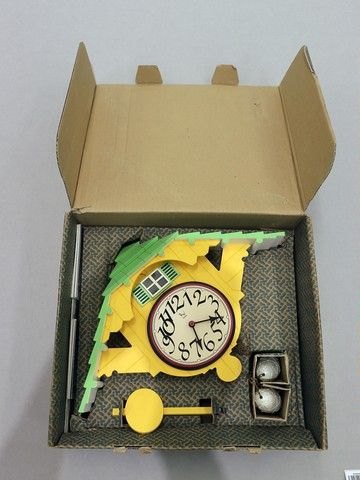
Cuckoo Clock by Robert Venturi
- Maker / attribution
- Robert Venturi (designer); Alessi S.p.A. (manufacturer)
- Date
- 1988
- Historical period
- Quartz Revolution (1969 – 1990)
- Country of origin
- United States
- Place
- Philadelphia
- Object type
- Cuckoo clock
- Materials / technique
- painted wood, metal, and cast iron
- Dimensions
- 16 × 16 × 4 3/4 in. (40.6 × 40.6 × 12.1 cm)
- Holding institution
- Yale University Art Gallery, New Haven
- Accession / object no.
- 2024.44.1
- Credit line
- Gift of Thomas Strong, M.F.A. 1967
- Catalogue title (original)
- Cuckoo Clock (English)
View the source record ↗ (opens another website in a new tab)Suggest a correction
Record summary
Held and catalogued by Yale University Art Gallery, New Haven (object number 2024.44.1), this is a cuckoo clock by Robert Venturi, made in Philadelphia, United States, dated 1988. The Atlas places it in the Quartz Revolution period (1969 – 1990) of its Clocks collection. Materials and techniques recorded by the source: painted wood, metal, and cast iron. Recorded dimensions: 16 × 16 × 4 3/4 in. (40.6 × 40.6 × 12.1 cm). The record is illustrated with 3 photographs.
Assembled from the source record's structured fields. Dates and attributions are given as the source states them; where a field is missing the Atlas leaves it blank rather than estimating.
Catalogue description
The source record does not include a narrative description. The structured fields above are reproduced from it.
Inscriptions & marks
“RV / ALESSI” on dial
Provenance
The manufacturer (founded 1921); sold to Tom Strong (born 1938), New Haven, Conn., 1990 [see note 1]; given to the Yale University Art Gallery, New Haven, Conn., 2024 Note 1: According to the donor, he bought the clock at a factory sale of Swid Powell designs; the sales happened once a year and designers were invited (Notes from a telephone call with Thomas Strong, March 27, 2024, copy in accession file).
Historical context
Quartz Revolution (1969 – 1990)
Seiko's Astron begins mass quartz timekeeping; traditional industries contract sharply.
Quartz movements and digital displays made accurate clocks cheap and ubiquitous after the early 1970s. LED and LCD clocks, clock radios and radio-controlled clocks appeared, while traditional mechanical clockmaking contracted sharply in Germany, France and Britain.
Read the period in the timelineMore clocks from this periodEarlier: Modern Mechanical Horology
Atlas type guide
Black Forest and cuckoo clocks
Clockmaking spread through the Black Forest in south-west Germany in the late seventeenth century as a winter occupation for farming families. Early clocks had wooden plates and wheels and a foliot ('Waaguhr') or short pendulum, with a painted wooden shield dial; pedlars (Uhrenträger) carried them across Europe. The cuckoo clock, which imitates the bird's call with two small bellows-driven pipes, appeared in the mid-eighteenth century.
The industry was organised around Furtwangen, Triberg, Schwenningen and Lenzkirch. The Furtwangen clockmaking school (1850) introduced the railway-house cuckoo clock design, and from the late nineteenth century factories such as Junghans, Kienzle and Hamburg-Amerikanische Uhrenfabrik produced clocks by the million. The German Clock Museum in Furtwangen preserves the region's history.
What to look for
- Wooden plates and wheels (earlier) versus brass movements (later).
- Painted shield dials (Lackschilduhr) with floral or figurative decoration.
- Cuckoo bellows and pipes, the carved 'railway house' or hunting-scene case.
- Trademarks and movement stamps of Black Forest factories.
Dating clues
- Wooden-wheeled foliot clocks: c. 1680–1750.
- Painted shield clocks: c. 1780–1880.
- Railway-house cuckoo clocks: after 1850; carved hunting-style cases after c. 1860.
General guidance written by the Atlas editors about this kind of object. It is not a statement about this particular piece; for that, rely on the source record above and on physical examination.
Read next:FoliotAnchor (recoil) escapement
Related records
Clocks · mid 1980s
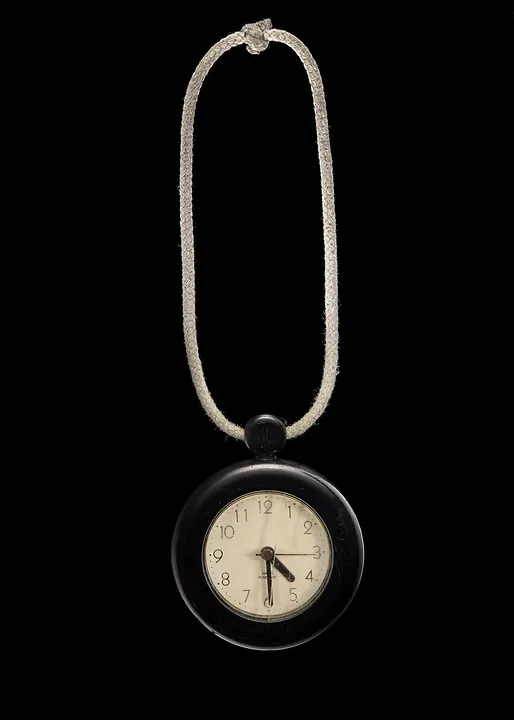
Clock necklace worn by Flavor Flav of Public Enemy, United States, mid-1980s
National Museum of African American History and Culture, Smithsonian Institution, Washington DC
Clocks · 1983
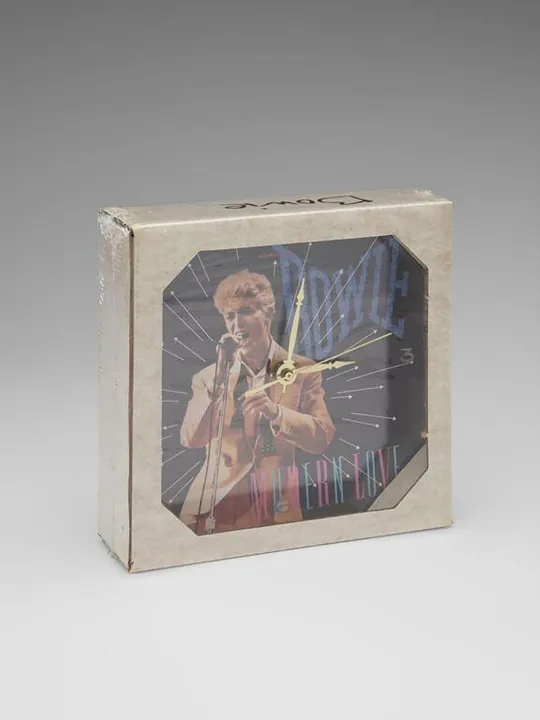
Clock by EMI, United States, 1983
Victoria and Albert Museum, London
Clocks · 1973
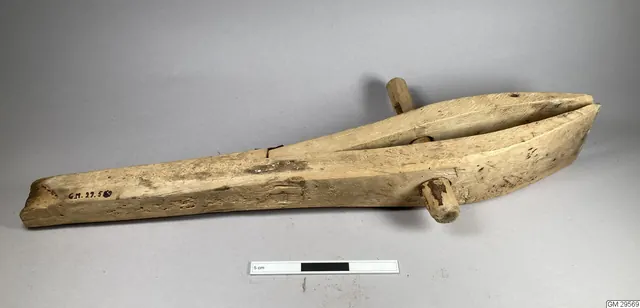
Wall clock by Waterbury Clock Co., United States, 1973
Museum of Gothenburg
Clocks · c. 1970
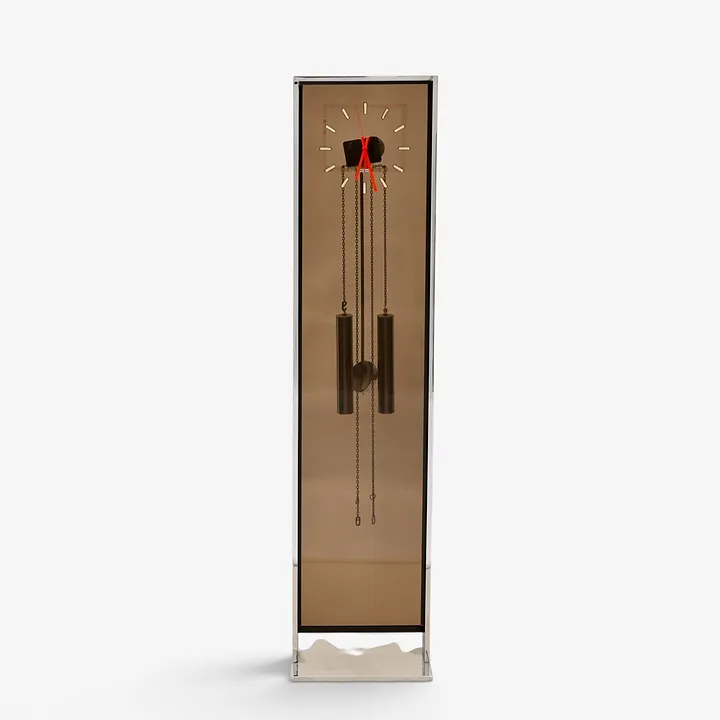
George Nelson for Howard Miller Echo lll Floor Clock, circa 1970
LiveAuctioneers auction archive
Clocks · c. 1970
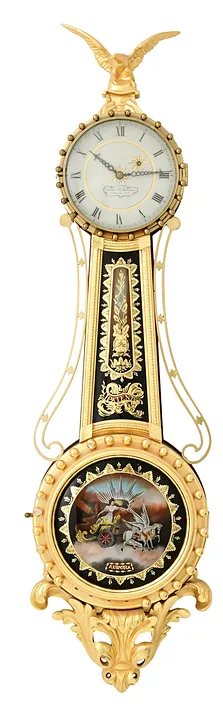
Elmer O. Stennes Girandole Banjo Clock, Pembroke, Massachusetts, c. 1970
LiveAuctioneers auction archive
Clocks · c. 1970
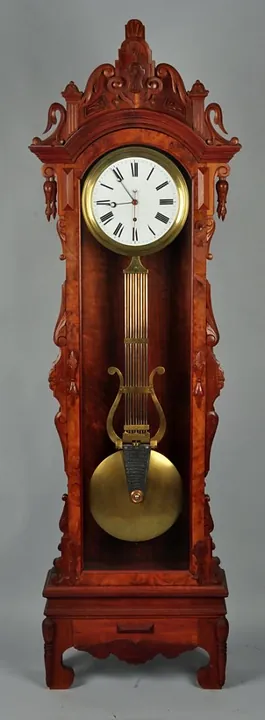
American Victorian Period Clock, c. 1970
LiveAuctioneers auction archive
Clocks · 1970s–1980s
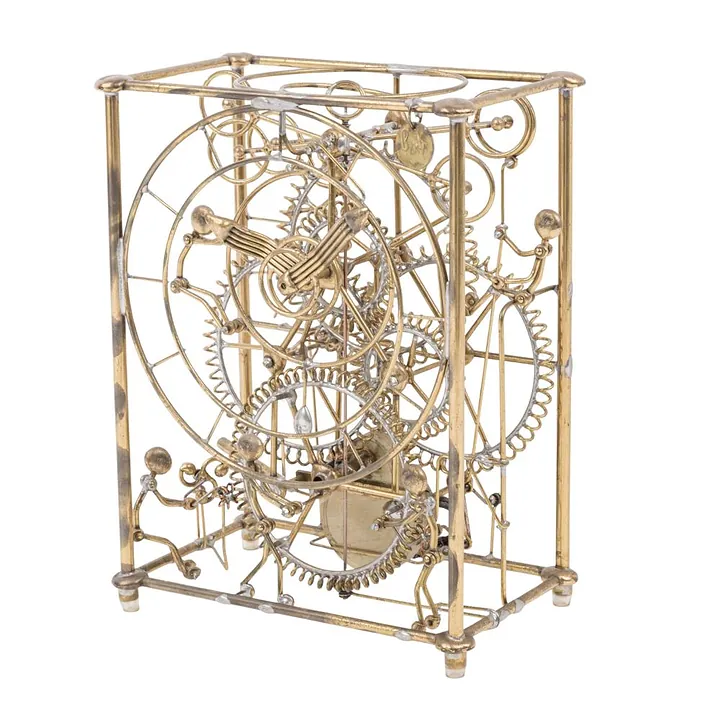
Gordon Bradt, kinetic table clock 'Six Man Clock', Kinetico Studios
Invaluable auction listings
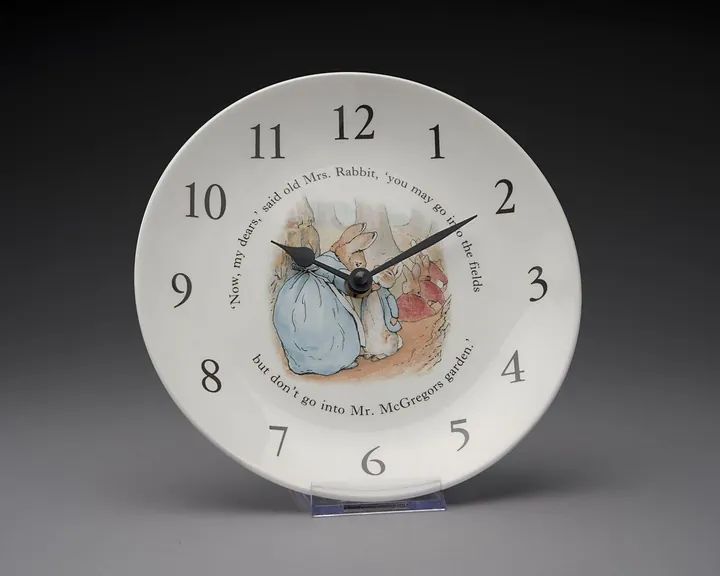
Clocks · late 20th century
Clock, 'Peter Rabbit', Queen's ware, transfer printing, Josiah Wedgwood and Sons, Barlaston, late 20th century (V&A WE.17466-2014)
Victoria and Albert Museum, London