
Wristwatches · Wristwatch
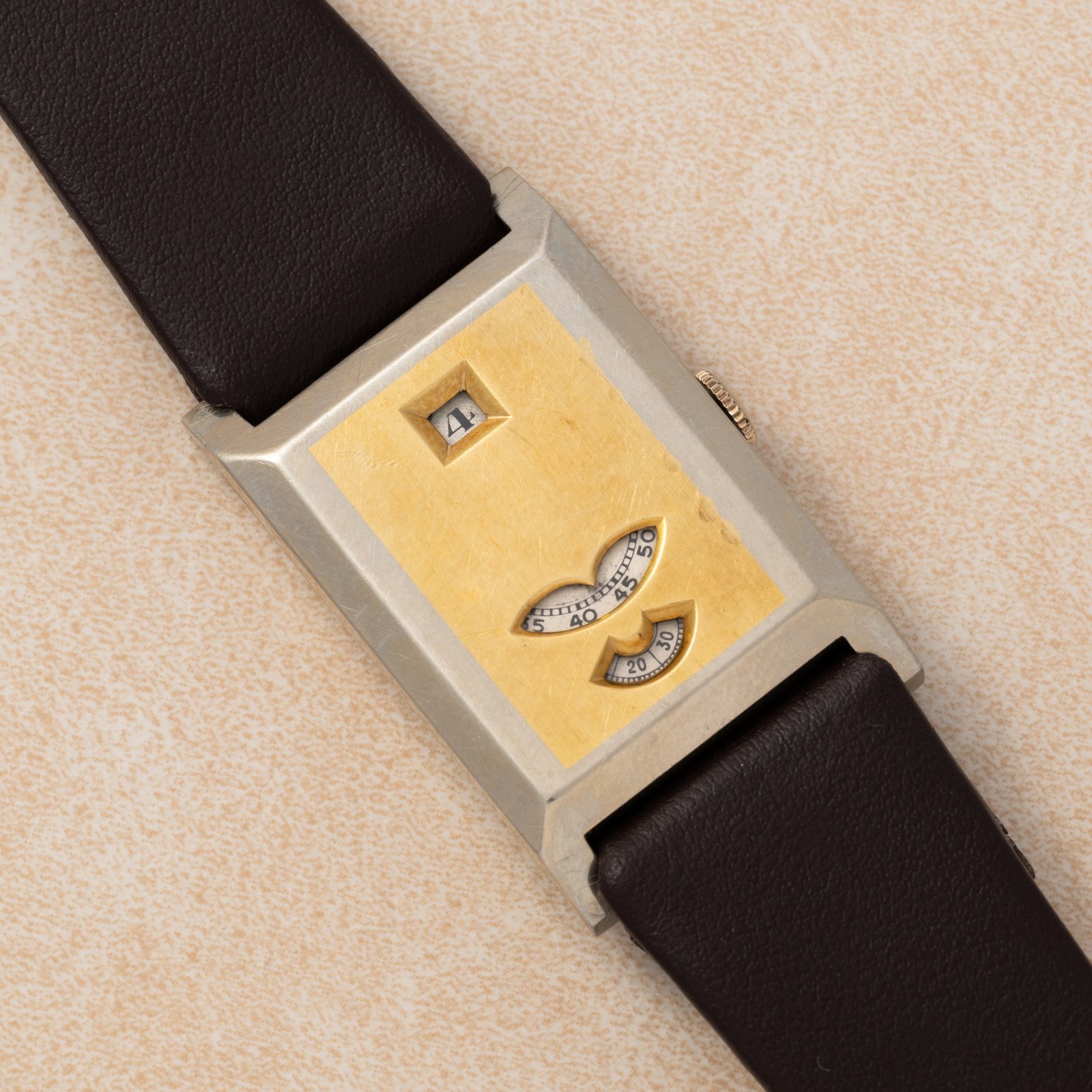
Glycine 'Jump Hour' 18k Two-Tone, 1930s
- Maker / attribution
- Glycine (maker)
- Date
- 1930s
- Historical period
- Golden Age of Mechanical Watchmaking (1900 – 1945)
- Country of origin
- Unrecorded in source
- Object type
- Wristwatch
- Materials / technique
- two-tone
- Dimensions
- Case 23 mm
- Stock no.
- 40991599
- Credit line
- Dealer listing, Analog/Shift (40991599)
- Catalogue title (original)
- Glycine 'Jump Hour' 18k Two-Tone (English)
View the source record (dealer listing) ↗ (opens another website in a new tab)Suggest a correction
Record summary
Catalogued by Analog/Shift (dealer), New York (stock number 40991599), this is a wristwatch by Glycine, dated 1930s. The Atlas places it in the Golden Age of Mechanical Watchmaking period (1900 – 1945) of its Wristwatches collection. Materials and techniques recorded by the source: two-tone. Recorded dimensions: Case 23 mm. The record is illustrated with 6 photographs.
Assembled from the source record's structured fields. Dates and attributions are given as the source states them; where a field is missing the Atlas leaves it blank rather than estimating.
Catalogue description
Dealer description — Analog/Shift
Founder Select Jumping hours mechanisms are one of my all time favorite complications, and I count several in my personal collection. While pieces such as this 1930s Glycine may have in recent memory been considered 'too small' to wear - compare it to the design-forward watches from brands such as Cartier, Piaget, and Patek Philippe that have been trending of late. Now blow the doors off with its complicated mechanism and incredible 18k white and yellow gold inlaid case! -James Lamdin We’re sure the first thing that comes to mind when you hear the brand name Glycine, their iconic Airman immediately comes to mind. We don’t blame you, it’s the same for us! Dig into their history and you'll find that Glycine has done so much more than the aviation and travel watches they are best known for. You'll discover they hold nine patents ranging from bracelet clasps and hacking mechanisms to vacuum casing and an incredible jump hour mechanism, such as the one presented here. This particular example dates to the 1930s and is housed in a two-tone rectangular case produced in solid white gold with a yellow gold inlay on the front, framing the time display. Measuring approximately 23mm x 34mm, the case is best characterized by its sharp edges and angular facets that extend from the top of the case all the way to the lugs - a stunning artifact from the pre-war period. The mechanism is their baguette shaped movement, first patented in October 1929, which integrated the jump hour, minute, and seconds discs onto a baguette surface, which offered more space than round movements. Giving the crown a few turns, the manual movement puts the discs in motion, displaying the time in three windows showcasing the hours, minutes, and running seconds. This fabulous Glycine Jump Hour offers an entirely different on-wrist experience than most contemporary collectors are familiar with. It’s all the little details that cohesively come together; its incredible two-tone gold case, the peculiar time-telling display that feels like a trip into a retro-futuristic steampunk world, its fixed bar construction, and ots accompanying steel ‘Gay Freres’ Bonklip bracelet. When the top of the hour comes, you'll find yourself taking a moment out of your day to watch the disc jump from one to the next, and we'd argue that the running seconds rotating disc is infinitely more soothing to behold than a sweeping seconds hand. In short, this is a special one.
Historical context
Golden Age of Mechanical Watchmaking (1900 – 1945)
The wristwatch displaces the pocket watch; waterproof cases, self-winding and grand complications.
The wristwatch overtook the pocket watch. Military use in the First World War, aviation, water-resistant cases (1926), automatic winding (1923–31), rectangular Art Deco designs and early chronographs and calendars defined the period.
Read the period in the timelineMore wristwatches from this periodEarlier: Industrial Revolution
Atlas type guide
Wristwatches
Bracelet watches were worn by women from the early nineteenth century — Breguet made one for Caroline Murat, Queen of Naples, in 1810–12 — but the wristwatch only became a man's instrument with military use and aviation in the early twentieth century. Between the World Wars it overtook the pocket watch; the 1920s and 1930s brought rectangular Art Deco cases, water-resistant cases and the first automatic winding systems.
After 1945 the wristwatch became a carrier of identity — dress watches, sports and dive watches, chronographs, calendars — produced by Swiss, American, Japanese, German, Soviet and Chinese industries. The quartz revolution after 1969 and the mechanical renaissance since the 1990s, including the rise of independent watchmakers, complete the story.
What to look for
- The reference number (between the lugs or inside the case back) and serial number, the starting point for dating.
- The calibre: its maker and number are often stamped under the dial or on the bridge.
- Originality of dial, hands and crown — refinished ('redial') dials are common.
- Case material marks: 18K/750, 14K/585, stainless steel, gold-filled, plated.
Dating clues
- Wire-lug cases: before c. 1925.
- Water-resistant screw-down cases: from 1926.
- Quartz movements: from 1969; sapphire crystals widespread after c. 1980.
General guidance written by the Atlas editors about this kind of object. It is not a statement about this particular piece; for that, rely on the source record above and on physical examination.
Related records
Wristwatches · c. 1930
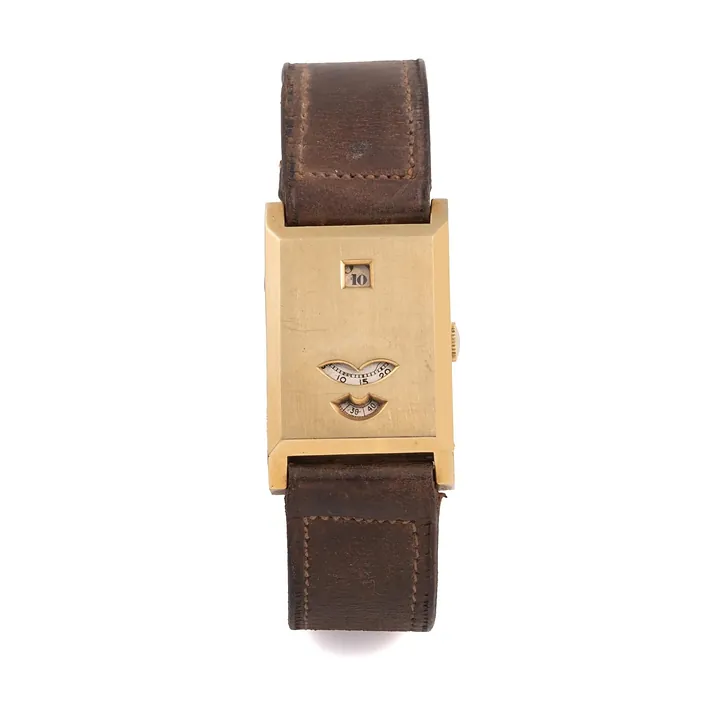
Glycine "jump Hour", c. 1930
Antiquorum auction archive, Geneva
Wristwatches · 1960s
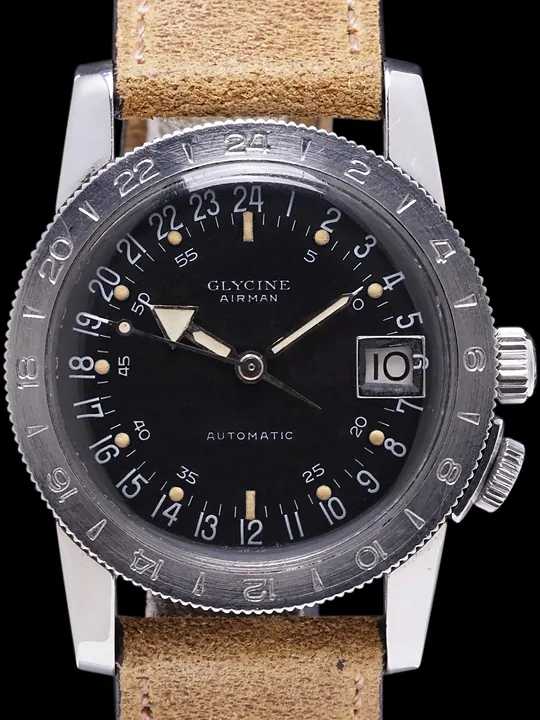
Glycine Airman Automatic, 1960s
Craft & Tailored (dealer), Los Angeles
Wristwatches · 1969
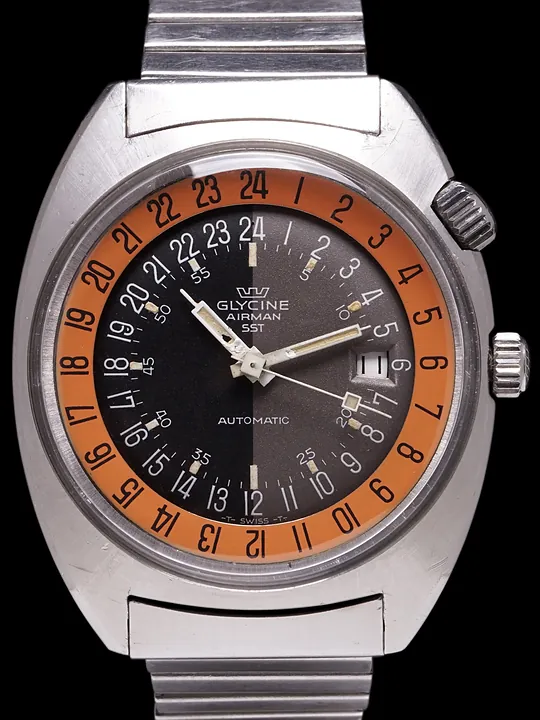
Glycine Airman SST 24Hr "Pumpkin", 1969
Craft & Tailored (dealer), Los Angeles
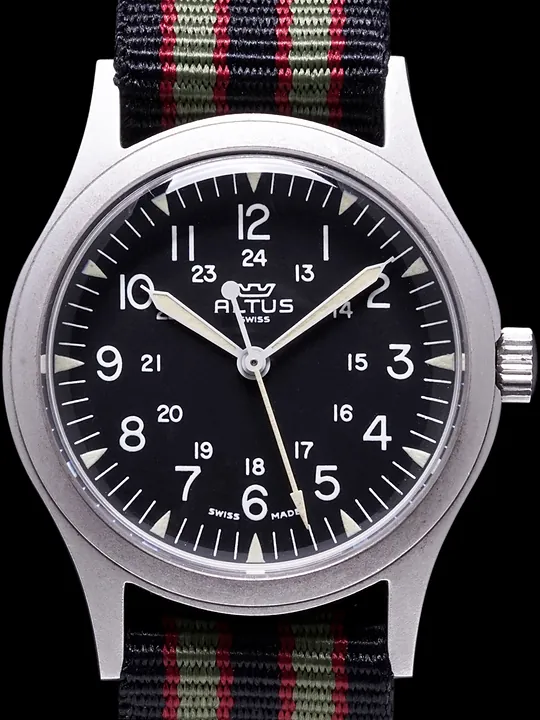
Wristwatches · 1986
Glycine Altus GG-W-113, 1986
Craft & Tailored (dealer), Los Angeles
Wristwatches · 1900–1999
Wristwatch by Mercury, 1900–1999
Modemuseum Hasselt
Wristwatches · 1900–1999
Wristwatch by Nutrix, 1900–1999
Modemuseum Hasselt

Wristwatches · 1920
Wristwatch, 1920
Modemuseum Hasselt

Wristwatches · 1931
Rolex 'Oyster Perpetual' rotor self-winding wrist-watch, lever escapement, in steel case with glass in back, Montres Rolex SA, Geneva, Switzerland, 1931
Science Museum Group, London