
Wristwatches · Wristwatch
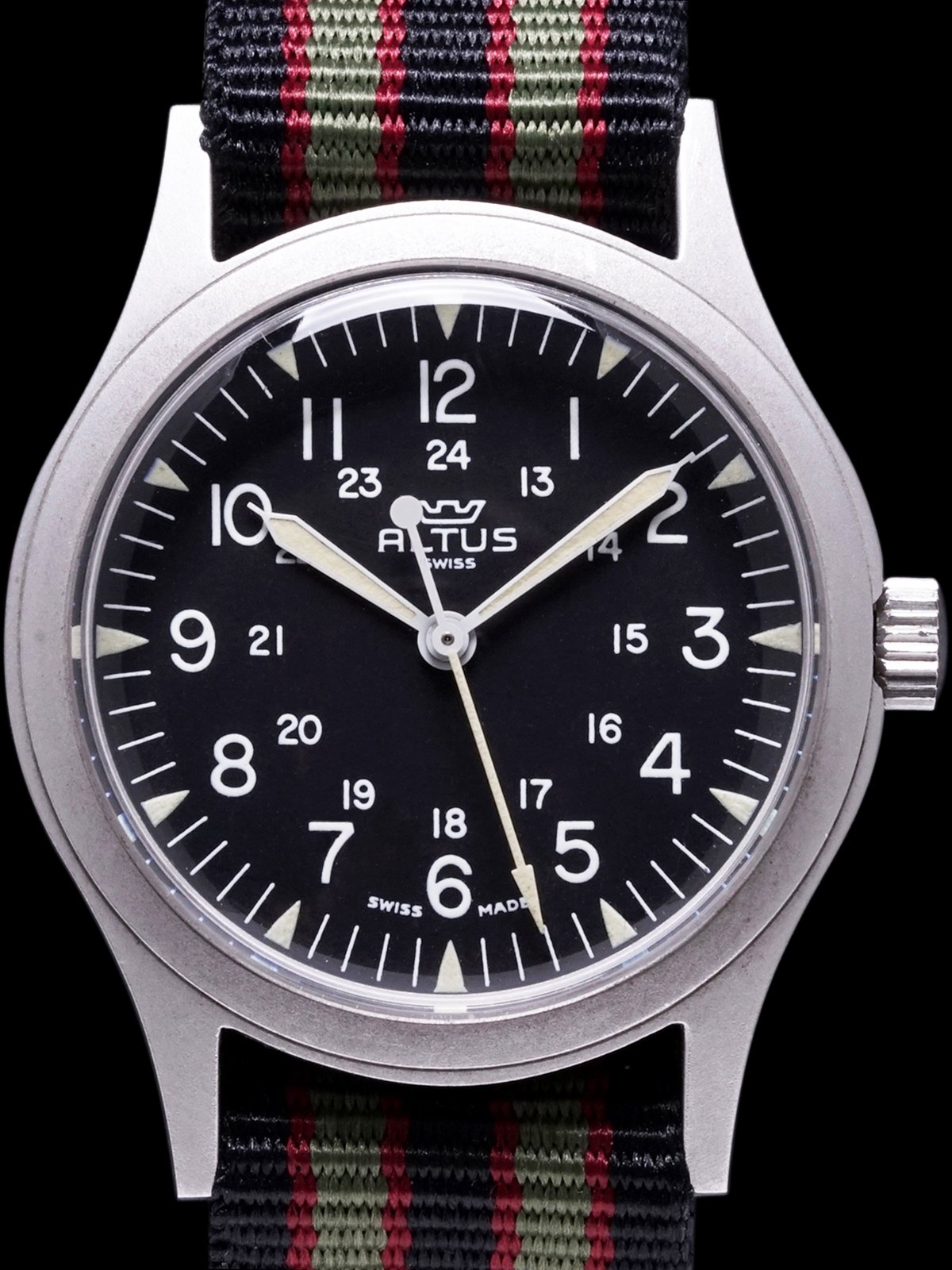
Glycine Altus GG-W-113, 1986
- Maker / attribution
- Glycine (maker)
- Date
- 1986
- Historical period
- Quartz Revolution (1969 – 1990)
- Country of origin
- Unrecorded in source
- Object type
- Wristwatch
- Dimensions
- Case 33.5 mm
- Stock no.
- GLYALT86
- Credit line
- Dealer listing, Craft & Tailored (GLYALT86)
- Catalogue title (original)
- 1986 Glycine Altus GG-W-113 (English)
View the source record (dealer listing) ↗ (opens another website in a new tab)Suggest a correction
Record summary
Catalogued by Craft & Tailored (dealer), Los Angeles (stock number GLYALT86), this is a wristwatch by Glycine, dated 1986. The Atlas places it in the Quartz Revolution period (1969 – 1990) of its Wristwatches collection. Recorded dimensions: Case 33.5 mm. The record is illustrated with 6 photographs.
Assembled from the source record's structured fields. Dates and attributions are given as the source states them; where a field is missing the Atlas leaves it blank rather than estimating.
Catalogue description
Dealer description — Craft & Tailored
By the 1980s Glycine had made a strong name for itself for reliable and functional pilots watches, with the likes of the Airman model. So it's no surprise that Glycine produced a few different military-issued timepieces over the course of the brand's history. However, the Glycine Altus is a bit of an anomaly as it was only in production for one contract year in 1986 under the GG-W-113 specification for the United States Air Force. The Glycine Altus' compact design features all of the military-issued goodies collectors know and love. Such as a bead-blasted stainless steel case, fix spring bars, and a high visibility no-nonsense dial. However, we think the Glycine Altus offers a unique wrist presence all its own, due to its more modest case diameter, the dial was designed with large Arabic numerals that jump off the dial and give this watch it's stylish and utilitarian wearability. Stock # GLYALT86 Brand Glycine Altus Style Military Pilots Watch Model GG-W-113 Serial N/A Size Men's Material Stainless Steel Dial Matte Black Millimeters 33.5mm Strap NATO Strap CASE & BRACELET The unpolished stainless steel case with fixed spring bars retains its factory bead-blasted matte finish and lines in excellent condition, showing minimal signs of use. The case retains its original bead-blasted crown which shows some signs of use. The caseback shows all the correct Govt. serial numbers and contract numbers. The watch will come on a NATO strap. DIAL & HANDS The matte black military dial with large Arabic numerals is in absolutely flawless condition, showing no aging or blemishes. The tritium arrow markers have taken on a warm creamy patina and exhibit no degradation when inspected under U.V. light. The original tritium hands match the dial nicely and show no degradation under U.V. light inspection. ACCESSORIES
Historical context
Quartz Revolution (1969 – 1990)
Seiko's Astron begins mass quartz timekeeping; traditional industries contract sharply.
Quartz and digital watches transformed the market after 1969. Swiss employment collapsed, Japanese and Hong Kong production soared, and the Swatch (1983) helped the Swiss industry recover; mechanical watches survived as luxury goods.
Read the period in the timelineMore wristwatches from this periodEarlier: Modern Mechanical Horology
Atlas type guide
Wristwatches
Bracelet watches were worn by women from the early nineteenth century — Breguet made one for Caroline Murat, Queen of Naples, in 1810–12 — but the wristwatch only became a man's instrument with military use and aviation in the early twentieth century. Between the World Wars it overtook the pocket watch; the 1920s and 1930s brought rectangular Art Deco cases, water-resistant cases and the first automatic winding systems.
After 1945 the wristwatch became a carrier of identity — dress watches, sports and dive watches, chronographs, calendars — produced by Swiss, American, Japanese, German, Soviet and Chinese industries. The quartz revolution after 1969 and the mechanical renaissance since the 1990s, including the rise of independent watchmakers, complete the story.
What to look for
- The reference number (between the lugs or inside the case back) and serial number, the starting point for dating.
- The calibre: its maker and number are often stamped under the dial or on the bridge.
- Originality of dial, hands and crown — refinished ('redial') dials are common.
- Case material marks: 18K/750, 14K/585, stainless steel, gold-filled, plated.
Dating clues
- Wire-lug cases: before c. 1925.
- Water-resistant screw-down cases: from 1926.
- Quartz movements: from 1969; sapphire crystals widespread after c. 1980.
General guidance written by the Atlas editors about this kind of object. It is not a statement about this particular piece; for that, rely on the source record above and on physical examination.
Related records
Wristwatches · c. 1930
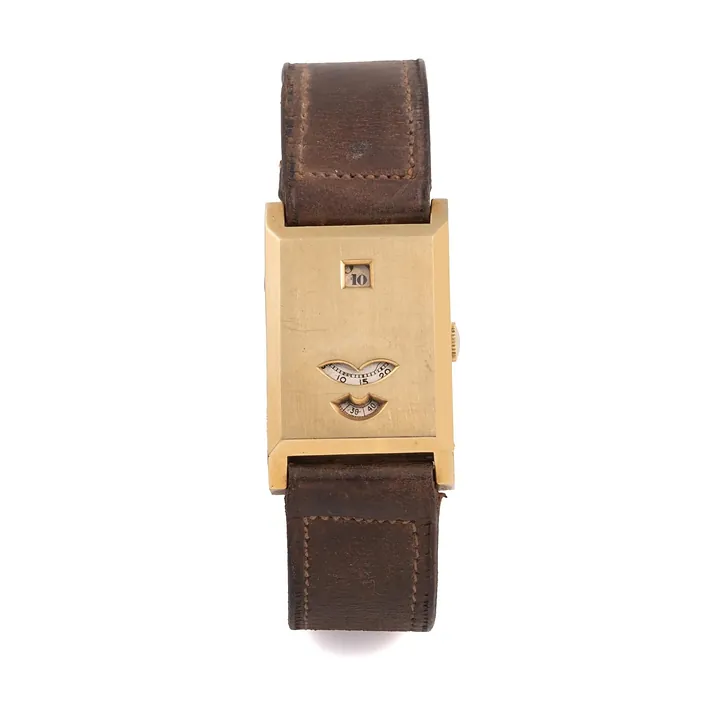
Glycine "jump Hour", c. 1930
Antiquorum auction archive, Geneva
Wristwatches · 1960s
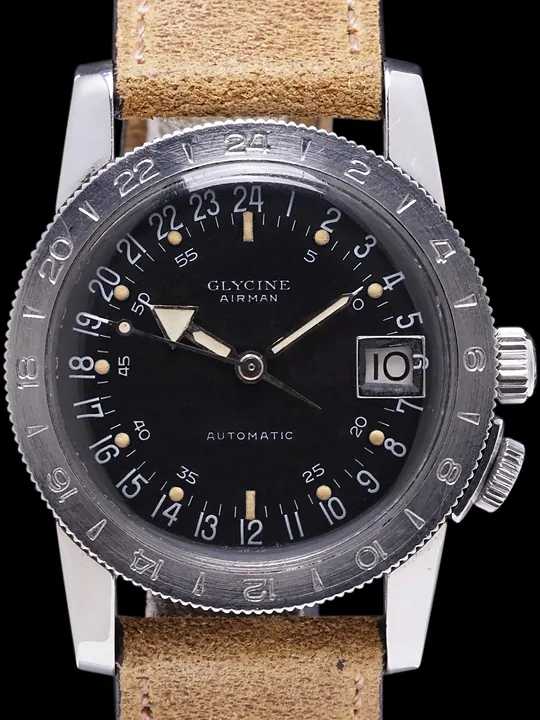
Glycine Airman Automatic, 1960s
Craft & Tailored (dealer), Los Angeles
Wristwatches · 1969
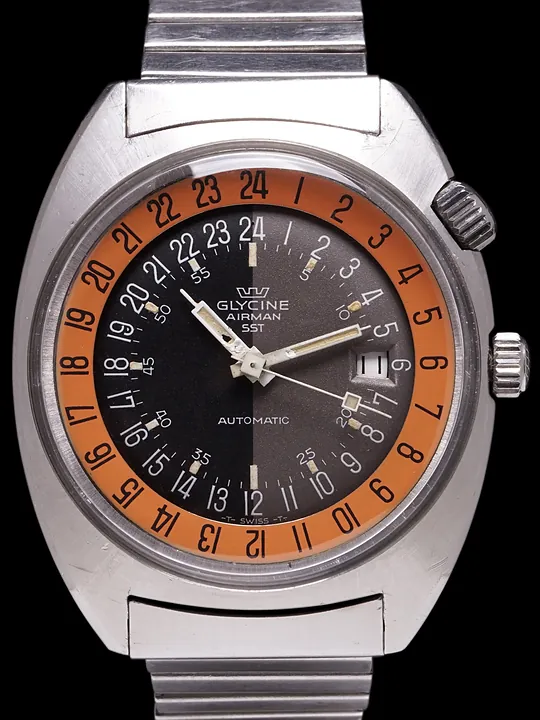
Glycine Airman SST 24Hr "Pumpkin", 1969
Craft & Tailored (dealer), Los Angeles
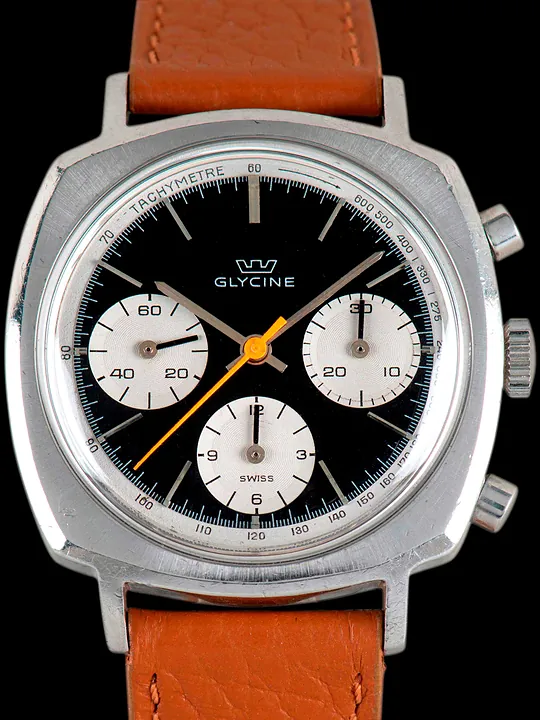
Wristwatches · 1960s
Glycine "Camaro" Chronograph (Ref. 85007) "Valjoux Cal. 72", 1960s
Craft & Tailored (dealer), Los Angeles

Wristwatches · 1970
Wristwatch by Heno, Switzerland, 1970
Museum Rotterdam
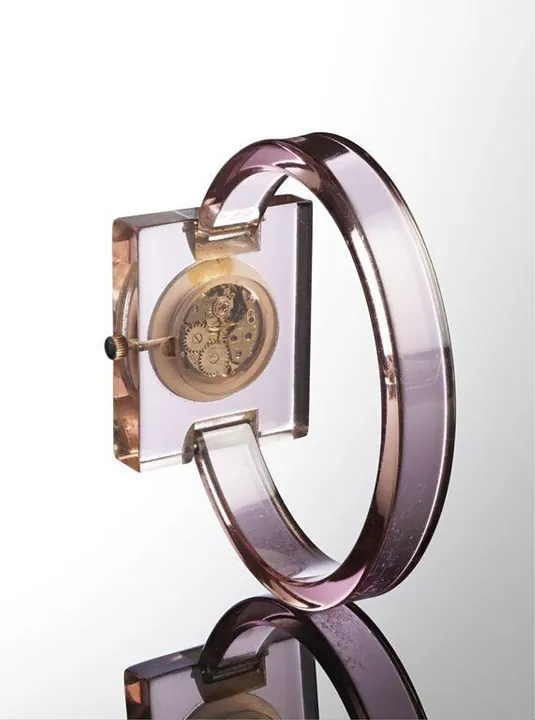
Wristwatches · 1970s
Wristwatch, plastic, by Gucci; Italy, 1970s.
Victoria and Albert Museum, London
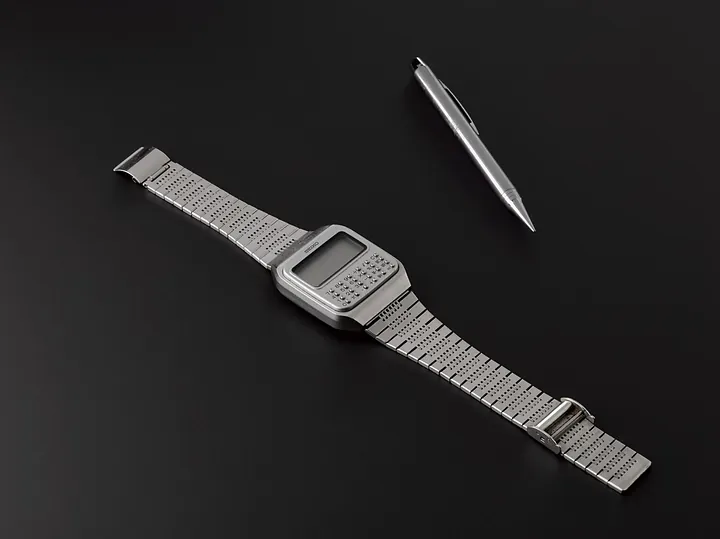
Wristwatches · 1978
Calculator wristwatch by Suwa Seikosha Co. Limited, Japan, 1978
Science Museum Group, London
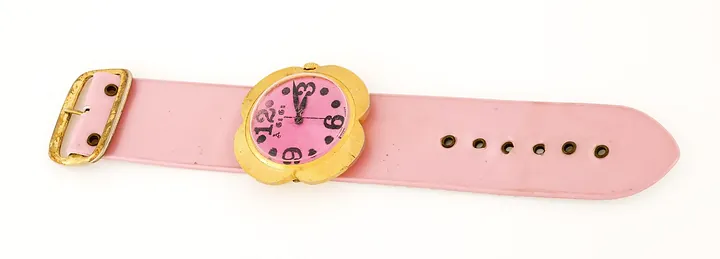
Wristwatches · 1980
Wristwatch, 1980 (no. 71413)
Museum Rotterdam