
Wristwatches · Wristwatch
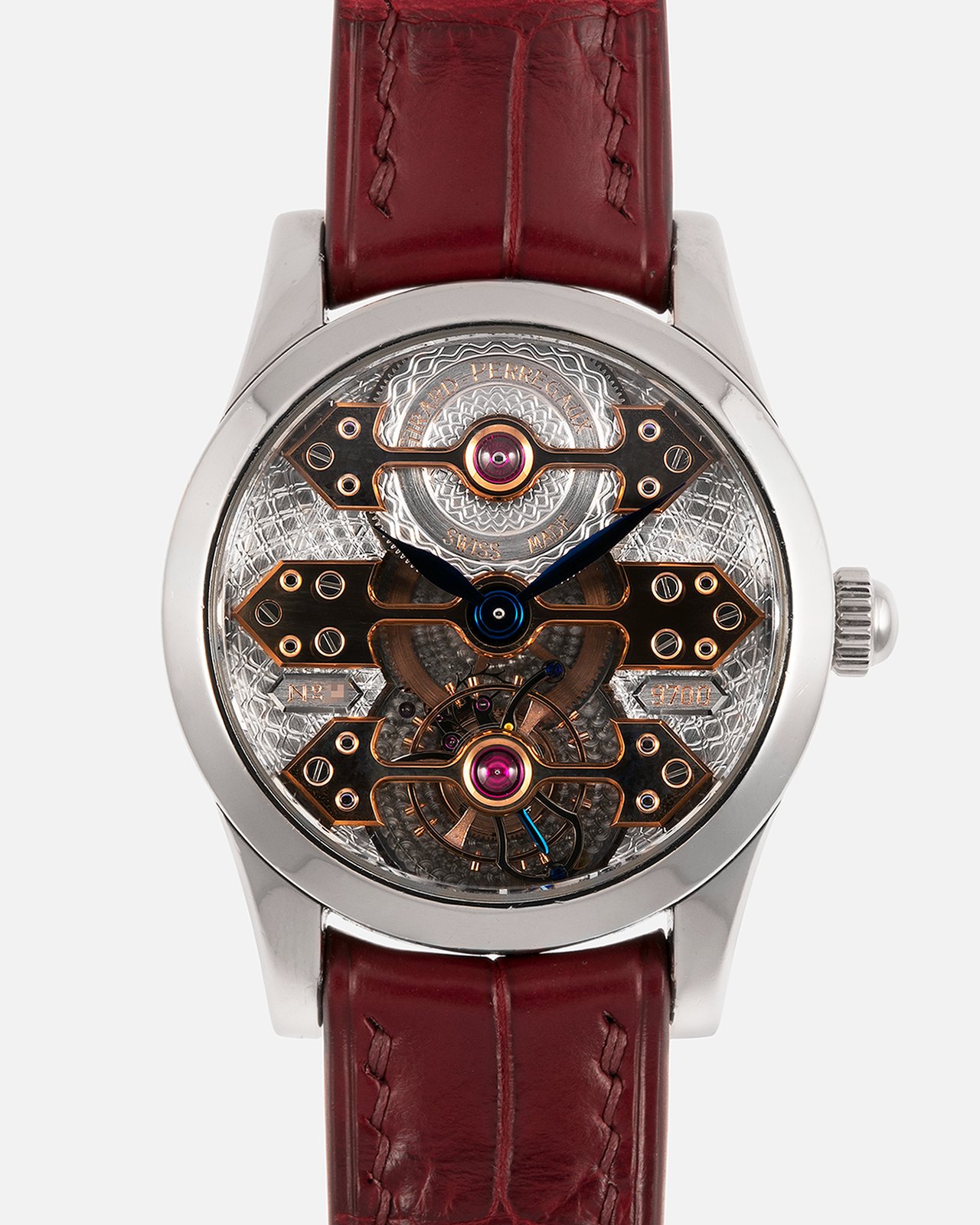
Girard Perregaux Three Bridges Tourbillon 9700 31mm White Gold, late 1990s
- Maker / attribution
- Girard-Perregaux (maker)
- Date
- late 1990s
- Historical period
- Mechanical Renaissance (1990 – 2010)
- Country of origin
- Switzerland
- Object type
- Wristwatch
- Materials / technique
- white gold
- Dimensions
- Case 31 mm
- Stock no.
- Product 7739310506071
- Credit line
- Dealer listing, S.Song Watches (product 7739310506071)
- Catalogue title (original)
- Girard Perregaux Three Bridges Tourbillon 9700 31mm White Gold (English)
View the source record (dealer listing) ↗ (opens another website in a new tab)Suggest a correction
Record summary
Catalogued by S.Song Watches (dealer), Seattle (stock number Product 7739310506071), this is a wristwatch by Girard-Perregaux, made in Switzerland, dated late 1990s. The Atlas places it in the Mechanical Renaissance period (1990 – 2010) of its Wristwatches collection. Materials and techniques recorded by the source: white gold. Recorded dimensions: Case 31 mm. The record is illustrated with 6 photographs.
Assembled from the source record's structured fields. Dates and attributions are given as the source states them; where a field is missing the Atlas leaves it blank rather than estimating.
Catalogue description
Dealer description — S.Song Watches
One of the oldest and most historically important names in Swiss watchmaking, Girard-Perregaux has been responsible for many incredible watches over its long history, but none is more emblematic of the brand than the Tourbillon Sous Trois Ponts d'Or, or Tourbillon with Three Gold Bridges. The origins of the Three Bridges date back to the 1860s, when Constant Girard began experimenting with tourbillon pocket watches featuring three parallel bridges. Rather than hiding these structural components beneath the dial, Girard turned them into a defining part of the watch itself, arranging the barrel, gear train and tourbillon vertically beneath three distinctive arrow-shaped bridges. The concept would become one of the most recognisable movement architectures in watchmaking and remains a signature of Girard-Perregaux more than 150 years later. Here, we have a particularly unusual execution in the form of the Ref. 9700, housed in an 18-carat white gold case measuring just 31mm. While 31mm sounds incredibly small by today's standards, there is something rather charming about fitting a complication as prestigious as a tourbillon into such a diminutive case. It is unapologetically a product of its era and, despite the dimensions, the open construction and long sculpted lugs give the watch considerably more presence than one might expect. The dial, if you can call it that, is undoubtedly the highlight. Three beautifully finished pink gold bridges run vertically across the watch, holding the barrel at 12 o'clock, the central wheel in the middle and the tourbillon at 6. Contrasting against the white gold case and intricate silver-coloured guilloché work beneath, the warm bridges, exposed ruby jewels and heat-blued hands create an incredible mixture of colours, textures and depth. Despite having virtually no conventional dial at all, the entire composition remains wonderfully symmetrical and balanced. Powering the watch is Girard-Perregaux's manual-winding Cal. T3P, with the three bridges forming an integral structural part of the movement rather than simply serving as decoration. This is what I have always loved about the Three Bridges. The movement is the dial and the dial is the movement, with almost every important mechanical component proudly displayed from the front. Rarity is another interesting aspect of the Ref. 9700. While I have never seen a reliable production figure published for the reference, these watches appear extremely infrequently, particularly in white gold. It is also difficult to imagine that Girard-Perregaux sold very many 31mm, precious metal, high-complication tourbillons during this period. While I wouldn't put a number on it without evidence, everything about the watch suggests production was extremely small. For me, the Ref. 9700 is one of the more charming and unusual interpretations of Girard-Perregaux's most important complication. At just 31mm, it is certainly not for everyone, but that is also exactly what makes it interesting. With its white gold case, contrasting pink gold bridges, intricate guilloché work and one of the most historically significant movement architectures in watchmaking, there is very little else quite like it.
Historical context
Mechanical Renaissance (1990 – 2010)
Mechanical watches return as cultural objects; independent watchmaking flourishes.
Mechanical watches returned as cultural and luxury objects. Complications, tourbillons and new materials proliferated; independent watchmakers such as George Daniels, F.P. Journe and Philippe Dufour revived artisanal watchmaking; collecting vintage watches became a major field.
Read the period in the timelineMore wristwatches from this periodEarlier: Quartz Revolution
Atlas type guide
Wristwatches
Bracelet watches were worn by women from the early nineteenth century — Breguet made one for Caroline Murat, Queen of Naples, in 1810–12 — but the wristwatch only became a man's instrument with military use and aviation in the early twentieth century. Between the World Wars it overtook the pocket watch; the 1920s and 1930s brought rectangular Art Deco cases, water-resistant cases and the first automatic winding systems.
After 1945 the wristwatch became a carrier of identity — dress watches, sports and dive watches, chronographs, calendars — produced by Swiss, American, Japanese, German, Soviet and Chinese industries. The quartz revolution after 1969 and the mechanical renaissance since the 1990s, including the rise of independent watchmakers, complete the story.
What to look for
- The reference number (between the lugs or inside the case back) and serial number, the starting point for dating.
- The calibre: its maker and number are often stamped under the dial or on the bridge.
- Originality of dial, hands and crown — refinished ('redial') dials are common.
- Case material marks: 18K/750, 14K/585, stainless steel, gold-filled, plated.
Dating clues
- Wire-lug cases: before c. 1925.
- Water-resistant screw-down cases: from 1926.
- Quartz movements: from 1969; sapphire crystals widespread after c. 1980.
General guidance written by the Atlas editors about this kind of object. It is not a statement about this particular piece; for that, rely on the source record above and on physical examination.
Related records
Wristwatches · 1970s
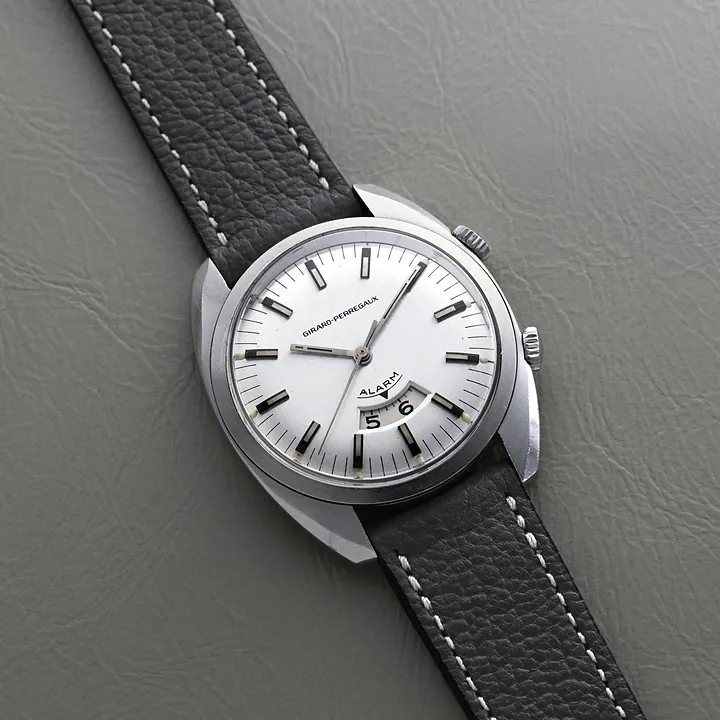
Girard Perregaux Alarm, 1970s
Analog/Shift (dealer), New York
Wristwatches · 1960s
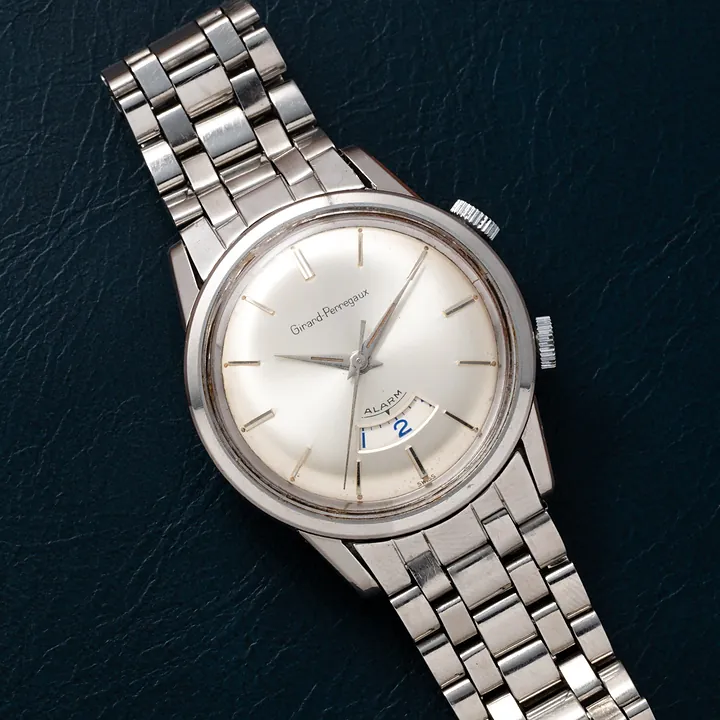
Girard Perregaux Alarm, 1960s
Analog/Shift (dealer), New York
Wristwatches · c. 1940s
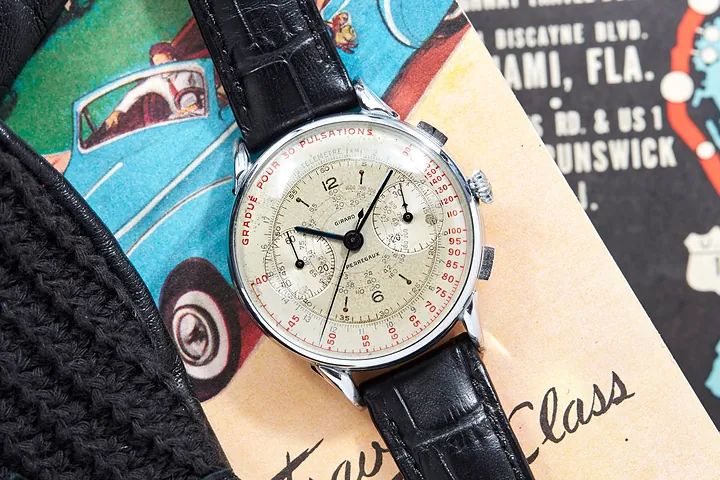
Girard-Perregaux Pulsations Chronograph, c. 1940s
Analog/Shift (dealer), New York
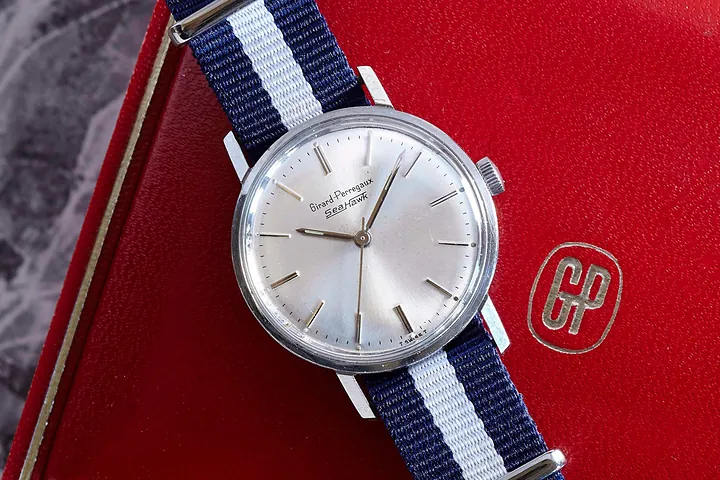
Wristwatches · 1960
Girard-Perregaux Seahawk, 1960
Analog/Shift (dealer), New York

Wristwatches · 2008
Wristwatch by Breitling?, 2008
Museum Rotterdam

Wristwatches · c. 1990s
Audemars Piguet Bamboo, c. 1990s
Antiquorum auction archive, Geneva

Wristwatches · c. 1990
Audemars Piguet Huitieme Perpetual Calendar, ref. 25696PT, c. 1990
Antiquorum auction archive, Geneva

Wristwatches · c. 1990
Breitling Chronomat, ref. b13050.1, c. 1990
Antiquorum auction archive, Geneva