
Wristwatches · Wristwatch
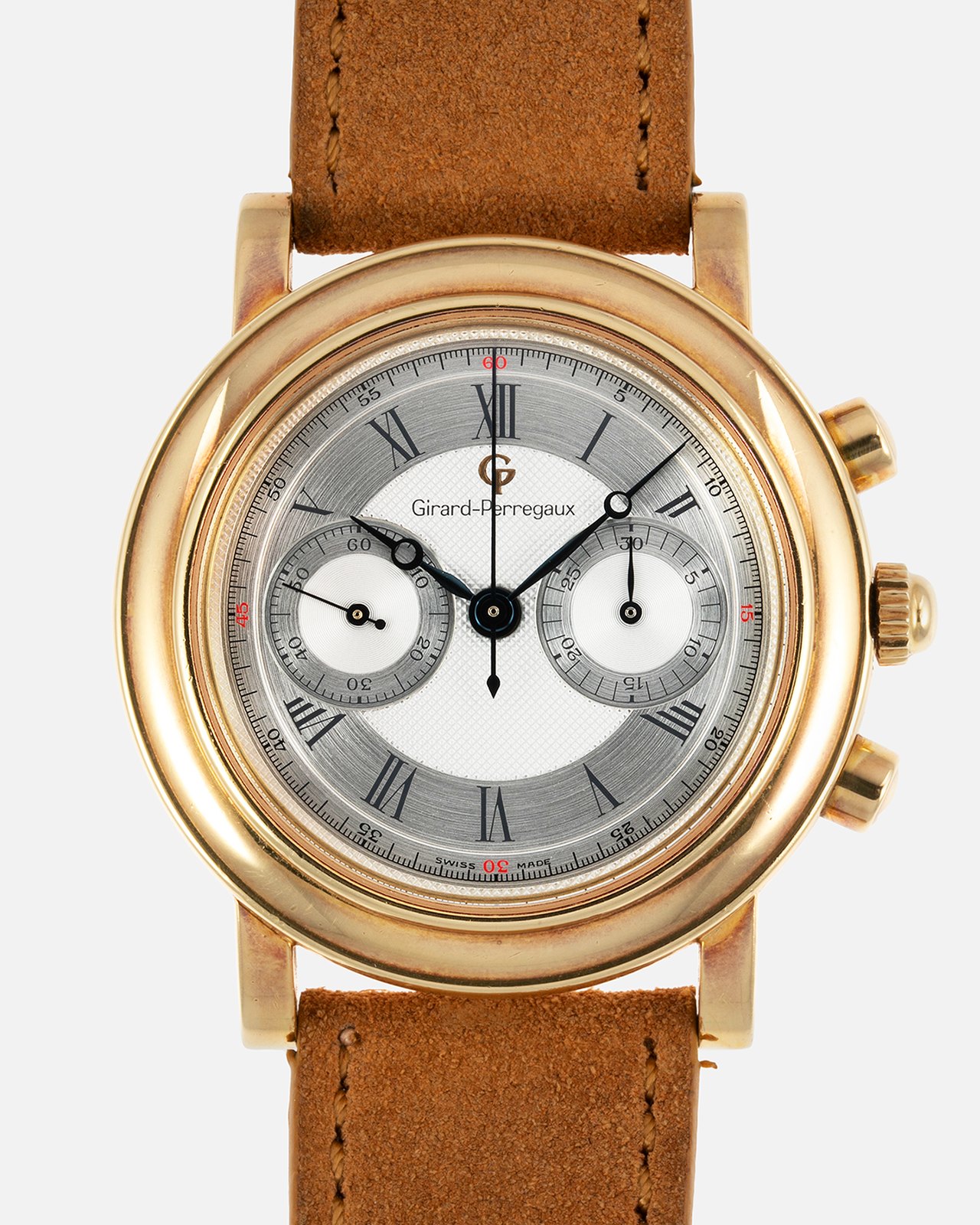
Girard Perregaux Chronograph Lemania 47930, 1990s
- Maker / attribution
- Girard-Perregaux (maker)
- Date
- 1990s
- Historical period
- Mechanical Renaissance (1990 – 2010)
- Country of origin
- Switzerland
- Object type
- Wristwatch
- Dimensions
- Case 38 mm
- Stock no.
- Product 6847199445079
- Credit line
- Dealer listing, S.Song Watches (product 6847199445079)
- Catalogue title (original)
- Girard Perregaux Chronograph Lemania 47930 (English)
View the source record (dealer listing) ↗ (opens another website in a new tab)Suggest a correction
Record summary
Catalogued by S.Song Watches (dealer), Seattle (stock number Product 6847199445079), this is a wristwatch by Girard-Perregaux, made in Switzerland, dated 1990s. The Atlas places it in the Mechanical Renaissance period (1990 – 2010) of its Wristwatches collection. Recorded dimensions: Case 38 mm. The record is illustrated with 6 photographs.
Assembled from the source record's structured fields. Dates and attributions are given as the source states them; where a field is missing the Atlas leaves it blank rather than estimating.
Catalogue description
Dealer description — S.Song Watches
Girard-Perregaux is one of the oldest fine watchmaking manufactures still in operation in Switzerland today with its origins being traced all the way back to 1791. From a collector’s and enthusiast’s standpoint, vintage / neo-vintage Girard Perregaux remains one of the collecting world’s best-kept secrets. Take this beautiful Girard-Perregaux Chronograph Lemania ref. 47930 in yellow gold for instance- this is a fantastic example of why vintage / neo-vintage Gerard Perregaux is so underrated in today’s collecting landscape. What can I say? This is an absolutely stunning watch, and it is not difficult at all to see why. It comes in a nicely sized 38mm 18-carat yellow gold case, which houses a stunning Cal. 8380-321 that is based on the venerable Lemania 1872 manual-wind chronograph movement made famous by Omega Speedmasters. The entire aesthetic and proportions of this Girard-Perregaux when held in hand and observed from a distance appears to be very well balanced. It is one of those watches that are more than meets the eye, simplistic in overall design yet detailed when examined up close. A glance over the face of the ref. 47930 you will find beneath the sapphire crystal, a two-tone dial with two sub-dials (seconds indicator on the left, and a 30-minute counter on the right) placed at the 3 and 9 o ‘clock respectively, a stunning guilloche center featuring blued hour, minute and chronograph hands, thin and minimal-looking roman numerals, a “Swiss Made” stamp at 6 o ‘clock and multiple red-accented numbers on the minute-track which gives the dial a nice touch of modernity. The bezel on the ref. 47930 is also stepped and domed which lends the watch some dimensionality and depth. The chronograph pushers are slightly rounded and are pleasing to the touch. Given its near-perfect proportions and slightly contoured lugs, this is a watch that would look great on any wrist and pair well with almost any outfit. As far as its history and provenance goes, there is not much information regarding the production of this ref. 47930, except for the fact that it was rumored to have been in production since the early to mid-90s in either stainless steel or yellow gold. Overall, the ref. 47930 offers a great balance in all aspects and possesses all the hallmarks of why neo-vintage watches have made such a comeback. The return to classical elegance is always welcomed here.
Historical context
Mechanical Renaissance (1990 – 2010)
Mechanical watches return as cultural objects; independent watchmaking flourishes.
Mechanical watches returned as cultural and luxury objects. Complications, tourbillons and new materials proliferated; independent watchmakers such as George Daniels, F.P. Journe and Philippe Dufour revived artisanal watchmaking; collecting vintage watches became a major field.
Read the period in the timelineMore wristwatches from this periodEarlier: Quartz Revolution
Atlas type guide
Chronographs and split-seconds watches
A chronograph is a watch with an additional seconds hand that can be started, stopped and returned to zero independently of the timekeeping. Louis Moinet built an early example in 1816 and Nicolas Rieussec a recording 'chronographe' in 1821; Adolphe Nicole's heart-shaped reset cam (patented 1862) made the modern return-to-zero possible. Split-seconds (rattrapante) chronographs add a second hand that can be stopped for intermediate times; flyback chronographs restart instantly.
Chronographs were essential tools for doctors (pulsometer scales), artillery (telemeter), engineers and sport. In wristwatches, Valjoux, Venus, Lemania and later the automatic chronographs of 1969 (Zenith El Primero, the Chronomatic Calibre 11 group and Seiko 6139) are milestones.
What to look for
- Push-pieces on the case band or a single button in the crown (monopusher).
- Subsidiary registers for minutes and hours; tachymeter, telemeter or pulsometer scales.
- Column wheel versus cam control visible in the movement.
- Calibre markings of specialist makers (Valjoux, Lemania, Venus, Landeron).
Dating clues
- Pocket chronographs with heart cam reset: after 1862.
- Wrist chronographs: from c. 1910; two-button designs from the 1930s.
- Automatic chronographs: from 1969.
General guidance written by the Atlas editors about this kind of object. It is not a statement about this particular piece; for that, rely on the source record above and on physical examination.
Read next:Flyback chronographChronograph
Related records
Wristwatches · 1970s
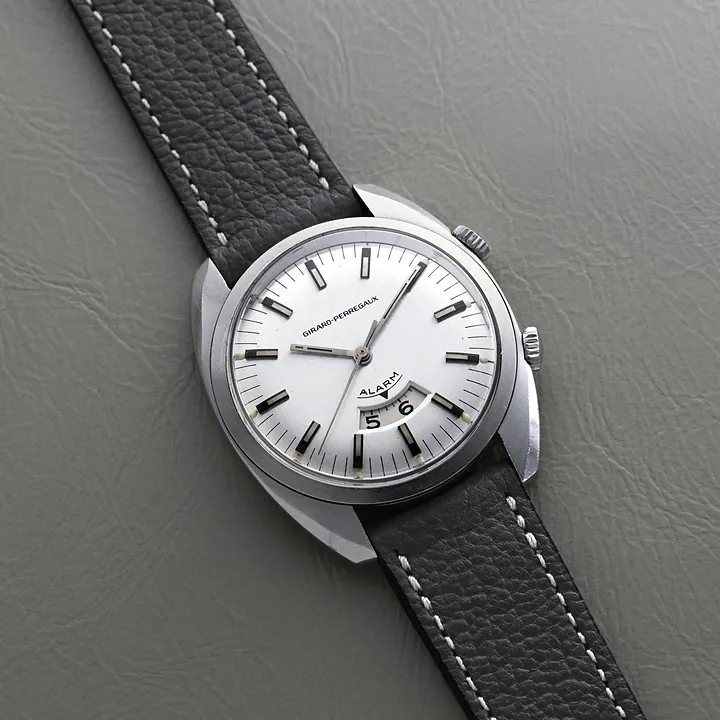
Girard Perregaux Alarm, 1970s
Analog/Shift (dealer), New York
Wristwatches · 1960s
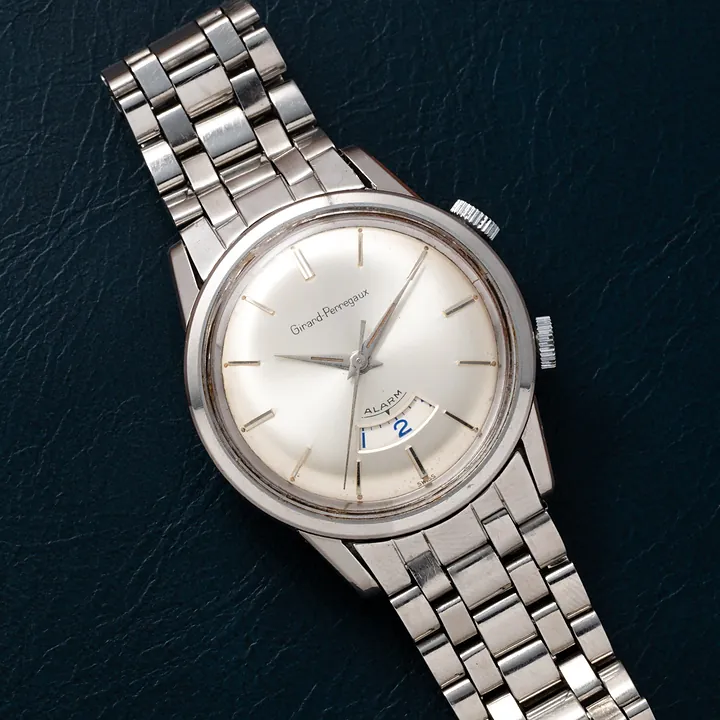
Girard Perregaux Alarm, 1960s
Analog/Shift (dealer), New York
Wristwatches · c. 1940s
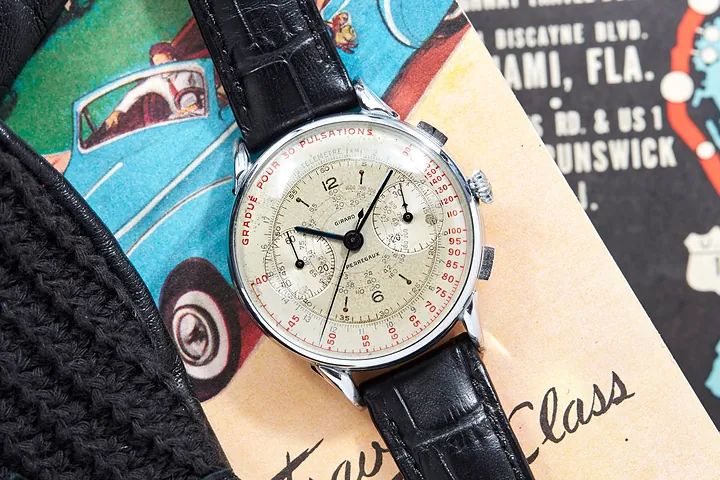
Girard-Perregaux Pulsations Chronograph, c. 1940s
Analog/Shift (dealer), New York
Wristwatches · 1960
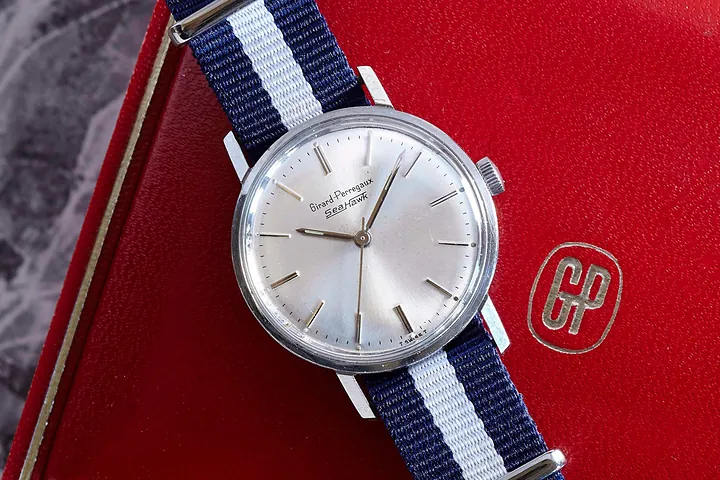
Girard-Perregaux Seahawk, 1960
Analog/Shift (dealer), New York

Wristwatches · 2008
Wristwatch by Breitling?, 2008
Museum Rotterdam

Wristwatches · c. 1990s
Audemars Piguet Bamboo, c. 1990s
Antiquorum auction archive, Geneva

Wristwatches · c. 1990
Audemars Piguet Huitieme Perpetual Calendar, ref. 25696PT, c. 1990
Antiquorum auction archive, Geneva

Wristwatches · c. 1990
Breitling Chronomat, ref. b13050.1, c. 1990
Antiquorum auction archive, Geneva