
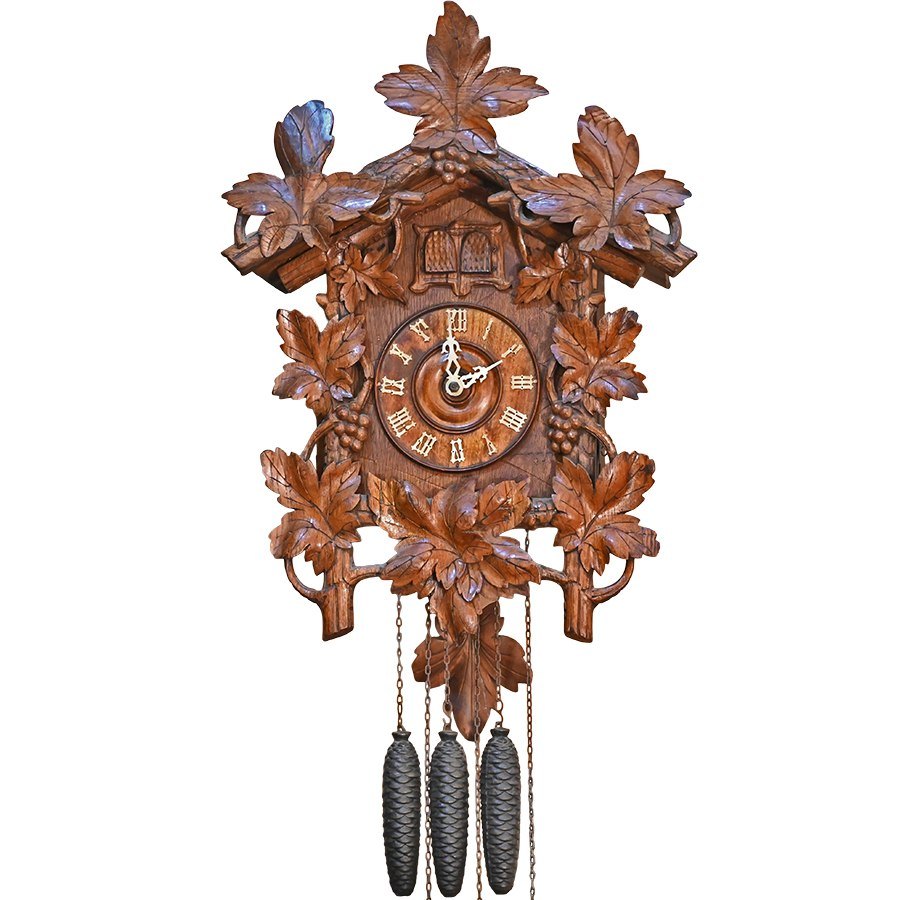
Clocks · Cuckoo and quail wall clock
German Black Forest Cuckoo and Quail Clock
- Maker / attribution
- Unrecorded in source
- Date
- c. 1880
- Historical period
- Industrial Revolution (1850 – 1900)
- Country of origin
- Germany
- Object type
- Cuckoo and quail wall clock
- Materials / technique
- Oak
- Dimensions
- 28″ High x 18″ Wide x 9″ Deep
- Holding institution
- Renaissance Antiques
- Accession / object no.
- RALF 36 P
- Credit line
- Renaissance Antiques
- Catalogue title (original)
- German Black Forrest Cuckoo and Quail Clock - Renaissance Antiques (English)
View the source record ↗ (opens another website in a new tab)Suggest a correction
Record summary
Held and catalogued by Renaissance Antiques (object number RALF 36 P), this is a cuckoo and quail wall clock, made in Germany, dated c. 1880. The Atlas places it in the Industrial Revolution period (1850 – 1900) of its Clocks collection. Materials and techniques recorded by the source: Oak. Recorded dimensions: 28″ High x 18″ Wide x 9″ Deep. The record is illustrated with 1 photograph.
Assembled from the source record's structured fields. Dates and attributions are given as the source states them; where a field is missing the Atlas leaves it blank rather than estimating.
Catalogue description
Original object description
Dating to circa 1880 according to source documentation, this Black Forest clock from Germany is housed in a hand-sculpted oak case decorated with leafy branches and berry clusters. Carved bone Roman numerals mark the wooden dial. The clock's movement triggers a quail call every fifteen minutes, while at each full hour, internal bellows and chimes sound as the cuckoo steps out from the front alongside the quail call and a striking gong. Drive power is provided by three chain-hung weights shaped like pinecones, suspended beside a carved wooden pendulum bob.
Original object description
Presented in source records as an example of late 19th-century horology from the German Black Forest (around 1880), the timepiece is encased in a hand-carved oak chalet measuring 28 inches tall, 18 inches wide, and 9 inches deep. Low-relief carvings representing berries, twigs, and oak foliage frame the cabinet. Three cast weights modeled as pinecones hang from drive chains at the bottom, positioned in front of a pendulum fitted with a leaf-carved bob. The upper facade includes a pair of small doors that open for the automated birds.
Original object description
A wooden chapter ring inlaid with carved bone Roman numerals constitutes the dial, where centrally mounted pale hands indicate the time. Positioned directly over the dial are two apertures containing the automaton figures. Based on seller accounts, the quail mechanism activates at fifteen-minute intervals, whereas the cuckoo emerges from its portal at the top of each hour to strike and call.
Original object description
The sound is generated internally by two small bellows for the cuckoo call, functioning in concert with an hourly counting gong strike, as reported in the source material. A set of three chains hangs downward to support the pinecone weights. The seller reports that a comprehensive restoration was carried out; however, specific caliber identification, maker hallmarks, movement imagery, and technical condition documentation are not present in the record, leaving the builder's identity and mechanical state unverified.
Historical context
Industrial Revolution (1850 – 1900)
American interchangeable-parts manufacture; railroad time standards; Swiss and German factory systems.
Factory production transformed the clock into an everyday object. American makers (Seth Thomas, Ansonia, Waterbury) and German factories (Junghans, Gustav Becker, Lenzkirch) sold millions of shelf, wall and alarm clocks worldwide; France produced standardised Paris movements and carriage clocks; electric time distribution began.
Read the period in the timelineMore clocks from this periodEarlier: Precision & Scientific Horology
Atlas type guide
Regulators, wall and Vienna clocks
A regulator is a precision pendulum clock used as a time standard in observatories, workshops and railway offices. Typical features are a deadbeat or Graham escapement, a temperature-compensated pendulum (mercury jar, gridiron or later invar), maintaining power and a regulator dial that separates hours, minutes and seconds. George Graham's deadbeat escapement (c. 1715) and his mercury pendulum, together with Harrison's gridiron, set the pattern for two centuries.
Wall clocks span a much wider range: the elegant Viennese Laterndluhr and Dachluhr of the Biedermeier period, the Dutch stoelklok and staartklok, English 'dial' clocks used in schools, offices and railway stations, and mass-produced spring and weight wall clocks from Germany (Gustav Becker, Junghans, Kienzle) and America.
What to look for
- Deadbeat escapement and compensated pendulum (gridiron rods, mercury jar or wood rod).
- A regulator dial with a large central minute hand and separate hour and seconds dials.
- Vienna regulators: glazed cases, slender pendulum, small weights, enamel two-piece dials.
- German factory trademarks stamped on the backplate (e.g. Gustav Becker anchor and crown, Junghans star).
Dating clues
- Graham-type deadbeat regulators: from c. 1720.
- Viennese Laterndluhr: c. 1800–1850.
- German factory 'Vienna-style' regulators: c. 1870–1930; Gustav Becker serial numbers allow close dating.
General guidance written by the Atlas editors about this kind of object. It is not a statement about this particular piece; for that, rely on the source record above and on physical examination.
Read next:Deadbeat escapementAnchor (recoil) escapementGrasshopper escapement
Related records
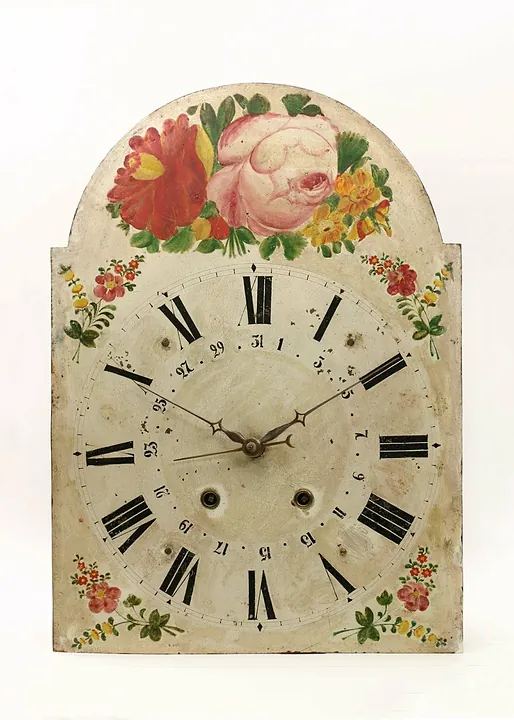
Clocks · c. 1850
Cuckoo / black forest clock, Germany, c. 1850
German Clock Museum
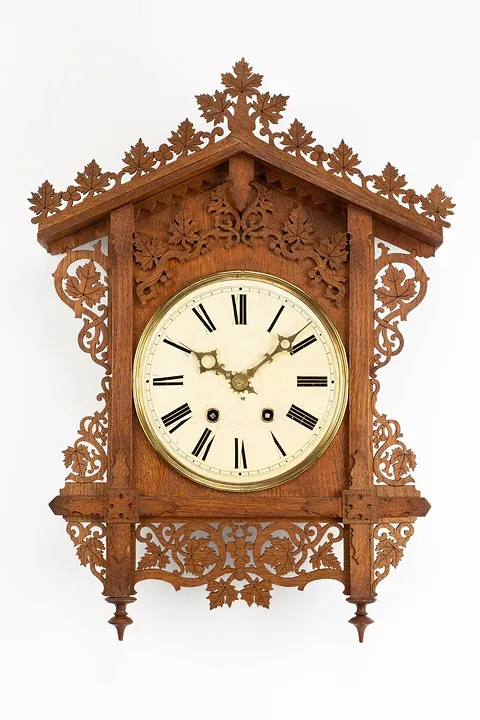
Clocks · 1850
Wall clock by Glatz und Co. Kreuzer, Germany, 1850
German Clock Museum
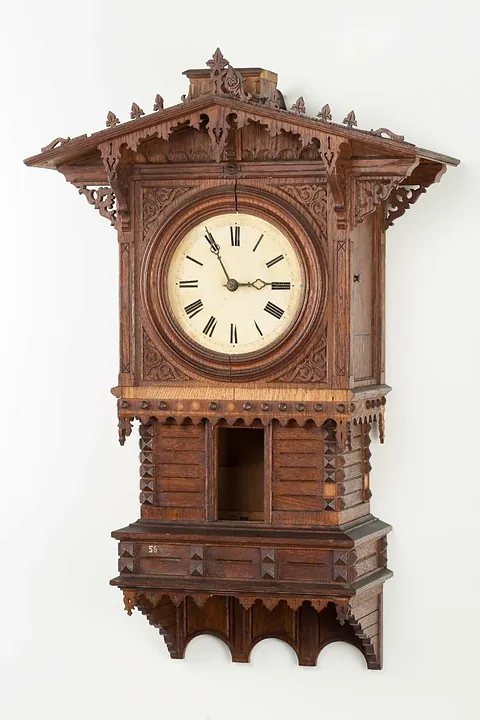
Clocks · 1858
Clock by Jacob Bäuerle, Germany, 1858
German Clock Museum
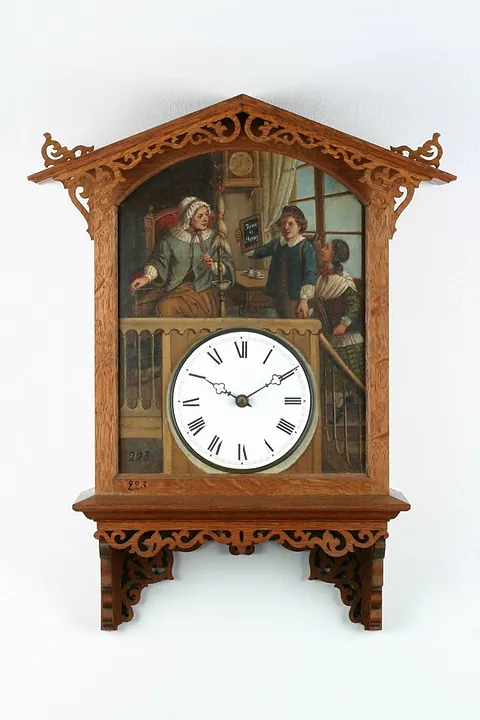
Clocks · 1860
Clock by August Tritschler, Germany, 1860
German Clock Museum
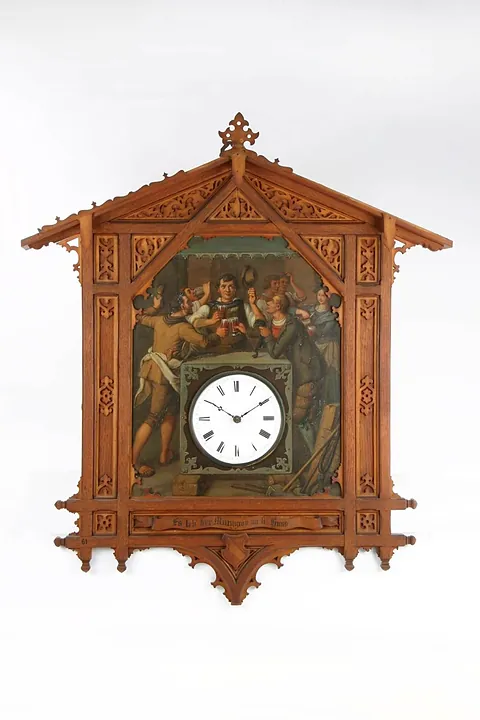
Clocks · 1860
Clock by Großherzoglich Badische Uhrmacherschule, Germany, 1860
German Clock Museum
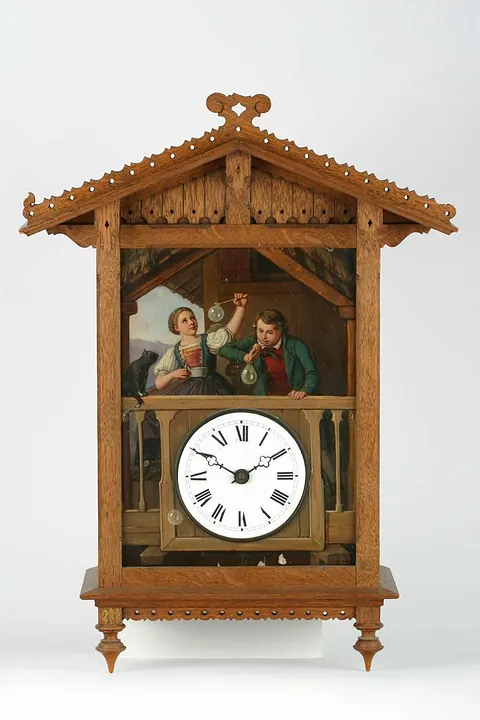
Clocks · c. 1860
Clock by Heinrich Frank, Germany, c. 1860
German Clock Museum
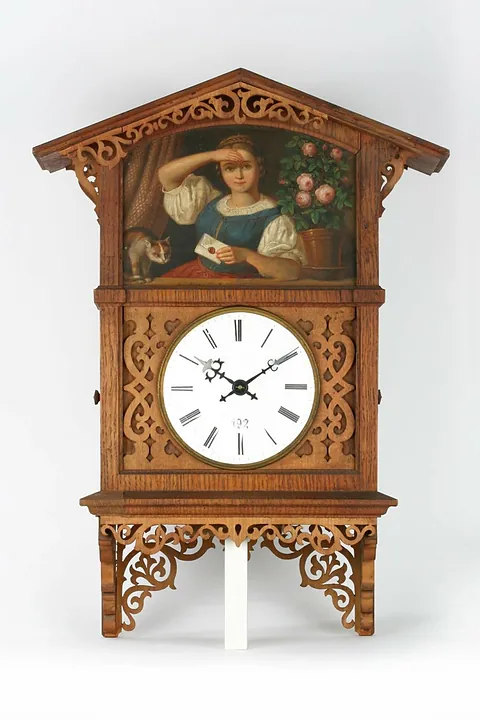
Clocks · c. 1860
Clock by M. Schuhmacher, Germany, c. 1860
German Clock Museum

Clocks · c. 1860
Clock by Martens und Cie., Germany, c. 1860 (no. 57930)
German Clock Museum