
Pocket Watches · Cabriolet pendant watch
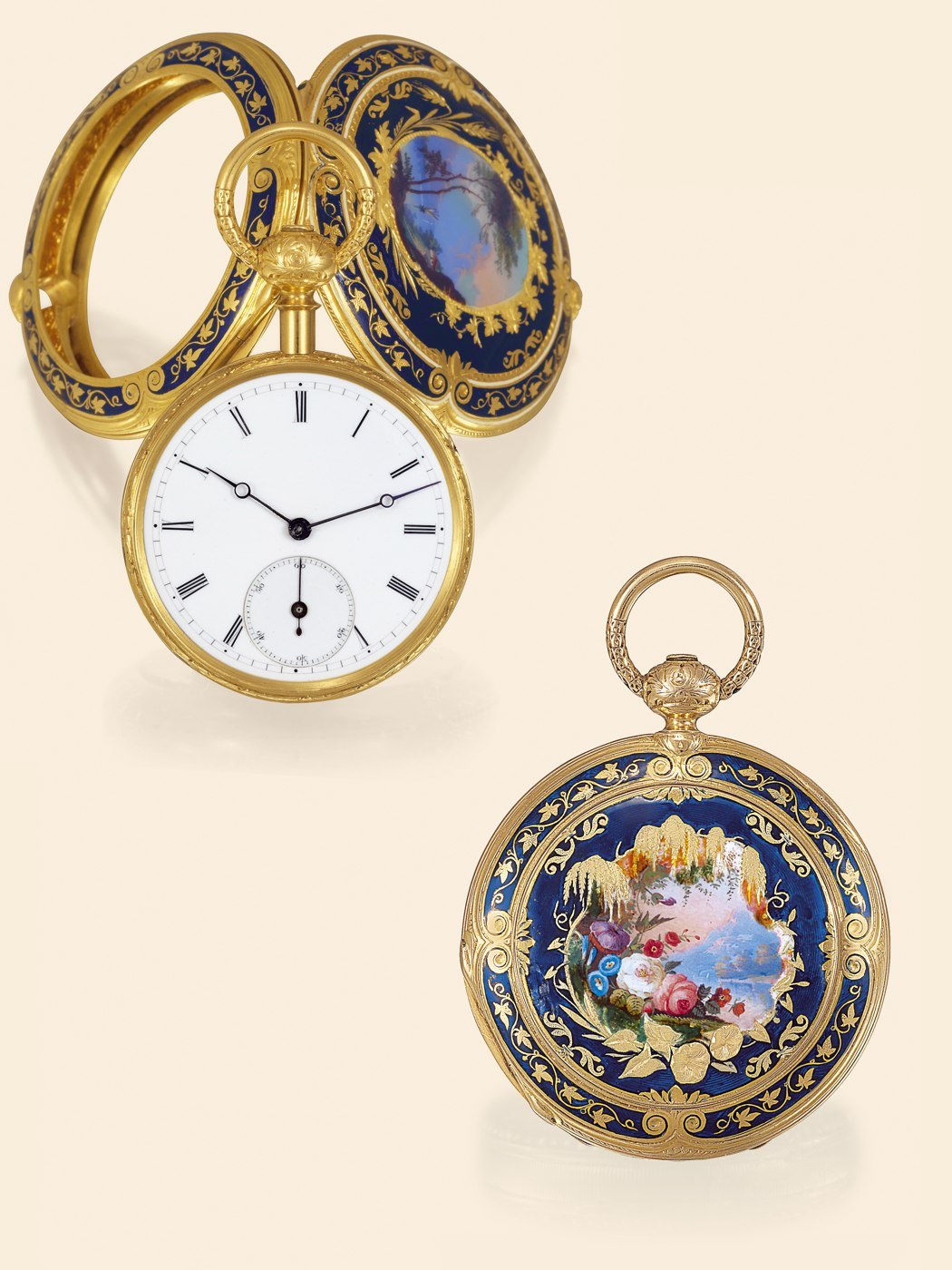
Fritz Courvoisier Cabriolet Lady's Pendant Watch
- Maker / attribution
- Fritz Courvoisier (source attribution)
- Date
- c. 1850
- Historical period
- Industrial Revolution (1850 – 1900)
- Country of origin
- Switzerland
- Object type
- Cabriolet pendant watch
- Materials / technique
- 18K gold
- Dimensions
- 43 mm
- Holding institution
- Antiquorum
- Accession / object no.
- 143
- Credit line
- Antiquorum
- Catalogue title (original)
- 'Alpine Landscape'\nFritz Courvoisier, Locle, No. 14263. Made\ncirca 1850.\nFine and rare, 18K gold and painted on enamel cabriolet\nlady's pendant watch. (English)
View the source record ↗ (opens another website in a new tab)Suggest a correction
Record summary
Held and catalogued by Antiquorum (object number 143), this is a cabriolet pendant watch attributed to Fritz Courvoisier, made in Switzerland, dated c. 1850. The Atlas places it in the Industrial Revolution period (1850 – 1900) of its Pocket Watches collection. Materials and techniques recorded by the source: 18K gold. Recorded dimensions: 43 mm. The record is illustrated with 1 photograph.
Assembled from the source record's structured fields. Dates and attributions are given as the source states them; where a field is missing the Atlas leaves it blank rather than estimating.
Catalogue description
Original object description
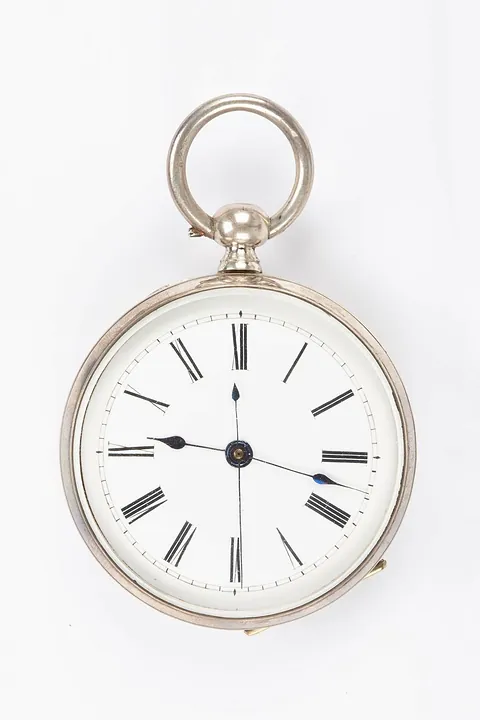
Attributed to Fritz Courvoisier of Le Locle and dating to circa 1850, this 18K gold pendant watch for women is built in a transformable cabriolet configuration. The outer three-piece hinged case is embellished with translucent royal blue enamel, engraved gold leaf sprays, and a central painted oval showing a Swiss landscape. Housed inside, the inner case has a chased foliate bezel, a gold cuvette, and a hinged back enamelled with a floral alpine view. Its white enamel dial incorporates Roman numerals, a peripheral minute track, a bottom subsidiary seconds dial, and blued steel hands in the Breguet style. A frosted gilt bar-type movement operates with 13 jewels, a detached lever escapement, and an un-cut bimetallic compensation balance. Matching serial numbers are struck throughout the case elements and the signed cuvette.
Case Construction and Enamelwork
Constructed with a two-part cabriolet case system, the watch features an outer three-piece hinged shell ornamented with gold vines, white enamel accents, translucent royal blue enamel, and an enameled scenic medallion of a Swiss vista. The inner case displays chased foliage on its bezel, while the rear cover is decorated with a flower-filled alpine scene framed by royal blue and gold enamel. A hinged gold cuvette protects the caliber within.
Movement and Dial Details
The watch is driven by a frosted gilt bar-caliber movement equipped with 13 jewels, an index regulator, an uncut bimetallic balance, a blued steel flat balance spring, and a detached lever escapement. The cuvette is engraved with the maker's signature and serial numbers. Under condition review, the white enamel dial displays Roman hour chapters, a minute ring, a low-set subsidiary seconds counter, and blued steel Breguet hands described as original.
Provenance and Condition Reporting
Under the identical serial and reference numbers, this piece was catalogued as lot 29 in an Antiquorum auction in February 2005. The sale catalogue rated the overall condition as 'AA' ('Very Good'), with individual assessments of 'Good' (3-01) for the dial, 'Good' (3-55) for the case, and 'Good' (3*) for the mechanism.
Inscriptions & marks
14263
Historical context
Industrial Revolution (1850 – 1900)
American interchangeable-parts manufacture; railroad time standards; Swiss and German factory systems.
Machine production with interchangeable parts, pioneered by Waltham (1850s) and adopted by Elgin, Longines, Omega and others, made reliable lever watches widely affordable. Keyless winding became standard, railroad watch standards were introduced (1890s), and Swiss and American industries competed globally.
Read the period in the timelineMore pocket watches from this periodEarlier: Precision & Scientific Horology
Atlas type guide
Early spring-driven watches
Portable spring-driven timepieces appeared in southern Germany, France and Italy in the early sixteenth century; Peter Henlein of Nuremberg is traditionally credited, although the historical record is complex. These early watches were worn as pendants or carried, had iron or brass movements with a verge escapement and a foliot or small balance, and used a stackfreed or fusee to equalise spring force. They indicated hours only and were notoriously inaccurate.
From the later sixteenth century watches were made in Blois, Paris, Geneva, London and Augsburg in oval, octagonal, cruciform, skull and other 'form' cases of rock crystal, gilt brass, silver and enamel. They were jewellery and status objects as much as timekeepers.
What to look for
- A single hour hand and often a touch-pin hour ring for feeling the time.
- Stackfreed (a cam and spring) instead of a fusee on German watches.
- Pierced and engraved cocks over the balance, fine gut fusee lines.
- Rock-crystal, enamelled or engraved form cases.
Dating clues
- Drum-shaped German watches: c. 1530–1580.
- Oval and form watches: c. 1580–1650.
- Before c. 1675 there is no balance spring; watches can vary by many minutes a day.
General guidance written by the Atlas editors about this kind of object. It is not a statement about this particular piece; for that, rely on the source record above and on physical examination.
Related records
Pocket Watches · c. 1850
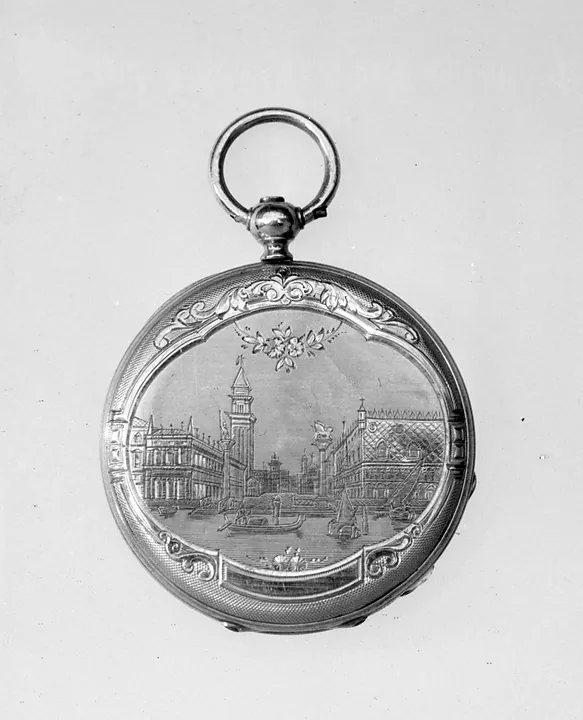
Watch by Eugène Bornand, Switzerland, c. 1850
The Metropolitan Museum of Art, New York
Pocket Watches · probably c. 1850–55
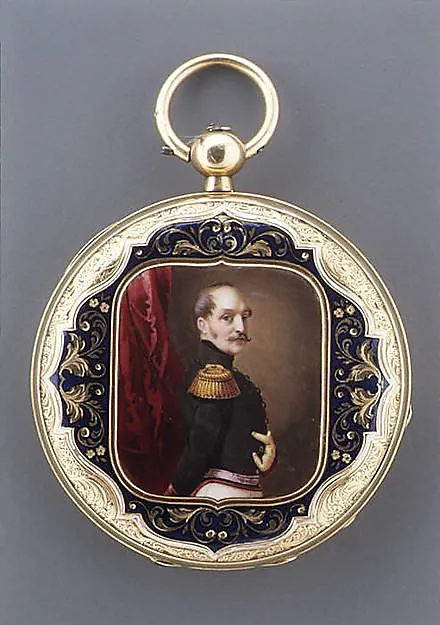
Watch by Firm of Perret & Cie, Switzerland, probably c. 1850–55
The Metropolitan Museum of Art, New York
Pocket Watches · c. 1850–55
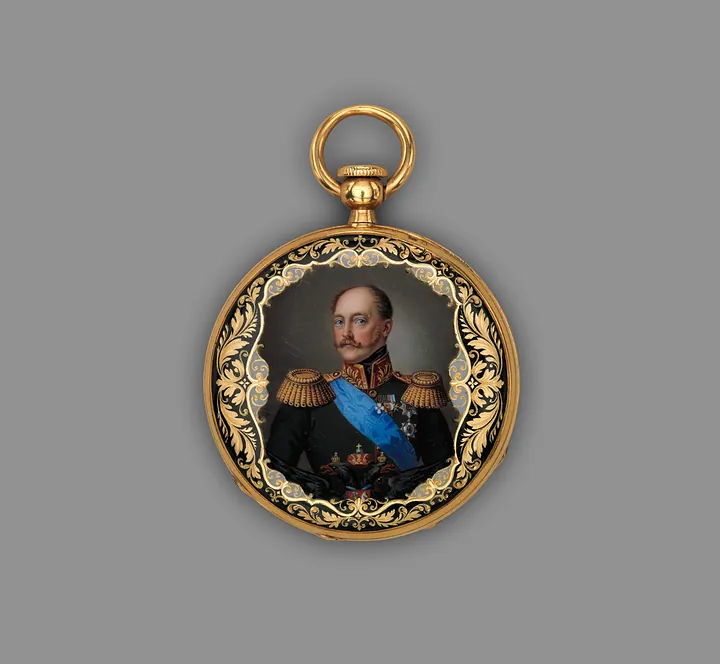
Watch by François Czapek, c. 1850–55
The Metropolitan Museum of Art, New York
Pocket Watches · c. 1850
Pocket watch by D Bachelard et Fils, Switzerland, c. 1850
German Clock Museum
Pocket Watches · 1850–1899
Pocket watch by GT, Switzerland, 1850–1899
Science Museum Group, London
Pocket Watches · c. 1850
Pocket watch by Perret et Cie., Switzerland, c. 1850
German Clock Museum
Pocket Watches · c. 1850
Pocket watch, probably Switzerland, c. 1850 (no. 58079)
German Clock Museum
Pocket Watches · c. 1850
Pocket watch, Switzerland, c. 1850 (no. 58081)
German Clock Museum