
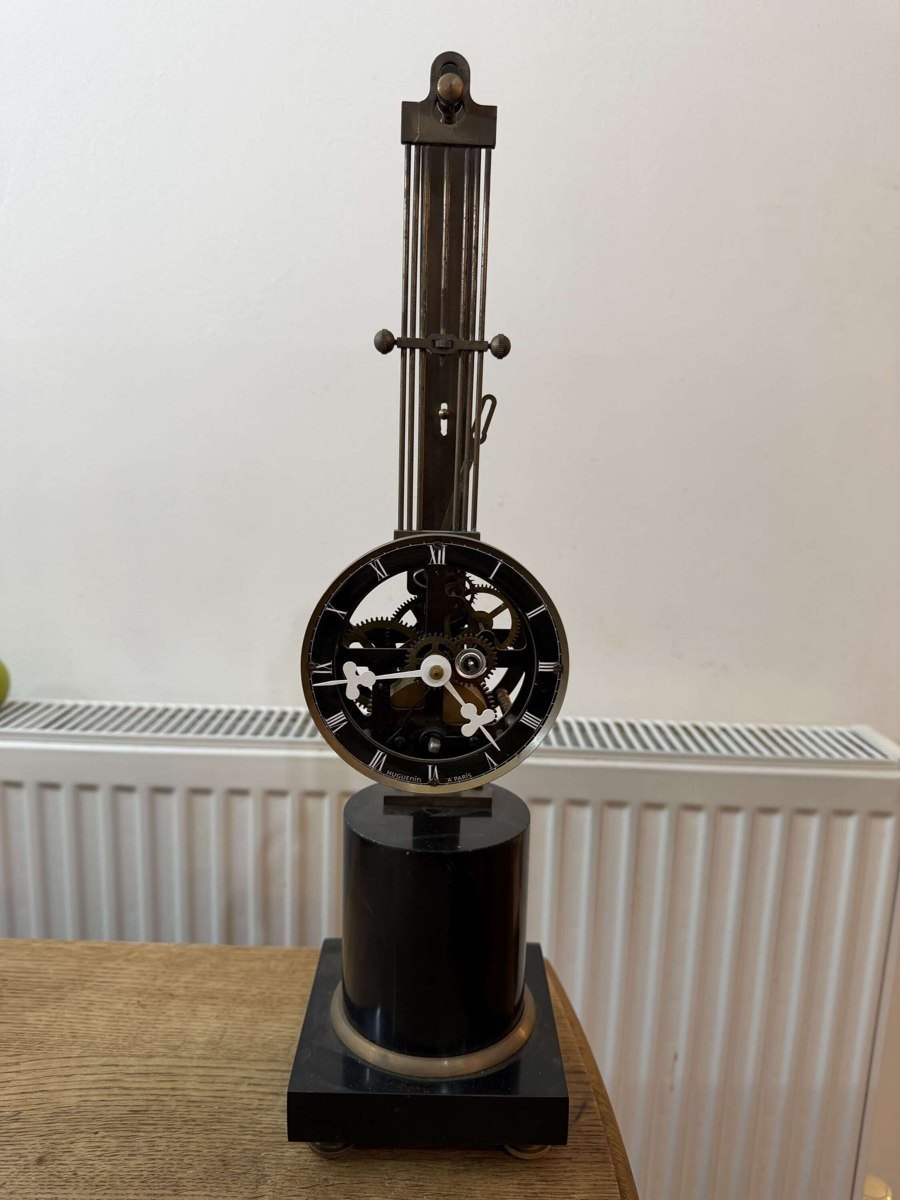
Clocks · Swinging mystery skeleton clock
French Style Mystery Pinwheel Upside Down Skeleton Swinging Clock
- Maker / attribution
- Unrecorded in source
- Date
- Early 20th Century
- Historical period
- Golden Age of Mechanical Watchmaking (1900 – 1945)
- Country of origin
- Unrecorded in source
- Object type
- Swinging mystery skeleton clock
- Dimensions
- 47cm (18.5\")
- Holding institution
- Michael OMara / Antiques Boutique
- Accession / object no.
- itm303844
- Credit line
- Michael OMara / Antiques Boutique
- Catalogue title (original)
- French Style Mystery Pinwheel Upside Down Skeleton Swinging Clock in Antique Mantel Clocks (English)
View the source record ↗ (opens another website in a new tab)Suggest a correction
Record summary
Held and catalogued by Michael OMara / Antiques Boutique (object number itm303844), this is a swinging mystery skeleton clock, dated Early 20th Century. The Atlas places it in the Golden Age of Mechanical Watchmaking period (1900 – 1945) of its Clocks collection. Recorded dimensions: 47cm (18.5\"). The record is illustrated with 1 photograph.
Assembled from the source record's structured fields. Dates and attributions are given as the source states them; where a field is missing the Atlas leaves it blank rather than estimating.
Catalogue description
Original object description
Measuring 47 cm in total height, this mantel clock is catalogued as a French-style mystery pinwheel inverted skeleton swinging timepiece. Its exposed movement is visible through an open dial ring marked with white spade hands and Roman numerals, above which rises an inverted pendulum formed from parallel vertical rods. The entire swinging skeleton mechanism is supported on a dark cylindrical column positioned on a stepped rectangular base described by the dealer as marble.
Original object description
Constructed with an open circular framework, the timepiece reveals its internal gearing behind a chapter ring set with white Roman numerals and white spade hands. Directly over the dial assembly rises an upside-down structure of parallel vertical rods. The swinging skeleton unit is mounted on a dark cylinder set into a stepped plinth that features metal ring edging.
Original object description
Indistinct lettering along the dial ring's lower edge appears to read 'HUGUENIN' and 'A PARIS', though sales documentation does not verify, transcribe, or historically substantiate this potential inscription. Furthermore, despite being listed as an inverted pinwheel mystery swinging movement, the object lacks technical documentation detailing its suspension, escapement, or internal components.
Original object description
Assigned generally to the early 20th century by the dealer, the clock is documented only by its overall height of 47 cm (18.5 inches), without movement dimensions, country of origin, or functional testing. Descriptions of the escapement as a pinwheel type and the plinth as marble stem purely from dealer statements without technical confirmation.
Historical context
Golden Age of Mechanical Watchmaking (1900 – 1945)
The wristwatch displaces the pocket watch; waterproof cases, self-winding and grand complications.
Between 1900 and 1945 clocks were electrified: master-clock systems ran factories and offices, synchronous mains clocks entered homes, and the Shortt free-pendulum clock set new standards of accuracy before the first quartz clocks (1927). Art Deco design reshaped mantel and table clocks.
Read the period in the timelineMore clocks from this periodEarlier: Industrial Revolution
Atlas type guide
Skeleton clocks
A skeleton clock displays its movement: the plates are pierced to a minimum so that wheels, escapement and fusee can be seen, usually under a glass dome. French makers produced fine skeleton clocks in the late eighteenth century; in Victorian England they became popular showpieces, with frames in the shapes of cathedrals and famous buildings.
What to look for
- Pierced brass plates in scroll or architectural shapes.
- A glass dome and wooden or marble base.
- Fusee movements and sometimes passing strike on a bell.
Dating clues
- French skeleton clocks: c. 1780–1830.
- English cathedral-style skeleton clocks: c. 1840–1890.
General guidance written by the Atlas editors about this kind of object. It is not a statement about this particular piece; for that, rely on the source record above and on physical examination.
Read next:FuseeAnchor (recoil) escapement
Related records
Clocks · 1890–1930
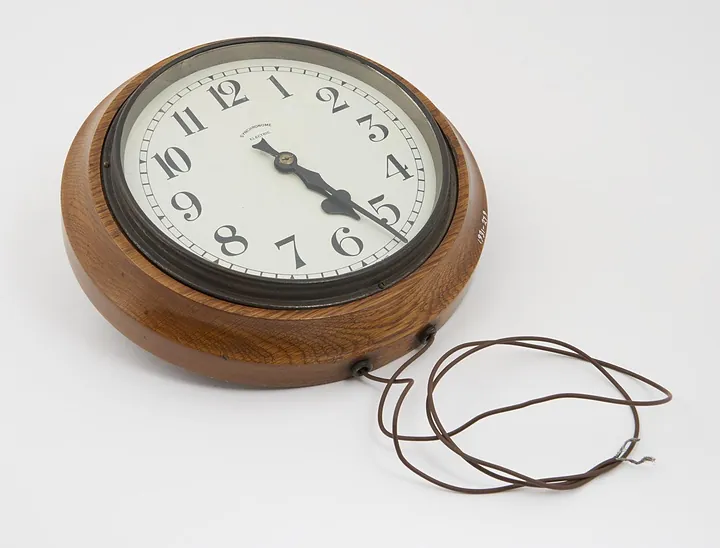
Clock with 8-inch impulse dial, by the Synchronome Company Limited, England, 1890–1930.
Science Museum Group, London
Clocks · c.1900
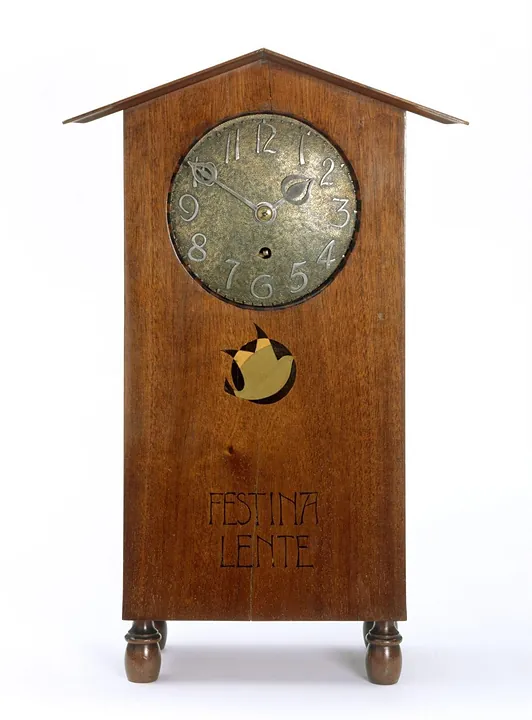
Clock by Mackay Hugh Baillie Scott, Bedfordshire, c.1900
Victoria and Albert Museum, London
Clocks · c. 1900
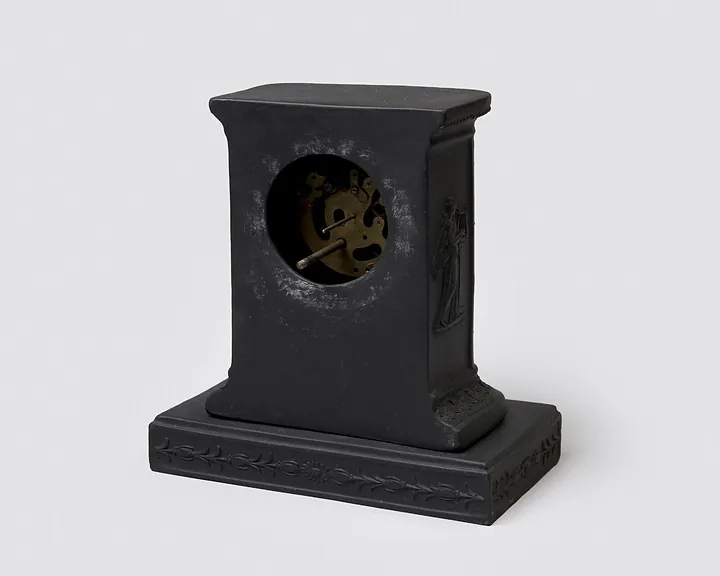
Clock, black basalt, brass, Josiah Wedgwood and Sons, Etruria, c. 1900
Victoria and Albert Museum, London
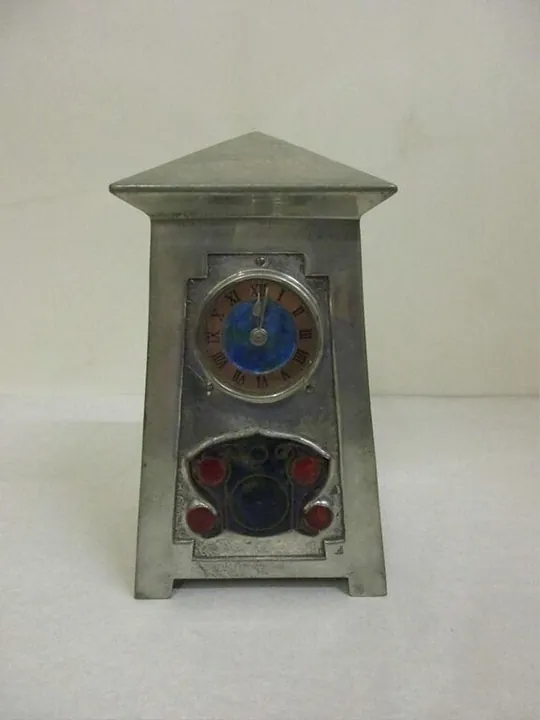
Clocks · c.1903-1904
Clock, pewter, made for Liberty& Co., England. 1903-4.
Victoria and Albert Museum, London
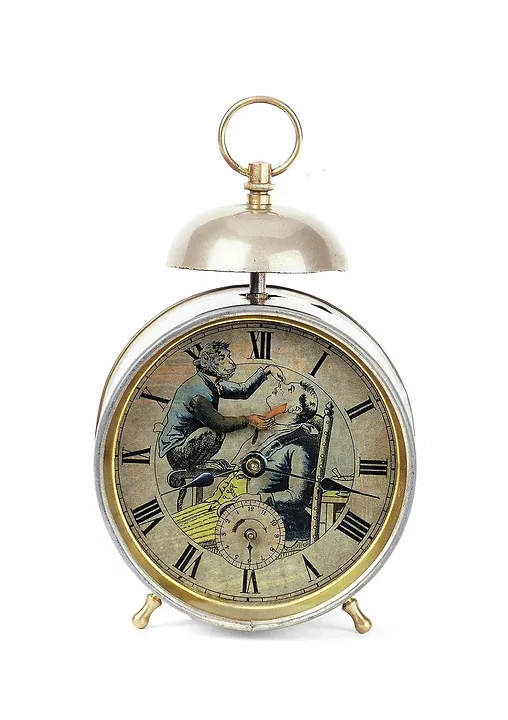
Clocks · c. 1900
Alarm clock by Union Clock Company, Germany, c. 1900
German Clock Museum
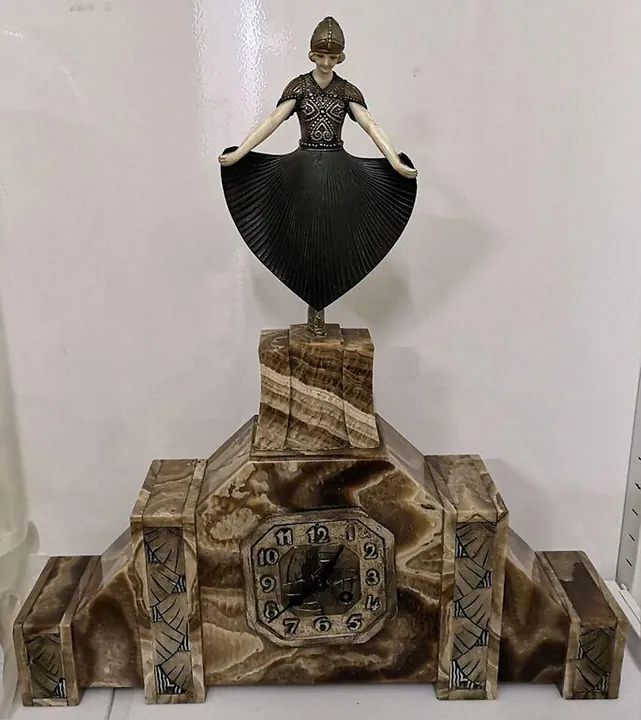
Clocks · 20th century
Base Metal, 20th c. Bronze, marble and ivory clock by Chiparus
Victoria and Albert Museum, London
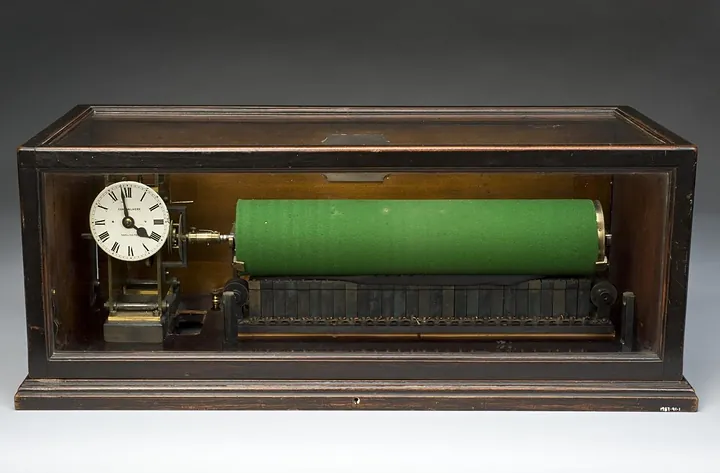
Clocks · 1900–1939
Clock by Cox-Walkers of Darlington, England, 1900–1939
Science Museum Group, London
Clocks · 1900–1999
Clock by Französisch (Schule), 1900–1999
Fine Arts Museum Vienna