
Clocks · Clock
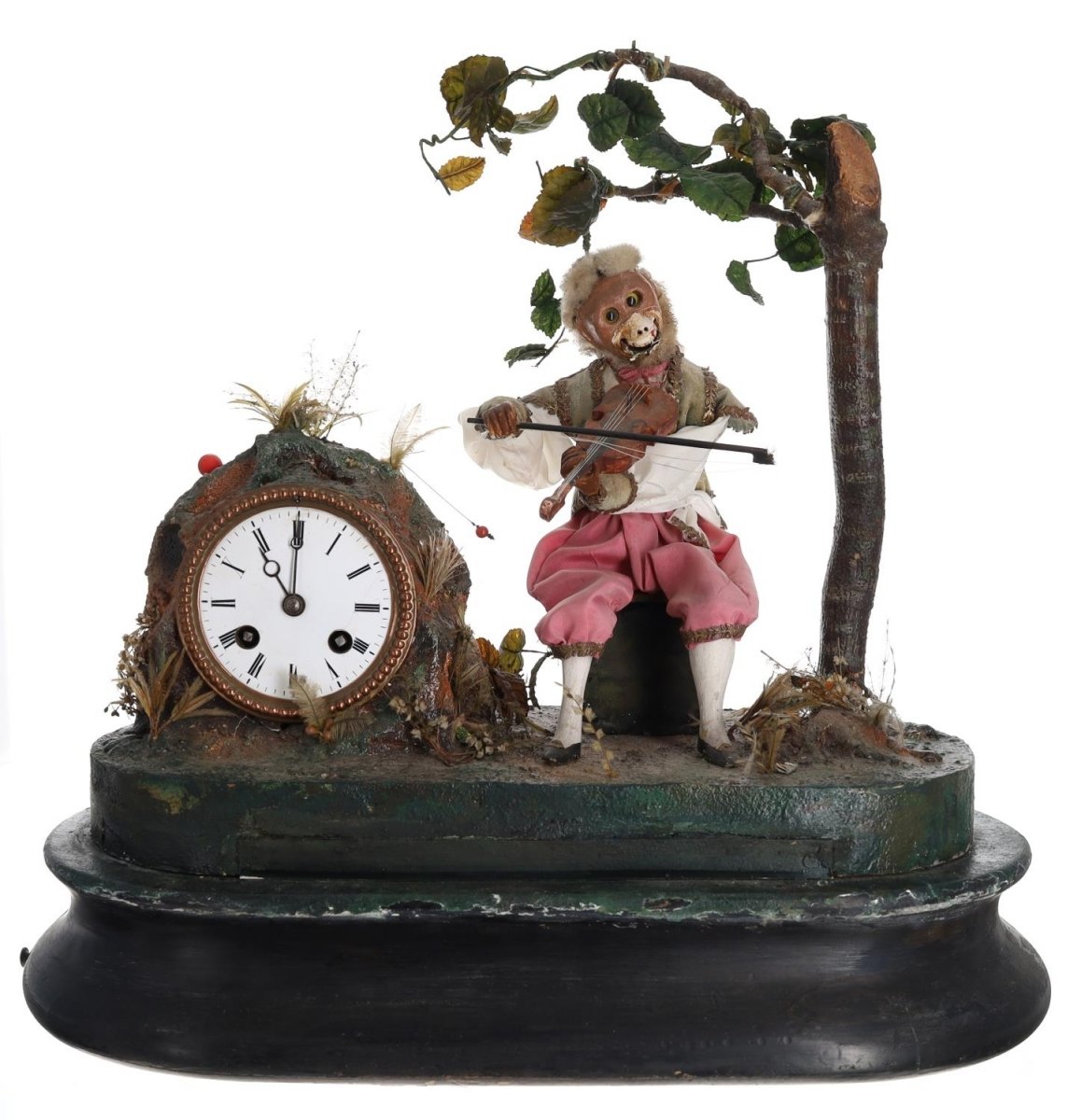
French late 19th century musical automaton clock
- Maker / attribution
- Unrecorded in source
- Date
- late 19th century
- Historical period
- Industrial Revolution (1850 – 1900)
- Country of origin
- France
- Object type
- Clock
- Dimensions
- Height 17.5 in (44 cm)
- Auction house
- Gardiner Houlgate (auction house), Corsham
- Lot
- Sale 42, lot 1235
- Credit line
- Auction lot record: lot 1235, Fine Clocks & Related Items, Gardiner Houlgate (22nd October 2026)
- Catalogue title (original)
- Rare French late 19th century musical automaton clock, the 3" circular enamel dial with Roman numerals and Breguet type moon hands, featuring a monkey playing a violin in a naturalistic setting, on an (English)
View the source record (auction lot) ↗ (opens another website in a new tab)Suggest a correction
Record summary
Catalogued by Gardiner Houlgate (auction house), Corsham (lot Sale 42, lot 1235), this is a clock, made in France, dated late 19th century. The Atlas places it in the Industrial Revolution period (1850 – 1900) of its Clocks collection. Recorded dimensions: Height 17.5 in (44 cm). The record is illustrated with 3 photographs.
Assembled from the source record's structured fields. Dates and attributions are given as the source states them; where a field is missing the Atlas leaves it blank rather than estimating.
Catalogue description
Lot description — Gardiner Houlgate
Rare French late 19th century musical automaton clock, the 3" circular enamel dial with Roman numerals and Breguet type moon hands, featuring a monkey playing a violin in a naturalistic setting, on an elongated oval ebonised base with two levers, S.Marti eight-day movement with outside countwheel striking the half hours and hours on a bell, numbered 7169, 17" long x 17.5" high (with faults)
Historical context
Industrial Revolution (1850 – 1900)
American interchangeable-parts manufacture; railroad time standards; Swiss and German factory systems.
Factory production transformed the clock into an everyday object. American makers (Seth Thomas, Ansonia, Waterbury) and German factories (Junghans, Gustav Becker, Lenzkirch) sold millions of shelf, wall and alarm clocks worldwide; France produced standardised Paris movements and carriage clocks; electric time distribution began.
Read the period in the timelineMore clocks from this periodEarlier: Precision & Scientific Horology
Atlas type guide
Astronomical, musical and automaton clocks
Astronomical clocks display more than the hour: the positions of the sun and moon in the zodiac, the phase of the moon, the calendar, sometimes the planets and eclipses. From Richard of Wallingford's and Giovanni de' Dondi's fourteenth-century clocks to the Prague Orloj and the Strasbourg cathedral clocks, they demonstrated the order of the cosmos. Renaissance makers in Augsburg and Nuremberg built celestial globe clocks and monstrance clocks as princely treasures.
Automaton and musical clocks entertained as well as informed: figures move, birds sing, organs and carillons play tunes from pinned cylinders. The eighteenth-century trade with China ('sing-songs') and Ottoman Turkey created a market for elaborate English, Swiss and French automata.
What to look for
- Subsidiary dials for moon phase, calendar, zodiac and planetary positions.
- Celestial globes or armillary spheres turned by the movement.
- Pinned cylinders, bellows and pipes or bells for music.
- Figures on cams and levers; separate trains for automaton work.
Dating clues
- Renaissance astronomical table and globe clocks: c. 1550–1650.
- English and Swiss automaton clocks for the Chinese market: c. 1760–1820.
- Picture clocks (clockwork pictures) are mostly nineteenth century.
General guidance written by the Atlas editors about this kind of object. It is not a statement about this particular piece; for that, rely on the source record above and on physical examination.
Read next:Verge escapementFusee
Related records
Clocks · 1840–1878
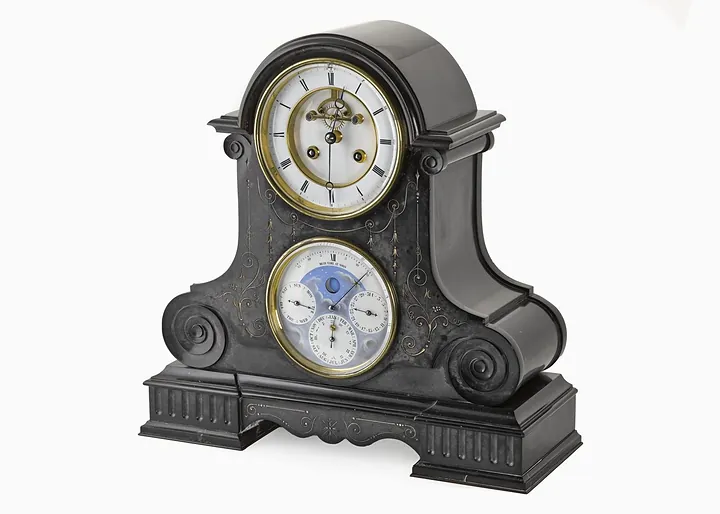
Mantel clock by A. Brocot, France, 1840–1878
Science Museum Group, London
Clocks · c. 1855
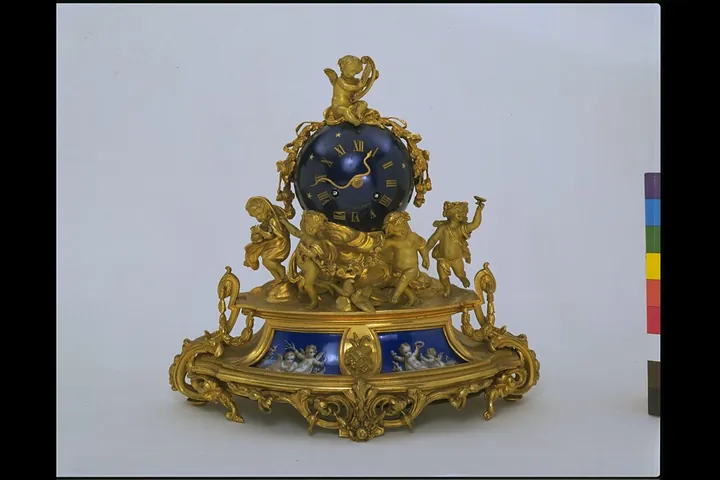
Ormolu and enamel clock, Paris, ca.1855, made by Lévy Frères.
Victoria and Albert Museum, London
Clocks · c. 1850
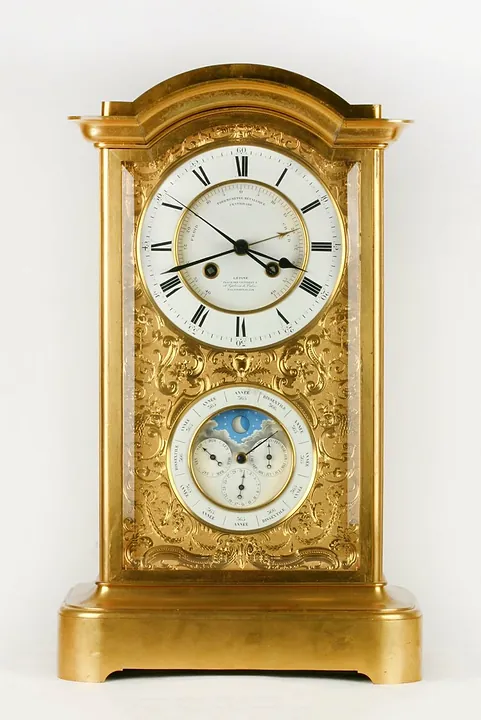
Table clock, France, c. 1850
German Clock Museum
Clocks · c. 1850
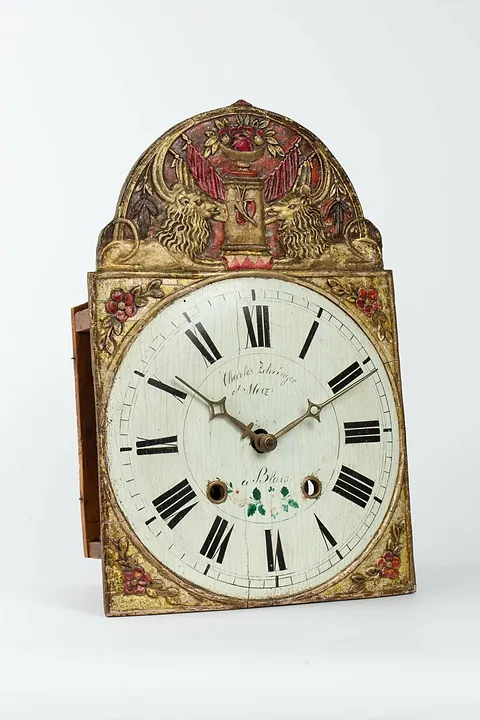
Wall clock by Charles et Merz Zehringer, France, c. 1850
German Clock Museum
Clocks · c. 1860
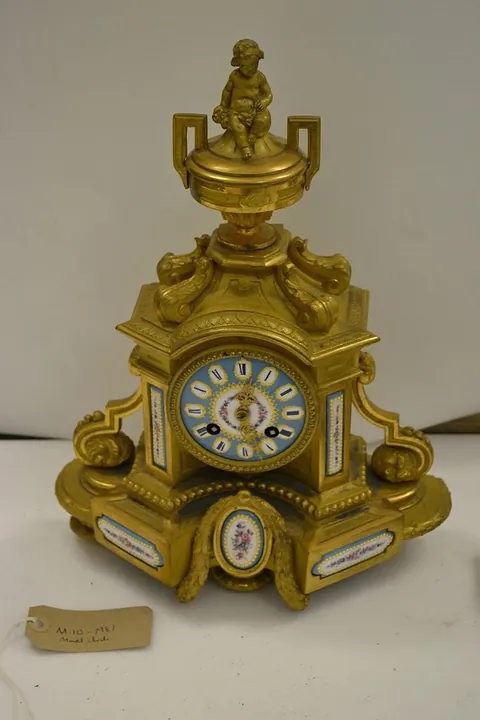
Mantel clock, French, c. 1860
Victoria and Albert Museum, London
Clocks · c. 1860
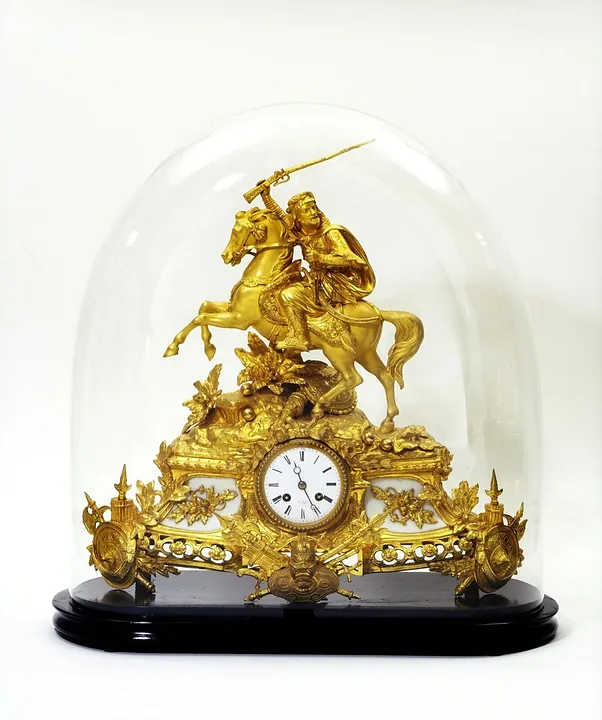
[*] French Clock under glass dome
Victoria and Albert Museum, London
Clocks · c. 1860
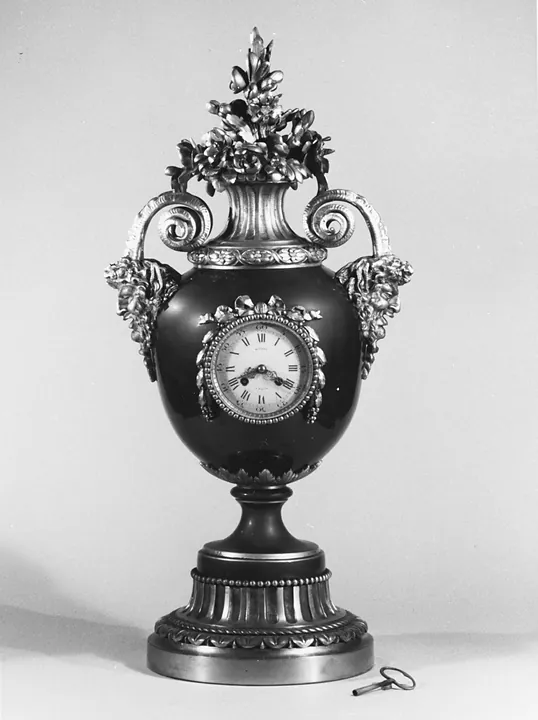
Clock by Auguste-Emile Rinquet-Leprince, France, c. 1860
The Metropolitan Museum of Art, New York
Clocks · 1860–1870
Clock by Raingo Frères, France, 1860–1870
Victoria and Albert Museum, London