
Wristwatches · Wristwatch
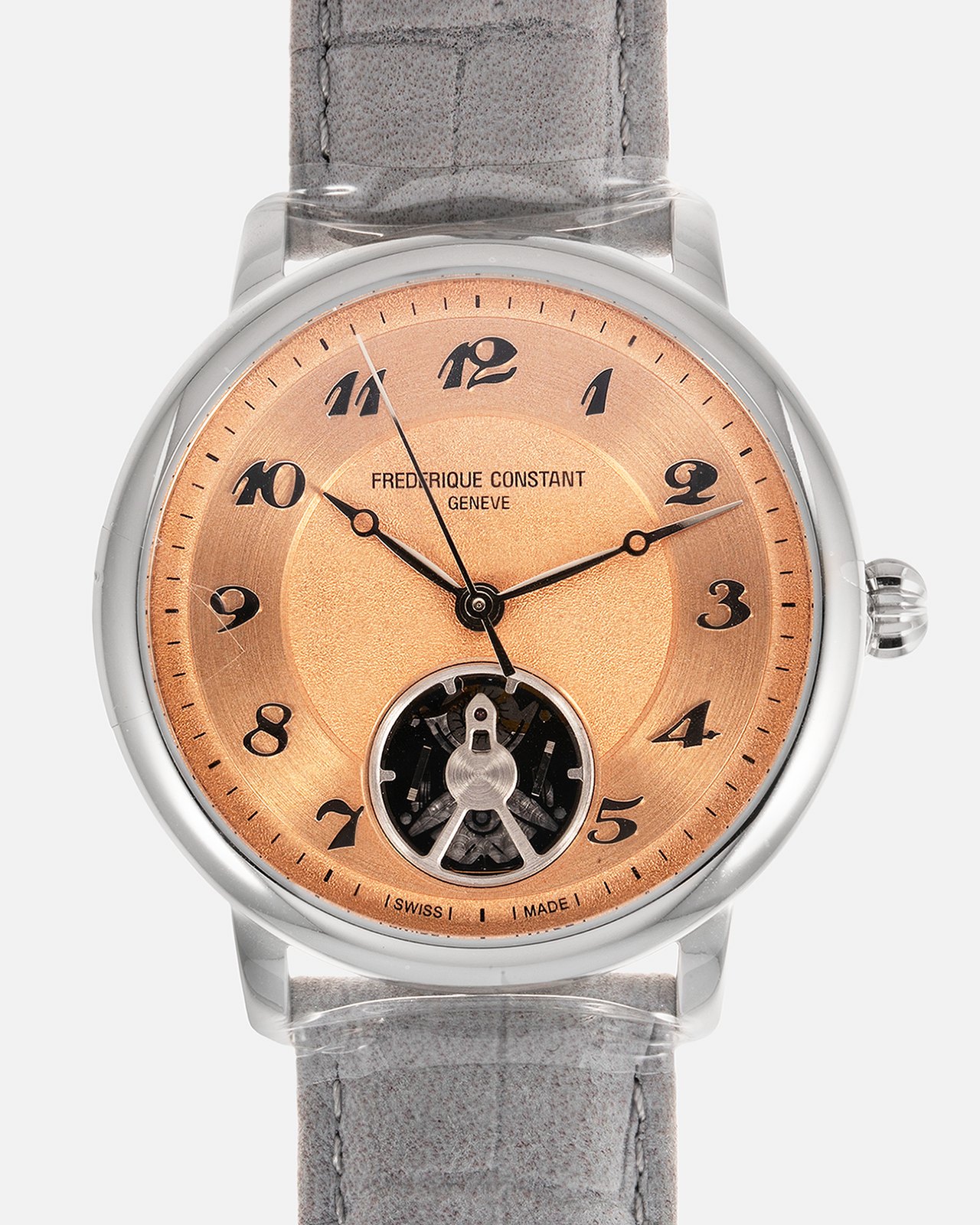
Frederique Constant x Revolution Slimline Monolithic FP(S) Salmon, 2023
- Maker / attribution
- Frédérique Constant (maker)
- Date
- 2023
- Historical period
- Contemporary Horology (2010 – Present)
- Country of origin
- Unrecorded in source
- Object type
- Wristwatch
- Dimensions
- Case 40 mm
- Stock no.
- Product 6909830234199
- Credit line
- Dealer listing, S.Song Watches (product 6909830234199)
- Catalogue title (original)
- Frederique Constant x Revolution Slimline Monolithic FP(S) Salmon (English)
View the source record (dealer listing) ↗ (opens another website in a new tab)Suggest a correction
Record summary
Catalogued by S.Song Watches (dealer), Seattle (stock number Product 6909830234199), this is a wristwatch by Frédérique Constant, dated 2023. The Atlas places it in the Contemporary Horology period (2010 – Present) of its Wristwatches collection. Recorded dimensions: Case 40 mm. The record is illustrated with 6 photographs.
Assembled from the source record's structured fields. Dates and attributions are given as the source states them; where a field is missing the Atlas leaves it blank rather than estimating.
Catalogue description
Dealer description — S.Song Watches
Truth be told, Frederique Constant wasn't a brand I typically found myself drawn to. However, in recent years, I've been thoroughly impressed by the brand's unwavering commitment to pushing the technical boundaries of watchmaking. Among their recent collection, one watch has truly captured my attention – the Slimline Monolithic Manufacture from 2021, which features an intriguing mechanism known as the monolithic silicon oscillator (more on this later). Offered here today is a limited edition derived from the aforementioned model, thoughtfully enhanced with a few tasteful aesthetic tweaks. This is the Frederique Constant x Revolution Slimline Monolithic FP(S), a limited edition of 100 pieces worldwide made in collaboration with Revolution Magazine. When I first held the FP(S) (which stands for: Future Past (Salmon)) in my hand, I was instantly struck by its unique and juxtaposed watch design. It seamlessly combines a classical dress-watch styling, boasting a slim 40mm x 11.4mm stainless steel case, with a daring horological innovation known as the monolithic oscillator. To understand the advantages of the usage of this oscillator mechanism, we need to go back to the basics. For context, a conventional watch movement typically consists of approximately 130 parts, with around 30 of them forming the escapement mechanism. While I am well aware that collectors take pleasure in observing these components work in perfect synchronization, from an engineering viewpoint, it presents a notable challenge due to the presence of friction. Nevertheless, Frederique Constant has ingeniously addressed this by introducing the monolithic oscillator, effectively reducing those 26 individual components, along with all their friction, wear, and lubrication concerns, to one single unit. The oscillator, crafted from a singular sheet of silicon (hence, monolithic), possesses exceptional attributes: immunity to magnetism and thermal variation, the absence of moving parts (resulting in no friction), as well as the elimination of the need for lubrication or a shock-absorbing mechanism. Additionally, the oscillator's high frequency, beating up to 10 times faster than a standard 4Hz movement (read: 40Hz / 288,000 bph), allows it to average out a significantly greater number of timekeeping errors and executes a remarkable 80 ‘ticks’ per second via the seconds hand – an animation that is simply invisible to the naked eye. Moving on to the captivating salmon-coloured dial of the FP(S), for those familiar with Wei Koh, it's well-known that he has a deep affection for salmon dials and has even poetically likened this dial's salmon hue to the colour of his beloved summer rosé, Domaines Ott . The dial also showcases a tri-sector layout with a variety of finishing techniques. The inner dial and outer minute track boast an aggressive frosted grené finish, whereas the middle section, adorned with applied Breguet numerals and hosts a set of hands, features a circular brushed pattern. Turn the FP(S) over, and you will be greeted by Frederique Constant's beautifully decorated in-house Cal. FC-810, which is capable of holding an impressive power reserve of 80 hours and is responsible for powering the monolithic oscillator positioned prominently at the front of the dial at 6 o'clock. In my opinion, the Slimline Monolithic stands out as one of the most captivating and enthralling modern watch designs I've ever come across so far. The fact that Wei Koh and Revolution embraced this remarkable template of a watch and infused it with their unique touch further elevates my admiration for its aesthetics and overall design. To me, the Slimline Monolithic (and the FP(S) limited edition), represents an intriguing exercise of watch design, skillfully striking a harmonious balance between contemporary and classic elements of watchmaking, all of which come together in a package like this incredible limited edition that is sure to resonate deeply with collectors from around the world.
Historical context
Contemporary Horology (2010 – Present)
Silicon components, connected watches, optical-lattice research clocks and a thriving independent scene.
Smartwatches became the world's best-selling watches, while mechanical watchmaking focuses on craft, innovation (silicon components, new escapements) and independent makers.
Read the period in the timelineMore wristwatches from this periodEarlier: Mechanical Renaissance
Atlas type guide
Wristwatches
Bracelet watches were worn by women from the early nineteenth century — Breguet made one for Caroline Murat, Queen of Naples, in 1810–12 — but the wristwatch only became a man's instrument with military use and aviation in the early twentieth century. Between the World Wars it overtook the pocket watch; the 1920s and 1930s brought rectangular Art Deco cases, water-resistant cases and the first automatic winding systems.
After 1945 the wristwatch became a carrier of identity — dress watches, sports and dive watches, chronographs, calendars — produced by Swiss, American, Japanese, German, Soviet and Chinese industries. The quartz revolution after 1969 and the mechanical renaissance since the 1990s, including the rise of independent watchmakers, complete the story.
What to look for
- The reference number (between the lugs or inside the case back) and serial number, the starting point for dating.
- The calibre: its maker and number are often stamped under the dial or on the bridge.
- Originality of dial, hands and crown — refinished ('redial') dials are common.
- Case material marks: 18K/750, 14K/585, stainless steel, gold-filled, plated.
Dating clues
- Wire-lug cases: before c. 1925.
- Water-resistant screw-down cases: from 1926.
- Quartz movements: from 1969; sapphire crystals widespread after c. 1980.
General guidance written by the Atlas editors about this kind of object. It is not a statement about this particular piece; for that, rely on the source record above and on physical examination.
Related records
Wristwatches · 2010s
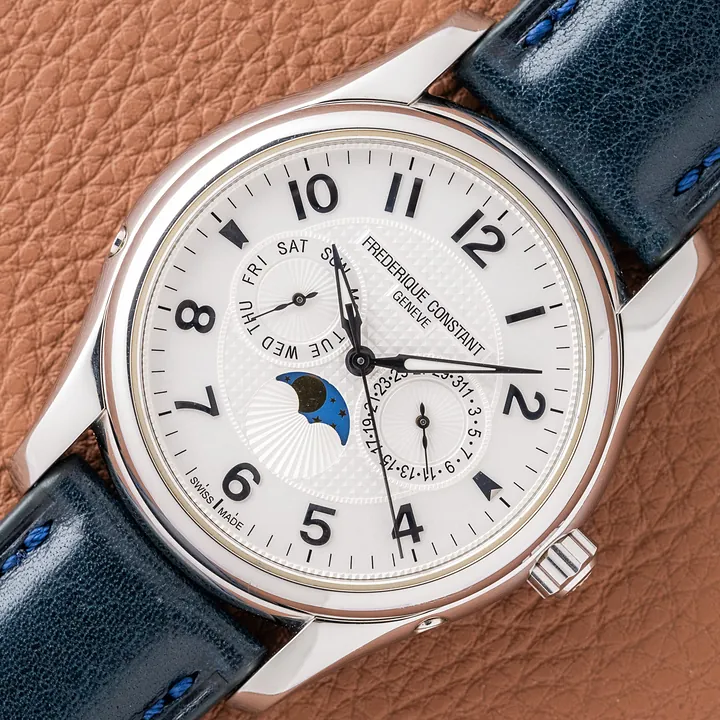
Frédérique Constant Runabout Moonphase (Ref. FC-360XR6B4/6), 2010s
Huntington Company (dealer)
Wristwatches · 2010
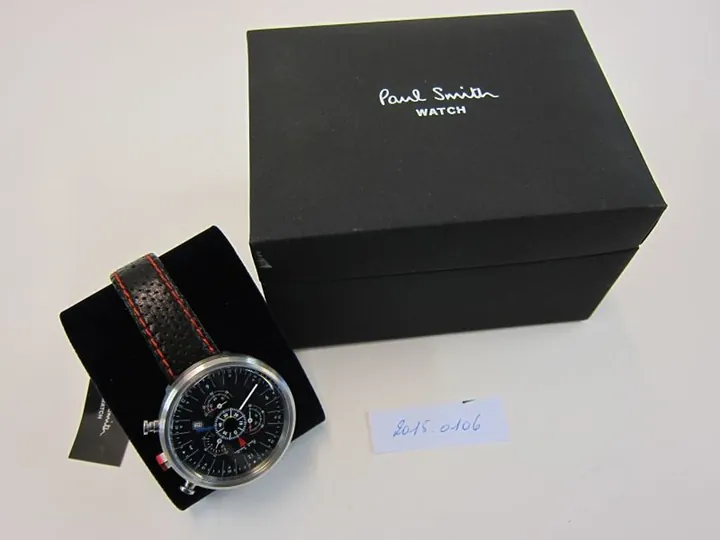
Wristwatch, 2010
Modemuseum Hasselt
Wristwatches · 2018 (Series 4 released in September 2018; '1977' in the source is the model number A1977)
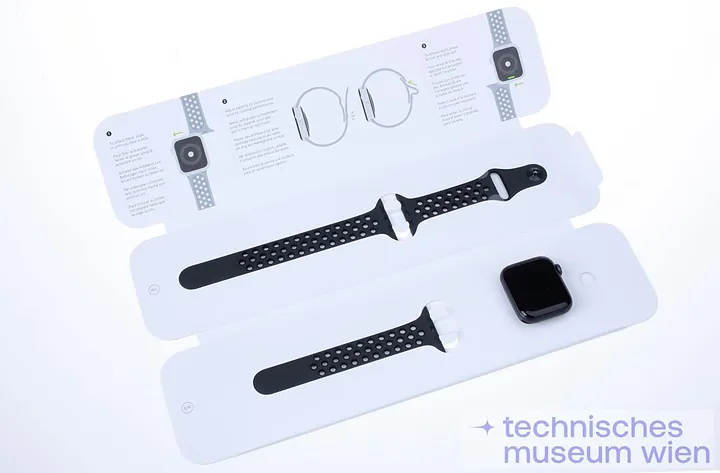
Apple Watch Series 4 (GPS, 40 mm, model A1977), 2018
Vienna Museum of Science and Technology
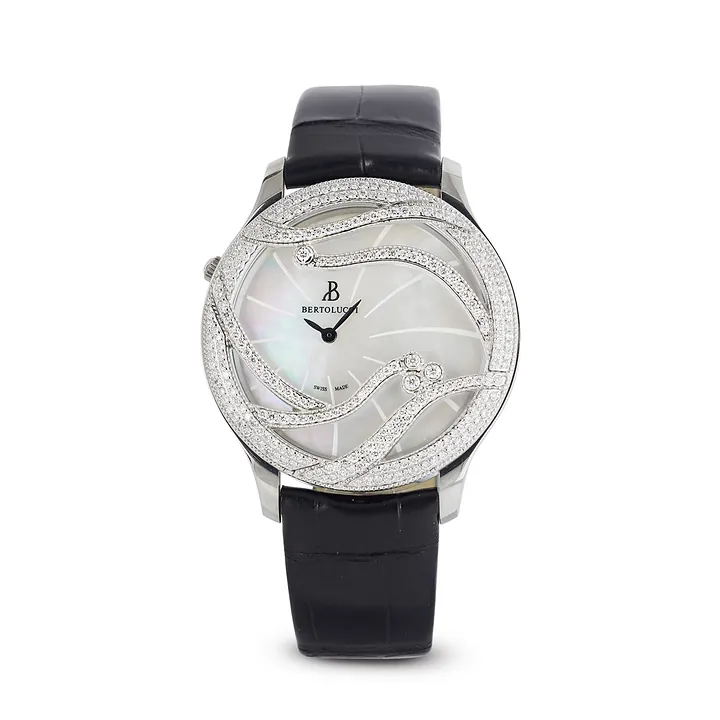
Wristwatches · c. 2010s
Bertolucci Stria III, ref. 11513.50.45.B88.6C1.501, c. 2010s
Antiquorum auction archive, Geneva
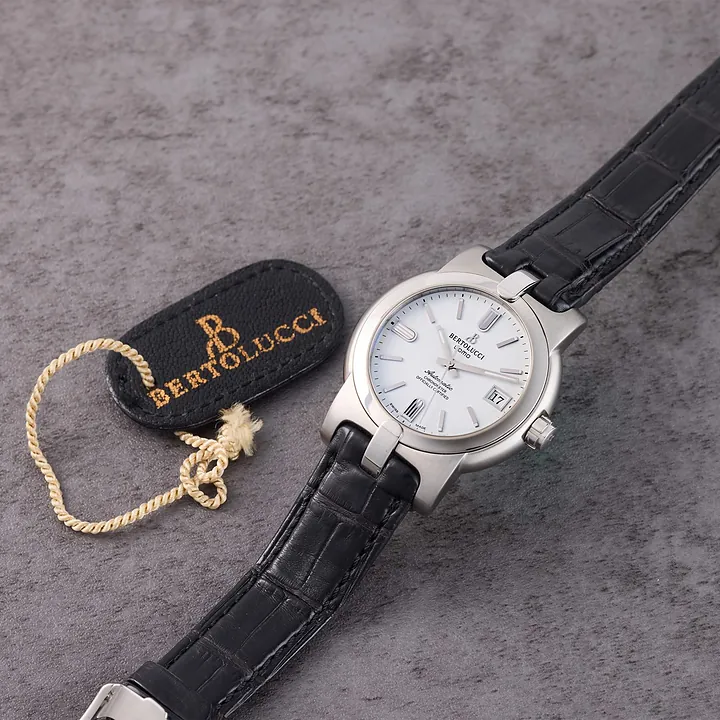
Wristwatches · c. 2010s
Bertolucci Uoma, ref. 824.51.41.10B, c. 2010s
Antiquorum auction archive, Geneva

Wristwatches · c. 2010s
Breguet Type XXI, ref. 3810, c. 2010s (Antiquorum Lot 381-24)
Antiquorum auction archive, Geneva

Wristwatches · c. 2010s
Breguet Type XXI, ref. 3810, c. 2010s (Antiquorum Lot 386-229)
Antiquorum auction archive, Geneva

Wristwatches · Sold in September 2010
Breitling Cosmonaute, ref. A 22322, Sold in September 2010
Antiquorum auction archive, Geneva