
Wristwatches · Wristwatch
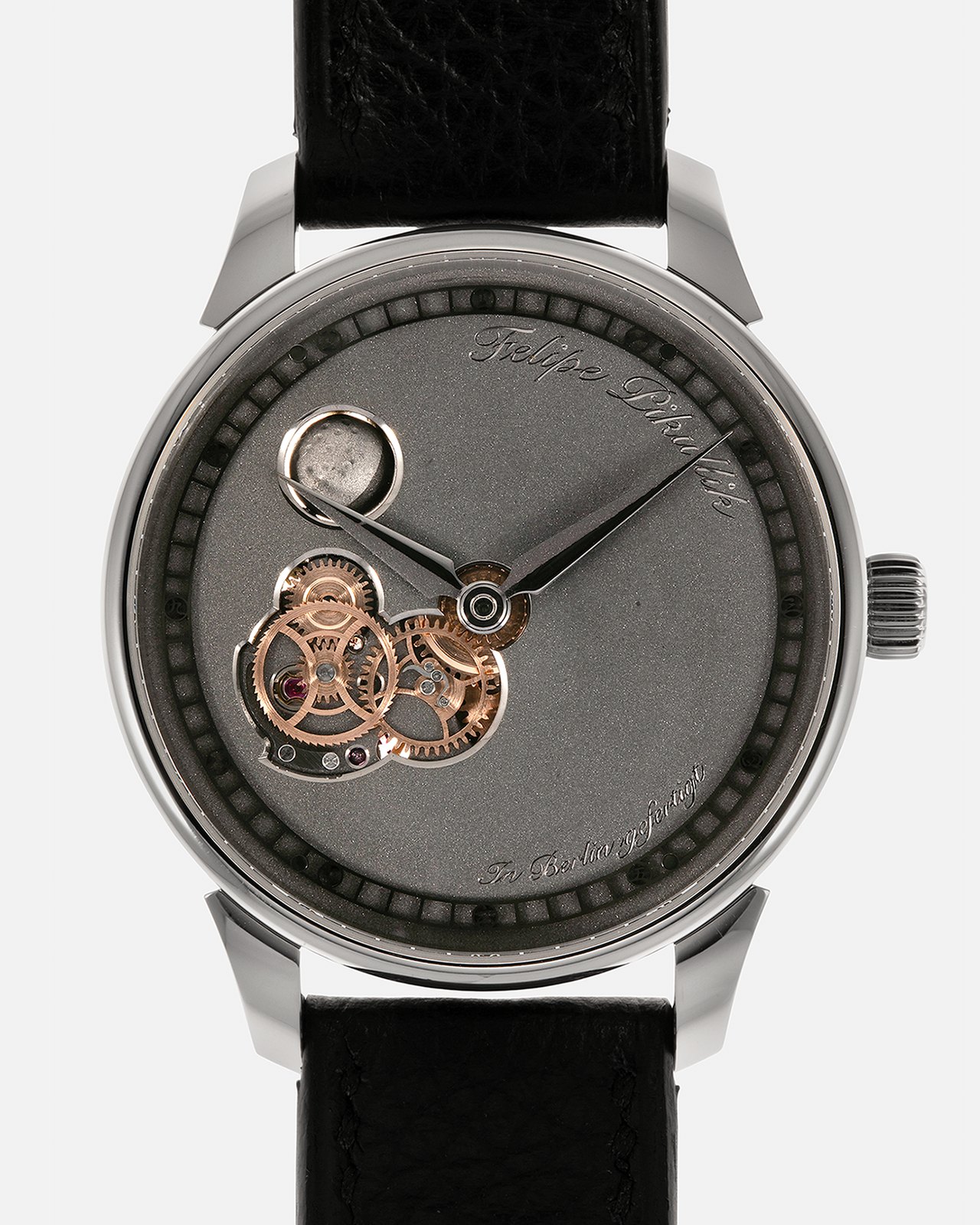
Felipe Pikullik Mondphase 1 Chinese Numerals, 2024
- Maker / attribution
- Felipe Pikullik (maker)
- Date
- 2024
- Historical period
- Contemporary Horology (2010 – Present)
- Country of origin
- China
- Object type
- Wristwatch
- Dimensions
- Case 41 mm
- Stock no.
- Product 7405526155351
- Credit line
- Dealer listing, S.Song Watches (product 7405526155351)
- Catalogue title (original)
- Felipe Pikullik Mondphase 1 Chinese Numerals (English)
View the source record (dealer listing) ↗ (opens another website in a new tab)Suggest a correction
Record summary
Catalogued by S.Song Watches (dealer), Seattle (stock number Product 7405526155351), this is a wristwatch by Felipe Pikullik, made in China, dated 2024. The Atlas places it in the Contemporary Horology period (2010 – Present) of its Wristwatches collection. Recorded dimensions: Case 41 mm. The record is illustrated with 6 photographs.
Assembled from the source record's structured fields. Dates and attributions are given as the source states them; where a field is missing the Atlas leaves it blank rather than estimating.
Catalogue description
Dealer description — S.Song Watches
Born and raised in Berlin in 1994, the capital city of Germany, Felipe Pikullik began his watchmaking journey at a very young age. As an aspiring watchmaker at the time, he faced many setbacks, including being denied entry into the prestigious watchmaking school in Glashütte multiple times. Despite these challenges, his passion and persistence never once wavered, and he eventually earned an opportunity as he was invited for a practical test, which he seized—and the rest is history. Fast forward to 2017, and Felipe established his eponymous brand at just 23 years old—a remarkable achievement, especially considering the competitive landscape of independent watchmaking at the time. Having followed the independent watchmaking space for some time now, I find Felipe’s approach quite intriguing; while he greatly emphasises the use of traditional watchmaking techniques, he simultaneously challenges conventional norms, adding his own unique and creative twist to his creations. In 2020, he released the Sternenhimmel (Starry Sky) and the ZBM1 (Zifferblatt Modell 1, or ‘Dial Model Number 1’), both of which were significant milestones for the brand and helped solidify his place in the German independent watchmaking scene. Today, we’re delighted to offer a watch that represents the next chapter following his first two aforementioned breakout releases—the Mondphase 1 . The first time I held the Mondphase 1, I was immediately struck by how stunning and captivating the watch looked in person. At first glance, it may appear simple from a distance, but a closer look reveals a masterful blend of technical sophistication, design restraint, and artistic expression. The dial, crafted from a rhodium-plated brass base and delicately frosted, has a subtle, shifting quality that plays beautifully with the light. The craftsmanship on display here is nothing short of exceptional—indeed, calling it merely "exceptional" doesn’t quite do it justice. Interestingly, as I examined the watch, I noticed a certain quality—something I couldn’t quite pinpoint—that reminded me of the Kudoke pieces we’ve listed on the site before. After some more research, I learned that Felipe had once apprenticed under Stephan Kudoke, which likely explains the subtle visual similarities, particularly in his approach to skeletonization. That said, aside from the frosted finish, I believe the focal point of the dial is the 3D spherical moon phase indication at 10:30, paired with the partially skeletonized section that reveals part of the movement. According to Felipe, it took approximately two years to develop and produce this feature due to his meticulous experimentation with various crafting techniques and the use of manually operated tools. If you look closer, you’ll notice that the spherical moon phase is depicted from the perspective of the Southern Hemisphere, a thoughtful nod to Felipe’s Brazilian roots. It showcases both a light and dark side, which poetically symbolizes the passage of time throughout the day. Like the frosted brass base of the dial, the moon phase also has a delicately textured surface, with tiny craters that closely resemble its real-life counterpart. The dial is further enhanced by hand-engraved inscriptions: " Felipe Pikulik " at the top right and " Gefertigt in Berlin " (translated as "Crafted in Berlin") at the bottom right. Completing the ensemble is a sleek, black-polished chapter ring with Chinese numerals that encircle the dial’s periphery, along with a set of beautifully half-frosted, half-polished hands that add a dynamic touch to the otherwise understated design. Felipe offered clients who ordered this watch the opportunity to choose what language the numerals to be in, so while it is limited to 20 pieces, there are even less in Chinese. As far as case size is concerned, the Mondphase 1 measures a contemporary 41mm x 10.5mm in dimensions, a size that feels well-suited to modern wrist sizes. The lugs are visually ornate, soldered on, and feature a gentle downward curve, ensuring the watch sits comfortably on the wrist. Overall, the case is impeccably finished, with a beautifully brushed midsection and a fluted crown that provides a fitting contrast to the mirror-polished bezel. Turn the watch over, and you’ll discover the magnificently finished manual-winding base movement, the Unitas Cal. 6497, which has been extensively reworked and modified by Felipe himself. It now boasts the intricately detailed spherical moon phase display, which, as you may have noticed, is visible both on the front and back of the case. As the photos clearly illustrate, the craftsmanship is unparalleled, showcasing a variety of traditional hand-finishing techniques. These include a rhodium-plated mainplate supporting the hand-skeletonized bridges, gold-plated gears, and a gold-plated, hand-engraved balance cock. Additionally, the screw heads are black-polished, while the crown and barrel wheels feature a striking sunburst-brushed finish. Every edge has been meticulously bevelled and polished by hand, making it an absolute visual delight to behold. As for power reserve, the movement can hold a charge up to 46 hours on a full wind. Produced in 2023 as a limited edition of just 20 pieces, the Mondphase 1 was recently nominated for one of the watch industry’s most prestigious honours—the Grand Prix d’Horlogerie de Genève (GPHG), in the ‘Calendar and Astronomy’ category. Although it didn’t take home the prize (that distinction went to the Bovet 1822 Récital 20 Astérium), the nomination alone is a remarkable achievement. For such a young brand, reaching this level of recognition so early on speaks volumes about Felipe Pikulik’s vision and the potential of what’s to come. All things considered, I believe the Mondphase 1 is the type of watch that requires you to, in the words of John Mayer, "look closer, look closer still." Only by doing so will this understated work of art reveal its true beauty. To me, this is what makes watches from indepe
Historical context
Contemporary Horology (2010 – Present)
Silicon components, connected watches, optical-lattice research clocks and a thriving independent scene.
Smartwatches became the world's best-selling watches, while mechanical watchmaking focuses on craft, innovation (silicon components, new escapements) and independent makers.
Read the period in the timelineMore wristwatches from this periodEarlier: Mechanical Renaissance
Atlas type guide
Wristwatches
Bracelet watches were worn by women from the early nineteenth century — Breguet made one for Caroline Murat, Queen of Naples, in 1810–12 — but the wristwatch only became a man's instrument with military use and aviation in the early twentieth century. Between the World Wars it overtook the pocket watch; the 1920s and 1930s brought rectangular Art Deco cases, water-resistant cases and the first automatic winding systems.
After 1945 the wristwatch became a carrier of identity — dress watches, sports and dive watches, chronographs, calendars — produced by Swiss, American, Japanese, German, Soviet and Chinese industries. The quartz revolution after 1969 and the mechanical renaissance since the 1990s, including the rise of independent watchmakers, complete the story.
What to look for
- The reference number (between the lugs or inside the case back) and serial number, the starting point for dating.
- The calibre: its maker and number are often stamped under the dial or on the bridge.
- Originality of dial, hands and crown — refinished ('redial') dials are common.
- Case material marks: 18K/750, 14K/585, stainless steel, gold-filled, plated.
Dating clues
- Wire-lug cases: before c. 1925.
- Water-resistant screw-down cases: from 1926.
- Quartz movements: from 1969; sapphire crystals widespread after c. 1980.
General guidance written by the Atlas editors about this kind of object. It is not a statement about this particular piece; for that, rely on the source record above and on physical examination.
Related records
Wristwatches · 2023
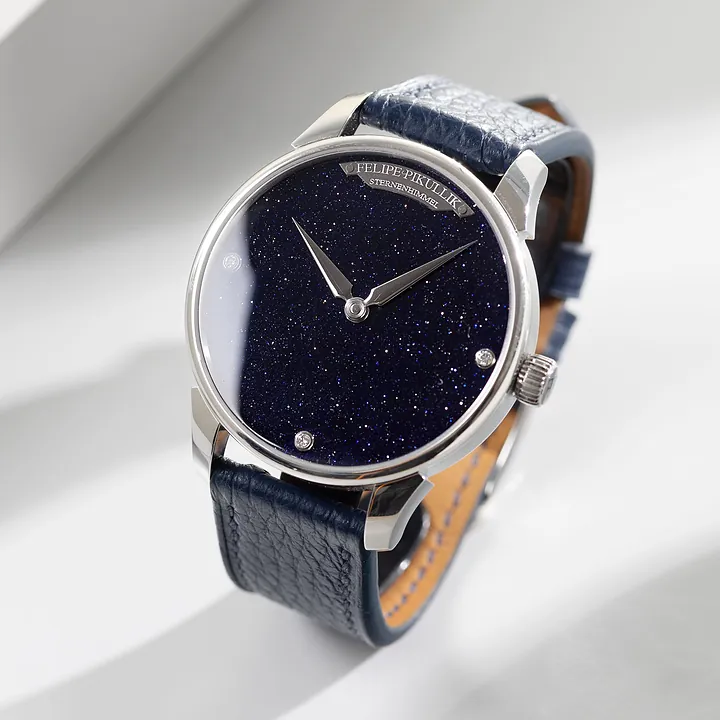
Felipe Pikullik "Sternen Himmel" with Blue Aventurine Dial, 2023
Bulang & Sons (dealer), Copenhagen
Wristwatches · 2014
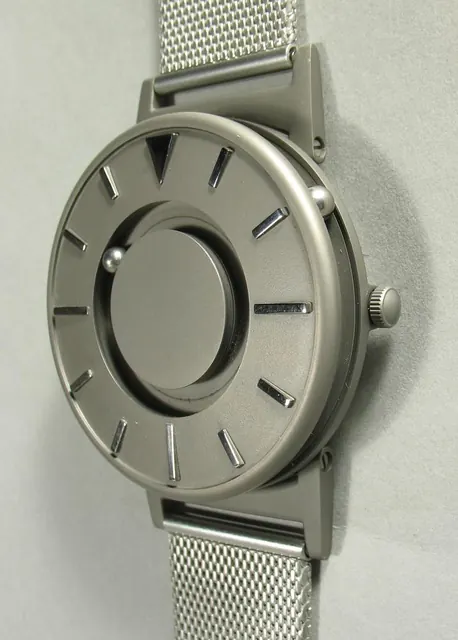
Quartz controlled wristwatch with ball-bearing time indication
British Museum
Wristwatches · 2010
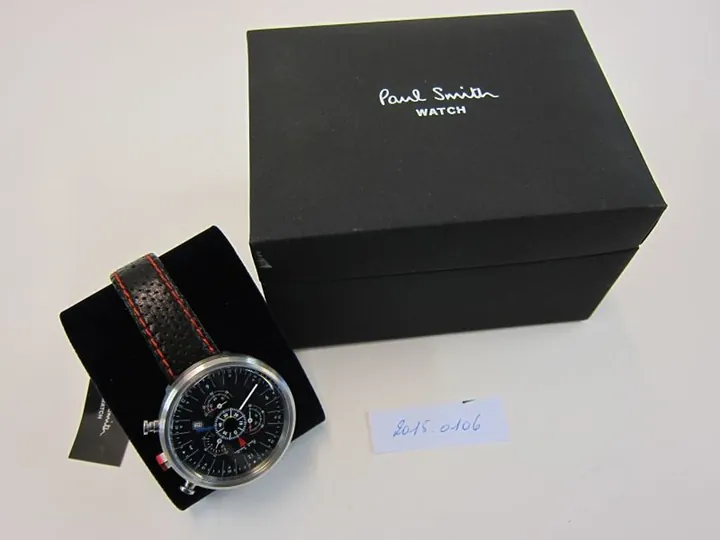
Wristwatch, 2010
Modemuseum Hasselt
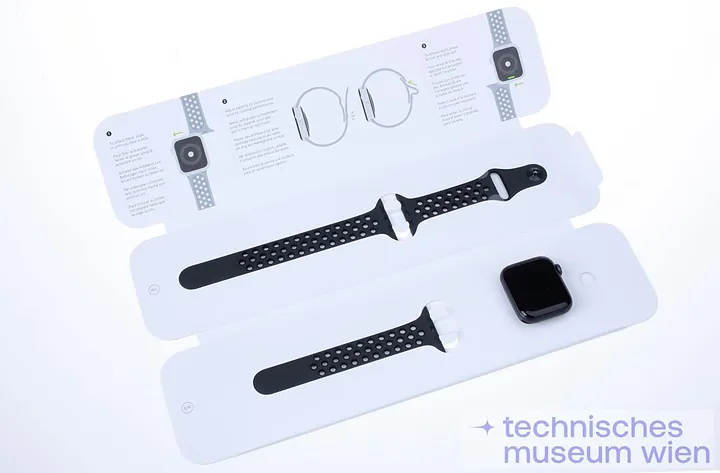
Wristwatches · 2018 (Series 4 released in September 2018; '1977' in the source is the model number A1977)
Apple Watch Series 4 (GPS, 40 mm, model A1977), 2018
Vienna Museum of Science and Technology
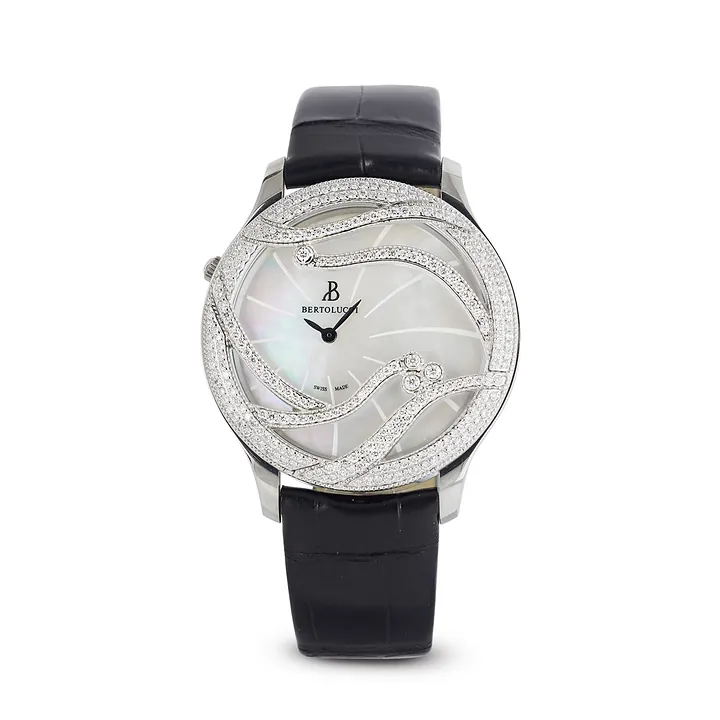
Wristwatches · c. 2010s
Bertolucci Stria III, ref. 11513.50.45.B88.6C1.501, c. 2010s
Antiquorum auction archive, Geneva
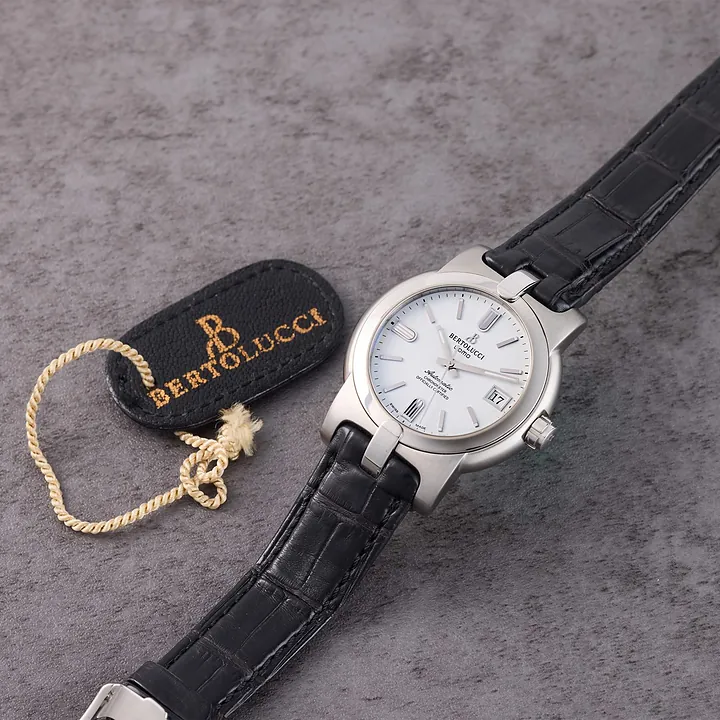
Wristwatches · c. 2010s
Bertolucci Uoma, ref. 824.51.41.10B, c. 2010s
Antiquorum auction archive, Geneva

Wristwatches · c. 2010s
Breguet Type XXI, ref. 3810, c. 2010s (Antiquorum Lot 381-24)
Antiquorum auction archive, Geneva

Wristwatches · c. 2010s
Breguet Type XXI, ref. 3810, c. 2010s (Antiquorum Lot 386-229)
Antiquorum auction archive, Geneva