
Wristwatches · Wristwatch
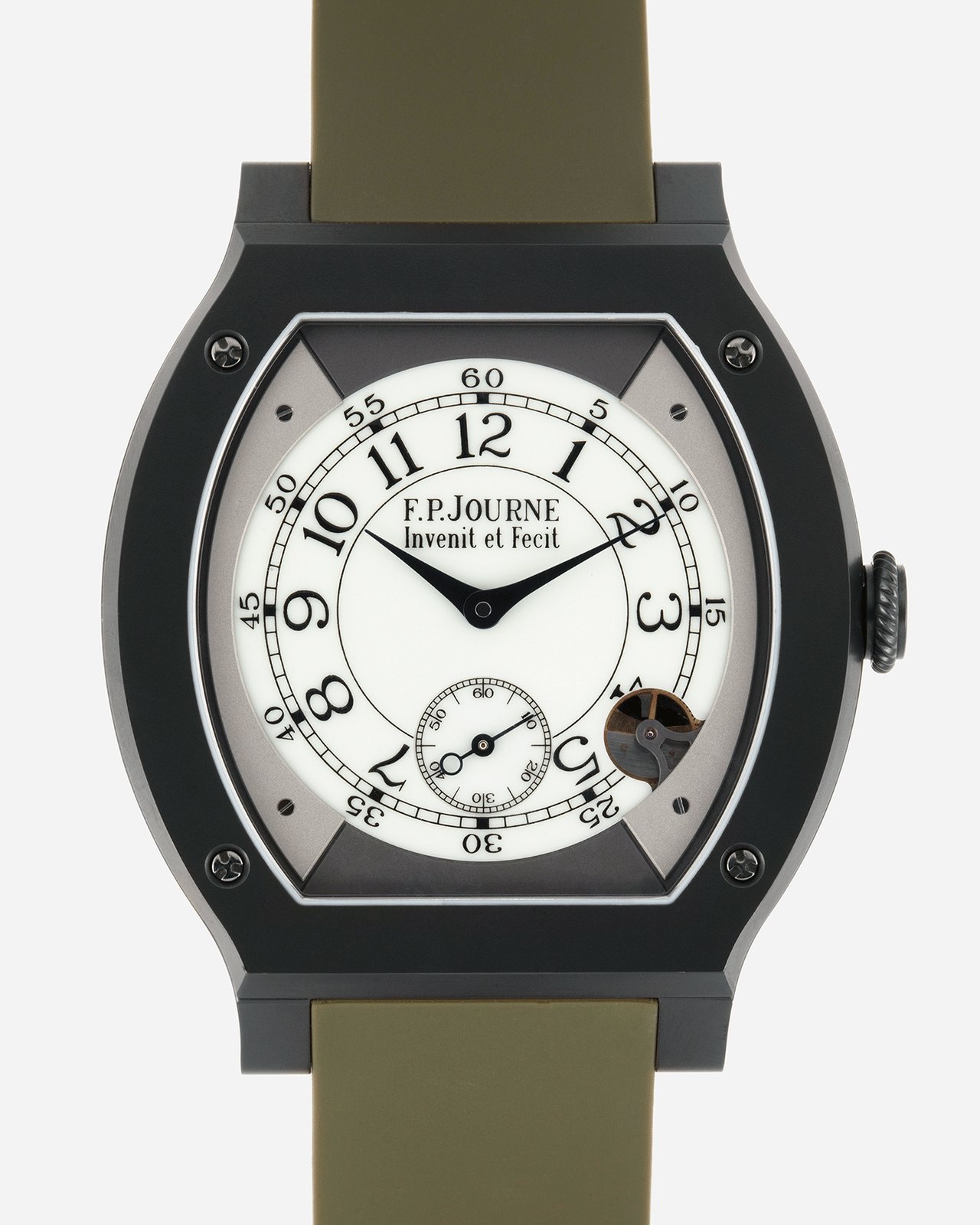
F.P. Journe Elegante 48 Titalyt, 2020
- Maker / attribution
- F.P. Journe (maker)
- Date
- 2020
- Historical period
- Contemporary Horology (2010 – Present)
- Country of origin
- Switzerland
- Object type
- Wristwatch
- Dimensions
- Case 48 mm
- Stock no.
- Product 6570283958359
- Credit line
- Dealer listing, S.Song Watches (product 6570283958359)
- Catalogue title (original)
- F.P. Journe Elegante 48 Titalyt (English)
View the source record (dealer listing) ↗ (opens another website in a new tab)Suggest a correction
Record summary
Catalogued by S.Song Watches (dealer), Seattle (stock number Product 6570283958359), this is a wristwatch by F.P. Journe, made in Switzerland, dated 2020. The Atlas places it in the Contemporary Horology period (2010 – Present) of its Wristwatches collection. Recorded dimensions: Case 48 mm. The record is illustrated with 6 photographs.
Assembled from the source record's structured fields. Dates and attributions are given as the source states them; where a field is missing the Atlas leaves it blank rather than estimating.
Catalogue description
Dealer description — S.Song Watches
Originally released as a women's watch in 2014, the F.P. Journe Elegante was a timepiece that was erroneously looked over as a timepiece worth considering due to its quartz movement. However, in typical F.P. Journe fashion, the Elegante's quartz movement is by no means your ordinary movement. With the general increase in appreciation of F.P. Journe watches, collectors finally looked at the Elegante and realised just how incredible it is as a piece of engineering. Powered by perhaps one of the most incredible quartz movements imaginable, the Elegante's cal. 1210 Electromechanical movement followed 8 years of development and is one of the most energy-efficient movements on the market. With a battery life of 8-18 years, depending on wear time, the cal. 1210 will stop operating if it has not been worn for over 35 minutes (standby mode) while still counting the time within its microprocessor. When the watch is moved again, the hands will spring back to action and display time as usual by taking the shortest route possible to save energy. In addition, the hours and minutes hands, and seconds hand use their own motors to reduce the need for lubricants which could dry up and deplete efficiency later on in the battery's lifespan. An incredible display of F.P. Journe's hyper-attentive design tendencies, the Elegante's patented movement is breath-taking in terms of engineering ingenuity. Featuring a 4N golden movement with an engraved and decorated battery bridge and stunning Cotes de Genève finishing throughout, F.P. Journe has brought a quartz movement into the annals of extreme high-end luxury watchmaking. With a fittingly unique 48mm X 40mm tonneau-shaped case made of titanium, the Elegante's incredible movement plays into its unique styling. Alongside a stunning translucent-esque dial featuring a luminescent centre portion that lights up in its entirety to provide stunning night-time legibility, the Elegante is remarkably user-friendly and recognisable. While there are several sizes and variants of the Elegante, none is as desirable as the full-size 48mm version that has gone through the brand’s proprietary ‘Titalyt’ treatment. The standard Elegante comes in a grade-5 titanium case, whereas this Titalyt treatment is achieved by generating oxide coatings on the case through an electrochemical treatment. This not only changes the aesthetic of the watch into something far more unique and attractive with the matte black finish, but also improves the material’s hardness and resistance to corrosion. With a mechanical motion detector visible behind an aperture at 4:30 on the dial, the F.P. Journe Elegante cheekily hints at the majesty within. Fitted to an exceptionally comfortable army green rubber strap with a titanium folding clasp, the F.P. Journe Elegante 48 is deserving of its praises as a wonderfully wearable and attractive piece. As a result of all of the over-engineering and ingenuity of the Elegante, the demand has been overwhelming with waitlists cancelled and deposits refunded. For a long time, the Elegante was disregarded and overlooked but today, it is pretty much impossible to buy an Elegante 48 Titalyt at retail. With rumours of discontinuation, it has gone from an entry-level Journe piece to one of the most desired. Don’t get me wrong though, it is not all just hype- the amount of effort and attention to detail makes this one of the most attractive Journe’s in the market.
Historical context
Contemporary Horology (2010 – Present)
Silicon components, connected watches, optical-lattice research clocks and a thriving independent scene.
Smartwatches became the world's best-selling watches, while mechanical watchmaking focuses on craft, innovation (silicon components, new escapements) and independent makers.
Read the period in the timelineMore wristwatches from this periodEarlier: Mechanical Renaissance
Atlas type guide
Wristwatches
Bracelet watches were worn by women from the early nineteenth century — Breguet made one for Caroline Murat, Queen of Naples, in 1810–12 — but the wristwatch only became a man's instrument with military use and aviation in the early twentieth century. Between the World Wars it overtook the pocket watch; the 1920s and 1930s brought rectangular Art Deco cases, water-resistant cases and the first automatic winding systems.
After 1945 the wristwatch became a carrier of identity — dress watches, sports and dive watches, chronographs, calendars — produced by Swiss, American, Japanese, German, Soviet and Chinese industries. The quartz revolution after 1969 and the mechanical renaissance since the 1990s, including the rise of independent watchmakers, complete the story.
What to look for
- The reference number (between the lugs or inside the case back) and serial number, the starting point for dating.
- The calibre: its maker and number are often stamped under the dial or on the bridge.
- Originality of dial, hands and crown — refinished ('redial') dials are common.
- Case material marks: 18K/750, 14K/585, stainless steel, gold-filled, plated.
Dating clues
- Wire-lug cases: before c. 1925.
- Water-resistant screw-down cases: from 1926.
- Quartz movements: from 1969; sapphire crystals widespread after c. 1980.
General guidance written by the Atlas editors about this kind of object. It is not a statement about this particular piece; for that, rely on the source record above and on physical examination.
Related records
Wristwatches · 2012
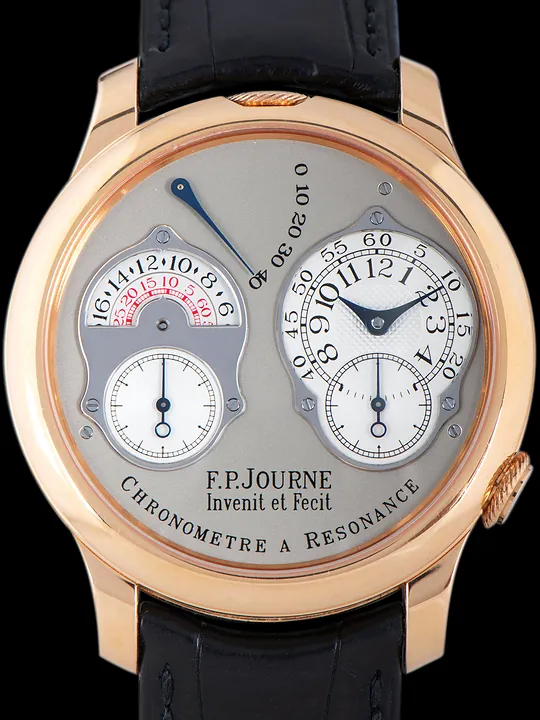
F.P. Journe Résonance "Parking Meter" 18K RG (Ref. RT) Grey Dial, 2012
Craft & Tailored (dealer), Los Angeles
Wristwatches · 2003
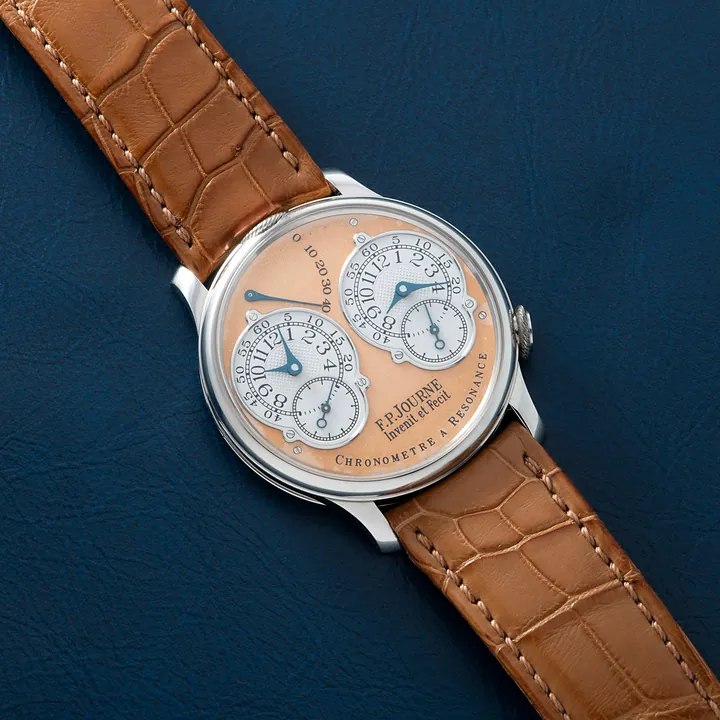
F.P. Journe Chronomètre à Résonance 'Brass Movement', 2003
Analog/Shift (dealer), New York
Wristwatches · 2019
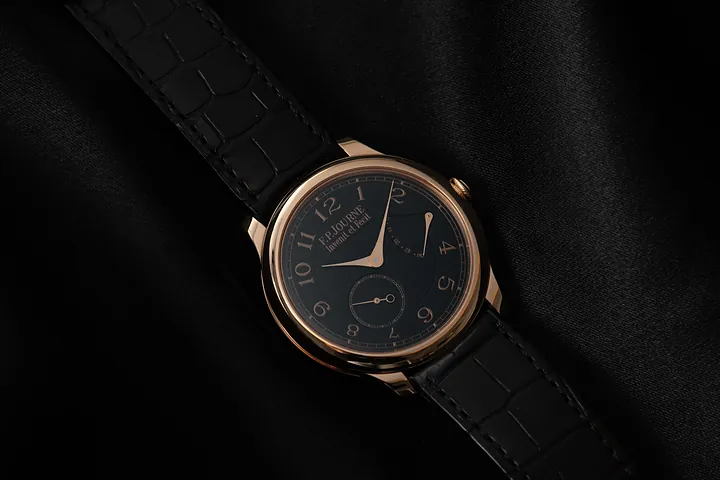
F.P. Journe Chronométre Souverain Boutique Edition, 2019
Analog/Shift (dealer), New York
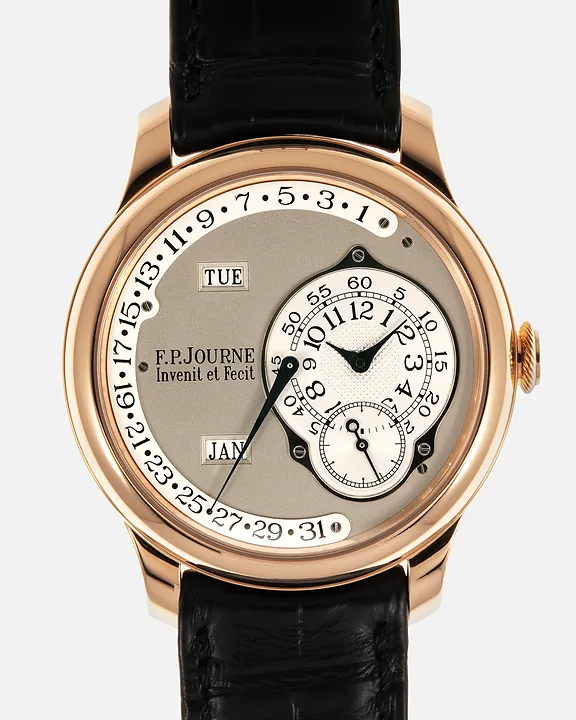
Wristwatches · 2006
F.P. Journe Octa Calendrier RG Grey 40mm, 2006
S.Song Watches (dealer), Seattle

Wristwatches · c. 2010s
Breguet Type XXI, ref. 3810, c. 2010s (Antiquorum Lot 381-24)
Antiquorum auction archive, Geneva

Wristwatches · c. 2010s
Breguet Type XXI, ref. 3810, c. 2010s (Antiquorum Lot 386-229)
Antiquorum auction archive, Geneva

Wristwatches · Sold in September 2010
Breitling Cosmonaute, ref. A 22322, Sold in September 2010
Antiquorum auction archive, Geneva

Wristwatches · c. 2010
Corum Bubble Chrono, ref. 396.150.20, c. 2010
Antiquorum auction archive, Geneva