
Wristwatches · Wristwatch
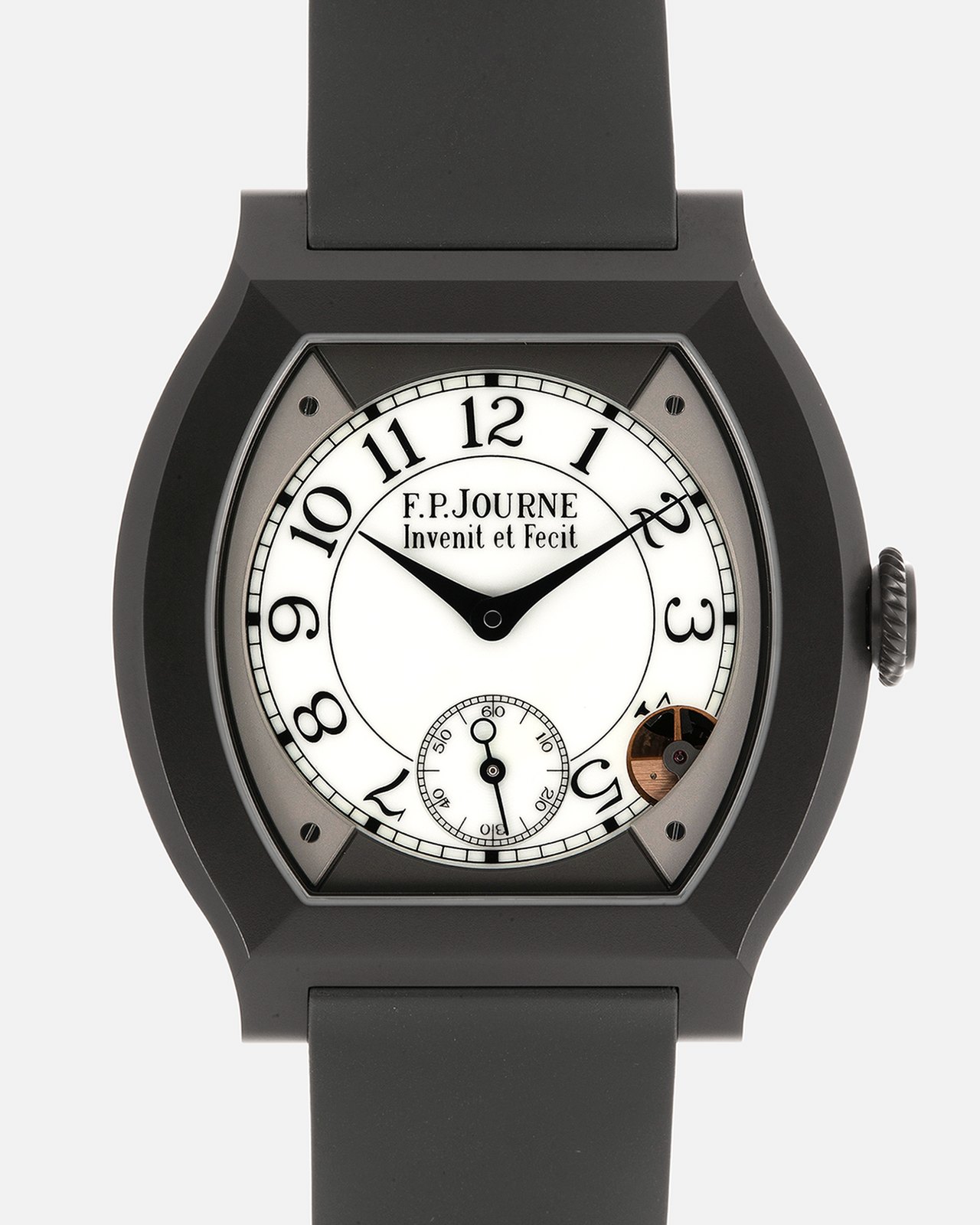
F.P. Journe Elegante 40 Titalyt, 2024
- Maker / attribution
- F.P. Journe (maker)
- Date
- 2024
- Historical period
- Contemporary Horology (2010 – Present)
- Country of origin
- Switzerland
- Object type
- Wristwatch
- Dimensions
- Case 40 mm
- Stock no.
- Product 7527019282519
- Credit line
- Dealer listing, S.Song Watches (product 7527019282519)
- Catalogue title (original)
- F.P. Journe Elegante 40 Titalyt (English)
View the source record (dealer listing) ↗ (opens another website in a new tab)Suggest a correction
Record summary
Catalogued by S.Song Watches (dealer), Seattle (stock number Product 7527019282519), this is a wristwatch by F.P. Journe, made in Switzerland, dated 2024. The Atlas places it in the Contemporary Horology period (2010 – Present) of its Wristwatches collection. Recorded dimensions: Case 40 mm. The record is illustrated with 6 photographs.
Assembled from the source record's structured fields. Dates and attributions are given as the source states them; where a field is missing the Atlas leaves it blank rather than estimating.
Catalogue description
Dealer description — S.Song Watches
Originally launched as a women’s watch in 2014, the F.P. Journe Elegante was frequently overlooked as a timepiece worth considering due to its quartz movement. However, true to F.P. Journe’s reputation, this quartz movement is far from ordinary. With the increasing appreciation for F.P. Journe watches in general, collectors have finally started to acknowledge the Elegante's value and impressive technical engineering. While there are several sizes and variants of the Elegante, I believe the 40mm x 35mm version is the most wearable option for those with medium-sized wrists, like mine. The standard Elegante features a grade-5 titanium tonneau-shaped case, but this example has undergone the brand’s proprietary ‘Titalyt’ treatment, achieved by generating oxide coatings on the case through an electrochemical process. This not only transforms the watch’s aesthetic into something far more unique, stealthy and attractive with its matte black finish but also enhances the material’s hardness and overall resistance to corrosion. Moving on, the Elegante also features a stunning translucent dial with a luminescent centre that illuminates entirely for excellent legibility under low light conditions, which makes it astonishingly user-friendly and easily recognisable. If you look closer, you’ll notice an open aperture at 4:30 on the dial, which reveals a mechanical motion detector that playfully hints at the remarkable marvel housed within. Powering the Elegante is one of the most impressive quartz movements available today: F.P. Journe’s in-house Cal. 1210. This electromechanical movement underwent 8 years of rigorous research and development, making it one of the most energy-efficient movements on the market. When you turn the watch over on its caseback, you’ll be greeted by a stunning 4N gold movement, featuring an intricately engraved and decorated battery bridge, complemented by exquisite Côtes de Genève finishing throughout. With a battery life of 8 to 18 years, depending on usage, the Cal. 1210 automatically enters standby mode after 35 minutes of inactivity, all while continuously tracking time with its microprocessor. When the watch is moved again, the hands instantly spring back into action, displaying the time as usual by taking the shortest route to conserve energy. Additionally, the hour, minute, and seconds hands each have their dedicated motors, minimising the need for lubricants that could dry up and potentially impact their efficiency later in the movement’s lifespan. This extraordinary design is a testament to F.P. Journe's meticulous philosophy, with the Elegante’s patented movement showcasing breathtaking engineering ingenuity. Considering everything I’ve mentioned above, the F.P. Journe Elegante is undoubtedly deserving of its accolades as a beautifully wearable and understated piece.
Historical context
Contemporary Horology (2010 – Present)
Silicon components, connected watches, optical-lattice research clocks and a thriving independent scene.
Smartwatches became the world's best-selling watches, while mechanical watchmaking focuses on craft, innovation (silicon components, new escapements) and independent makers.
Read the period in the timelineMore wristwatches from this periodEarlier: Mechanical Renaissance
Atlas type guide
Wristwatches
Bracelet watches were worn by women from the early nineteenth century — Breguet made one for Caroline Murat, Queen of Naples, in 1810–12 — but the wristwatch only became a man's instrument with military use and aviation in the early twentieth century. Between the World Wars it overtook the pocket watch; the 1920s and 1930s brought rectangular Art Deco cases, water-resistant cases and the first automatic winding systems.
After 1945 the wristwatch became a carrier of identity — dress watches, sports and dive watches, chronographs, calendars — produced by Swiss, American, Japanese, German, Soviet and Chinese industries. The quartz revolution after 1969 and the mechanical renaissance since the 1990s, including the rise of independent watchmakers, complete the story.
What to look for
- The reference number (between the lugs or inside the case back) and serial number, the starting point for dating.
- The calibre: its maker and number are often stamped under the dial or on the bridge.
- Originality of dial, hands and crown — refinished ('redial') dials are common.
- Case material marks: 18K/750, 14K/585, stainless steel, gold-filled, plated.
Dating clues
- Wire-lug cases: before c. 1925.
- Water-resistant screw-down cases: from 1926.
- Quartz movements: from 1969; sapphire crystals widespread after c. 1980.
General guidance written by the Atlas editors about this kind of object. It is not a statement about this particular piece; for that, rely on the source record above and on physical examination.
Related records
Wristwatches · 2012
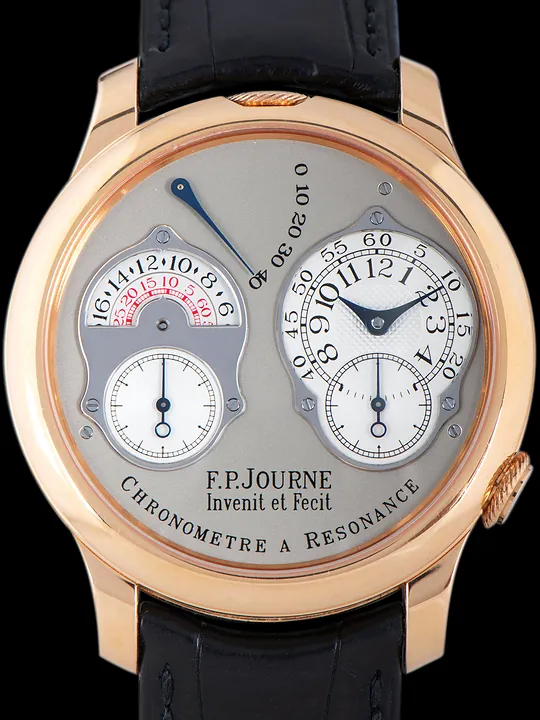
F.P. Journe Résonance "Parking Meter" 18K RG (Ref. RT) Grey Dial, 2012
Craft & Tailored (dealer), Los Angeles
Wristwatches · 2003
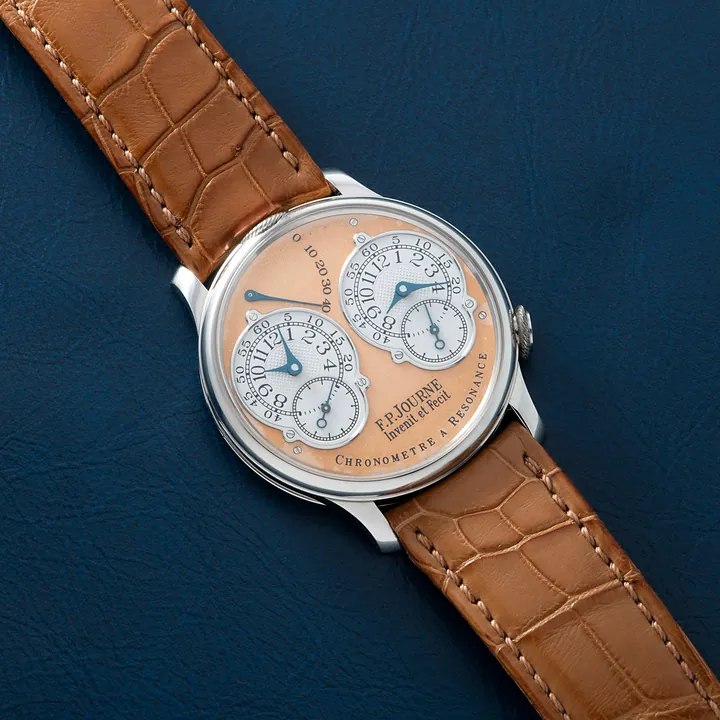
F.P. Journe Chronomètre à Résonance 'Brass Movement', 2003
Analog/Shift (dealer), New York
Wristwatches · 2019
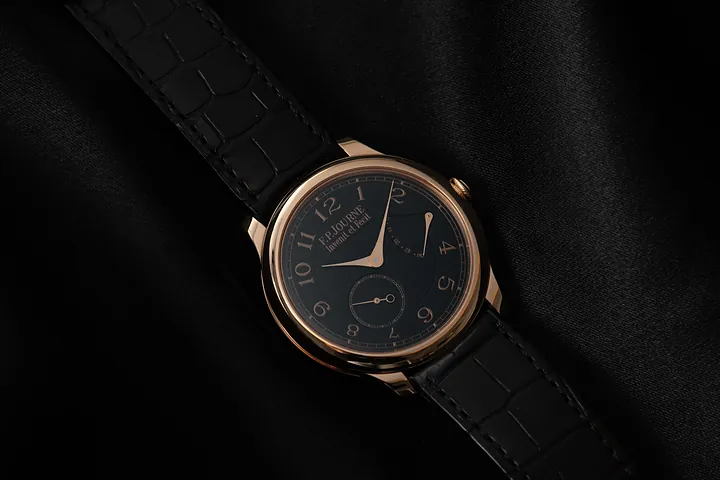
F.P. Journe Chronométre Souverain Boutique Edition, 2019
Analog/Shift (dealer), New York
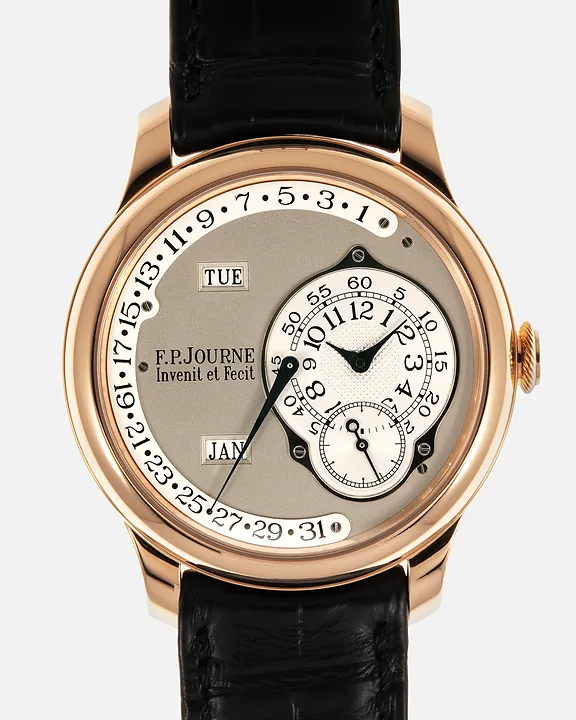
Wristwatches · 2006
F.P. Journe Octa Calendrier RG Grey 40mm, 2006
S.Song Watches (dealer), Seattle

Wristwatches · c. 2010s
Breguet Type XXI, ref. 3810, c. 2010s (Antiquorum Lot 381-24)
Antiquorum auction archive, Geneva

Wristwatches · c. 2010s
Breguet Type XXI, ref. 3810, c. 2010s (Antiquorum Lot 386-229)
Antiquorum auction archive, Geneva

Wristwatches · Sold in September 2010
Breitling Cosmonaute, ref. A 22322, Sold in September 2010
Antiquorum auction archive, Geneva

Wristwatches · c. 2010
Corum Bubble Chrono, ref. 396.150.20, c. 2010
Antiquorum auction archive, Geneva