
Wristwatches · Chronograph wristwatch
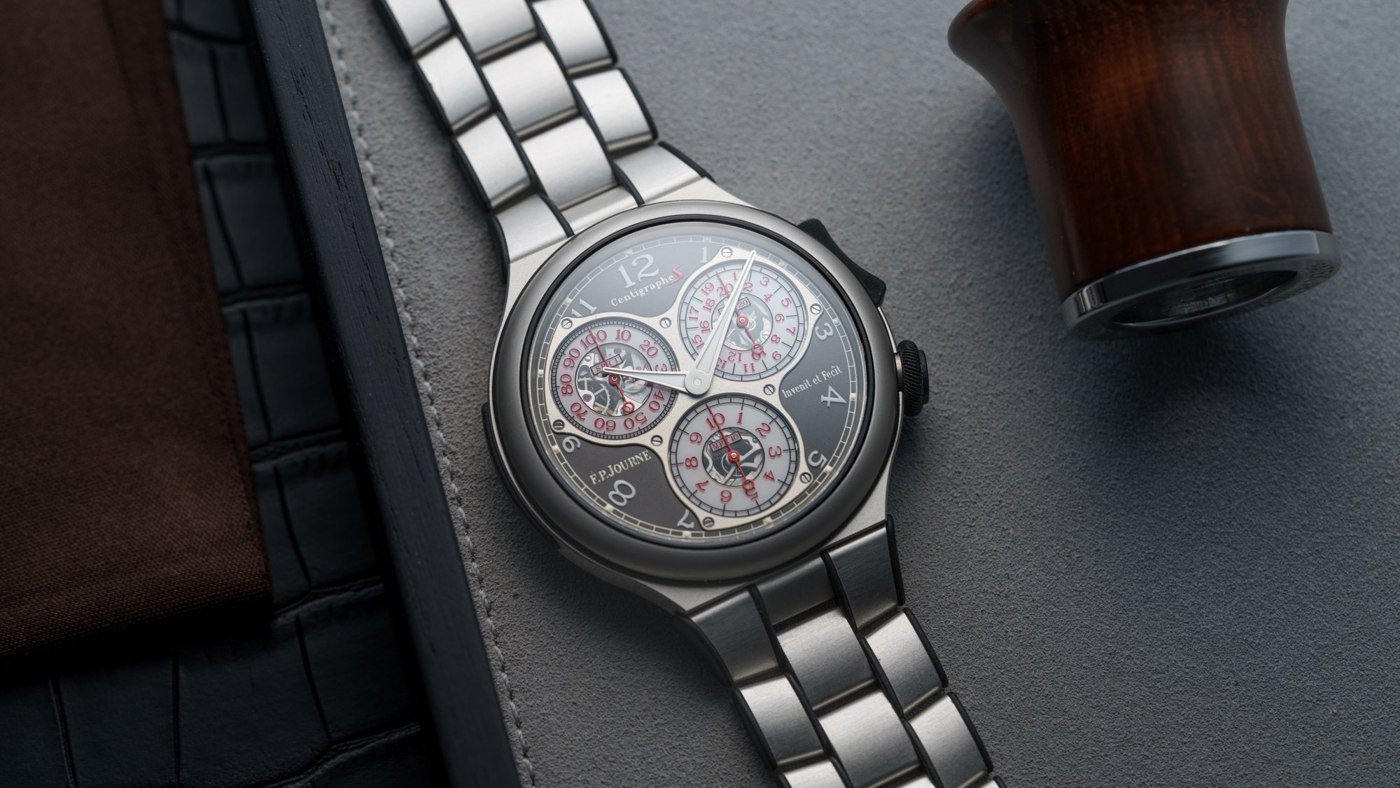
F.P. Journe Centigraphe Sport Aluminum
- Maker / attribution
- F.P. Journe (source attribution)
- Date
- 2011
- Historical period
- Contemporary Horology (2010 – Present)
- Country of origin
- Switzerland
- Object type
- Chronograph wristwatch
- Materials / technique
- Aluminum
- Holding institution
- Zamanito
- Accession / object no.
- f-p-journe-centigraphe-sport-aluminum-1bcb3aeff5
- Credit line
- Zamanito
- Catalogue title (original)
- ساعت مچی کرنوگراف F.P. Journe مدل Centigraphe Sport آلومینیومی (English)
View the source record ↗ (opens another website in a new tab)Suggest a correction
Record summary
Held and catalogued by Zamanito (object number f-p-journe-centigraphe-sport-aluminum-1bcb3aeff5), this is a chronograph wristwatch attributed to F.P. Journe, made in Switzerland, dated 2011. The Atlas places it in the Contemporary Horology period (2010 – Present) of its Wristwatches collection. Materials and techniques recorded by the source: Aluminum. The record is illustrated with 1 photograph.
Assembled from the source record's structured fields. Dates and attributions are given as the source states them; where a field is missing the Atlas leaves it blank rather than estimating.
Catalogue description
Original object description
Introduced in 2011, this F.P. Journe Centigraphe Sport constitutes the brand's inaugural execution of its mechanical chronograph crafted from aluminum. Fabricated with an aluminum alloy case, movement, and bracelet, the watch achieves an ultralight overall mass of approximately 55 grams. Rubber inserts are integrated into the case and bracelet elements to buffer against wear during athletic use. The front dial presents three separate registers capable of recording intervals as fine as 1/100th of a second, while the aluminum caliber can be inspected through a rear sapphire crystal. Following three years of manufacturing, aluminum gave way to titanium as the material of choice for the model. Showing no apparent signs of handling or wear, the catalogued specimen is graded in excellent condition, though it lacks maintenance records.
Original object description
Debuting in 2011, the timepiece is recognized as the earliest wristwatch to feature an all-aluminum construction uniting the case, internal mechanism, and integrated bracelet. This unified alloy structure keeps total mass at around 55 grams while housing a sophisticated mechanical movement. Embedded rubber buffers on the case and bracelet links provide additional shock absorption for sports activities. The front layout offers a three-subdial chronograph array, while the reverse features a sapphire window displaying the aluminum movement architecture.
Original object description
Engineered with split-second timing capabilities, the mechanical caliber accurately registers increments down to 1/100th of a second via three dedicated registers positioned across the dial. The movement is fabricated entirely upon an aluminum chassis to satisfy the watch's ultra-lightweight design objectives, remaining observable via the sapphire case back.
Original object description
Following its launch in 2011, production of the aluminum Centigraphe Sport continued for three years before titanium replaced it as the reference's primary material. In the auction catalog, this specific watch is reported to be in remarkable condition, free from detectable evidence of prior wear or handling. No historical records regarding mechanical maintenance or servicing are provided.
Historical context
Contemporary Horology (2010 – Present)
Silicon components, connected watches, optical-lattice research clocks and a thriving independent scene.
Smartwatches became the world's best-selling watches, while mechanical watchmaking focuses on craft, innovation (silicon components, new escapements) and independent makers.
Read the period in the timelineMore wristwatches from this periodEarlier: Mechanical Renaissance
Atlas type guide
Chronographs and split-seconds watches
A chronograph is a watch with an additional seconds hand that can be started, stopped and returned to zero independently of the timekeeping. Louis Moinet built an early example in 1816 and Nicolas Rieussec a recording 'chronographe' in 1821; Adolphe Nicole's heart-shaped reset cam (patented 1862) made the modern return-to-zero possible. Split-seconds (rattrapante) chronographs add a second hand that can be stopped for intermediate times; flyback chronographs restart instantly.
Chronographs were essential tools for doctors (pulsometer scales), artillery (telemeter), engineers and sport. In wristwatches, Valjoux, Venus, Lemania and later the automatic chronographs of 1969 (Zenith El Primero, the Chronomatic Calibre 11 group and Seiko 6139) are milestones.
What to look for
- Push-pieces on the case band or a single button in the crown (monopusher).
- Subsidiary registers for minutes and hours; tachymeter, telemeter or pulsometer scales.
- Column wheel versus cam control visible in the movement.
- Calibre markings of specialist makers (Valjoux, Lemania, Venus, Landeron).
Dating clues
- Pocket chronographs with heart cam reset: after 1862.
- Wrist chronographs: from c. 1910; two-button designs from the 1930s.
- Automatic chronographs: from 1969.
General guidance written by the Atlas editors about this kind of object. It is not a statement about this particular piece; for that, rely on the source record above and on physical examination.
Read next:Flyback chronographChronograph
Related records
Wristwatches · 2012
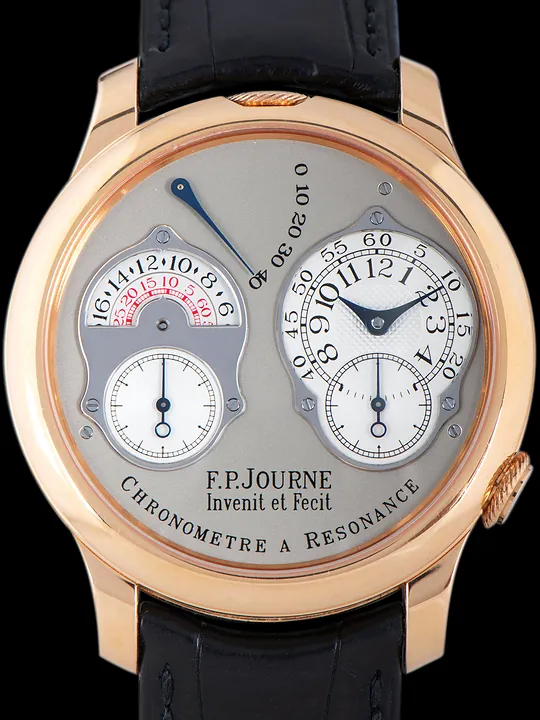
F.P. Journe Résonance "Parking Meter" 18K RG (Ref. RT) Grey Dial, 2012
Craft & Tailored (dealer), Los Angeles
Wristwatches · 2003
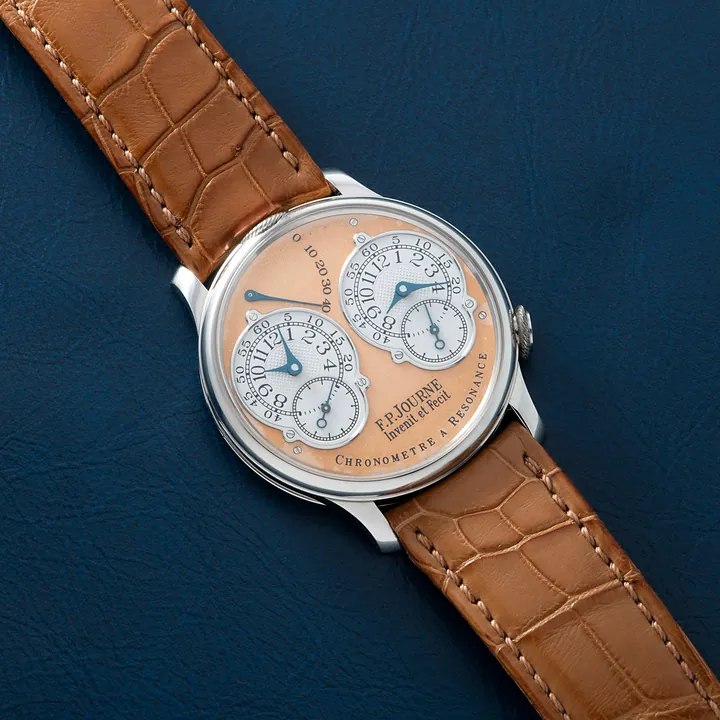
F.P. Journe Chronomètre à Résonance 'Brass Movement', 2003
Analog/Shift (dealer), New York
Wristwatches · 2019
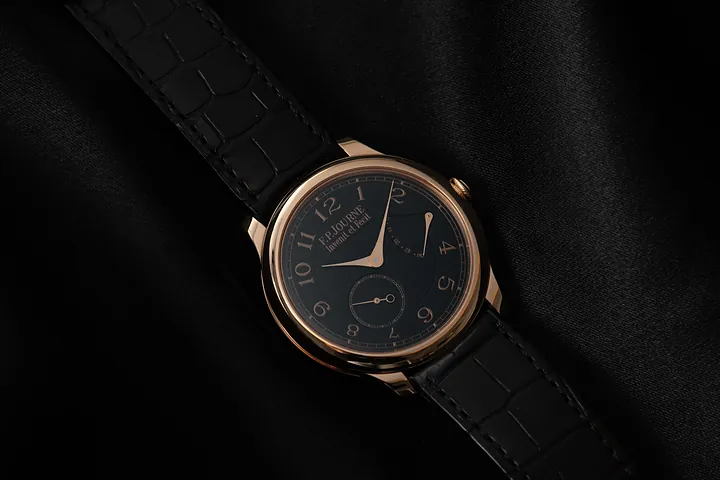
F.P. Journe Chronométre Souverain Boutique Edition, 2019
Analog/Shift (dealer), New York
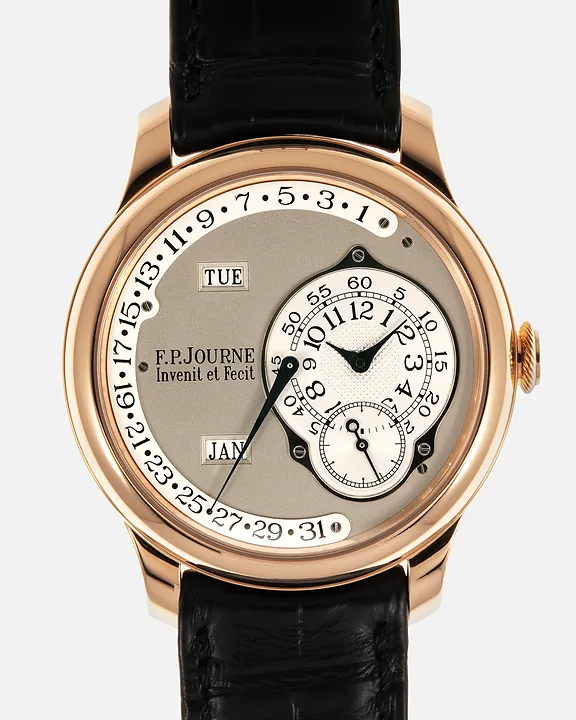
Wristwatches · 2006
F.P. Journe Octa Calendrier RG Grey 40mm, 2006
S.Song Watches (dealer), Seattle

Wristwatches · c. 2010s
Breguet Type XXI, ref. 3810, c. 2010s (Antiquorum Lot 381-24)
Antiquorum auction archive, Geneva

Wristwatches · c. 2010s
Breguet Type XXI, ref. 3810, c. 2010s (Antiquorum Lot 386-229)
Antiquorum auction archive, Geneva

Wristwatches · Sold in September 2010
Breitling Cosmonaute, ref. A 22322, Sold in September 2010
Antiquorum auction archive, Geneva

Wristwatches · c. 2010
Corum Bubble Chrono, ref. 396.150.20, c. 2010
Antiquorum auction archive, Geneva