
Clocks · Clock
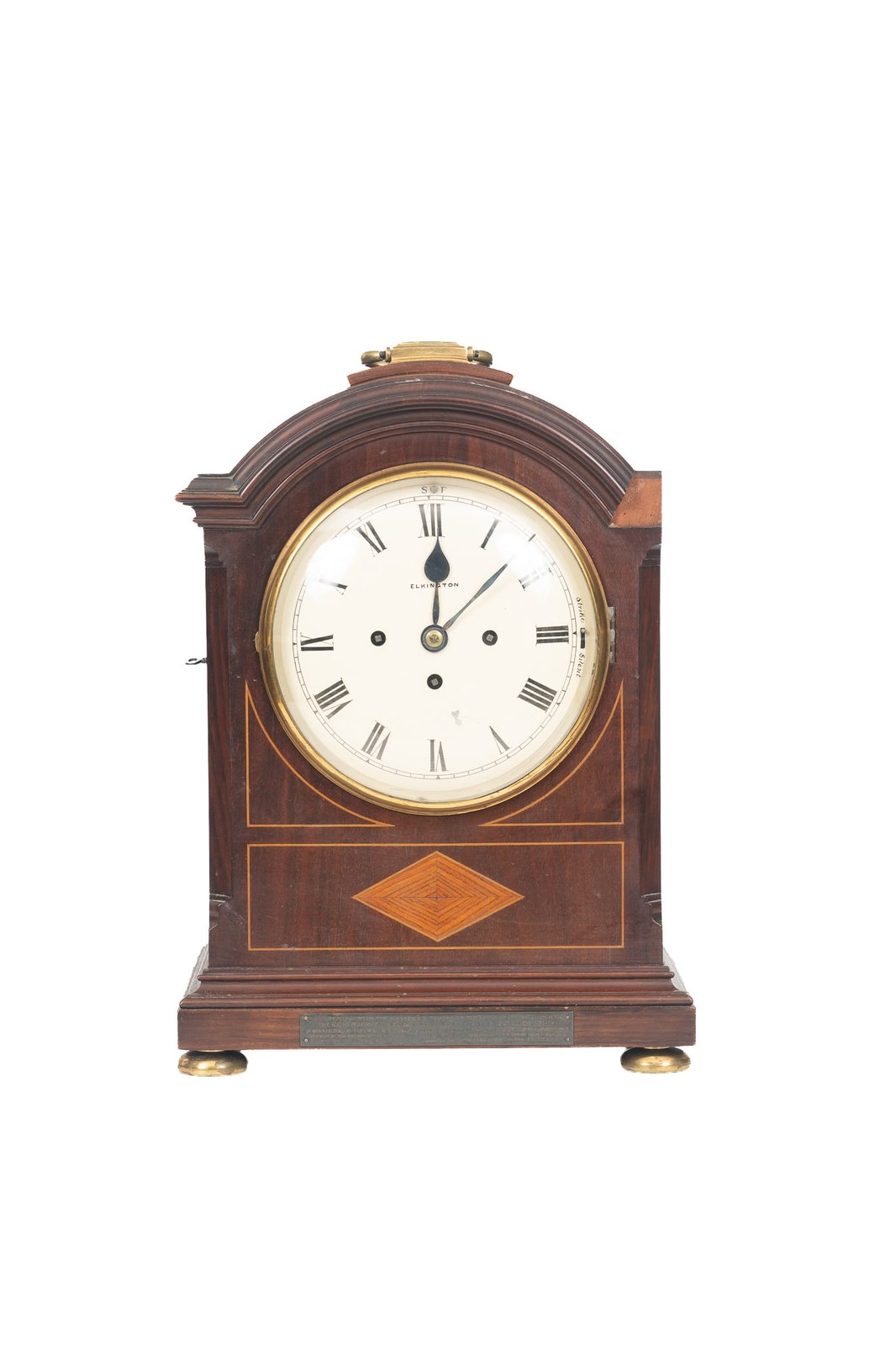
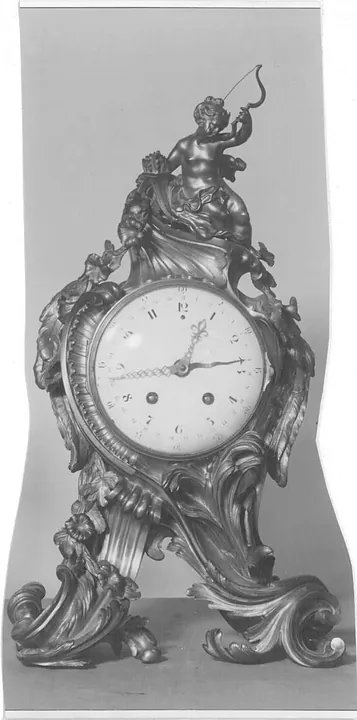
Elkington & Co. Presentation Bracket Clock Lord Mayor's Titanic Relief Fund circa 1912
- Maker / attribution
- Unrecorded in source
- Date
- c. 1912
- Historical period
- Golden Age of Mechanical Watchmaking (1900 – 1945)
- Country of origin
- Unrecorded in source
- Object type
- Clock
- Dimensions
- 16 x 11.5 x 8 in
- Auction house
- LiveAuctioneers auction archive
- Lot
- Item 243279010
- Credit line
- Auction lot record: lot 64, The Southern Historian's Collection, Bryant Estate Sales (2026), via LiveAuctioneers
- Catalogue title (original)
- Elkington & Co. Presentation Bracket Clock Lord Mayor's Titanic Relief Fund Circa 1912 (English)
View the source record (auction lot) ↗ (opens another website in a new tab)Suggest a correction
Record summary
Catalogued by LiveAuctioneers auction archive (lot Item 243279010), this is a clock, dated c. 1912. The Atlas places it in the Golden Age of Mechanical Watchmaking period (1900 – 1945) of its Clocks collection. Recorded dimensions: 16 x 11.5 x 8 in. The record is illustrated with 4 photographs.
Assembled from the source record's structured fields. Dates and attributions are given as the source states them; where a field is missing the Atlas leaves it blank rather than estimating.
Catalogue description
Lot description — Bryant Estate Sales
Presentation bracket clock by Elkington & Co., made in connection with the Lord Mayor of London's Mansion House Titanic Relief Fund, opened in April 1912. Engraved presentation plaque on the lower front base reads: "PRESENTED WITH THE UNANIMOUS THANKS OF THE COURT OF COMMON COUNCIL TO THE RIGHT HONORABLE SIR THOMAS BOOR CROSBY M.D. LL.D. LORD MAYOR 1911-12 IN ACKNOWLEDGMENT OF HIS ENERGETIC DIGNIFIED AND SUCCESSFUL FULFILMENT OF THE VARIED DUTIES OF THAT IMPORTANT OFFICE ESPECIALLY ON THE OCCASION OF THE RECEPTION OF THEIR MAJESTIES THE KING AND QUEEN ON THEIR RETURN FROM INDIA AND IN CONNECTION WITH THE FUND FOR THE RELIEF OF SUFFERERS BY THE APPALLING LOSS OF THE S.S. TITANIC." Maker: Elkington & Co. Origin: England Date: Circa 1912 Dimensions: 16" H x 11 1/2" W x 8" D Condition: Not in running condition; pendulum missing; upper right trim missing; front right leg is loose; enameled face shows spots with chipping. RECOMMENDED SHIPPERS For your convenience, the following shippers are familiar with our pickup location and can provide quotes: Pakmail Lee Branch (highly recommended) Chandler Pruitt & Caleb Gore 1401 Doug Baker Blvd, Ste 107, Birmingham, AL 35242 (205) 980-8879 | US738@pakmail.com Handles everything from the smallest objects to life-size sculpture, with custom crating available. Contact Caleb for a quote; your item will be well cared for. The UPS Store, Mountain Brook Milan Manville, Store Manager 217 Country Club Park, Birmingham, AL 35213 (205) 870-7797 | store3213@theupsstore.com The UPS Store, Grants Mill 1284 Grants Mill Rd, Ste 140, Irondale, AL 35210 (205) 460-8350 or (205) 588-7589 | store7888@theupsstore.com Large Objects and Furniture SME Logistics (Texas): Mark Mauricio, (210) 632-7301 | Smelogistics210@gmail.com Roberson Logistics (East Coast): Jeremy Roberson, (302) 480-0207 Bryant Estate Sales, LLC provides these referrals as a courtesy and is not responsible for the services of third-party shippers. Please request a shipping quote before bidding. CONDITION DISCLAIMER Condition reports are provided as a courtesy by Bryant Estate Sales, LLC and represent our opinion based on visual inspection only. They are not a guarantee or warranty of any kind. All lots are sold "as is, where is." The absence of a condition statement does not imply that a lot is free of wear, imperfections, restoration, or defects. Bidders are strongly encouraged to review all photographs and to request additional images or information prior to bidding.
Historical context
Golden Age of Mechanical Watchmaking (1900 – 1945)
The wristwatch displaces the pocket watch; waterproof cases, self-winding and grand complications.
Between 1900 and 1945 clocks were electrified: master-clock systems ran factories and offices, synchronous mains clocks entered homes, and the Shortt free-pendulum clock set new standards of accuracy before the first quartz clocks (1927). Art Deco design reshaped mantel and table clocks.
Read the period in the timelineMore clocks from this periodEarlier: Industrial Revolution
Atlas type guide
Bracket, table and spring-driven clocks
Spring-driven clocks freed timekeeping from the hanging weight. The coiled mainspring, documented from the fifteenth century, made portable table clocks possible; to even out its declining force, makers used the fusee, a conical pulley connected to the barrel by a gut line or chain. Renaissance table clocks from Augsburg and Nuremberg — drum-shaped, square or tower-shaped in gilt brass — were luxury scientific objects, often with astronomical dials and alarms.
After the pendulum, English makers developed the bracket clock: a wooden case with a carrying handle, a short pendulum with a verge escapement, and often repeating work to sound the hours on demand at night. Later examples use the anchor escapement. In the nineteenth century, 'table clock' became a broad term for spring clocks of every nationality.
What to look for
- A fusee in the movement (cone-shaped pulley) and the type of line — gut or chain.
- Verge escapement with a short bob pendulum, often with a decoratively engraved backplate.
- Repeat cords or buttons that make the clock strike again on demand.
- Gilt-brass engraved cases and horizontal dials on Renaissance pieces.
- Case shapes: inverted bell, bell top, break-arch, lancet or balloon.
Dating clues
- Drum and tower table clocks: c. 1520–1650.
- Ebony veneered English bracket clocks with verge escapements: c. 1670–1800.
- Engraved backplates were usual on English clocks until c. 1800, then generally plain.
General guidance written by the Atlas editors about this kind of object. It is not a statement about this particular piece; for that, rely on the source record above and on physical examination.
Related records
Clocks · 1890–1930
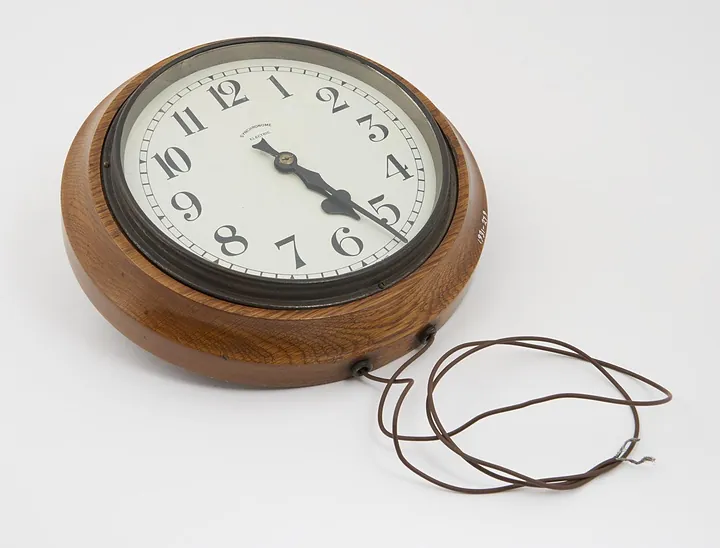
Clock with 8-inch impulse dial, by the Synchronome Company Limited, England, 1890–1930.
Science Museum Group, London
Clocks · c.1900
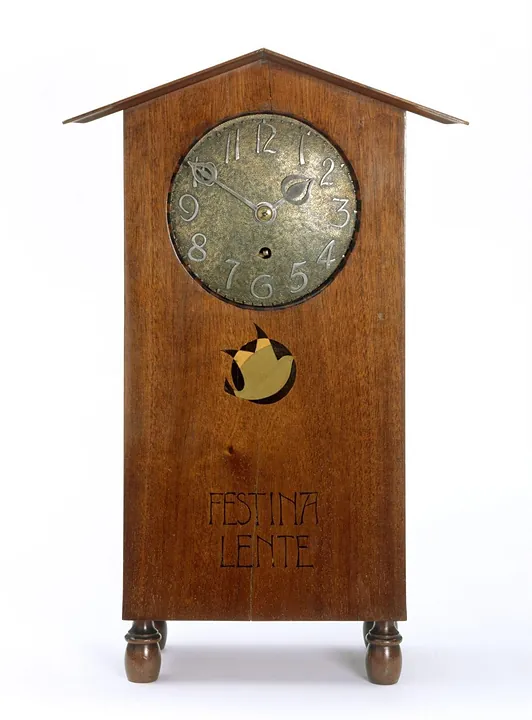
Clock by Mackay Hugh Baillie Scott, Bedfordshire, c.1900
Victoria and Albert Museum, London
Clocks · c. 1900
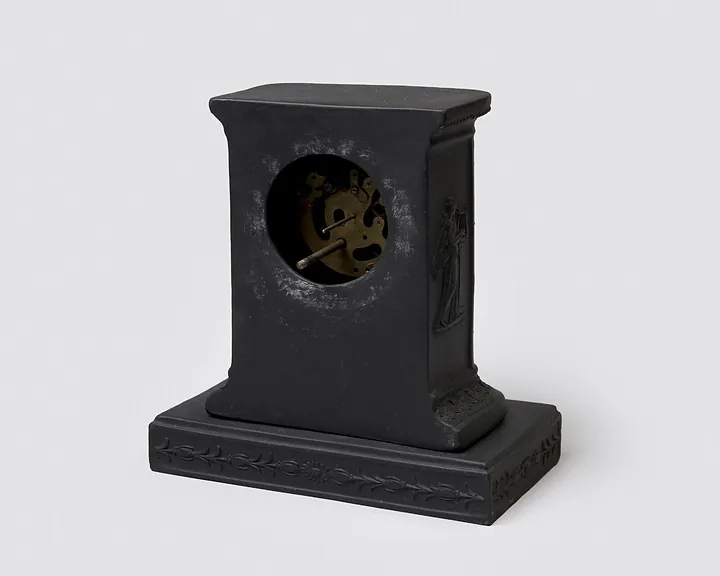
Clock, black basalt, brass, Josiah Wedgwood and Sons, Etruria, c. 1900
Victoria and Albert Museum, London
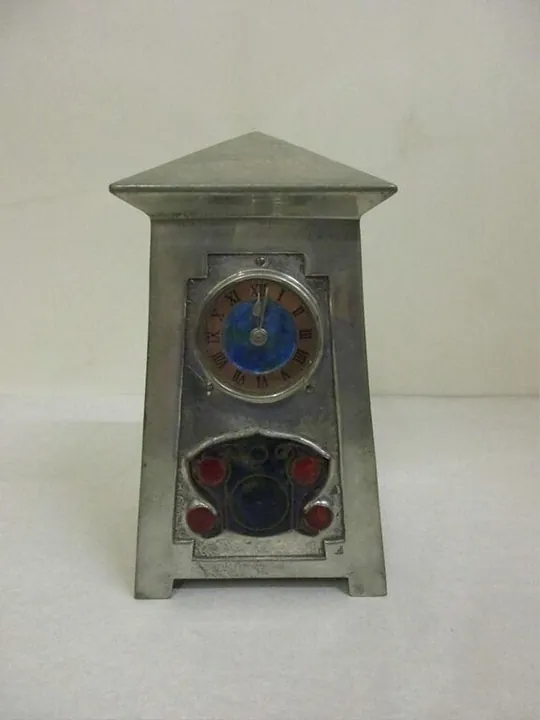
Clocks · c.1903-1904
Clock, pewter, made for Liberty& Co., England. 1903-4.
Victoria and Albert Museum, London
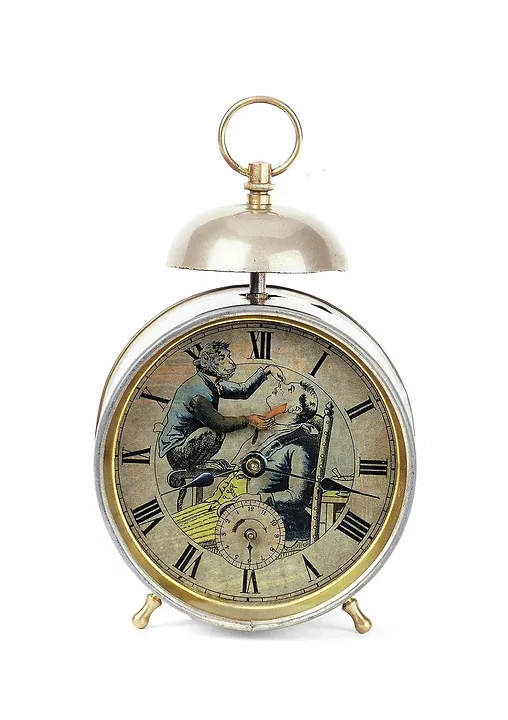
Clocks · c. 1900
Alarm clock by Union Clock Company, Germany, c. 1900
German Clock Museum
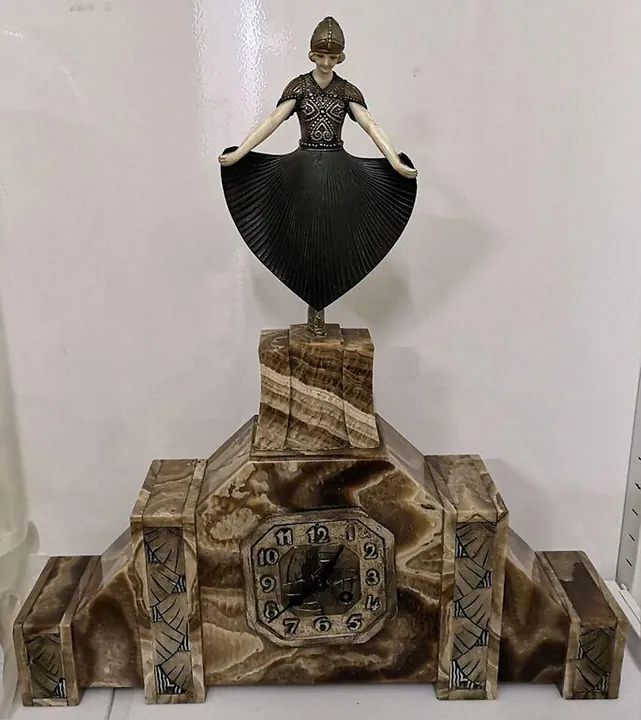
Clocks · 20th century
Base Metal, 20th c. Bronze, marble and ivory clock by Chiparus
Victoria and Albert Museum, London
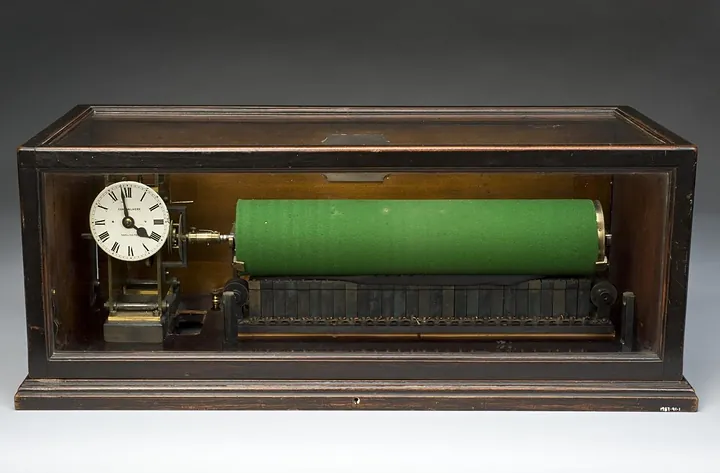
Clocks · 1900–1939
Clock by Cox-Walkers of Darlington, England, 1900–1939
Science Museum Group, London
Clocks · 1900–1999
Clock by Französisch (Schule), 1900–1999
Fine Arts Museum Vienna