
Wristwatches · Wristwatch
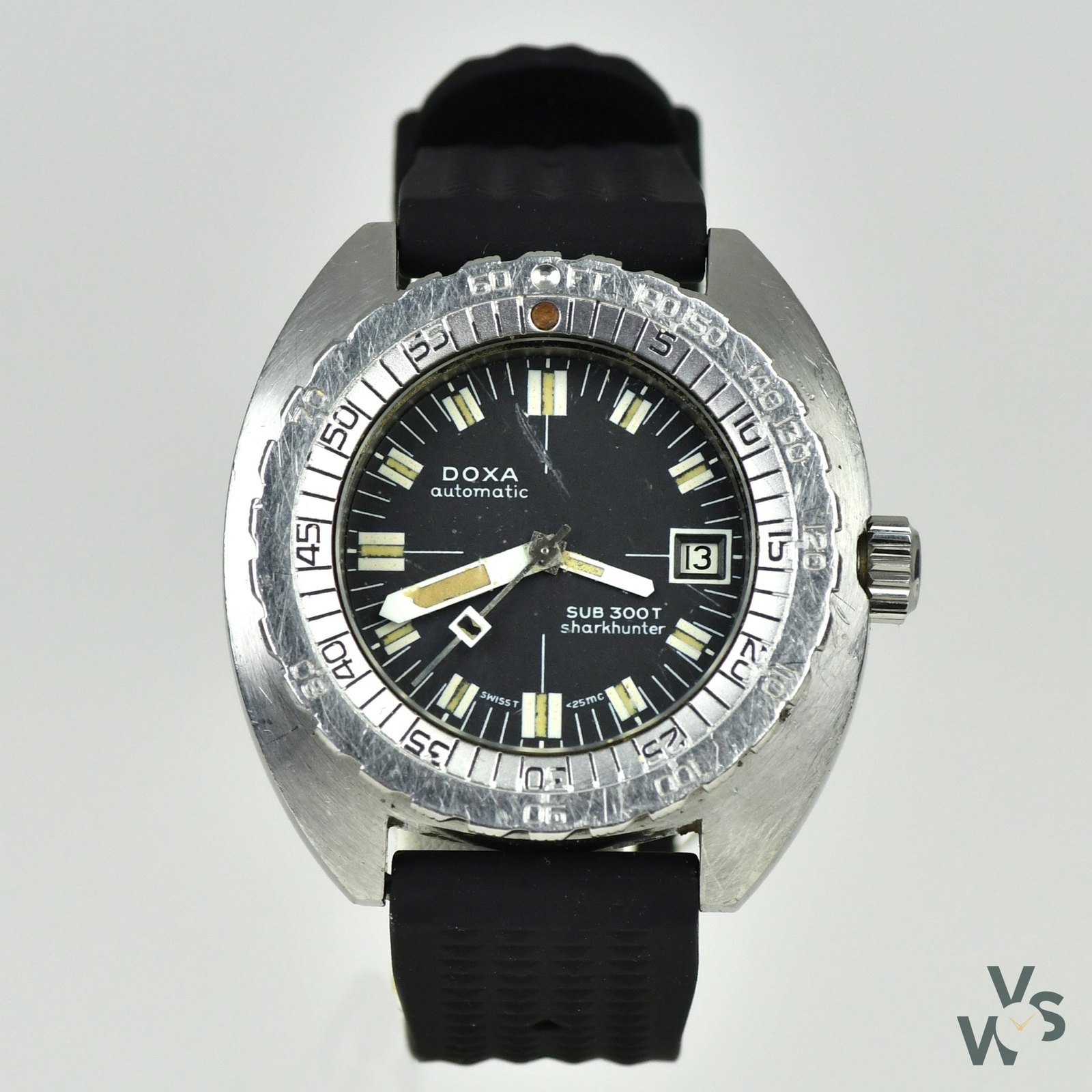
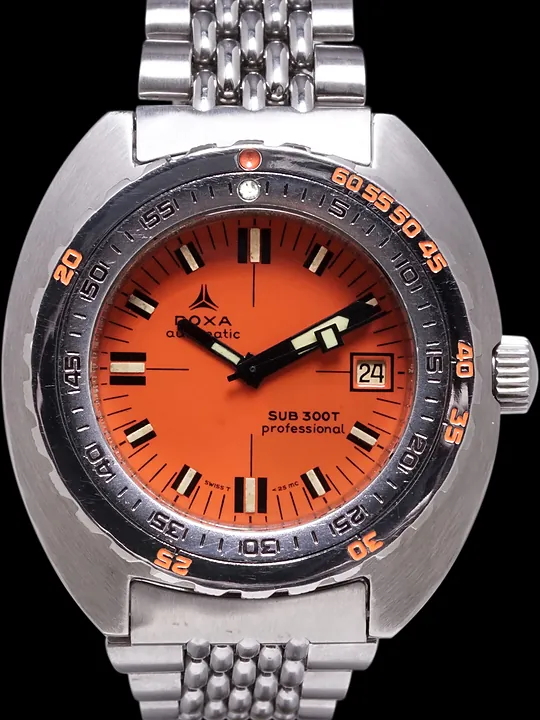
Doxa Automatic Sub 300T 'Sharkhunter', Professional Divers' Watch, Black Dial, circa 1969
- Maker / attribution
- DOXA (maker)
- Date
- c. 1969
- Historical period
- Quartz Revolution (1969 – 1990)
- Country of origin
- Switzerland
- Object type
- Wristwatch
- Dimensions
- Case 42 mm
- Stock no.
- vws0748
- Credit line
- Dealer listing, Vintage Watch Specialist (vws0748)
- Catalogue title (original)
- Doxa Automatic Sub 300T 'Sharkhunter' - Professional Divers' Watch - Black Dial c.1969 ***SOLD*** (English)
View the source record (dealer listing) ↗ (opens another website in a new tab)Suggest a correction
Record summary
Catalogued by Vintage Watch Specialist (dealer), United Kingdom (stock number vws0748), this is a wristwatch by DOXA, made in Switzerland, dated c. 1969. The Atlas places it in the Quartz Revolution period (1969 – 1990) of its Wristwatches collection. Recorded dimensions: Case 42 mm. The record is illustrated with 5 photographs.
Assembled from the source record's structured fields. Dates and attributions are given as the source states them; where a field is missing the Atlas leaves it blank rather than estimating.
Catalogue description
Dealer description — Vintage Watch Specialist
We Are Sorry But This Watch Is Now Sold - If However You Are Looking To Buy Or Sell Something Similar Then Please Email Sales@Vintagewatchspecialist.Com Or Whatsapp/Call +44 7831 454658. Thanks Gents Vintage 1969 Doxa Automatic Sub 300T ‘Sharkhunter’ Wrist Watch In 1969, Doxa launched the Sub 300T, the first general release diver’s wrist watch to feature a helium release valve. Still in operation today, the innovative and industry-leading Doxa company was founded back in 1889 by Georges Ducommun, an ambitious young craftsman who started out as a maker of exquisite, hand decorated pocket watches. Ducommun became an innovator within the industry in 1908, when he patented a pioneering 8-day mechanical watch movement that was placed in a larger case, creating the perfect timepiece for the new leisure pursuits of the era - aviation and motor cars. In the 1960s, when Jacques-Yves Cousteau co-developed the aqua-lung and popularized diving as a sport, Doxa decided to add a dive watch to its wristwatch collection, forming a research team with several professional divers to develop the Sub 300T, an affordable sports divers watch for both pros and recreational divers. The Doxa Sub 300T included many innovative features that we take for granted today but were revolutionary at the time. It’s still regarded as a reliable, comfortable and highly legible timepiece that’s as easy to use as it is easy on the eye. The ‘Sharkhunter’ was one of six Swiss-made Sub 300T models and is recognizable by its distinctive matte black dial. The model also has a rotatable steel bezel, screw down crown and features the Doxa yacht logo, crisply engraved on the case back. What’s on offer: This piece has recently been professionally serviced and pressure tested to 6-bar. It’s in full working order with a brand new unsigned crown and tube and is in excellent condition overall, with only a small, superficial mark on the crystal glass (this can be replaced should you wish, at your request). The lume insert is also missing from the seconds hand! This watch will be fitted with a brand new, retro black rubber tropic strap. Additional information: Made from: Case: stainless steel (Sharp and unpolished)! Dial : Matte black with Tritium lume. Crystal : Sapphire crystal glass. Bracelet : New retro black rubber tropic strap. Technical specifications Winding : Self winding Movement type: Automatic Calibre: 2852. Jewels: 17. Purchase details Condition : Excellent for its age. One small superficial mark on crystal glass. Model reference : Sub 300T Sharkhunter Date of issue: 1969. Guarantee Supplied with a 12-month Vintage Watch Specialist guarantee. Dimensions Width: (without crown) 42mm Height: (lug to lug) 45mm Lug width : 20mm. Wrist size: Adjustable. More information Giannopoulos, I. (2016, September 2). Historical Perspective – The Doxa Sub 300, The Dive Watch Personified . Retrieved August 23, 2017, from Monochrome: https://monochrome-watches.com/historical-perspective-the-doxa-sub-300-the-dive-watch-personified/ 96 Normal 0 false false false EN-US X-NONE X-NONE
Historical context
Quartz Revolution (1969 – 1990)
Seiko's Astron begins mass quartz timekeeping; traditional industries contract sharply.
Quartz and digital watches transformed the market after 1969. Swiss employment collapsed, Japanese and Hong Kong production soared, and the Swatch (1983) helped the Swiss industry recover; mechanical watches survived as luxury goods.
Read the period in the timelineMore wristwatches from this periodEarlier: Modern Mechanical Horology
Atlas type guide
Dive and water-resistant watches
Keeping water and dust out of a wristwatch was a long-standing challenge. Rolex's screw-down Oyster case (1926) and Omega's Marine (1932) were landmarks; in the early 1950s Blancpain's Fifty Fathoms and Rolex's Submariner defined the professional dive watch with rotating bezels for timing dives, luminous dials and high water resistance. The ISO 6425 standard (1982) later codified what a 'diver's watch' must do.
Dive watches became icons of post-war design and exploration, and their evolution — helium escape valves, ceramic bezels, saturation-diving depth ratings — records the history of underwater work.
What to look for
- Unidirectional or bidirectional rotating bezel with minute markings.
- Screw-down crown and case back; depth rating printed on the dial.
- Luminous hands and markers (radium before c. 1960, tritium c. 1960–1998, then Super-LumiNova).
- Reference numbers on the case between the lugs or inside the back.
Dating clues
- Screw-down Oyster cases: from 1926.
- Professional dive watches: from 1953.
- Tritium 'T' marks on dials: c. 1960–1998.
General guidance written by the Atlas editors about this kind of object. It is not a statement about this particular piece; for that, rely on the source record above and on physical examination.
Related records
Wristwatches · 2002
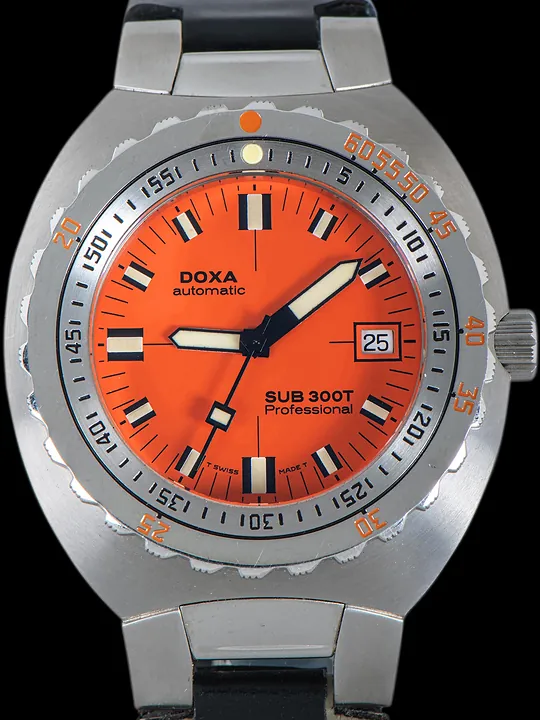
Doxa Sub 300T Professional (Ref. 30010), 2002
Craft & Tailored (dealer), Los Angeles
Wristwatches · 1970s
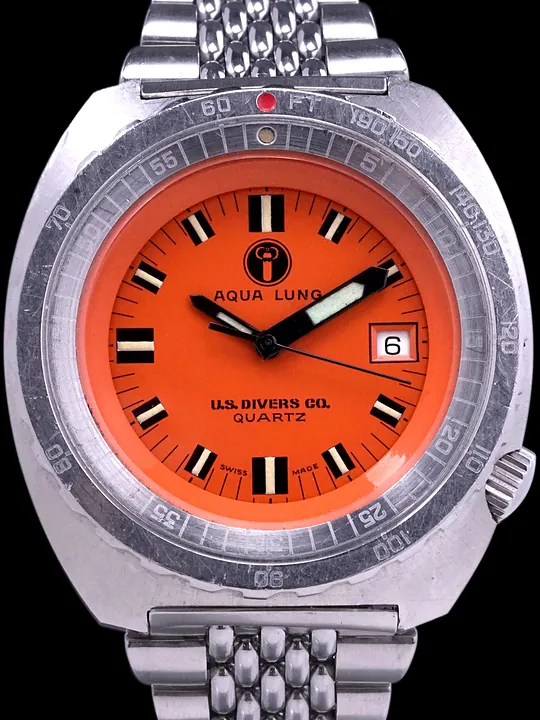
Aqua Lung Quartz Diver (Ref. 7336-000) "U.S Divers Co.", 1970s
Craft & Tailored (dealer), Los Angeles
Wristwatches · 1983
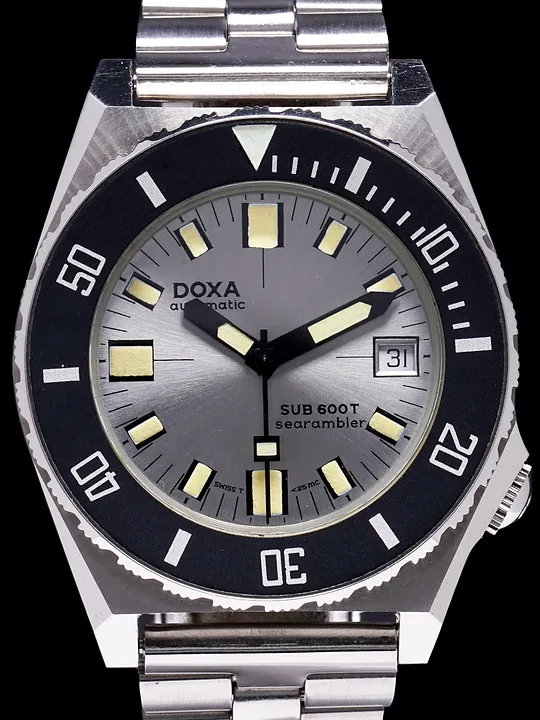
Doxa Sub 600T Searambler Silver Dial (Aubry Era), 1983
Craft & Tailored (dealer), Los Angeles
Wristwatches · 1970s
Doxa Sub 300T Professional (Synchron Era), 1970s
Craft & Tailored (dealer), Los Angeles

Wristwatches · 1970
Wristwatch by Heno, Switzerland, 1970
Museum Rotterdam

Wristwatches · 1960–1986
'Tri-Compax' calendar chronograph wristwatch in gold case, by Universal, Geneva, Switzerland, 1960–1986.
Science Museum Group, London

Wristwatches · 1969–1970
Beta 21 Quartz wristwatch movement, made in Switzerland, 1970.
Science Museum Group, London

Wristwatches · c. 1969
Omega Speedmaster Moonwatch, ref. 145022-69st, c. 1969
Antiquorum auction archive, Geneva