
Wristwatches · Wristwatch
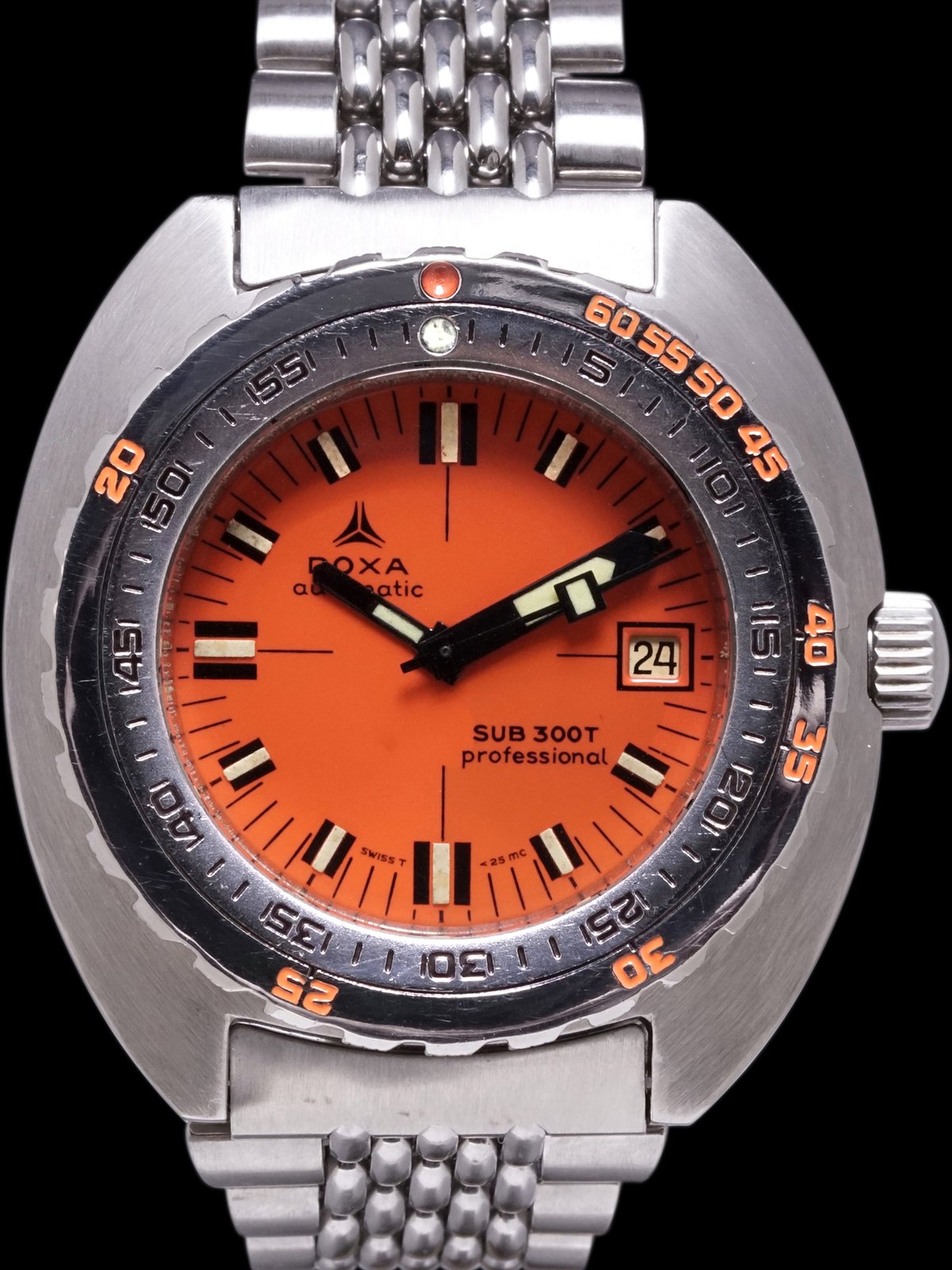
Doxa Sub 300T Professional (Synchron Era), 1970s
- Maker / attribution
- DOXA (maker)
- Date
- 1970s
- Historical period
- Quartz Revolution (1969 – 1990)
- Country of origin
- Switzerland
- Object type
- Wristwatch
- Stock no.
- DXPRO300T
- Credit line
- Dealer listing, Craft & Tailored (DXPRO300T)
- Catalogue title (original)
- 1970s DOXA Sub 300T Professional (Synchron Era) (English)
View the source record (dealer listing) ↗ (opens another website in a new tab)Suggest a correction
Record summary
Catalogued by Craft & Tailored (dealer), Los Angeles (stock number DXPRO300T), this is a wristwatch by DOXA, made in Switzerland, dated 1970s. The Atlas places it in the Quartz Revolution period (1969 – 1990) of its Wristwatches collection. The record is illustrated with 6 photographs.
Assembled from the source record's structured fields. Dates and attributions are given as the source states them; where a field is missing the Atlas leaves it blank rather than estimating.
Catalogue description
Dealer description — Craft & Tailored
Doxa S.A. was founded in 1889 by Georges Ducommun as a maker of dress watches and other timepieces. In the late 1960s, Doxa decided to dedicate resources to produce a timepiece to be used exclusively for diving. Doxa consulted with various Navy dive teams and divers including Jacques Cousteau who was then chairman of "U.S. Divers." Doxa's innovative watches were quickly adopted by both commercial and military divers. Jacques Cousteau, who at the time was the head of U.S. Divers, was so impressed by the Doxa Sub300T that he became a distributor of the reference in the United States and co-branded the dial of the Sub300T with the U.S. Divers logo. The Doxa company went through many acquisitions and changed ownership a few times over the years. Synchron bought Doxa in the late 1960s and added the brand to a group that also included Ernest Borel and Cyma, and was purchase again in 1978 by the Aubry Freres Company. The second-generation or “Synchron Era" as many refer to it, was aimed to be the watch of choice for the emerging recreational diving community. With sturdy cases, high visibility dials, and smart bezel design, the Synchron era Doxa Subs quickly became the watch of choice for recreational divers in both America and Europe. SPECS Stock # DXPRO300T Brand DOXA Style Sub 300T Model Professional Serial N/A Size Men's Material Stainless Steel Dial Orange Millimeters 42 Bracelet Doxa "Beads of Rice" Micro-Adjust Stretch Bracelet CASE & BRACELET The excellent case has seen only light polishing in the past and retains strong dimensions with minimal signs of use. The stainless steel unidirectional bezel is in stunning condition, showing almost no signs of use and retaining its orange enamel and tritium pearl at the 12 o’clock position. The unsigned crown is believed to be an early replacement. The original mineral glass crystal is clean and shows no wear. The original Doxa signed "bead of rice" stretch bracelet features a unique ratcheting micro-adjust divers extension within the clasp, the bracelet shows some stretch and will fit a 7.5-inch wrist DIAL & HANDS The high visibility orange Professional dial is in beautiful vintage condition and displays some light surface bubbling that is only visible under a loupe. The tritium lume plots have taken on a satisfying creamy yellow patina and exhibit no degradation when inspected under U.V. light. The original tritium hands match the dial perfectly and display no degradation under U.V. light inspection. ACCESSORIES None. The watch is keeping time perfectly previous service history is unknown.
Historical context
Quartz Revolution (1969 – 1990)
Seiko's Astron begins mass quartz timekeeping; traditional industries contract sharply.
Quartz and digital watches transformed the market after 1969. Swiss employment collapsed, Japanese and Hong Kong production soared, and the Swatch (1983) helped the Swiss industry recover; mechanical watches survived as luxury goods.
Read the period in the timelineMore wristwatches from this periodEarlier: Modern Mechanical Horology
Atlas type guide
Wristwatches
Bracelet watches were worn by women from the early nineteenth century — Breguet made one for Caroline Murat, Queen of Naples, in 1810–12 — but the wristwatch only became a man's instrument with military use and aviation in the early twentieth century. Between the World Wars it overtook the pocket watch; the 1920s and 1930s brought rectangular Art Deco cases, water-resistant cases and the first automatic winding systems.
After 1945 the wristwatch became a carrier of identity — dress watches, sports and dive watches, chronographs, calendars — produced by Swiss, American, Japanese, German, Soviet and Chinese industries. The quartz revolution after 1969 and the mechanical renaissance since the 1990s, including the rise of independent watchmakers, complete the story.
What to look for
- The reference number (between the lugs or inside the case back) and serial number, the starting point for dating.
- The calibre: its maker and number are often stamped under the dial or on the bridge.
- Originality of dial, hands and crown — refinished ('redial') dials are common.
- Case material marks: 18K/750, 14K/585, stainless steel, gold-filled, plated.
Dating clues
- Wire-lug cases: before c. 1925.
- Water-resistant screw-down cases: from 1926.
- Quartz movements: from 1969; sapphire crystals widespread after c. 1980.
General guidance written by the Atlas editors about this kind of object. It is not a statement about this particular piece; for that, rely on the source record above and on physical examination.
Related records
Wristwatches · 2002
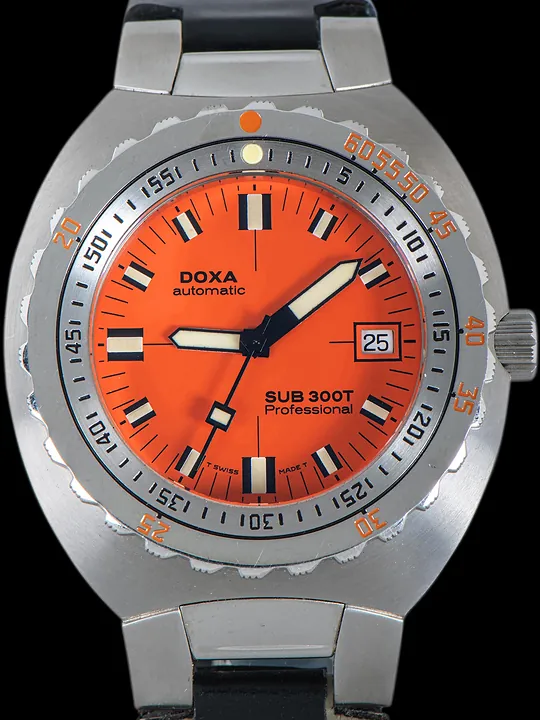
Doxa Sub 300T Professional (Ref. 30010), 2002
Craft & Tailored (dealer), Los Angeles
Wristwatches · 1970s
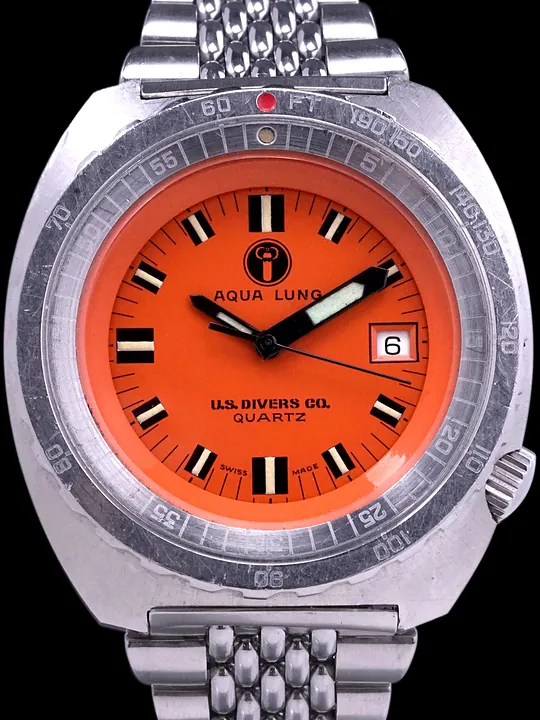
Aqua Lung Quartz Diver (Ref. 7336-000) "U.S Divers Co.", 1970s
Craft & Tailored (dealer), Los Angeles
Wristwatches · 1983
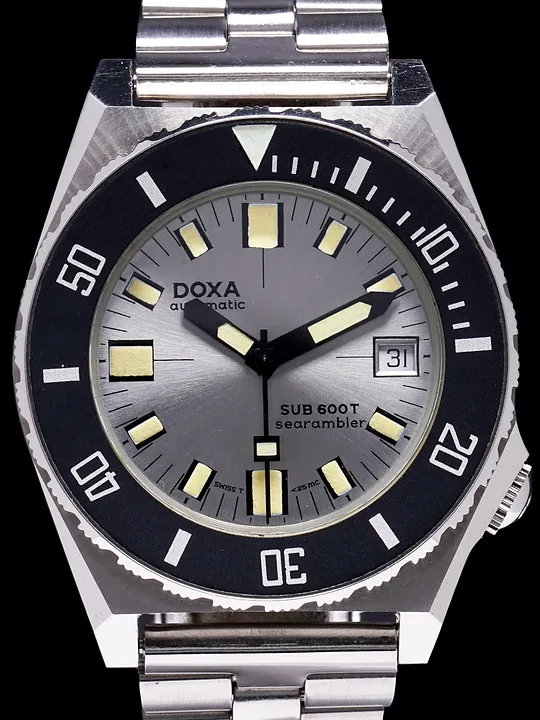
Doxa Sub 600T Searambler Silver Dial (Aubry Era), 1983
Craft & Tailored (dealer), Los Angeles
Wristwatches · 1970s
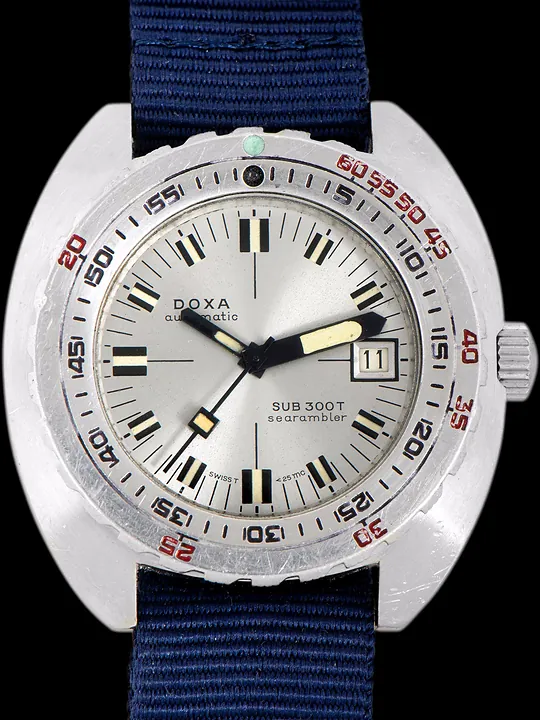
Doxa Sub 300T Searambler (Ref. 11899 4), 1970s
Craft & Tailored (dealer), Los Angeles

Wristwatches · 1970
Wristwatch by Heno, Switzerland, 1970
Museum Rotterdam

Wristwatches · 1960–1986
'Tri-Compax' calendar chronograph wristwatch in gold case, by Universal, Geneva, Switzerland, 1960–1986.
Science Museum Group, London

Wristwatches · 1969–1970
Beta 21 Quartz wristwatch movement, made in Switzerland, 1970.
Science Museum Group, London

Wristwatches · c. 1969
Omega Speedmaster Moonwatch, ref. 145022-69st, c. 1969
Antiquorum auction archive, Geneva