
Movements & Components · Dial
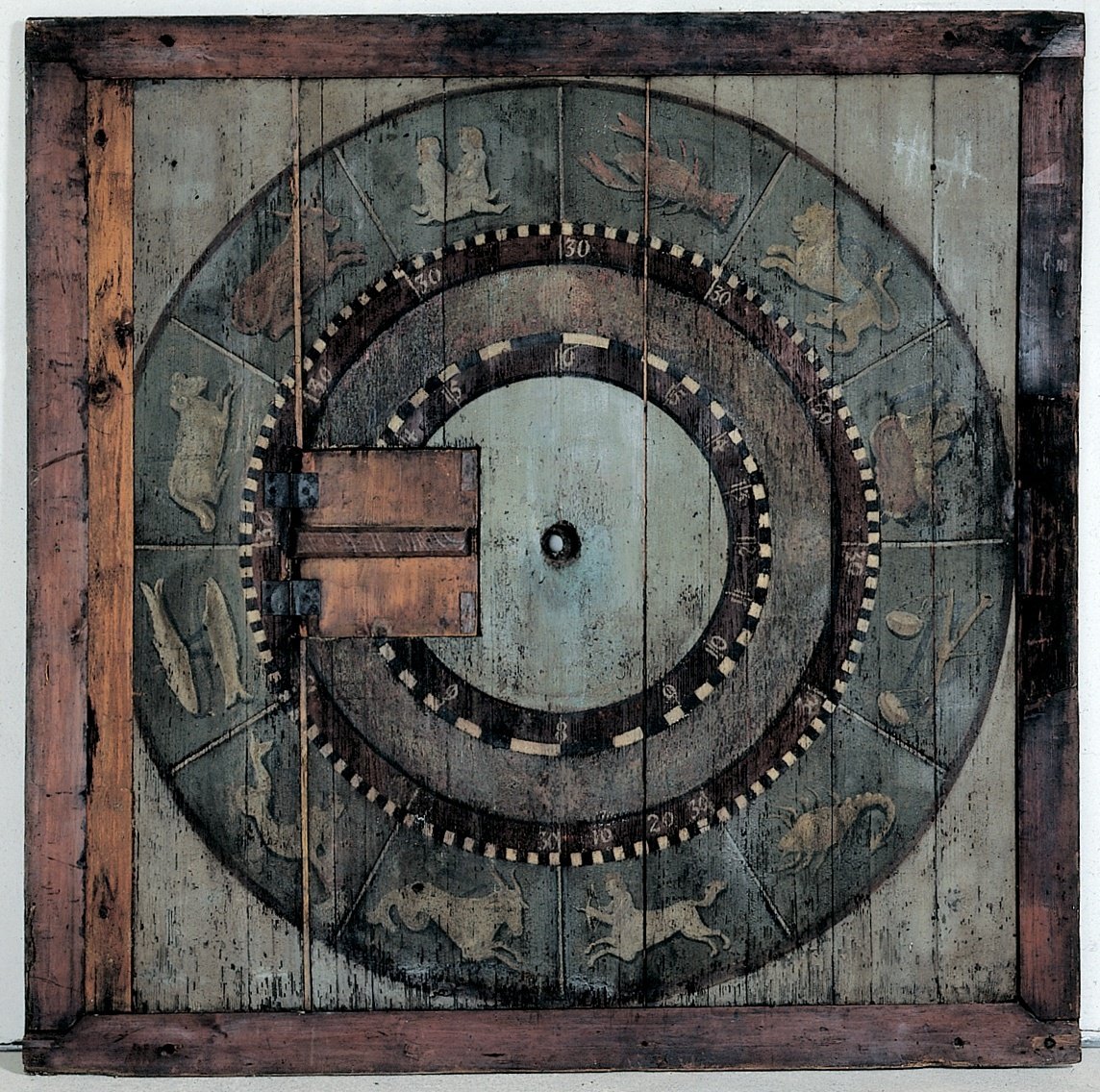
Dial by Johannes Stöffler, 1511
- Maker / attribution
- Johannes Stöffler (Created)
- Date
- 1511
- Historical period
- Renaissance Horology (1400 – 1600)
- Country of origin
- Unrecorded in source
- Place
- Tübingen
- Object type
- Dial
- Materials / technique
- Tannenholz, bemalt
- Dimensions
- H 195 cm; B 195 cm
- Holding institution
- Stadtmuseum Tübingen
- Accession / object no.
- 10288
- Credit line
- Stadtmuseum Tübingen
- Catalogue title (original)
- Zifferblatt der Tübinger Rathausuhr (German)
View the source record ↗ (opens another website in a new tab)Suggest a correction
Record summary
Held and catalogued by Stadtmuseum Tübingen (object number 10288), this is a dial by Johannes Stöffler, made in Tübingen, dated 1511. The Atlas places it in the Renaissance Horology period (1400 – 1600) of its Movements & Components collection. Materials and techniques recorded by the source: Tannenholz, bemalt. Recorded dimensions: H 195 cm; B 195 cm. The record is illustrated with 1 photograph.
Assembled from the source record's structured fields. Dates and attributions are given as the source states them; where a field is missing the Atlas leaves it blank rather than estimating.
Catalogue description
Catalogue description from Stadtmuseum Tübingen (German)
Bis Ende des 18. Jahrhunderts waren Rathaus- und Kirchturmuhren meist die einzigen Zeitmesser und strukturierten, für jedermann gut sichtbar, den Tag von Sonnenauf- bis -untergang. Dieses Zifferblatt zierte ab 1511 die astronomische Uhr des Tübinger Rathauses. Sie zeigt demnach nicht die Stunden, sondern astronomische Daten. Es verweist mit den äußeren Bildern auf die Tierkreiszeichen im Jahresverlauf. Mit dem gleichen Zeiger wird außerdem die unterschiedliche Länge der Tage im Jahresverlauf angegeben. Die Rathausuhr kündigte zudem die Mondphasen und eine mögliche Mond- oder Sonnenfinsternis an. Das kleine Türchen im Zifferblatt konnte zum Stellen der Zeiger geöffnet werden.
Shown in the original language of the source catalogue. An editor-reviewed English translation has not yet been published; we do not publish machine translations as authoritative text.
Provenance
Literature: Fastnacht, Kathrin/Pachnicke, Claudine (Hrsg.): Der stadthistorische Spaziergang. Begleitbuch zur Ausstellung im Stadtmuseum Tübingen. Katalog zur gleichnamigen Ausstellung am Stadtmuseum Tübingen (2005)
Historical context
Renaissance Horology (1400 – 1600)
Spring power makes clocks portable; Nuremberg and Augsburg produce the first watches; the Prague Orloj is built.
Movements were made by hand in iron and brass; screws were rare and parts were fixed with pins and wedges.
Read the period in the timelineMore movements & components from this periodEarlier: Medieval Period
Atlas type guide
Dials and hands
Dials record both fashion and technology. Early watches had engraved metal dials; champlevé dials with raised numerals dominated around 1680–1730, followed by white vitreous enamel, guilloché gold and silver dials, and printed metal dials in the twentieth century. Luminous paints — radium from c. 1910, tritium from c. 1960 and non-radioactive pigments from the late 1990s — answered the need for legibility in the dark.
Because dials are visible and easily damaged, they were often restored or replaced. Distinguishing original dials from 'redials', and original hands from later replacements, is one of the main tasks of identification and authentication.
What to look for
- Enamel hairlines, chips and the quality of painted numerals.
- Signatures and Swiss-made markings ('Swiss', 'Swiss Made', 'T Swiss T') at the bottom edge.
- Lume colour and condition, which should match between hands and dial.
- Dial feet and their positions on the reverse, which must match the movement.
Dating clues
- Champlevé metal dials: c. 1680–1730.
- 'Swiss Made' dial markings became usual after the 1950s; 'T Swiss T' indicates tritium (c. 1960–1998).
General guidance written by the Atlas editors about this kind of object. It is not a statement about this particular piece; for that, rely on the source record above and on physical examination.
Related records
Movements & Components · 1500–1599
Watch movement by J. [trol.] Hovenschiöld, Sweden, 1500–1599
Museum of Gothenburg
Movements & Components · 1500–1600
Watch movement, 1500–1600
Swedish National Museum of Science and Technology
Movements & Components · late 16th century
Clock case with figure of St George and the Dragon. Gilt brass openwork, cast and chased, South German, late 16th century.
Victoria and Albert Museum, London
Movements & Components · 1575–1600
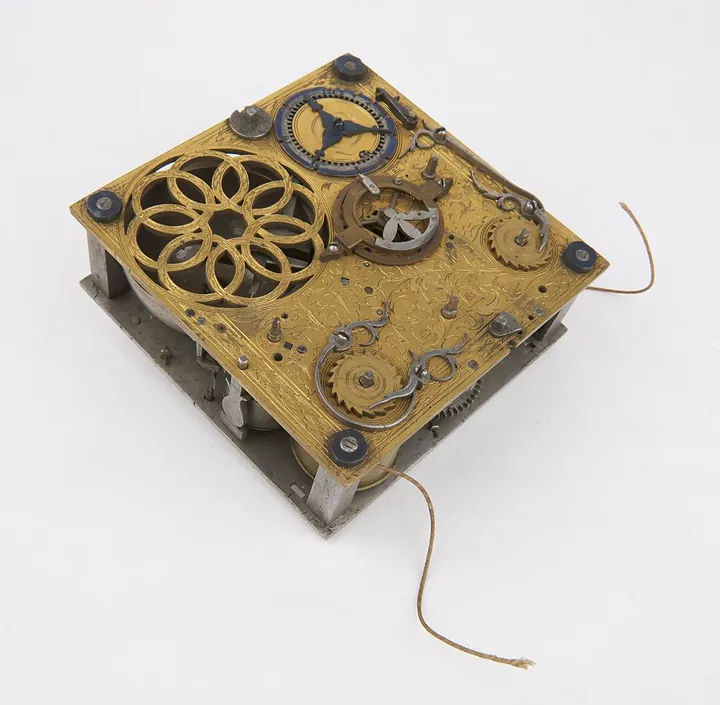
Movement or square striking table clock (probably 1575–1600, German)
Science Museum Group, London
Movements & Components · 1579
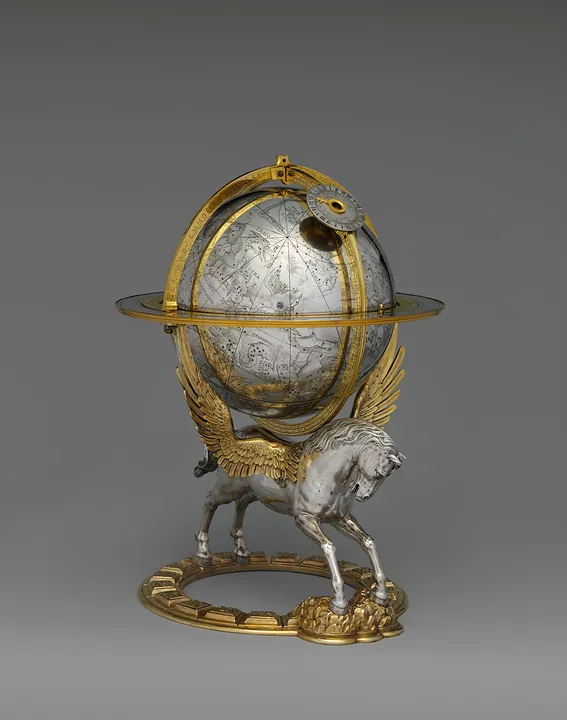
Celestial globe with clockwork by Gerhard Emmoser, Austria, 1579
The Metropolitan Museum of Art, New York
Movements & Components · 1592
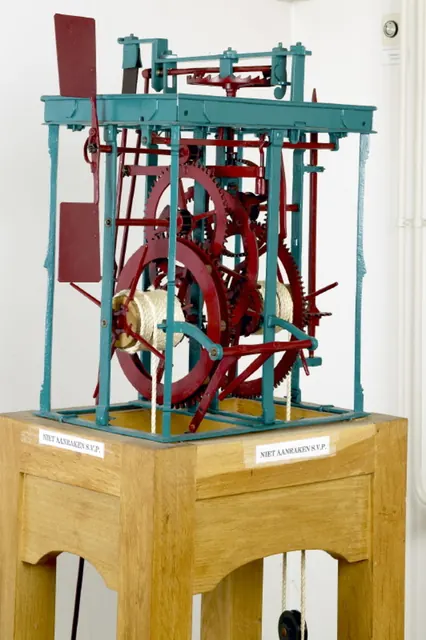
Tower clock movement by Joris Clauwert, 1592
Loevestein Castle
Movements & Components · 1500–1600
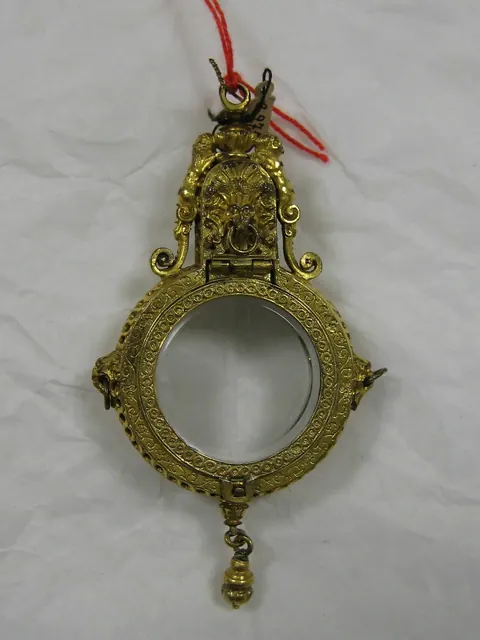
Watch case, Italy, 1500–1600
Musée du Louvre, Paris
Movements & Components · 16th century
Table-clock movement, Italy, 16th century
Museo Galileo, Florence