
Wristwatches · Wristwatch
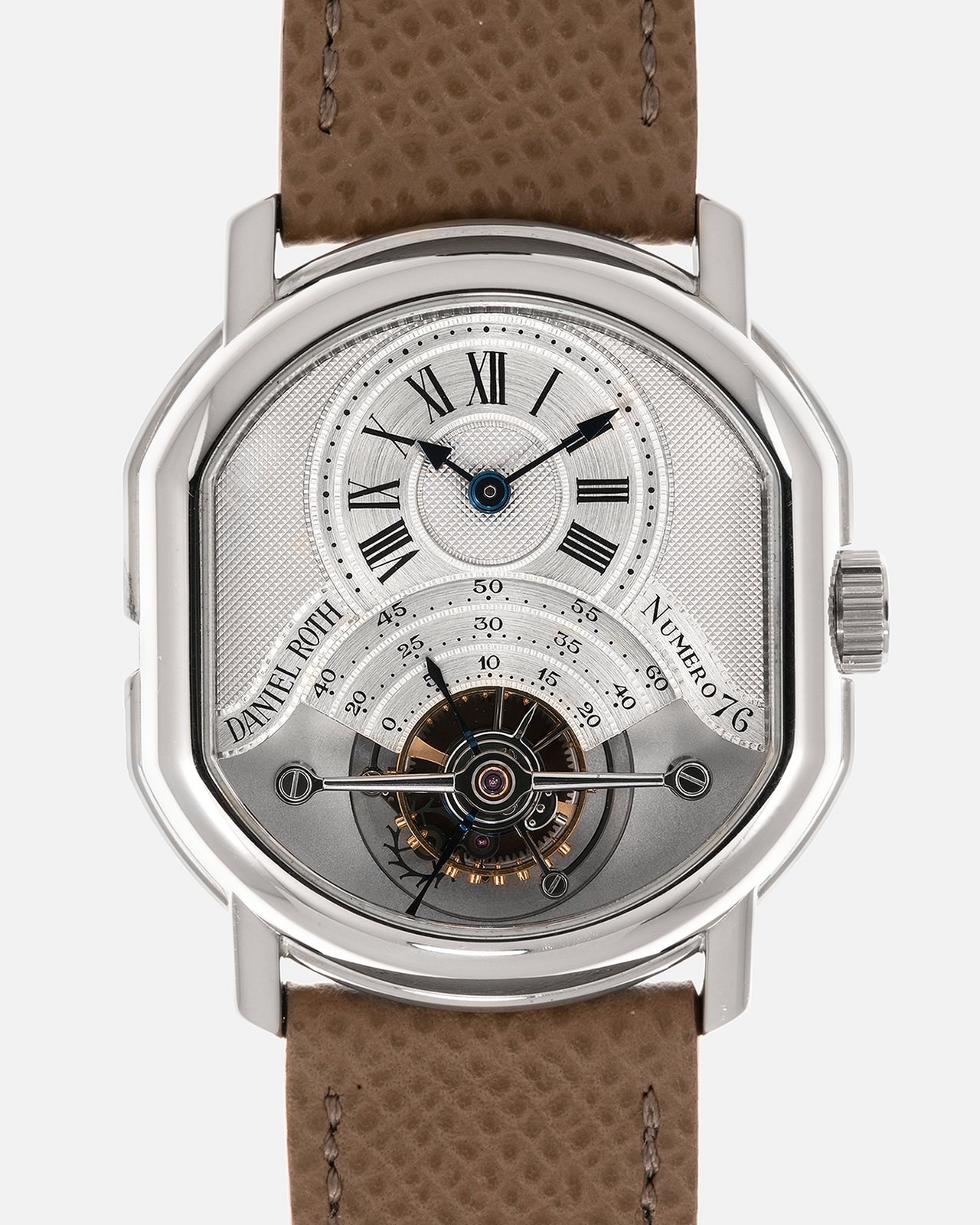
Daniel Roth Tourbillon 2187 White Gold Clous De Paris, 1990s
- Maker / attribution
- Daniel Roth (maker)
- Date
- 1990s
- Historical period
- Mechanical Renaissance (1990 – 2010)
- Country of origin
- France
- Object type
- Wristwatch
- Materials / technique
- white gold
- Dimensions
- Case 35 mm
- Stock no.
- Product 7592649261143
- Credit line
- Dealer listing, S.Song Watches (product 7592649261143)
- Catalogue title (original)
- Daniel Roth Tourbillon 2187 White Gold Clous De Paris (English)
View the source record (dealer listing) ↗ (opens another website in a new tab)Suggest a correction
Record summary
Catalogued by S.Song Watches (dealer), Seattle (stock number Product 7592649261143), this is a wristwatch by Daniel Roth, made in France, dated 1990s. The Atlas places it in the Mechanical Renaissance period (1990 – 2010) of its Wristwatches collection. Materials and techniques recorded by the source: white gold. Recorded dimensions: Case 35 mm. The record is illustrated with 6 photographs.
Assembled from the source record's structured fields. Dates and attributions are given as the source states them; where a field is missing the Atlas leaves it blank rather than estimating.
Catalogue description
Dealer description — S.Song Watches
When we think of modern independent watchmaking, names like Kari Voutilainen, Philippe Dufour, F.P. Journe, and Roger Smith often come to mind. Independent horology has grown so much in stature that owning at least one watch from an independent brand is now considered a hallmark of serious collecting. That being said, before this wave of recognition, there was Daniel Roth—a watchmaker who, in many ways, helped lay the foundation for today’s independent movement. To add some context, Daniel Roth was one of the most talented watchmakers of his generation and is responsible for many things we see in watchmaking today. For one, he was a leading figure who firmly established the design language of the Breguet watches you see today. In the '60s and ’70s, Breguet had become a shadow of its former self with seemingly no future until it was acquired by Chaumet, who in turn brought in Daniel Roth to take the helm. The reference 3130, with its guilloché dial and straight-lugged case, set the tone for Breguet’s rebirth. Beyond design, Roth also contributed to the development of complex movements at Lemania, which, may I remind you, still supplied chronograph calibres to Patek Philippe and Vacheron Constantin until fairly recently. Daniel Roth, the brand, unfolds in three distinct eras: the early independent years, its time under The Hour Glass, and the final chapter under Bulgari after Roth’s departure. Among Roth’s early models, the Régulateur Tourbillon 2187 arguably stands out as the most iconic, and offered here today is a particularly rare example from the revered first generation. Unlike his usual vertical pinstripe guilloché , this watch features the exceptionally scarce Clous de Paris motif on both front and back dials—a finishing detail that was only used for extremely early pieces. While it bears unmistakable Daniel Roth design elements, one can undoubtedly observe how his previous experience working at Breguet influenced the stylistic and technical savoir-faire in his designs. This fantastic example here features an elegant 35mm x 38mm 18-carat white gold ‘ellipso-curvex’ case and houses a fantastically finished one-minute triple-armed tourbillon at the lower half of the dial. Attached to the cage are three heat-blued hands of varying lengths that act as a second counter corresponding to the three-tiered display positioned right above the tourbillon cage, taking turns to indicate the seconds as time passes. At the time, displaying the tourbillon on the front dial side was highly unconventional, and this captivating seconds display remains one of Roth’s most compelling original innovations. As you can see from the photos, the front primary dial is visually arresting and a technical marvel in itself: it is segmented beautifully with the top half showcasing the aforementioned Clous de Paris guilloché , while a knurled-edged chapter ring with black Roman numerals adds a touch of visual depth and contrast. On the reverse, a second dial mirrors these details and displays the date alongside the power reserve. Generally, tourbillon watches from this era are often perceived as slightly crude and lacking elegance, but the 2187 defies that notion entirely. From the beautifully polished tourbillon bridges to the overall layout and conservative proportions of the watch, it is, in my opinion, a true benchmark of sublime watch design. Every detail, from the choice of font to the contrasting finishes, reinforces its distinctly hand-crafted character. As I briefly mentioned earlier, pieces from this early first-generation period remain the most collectable, not only for their historical importance but also for the purity and quality of the watches produced. Every piece was made from precious metals, and no corners were cut. Thankfully, that era has given way to renewal. With Daniel Roth’s recent resurgence under La Fabrique du Temps and LVMH, and the introduction of the Tourbillon Souscription, Extra Plat and Extra Plat Rose Gold Skeleton models, I’m elated to see that Daniel Roth is finally returning to form and being celebrated for what it always was: one of the most important and original voices in the realm of high-end independent watchmaking. On a closing note, having pursued, handled, and offered some of the most extraordinary Daniel Roth timepieces over the years, I can confidently say there is nothing quite like an early first-generation Daniel Roth tourbillon, especially one that is as elusive as this. From its case design and proportions to the impeccable two-dial layout as well as its beautiful Clous de Paris guilloché motif, it delights in the way the dial shimmers under light and in the ease of sliding it under a cuff. It is truly a pleasure to offer this remarkable example of mechanical art today.
Historical context
Mechanical Renaissance (1990 – 2010)
Mechanical watches return as cultural objects; independent watchmaking flourishes.
Mechanical watches returned as cultural and luxury objects. Complications, tourbillons and new materials proliferated; independent watchmakers such as George Daniels, F.P. Journe and Philippe Dufour revived artisanal watchmaking; collecting vintage watches became a major field.
Read the period in the timelineMore wristwatches from this periodEarlier: Quartz Revolution
Atlas type guide
Wristwatches
Bracelet watches were worn by women from the early nineteenth century — Breguet made one for Caroline Murat, Queen of Naples, in 1810–12 — but the wristwatch only became a man's instrument with military use and aviation in the early twentieth century. Between the World Wars it overtook the pocket watch; the 1920s and 1930s brought rectangular Art Deco cases, water-resistant cases and the first automatic winding systems.
After 1945 the wristwatch became a carrier of identity — dress watches, sports and dive watches, chronographs, calendars — produced by Swiss, American, Japanese, German, Soviet and Chinese industries. The quartz revolution after 1969 and the mechanical renaissance since the 1990s, including the rise of independent watchmakers, complete the story.
What to look for
- The reference number (between the lugs or inside the case back) and serial number, the starting point for dating.
- The calibre: its maker and number are often stamped under the dial or on the bridge.
- Originality of dial, hands and crown — refinished ('redial') dials are common.
- Case material marks: 18K/750, 14K/585, stainless steel, gold-filled, plated.
Dating clues
- Wire-lug cases: before c. 1925.
- Water-resistant screw-down cases: from 1926.
- Quartz movements: from 1969; sapphire crystals widespread after c. 1980.
General guidance written by the Atlas editors about this kind of object. It is not a statement about this particular piece; for that, rely on the source record above and on physical examination.
Related records
Wristwatches · 2001
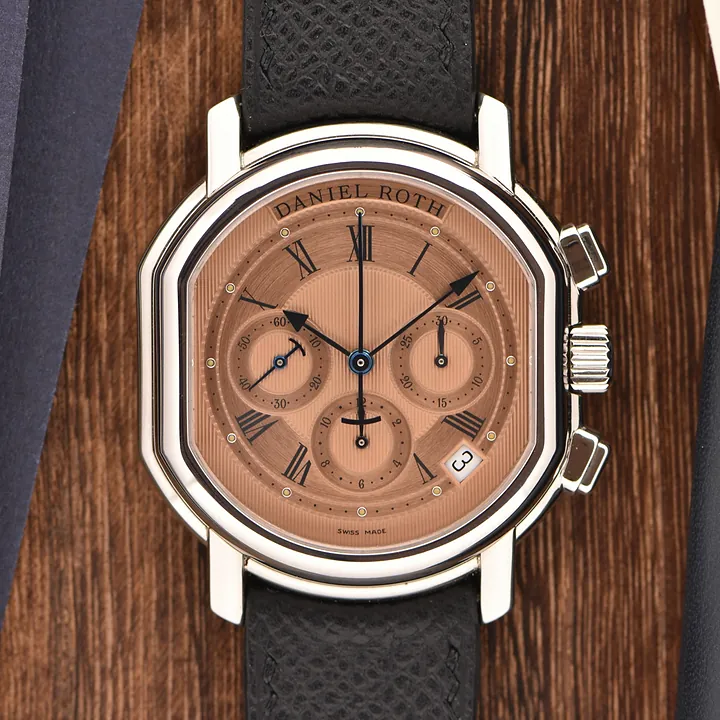
Daniel Roth Masters Chronograph Salmon, 2001
Huntington Company (dealer)
Wristwatches · 1990s
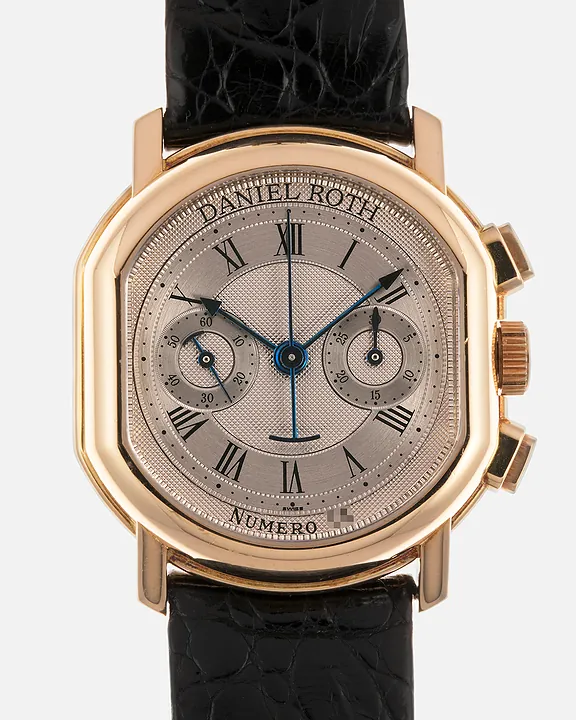
Daniel Roth Chronograph Lemania 2147 Clous De Paris, 1990s
S.Song Watches (dealer), Seattle
Wristwatches · 1990s
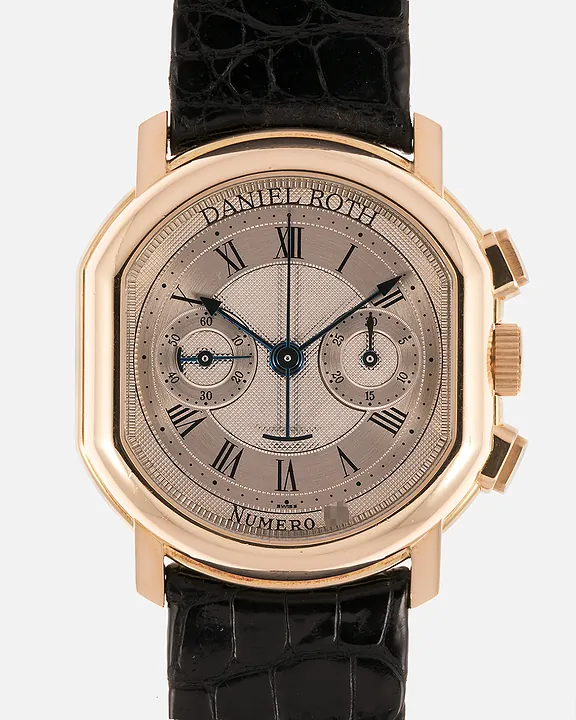
Daniel Roth Chronograph Lemania 2147 Clous De Paris, 1990s
S.Song Watches (dealer), Seattle
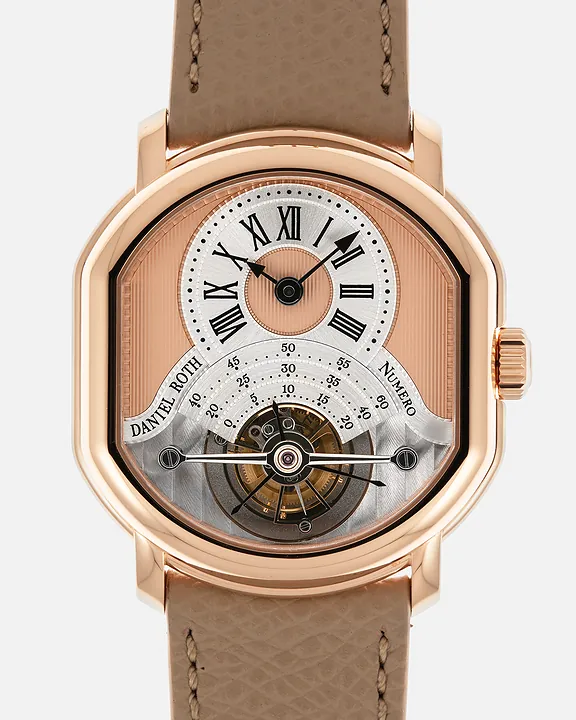
Wristwatches · 2025
Daniel Roth Tourbillon Rose Gold DR 001, 2025
S.Song Watches (dealer), Seattle
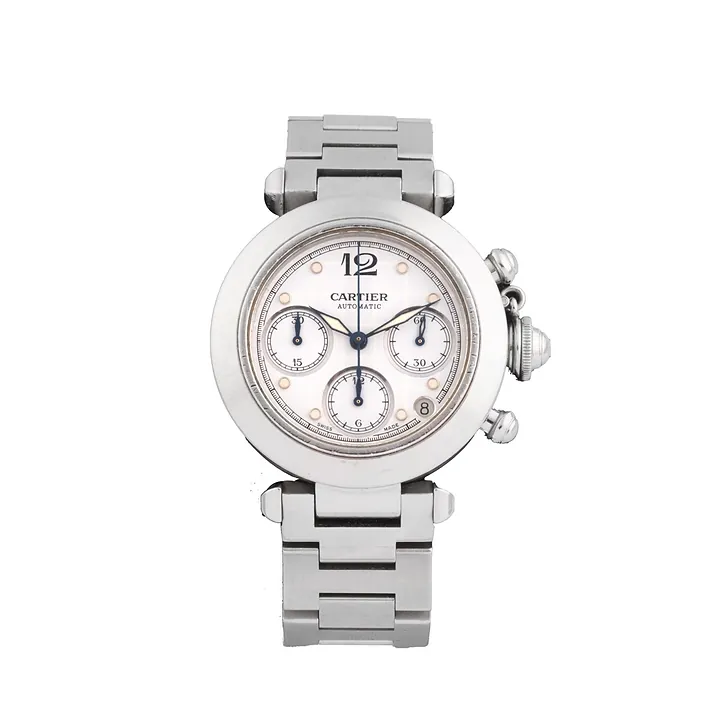
Wristwatches · c. 1990
Cartier Pasha, ref. 2412, c. 1990
Antiquorum auction archive, Geneva
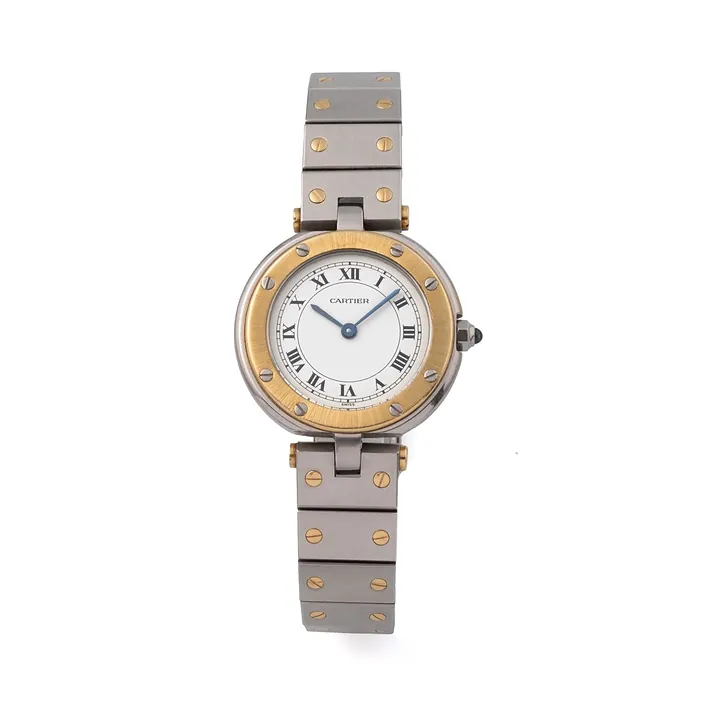
Wristwatches · c. 1990
Cartier Santos Ronde Vendome, c. 1990
Antiquorum auction archive, Geneva
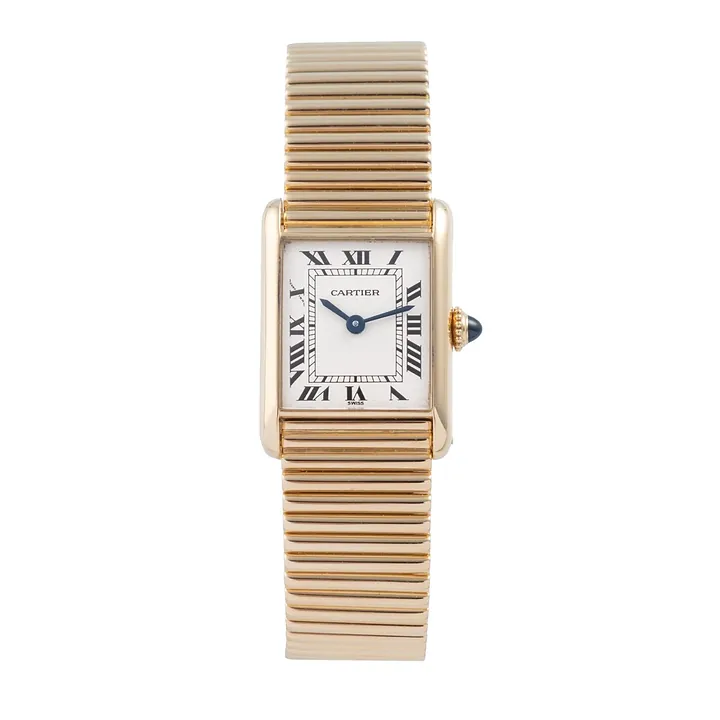
Wristwatches · c. 1990s
Cartier Tank Louis Cartier, ref. 6711, c. 1990s
Antiquorum auction archive, Geneva
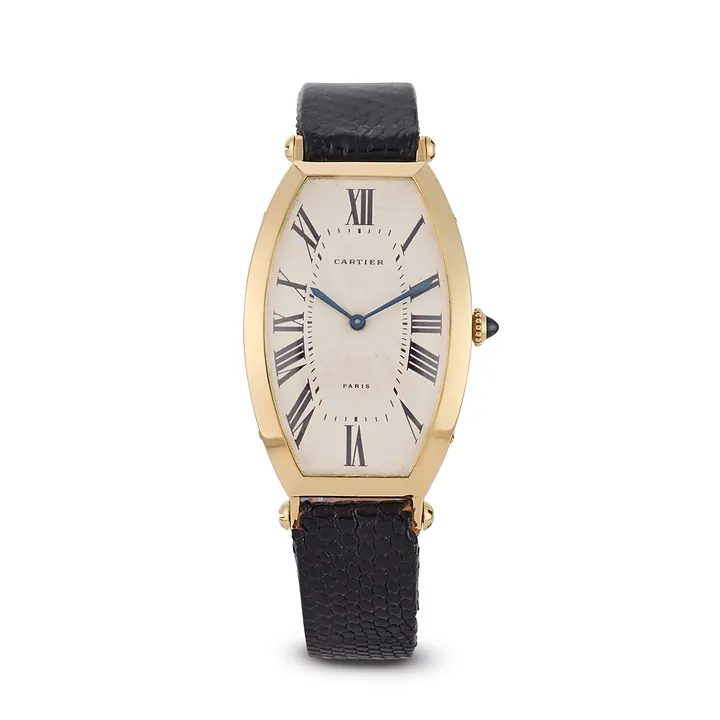
Wristwatches · c. 1991
Cartier Tonneau Paris 1991, c. 1991
Antiquorum auction archive, Geneva