
Wristwatches · Wristwatch
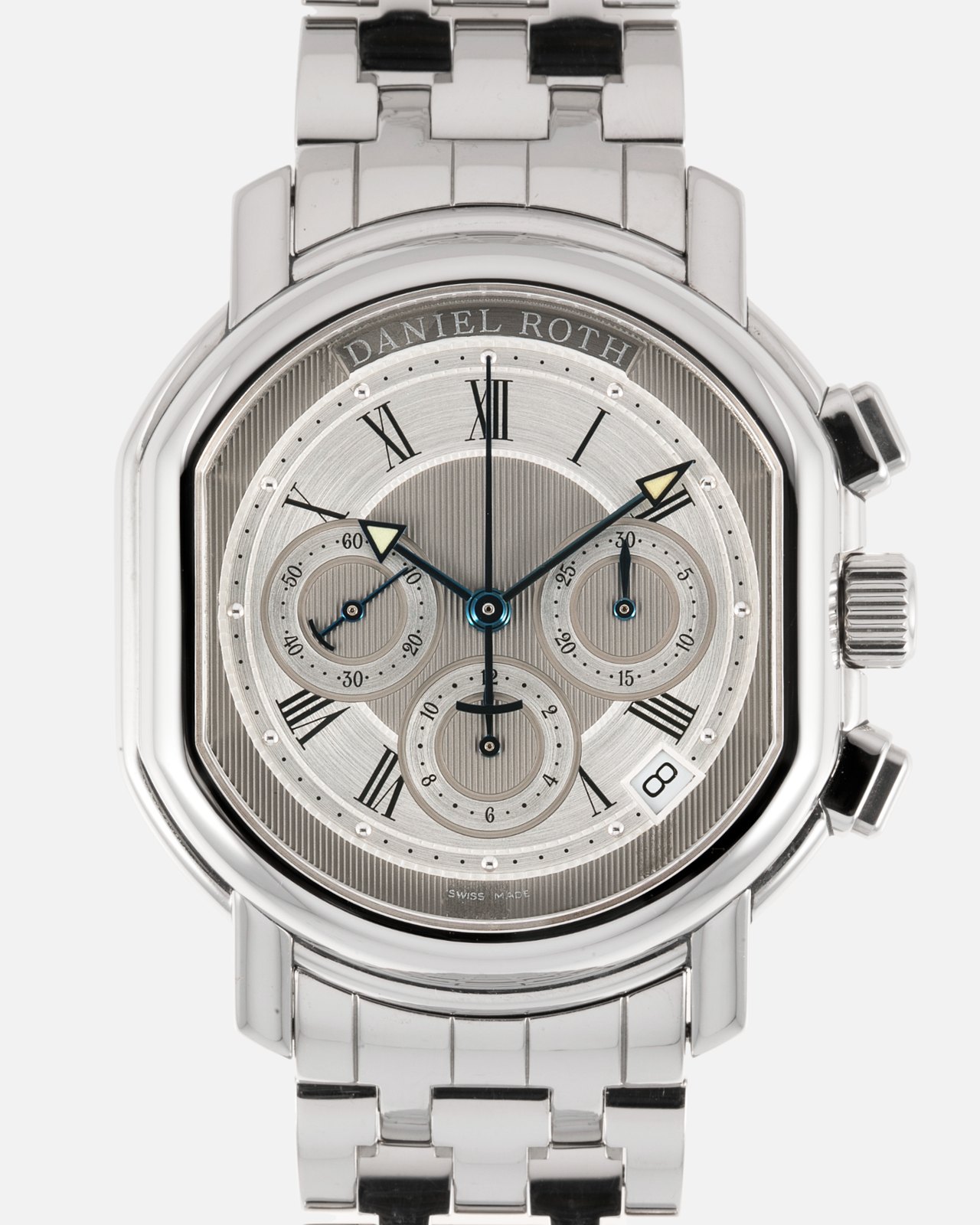
Daniel Roth Masters Chronograph S247 NOS, 1990s
- Maker / attribution
- Daniel Roth (maker)
- Date
- 1990s
- Historical period
- Mechanical Renaissance (1990 – 2010)
- Country of origin
- Switzerland
- Object type
- Wristwatch
- Stock no.
- Product 6737296719959
- Credit line
- Dealer listing, S.Song Watches (product 6737296719959)
- Catalogue title (original)
- Daniel Roth Masters Chronograph S247 NOS (English)
View the source record (dealer listing) ↗ (opens another website in a new tab)Suggest a correction
Record summary
Catalogued by S.Song Watches (dealer), Seattle (stock number Product 6737296719959), this is a wristwatch by Daniel Roth, made in Switzerland, dated 1990s. The Atlas places it in the Mechanical Renaissance period (1990 – 2010) of its Wristwatches collection. The record is illustrated with 6 photographs.
Assembled from the source record's structured fields. Dates and attributions are given as the source states them; where a field is missing the Atlas leaves it blank rather than estimating.
Catalogue description
Dealer description — S.Song Watches
When we think of the big independents today, names such as Voutilainen, Dufour, Journe, and Smith come to mind. In fact, there is such a huge appreciation for independents today that it has become somewhat mainstream within collecting circles to own at least one watch from an independent brand. Before all of this hype though, there was Daniel Roth. To be honest, in my opinion, the story of the Daniel Roth brand is a tragic one that could’ve worked out very differently. To add some context, Daniel Roth was one of the most talented watchmakers of his generation and was responsible for many things you see today but do not realize. For one, he was a leading figure that established the design language of Breguet dress watches that you see today. In the 60s and ’70s, Breguet had become a below-average watch brand with no future, until they were acquired by Chaumet, who in turn brought in Daniel Roth to lead the helm. The reference 3130, with its guilloche dial and its straight lugged case, set the tone for Breguet and was during the time of Daniel Roth. Moreover, he played a significant role in producing complicated movements for Lemania who may I remind you up until recently still provided the likes of Patek Philippe and Vacheron Constantin with chronograph calibers. After that chapter of Roth’s life and entering into the ’90s, the independent brand ‘Daniel Roth’ began taking form. There are three distinct periods in the Daniel Roth brand, the early period when he was truly independent, the middle period when The Hour Glass was a stakeholder, and the final period when Bvlgari took over and Daniel Roth left the company. In 1995, Daniel Roth joined forces with The Hour Glass Group and the example you see here today is part of that period. While any early Daniel Roth piece is considered hugely desirable, there are still a few pieces in the Hour Glass period that I think is great and worthy of being included. This Master Chronograph S247 model manages to retain some excellent original Daniel Roth traits that I find desirable, including the classic grey vertical guilloche dial reminiscent of his days in Breguet and a beautifully symmetrical design layout. The overall depth of the dial is accentuated further through the contrasting applied silver hour chapter ring that finishes off the elegant look, making this watch unmistakably a Roth. Furthermore, this second-generation Daniel Roth Chronograph comes equipped with a high-quality Zenith El Primero 400 movement, similar to what was used on the Rolex Daytona 16520s. What makes this particular example even more special is that it comes fitted on its original Daniel Roth bracelet, which you do not see very often, and of course, the fact that it is in new old stock condition! I truly think that these Daniel Roth watches are hugely under-appreciated and it is a tragedy that the man himself does not get the recognition he deserves. Due to bad business decisions, several takeovers, and just pure bad luck, the brand Daniel Roth eventually ended up with Bvlgari, who today absorbed his distinctive case shape and branded it under their own. Compared to the original Roth pieces, which were elegant, understated, and beautiful, today’s reiteration by Bvlgari is a far cry from that- oversized and gaudy. It does make me sad to see such a great watch brand tarnished, but as I have been an advocate for Daniel Roth for quite a few years now, it is great to finally see that early examples from the brand are coming back into the fore, getting the recognition it has always deserved.
Historical context
Mechanical Renaissance (1990 – 2010)
Mechanical watches return as cultural objects; independent watchmaking flourishes.
Mechanical watches returned as cultural and luxury objects. Complications, tourbillons and new materials proliferated; independent watchmakers such as George Daniels, F.P. Journe and Philippe Dufour revived artisanal watchmaking; collecting vintage watches became a major field.
Read the period in the timelineMore wristwatches from this periodEarlier: Quartz Revolution
Atlas type guide
Chronographs and split-seconds watches
A chronograph is a watch with an additional seconds hand that can be started, stopped and returned to zero independently of the timekeeping. Louis Moinet built an early example in 1816 and Nicolas Rieussec a recording 'chronographe' in 1821; Adolphe Nicole's heart-shaped reset cam (patented 1862) made the modern return-to-zero possible. Split-seconds (rattrapante) chronographs add a second hand that can be stopped for intermediate times; flyback chronographs restart instantly.
Chronographs were essential tools for doctors (pulsometer scales), artillery (telemeter), engineers and sport. In wristwatches, Valjoux, Venus, Lemania and later the automatic chronographs of 1969 (Zenith El Primero, the Chronomatic Calibre 11 group and Seiko 6139) are milestones.
What to look for
- Push-pieces on the case band or a single button in the crown (monopusher).
- Subsidiary registers for minutes and hours; tachymeter, telemeter or pulsometer scales.
- Column wheel versus cam control visible in the movement.
- Calibre markings of specialist makers (Valjoux, Lemania, Venus, Landeron).
Dating clues
- Pocket chronographs with heart cam reset: after 1862.
- Wrist chronographs: from c. 1910; two-button designs from the 1930s.
- Automatic chronographs: from 1969.
General guidance written by the Atlas editors about this kind of object. It is not a statement about this particular piece; for that, rely on the source record above and on physical examination.
Read next:Flyback chronographChronograph
Related records
Wristwatches · 2001
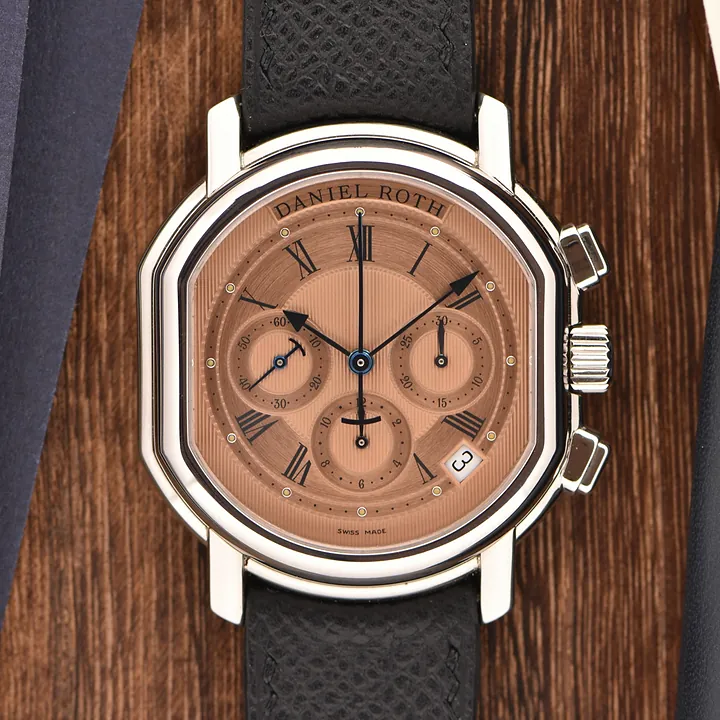
Daniel Roth Masters Chronograph Salmon, 2001
Huntington Company (dealer)
Wristwatches · 1990s
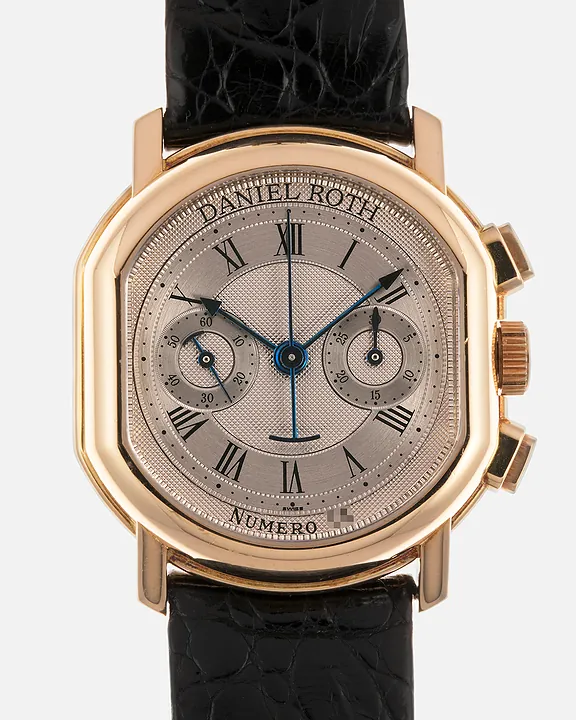
Daniel Roth Chronograph Lemania 2147 Clous De Paris, 1990s
S.Song Watches (dealer), Seattle
Wristwatches · 1990s
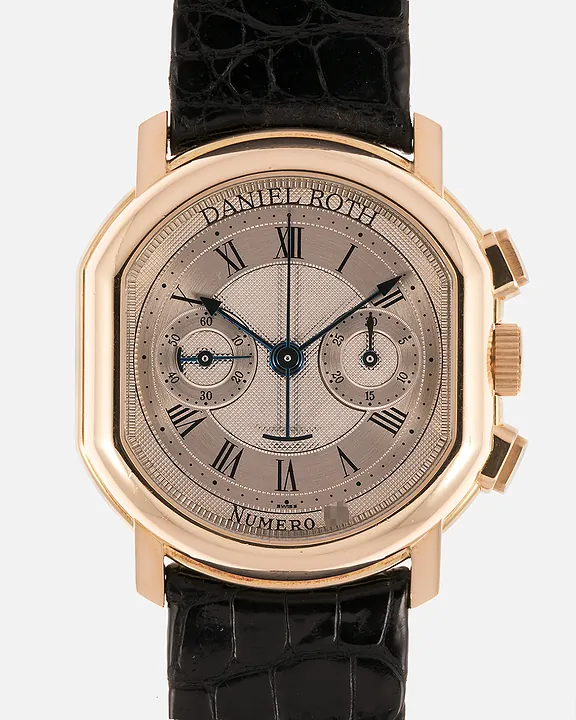
Daniel Roth Chronograph Lemania 2147 Clous De Paris, 1990s
S.Song Watches (dealer), Seattle
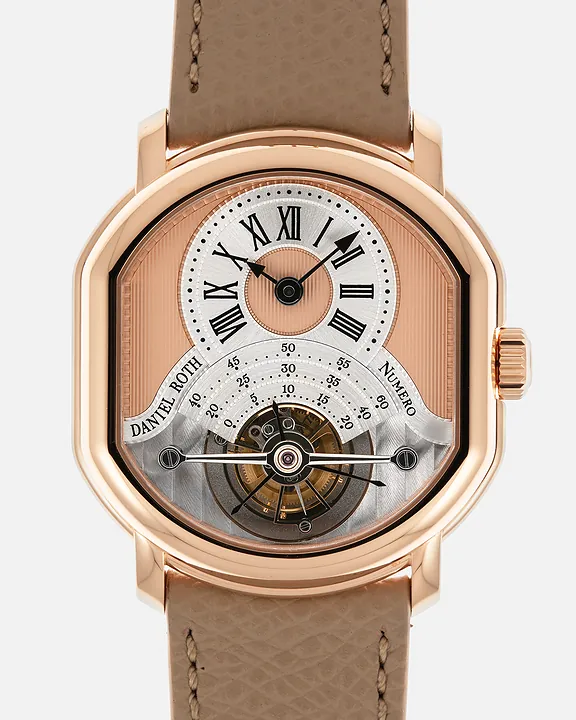
Wristwatches · 2025
Daniel Roth Tourbillon Rose Gold DR 001, 2025
S.Song Watches (dealer), Seattle

Wristwatches · 2008
Wristwatch by Breitling?, 2008
Museum Rotterdam

Wristwatches · c. 1990s
Audemars Piguet Bamboo, c. 1990s
Antiquorum auction archive, Geneva

Wristwatches · c. 1990
Audemars Piguet Huitieme Perpetual Calendar, ref. 25696PT, c. 1990
Antiquorum auction archive, Geneva

Wristwatches · c. 1990
Breitling Chronomat, ref. b13050.1, c. 1990
Antiquorum auction archive, Geneva