
Wristwatches · Wristwatch
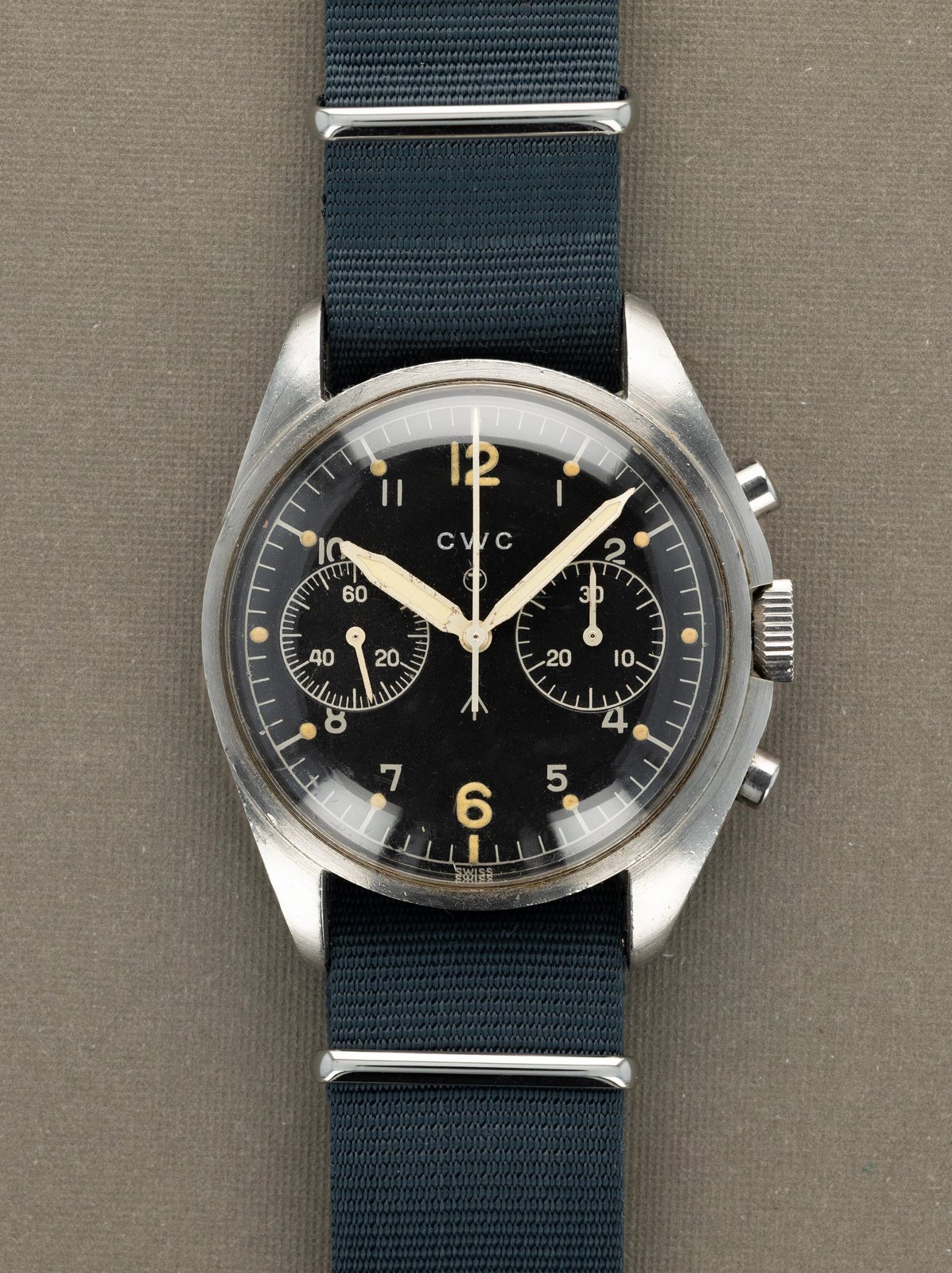
CWC 'RAF' Chronograph ref. 0552/924-3306, Matte Black 'Gilt' Dial
- Maker / attribution
- CWC (maker)
- Date
- c. 1975
- Historical period
- Quartz Revolution (1969 – 1990)
- Country of origin
- Unrecorded in source
- Object type
- Wristwatch
- Dimensions
- Case 39 mm
- Stock no.
- Product 10408960360765
- Credit line
- Dealer listing, Oliver & Clarke (product 10408960360765)
- Catalogue title (original)
- CWC 'RAF' Chronograph Ref. 0552/924-3306 - Matte Black 'Gilt' Dial Unpolished (English)
View the source record (dealer listing) ↗ (opens another website in a new tab)Suggest a correction
Record summary
Catalogued by Oliver & Clarke (dealer), United Kingdom (stock number Product 10408960360765), this is a wristwatch by CWC, dated c. 1975. The Atlas places it in the Quartz Revolution period (1969 – 1990) of its Wristwatches collection. Recorded dimensions: Case 39 mm. The record is illustrated with 6 photographs.
Assembled from the source record's structured fields. Dates and attributions are given as the source states them; where a field is missing the Atlas leaves it blank rather than estimating.
Catalogue description
Dealer description — Oliver & Clarke
Cabot Watch Company, better known as CWC, was founded in 1972 by Ray Mellor, a former Royal Air Force serviceman who saw an opportunity as British military watch contracts began shifting away from long-established suppliers. Named after the explorer John Cabot, the company was established with a singular purpose: to produce robust, no-nonsense timepieces built to the exacting standards of the Ministry of Defence. Where earlier names like Smiths and Newmark had defined previous generations of British-made issued watches, CWC arrived at precisely the right moment to become the standard bearer for Britain's armed forces. For the next three decades, CWC supplied everything from General Service watches to chronographs and Royal Navy dive watches, earning a reputation through reliability rather than marketing. Its asymmetrical chronographs became a familiar sight on the wrists of military personnel, while the quartz-powered G10, introduced in the early 1980s, would go on to become one of the most widely issued British military watches ever produced. Although official procurement eventually broadened beyond CWC, the company never abandoned the military-first philosophy on which it was founded, and today its watches remain remarkably faithful to the original specifications that earned them their place in British service. The piece that we have here is chronograph issued to the Royal Air Force dating to circa 1975. It features a 39mm asymmetrical case, not dissimilar to that of what you'd find on a Speedmaster, complete with 'pump' pushers, a recessed crown, and a screw-down caseback. It has seemingly been spares of previous polishing, with nice defined finishing and shows normal wear throughout with clear military engravings on the caseback. Inside, the matte black dial features a very unusual 'gilt'-style of displaying the silver indices printing, with the exception of the 'CWC' text which is stamped. The Tritium indices have developed an attractive and uniform patina from age, and the correct white-painted 'sword' handset is a later set replaced under contract service. Powering this piece is a workhorse Valjoux Cal. 7733 manual-winding movement and it comes fitted to a very appropriate 'Admiralty Grey' NATO strap. Not only is this a piece of history, but when compared to other military-issued pieces from other brands, this actually is fantastic value, and they do not grow on trees!
Historical context
Quartz Revolution (1969 – 1990)
Seiko's Astron begins mass quartz timekeeping; traditional industries contract sharply.
Quartz and digital watches transformed the market after 1969. Swiss employment collapsed, Japanese and Hong Kong production soared, and the Swatch (1983) helped the Swiss industry recover; mechanical watches survived as luxury goods.
Read the period in the timelineMore wristwatches from this periodEarlier: Modern Mechanical Horology
Atlas type guide
Chronographs and split-seconds watches
A chronograph is a watch with an additional seconds hand that can be started, stopped and returned to zero independently of the timekeeping. Louis Moinet built an early example in 1816 and Nicolas Rieussec a recording 'chronographe' in 1821; Adolphe Nicole's heart-shaped reset cam (patented 1862) made the modern return-to-zero possible. Split-seconds (rattrapante) chronographs add a second hand that can be stopped for intermediate times; flyback chronographs restart instantly.
Chronographs were essential tools for doctors (pulsometer scales), artillery (telemeter), engineers and sport. In wristwatches, Valjoux, Venus, Lemania and later the automatic chronographs of 1969 (Zenith El Primero, the Chronomatic Calibre 11 group and Seiko 6139) are milestones.
What to look for
- Push-pieces on the case band or a single button in the crown (monopusher).
- Subsidiary registers for minutes and hours; tachymeter, telemeter or pulsometer scales.
- Column wheel versus cam control visible in the movement.
- Calibre markings of specialist makers (Valjoux, Lemania, Venus, Landeron).
Dating clues
- Pocket chronographs with heart cam reset: after 1862.
- Wrist chronographs: from c. 1910; two-button designs from the 1930s.
- Automatic chronographs: from 1969.
General guidance written by the Atlas editors about this kind of object. It is not a statement about this particular piece; for that, rely on the source record above and on physical examination.
Read next:Flyback chronographChronograph
Related records
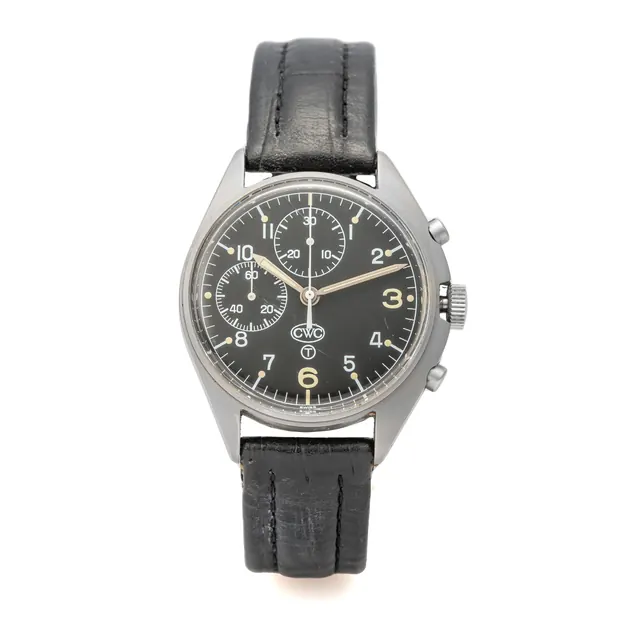
Wristwatches · c. 1985
Cwc wristwatch, Military Chronograph, circa 1985
Antiquorum auction archive, Geneva
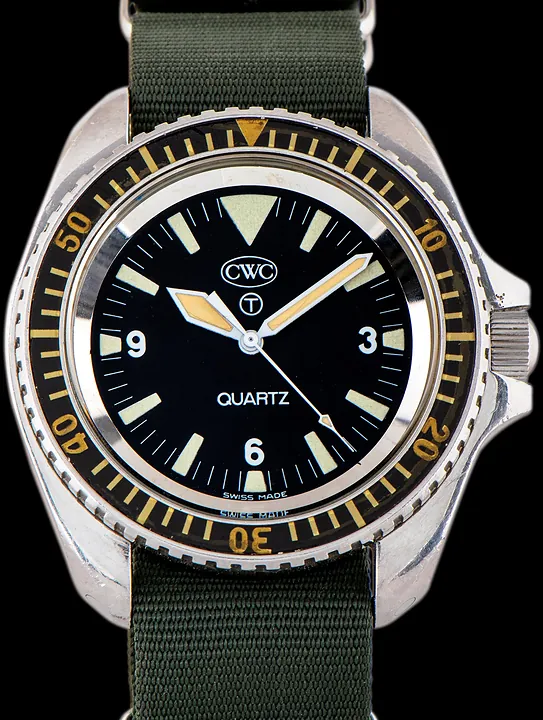
Wristwatches · 1986
CWC Royal Navy Diver 0552/6645-99-7573314, 1986
Craft & Tailored (dealer), Los Angeles
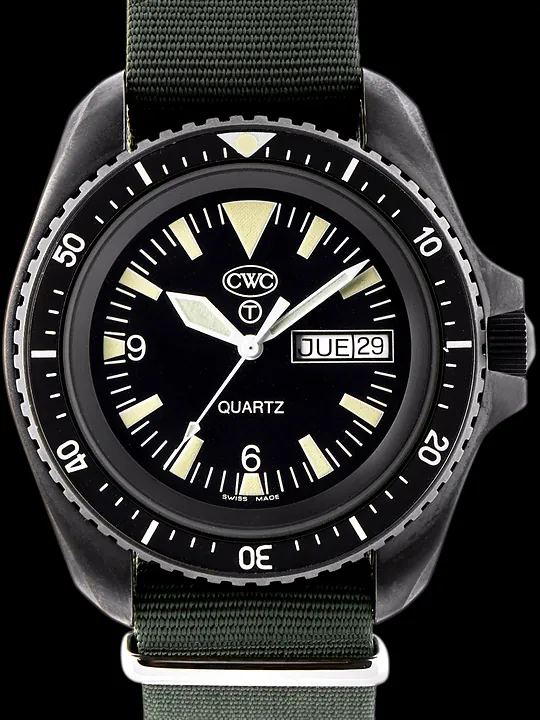
Wristwatches · 2005
CWC Royal Navy SBS Diver W10/6645-99-7995443, 2005
Craft & Tailored (dealer), Los Angeles
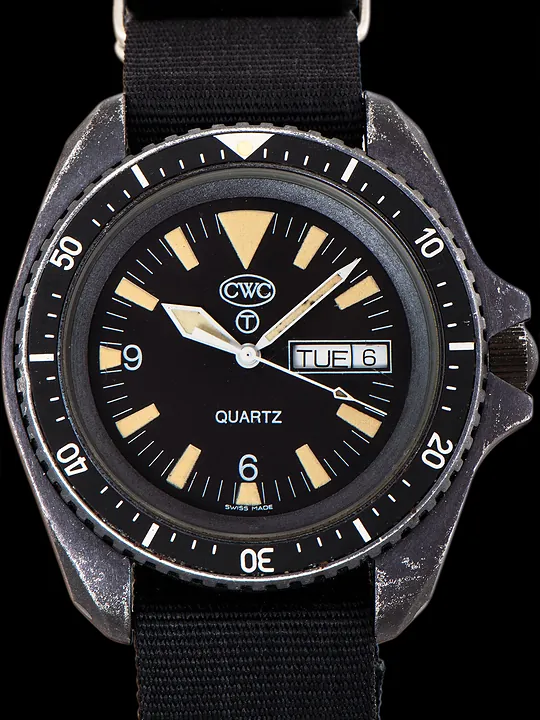
Wristwatches · 1993
CWC Royal Navy SBS Diver 0555/6645-99-7995443, 1993
Craft & Tailored (dealer), Los Angeles

Wristwatches · 1970
Wristwatch by Heno, Switzerland, 1970
Museum Rotterdam
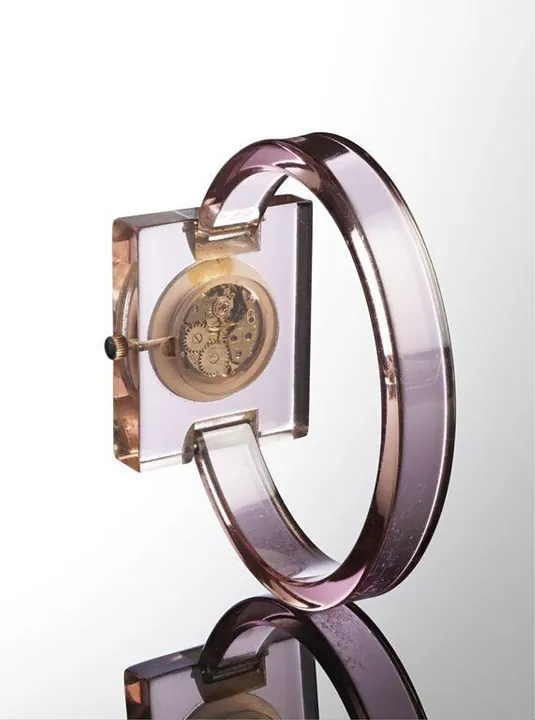
Wristwatches · 1970s
Wristwatch, plastic, by Gucci; Italy, 1970s.
Victoria and Albert Museum, London
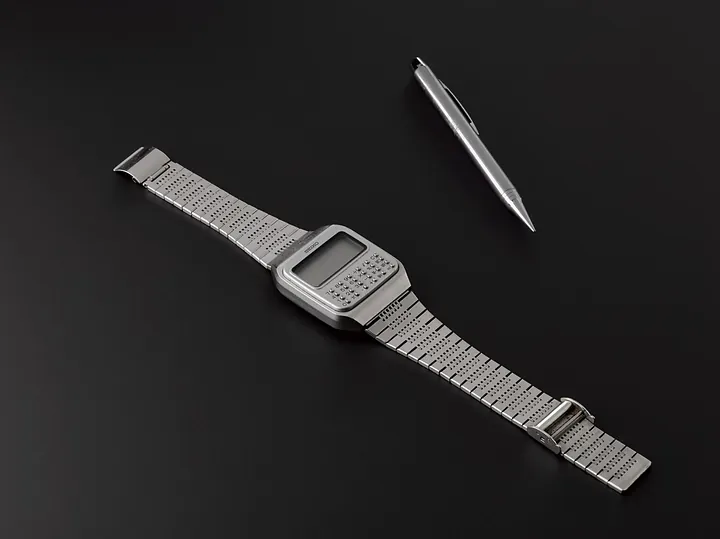
Wristwatches · 1978
Calculator wristwatch by Suwa Seikosha Co. Limited, Japan, 1978
Science Museum Group, London
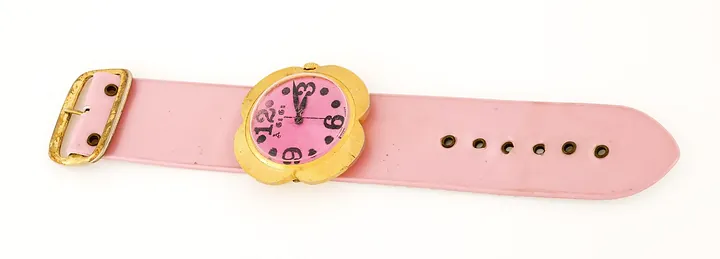
Wristwatches · 1980
Wristwatch, 1980 (no. 71413)
Museum Rotterdam