
Wristwatches · Wristwatch
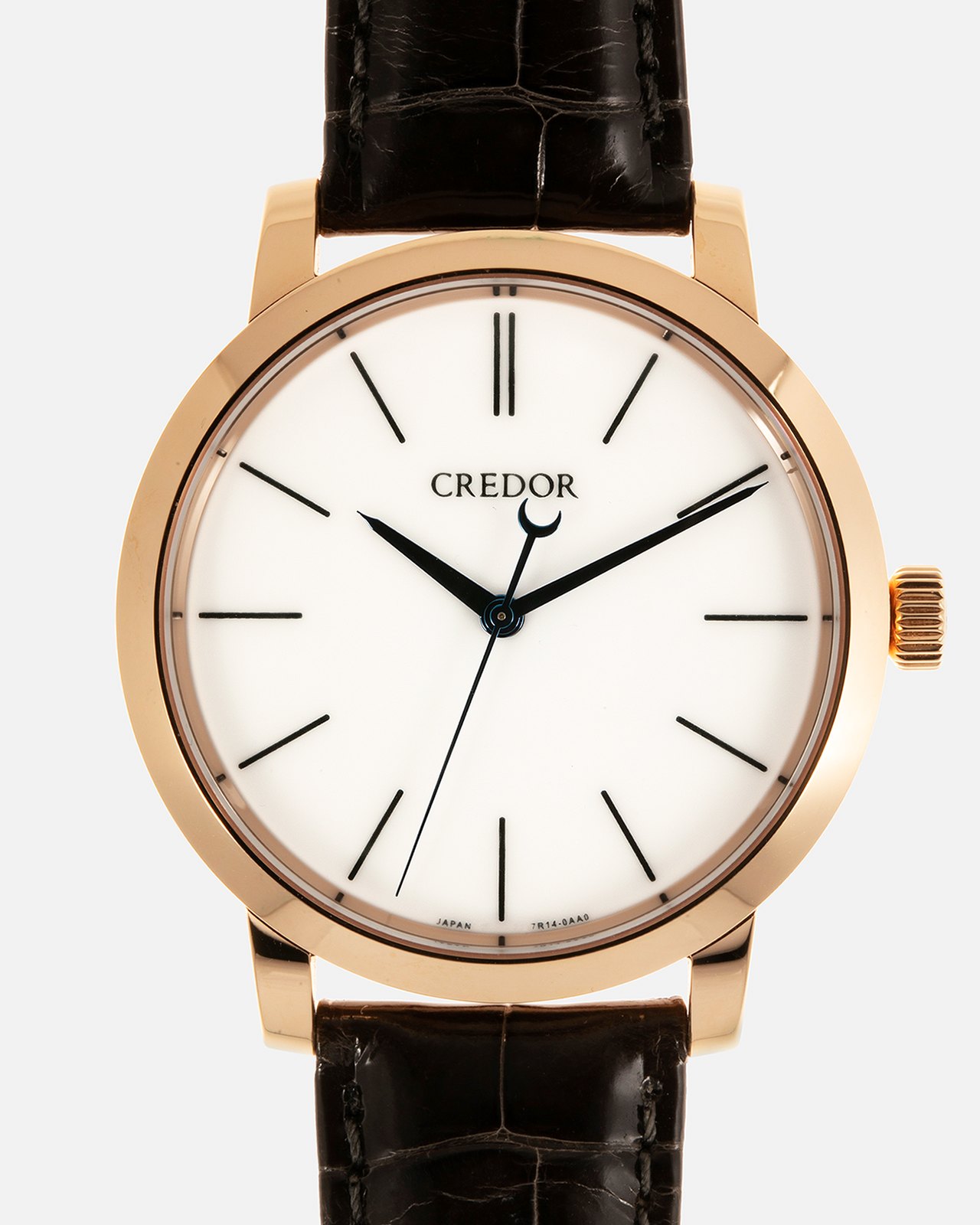
Credor Eichi II Rose Gold, 2019
- Maker / attribution
- Credor (maker)
- Date
- 2019
- Historical period
- Contemporary Horology (2010 – Present)
- Country of origin
- Unrecorded in source
- Object type
- Wristwatch
- Materials / technique
- rose gold
- Dimensions
- Case 39 mm
- Stock no.
- Product 7208870445143
- Credit line
- Dealer listing, S.Song Watches (product 7208870445143)
- Catalogue title (original)
- Credor Eichi II Rose Gold (English)
View the source record (dealer listing) ↗ (opens another website in a new tab)Suggest a correction
Record summary
Catalogued by S.Song Watches (dealer), Seattle (stock number Product 7208870445143), this is a wristwatch by Credor, dated 2019. The Atlas places it in the Contemporary Horology period (2010 – Present) of its Wristwatches collection. Materials and techniques recorded by the source: rose gold. Recorded dimensions: Case 39 mm. The record is illustrated with 6 photographs.
Assembled from the source record's structured fields. Dates and attributions are given as the source states them; where a field is missing the Atlas leaves it blank rather than estimating.
Catalogue description
Dealer description — S.Song Watches
When you think of Grand Seiko, words like ‘Spring Drive’ and 'superlative finishing' instantly spring to mind. But did you know that there's an echelon even higher than this? Since its inception in 1974, Credor has been renowned for crafting highly refined timepieces in precious metals under the Seiko umbrella. By 1978, it had transitioned into an independent entity within the Seiko family. At the forefront of Credor's offerings today is the revered Eichi II, recognized as the brand's flagship model and highly coveted creation. For context, the term ‘Eichi’ originates from the Japanese word for wisdom (英智), which signifies the amalgamation of Seiko Watch Corporation's decades-long watchmaking expertise along with the cutting-edge innovation of the Spring Drive movement. Every facet of the Eichi II, like the one offered here today, from the design of each component to the intricate hand-painting of the dial, is meticulously executed by a small dedicated team consisting of world-class artisans and watchmakers. Led by the esteemed master watchmaker Yoshifusa Nakazawa, this team operates from within the Micro Artist Studio in Shiojiri, located in central Japan. At first glance, you might think that the Eichi II is just a simple dress watch, right? However, true to the style and ethos of Japanese high-end watchmaking; there is more to this Eichii II than meets the eye. Let me explain. Starting with its case, sized at a modern 39mm x 10.3mm, it is crafted from resplendent 18-carat rose gold highly polished in the style of Zaratsu to attain a flawless, distortion-free and mirror-like finish. Encased within that is a simple and unassuming dial that hosts a plethora of hidden details which may not be immediately noticeable at first glance. The serene white dial is crafted from porcelain by Japanese specialists, which depicts the scenery of the snowy and wintry landscapes of the mountainous Shinshu region. From a technical standpoint, the manufacturing process for artisanal watch dials is far from straightforward; these porcelain dials entail a notably high failure rate due to their brittle and highly delicate nature. Adding to this complexity, the hour markers, the ‘Credor’ logo and the minuscule line of text at the 6:00 position are all carefully hand-painted by the Micro Artist Studio. It is also worth mentioning that this process is so tedious that it demands almost an entire day alone to complete one single dial. At the core of the Eichi II lies its manual-winding Spring Drive Cal. 7R14, which incorporates a power reserve display indicated by blued steel hands and a patented ‘Torque Return System’ — a proprietary mechanism developed by Seiko to harness surplus torque generated when the mainspring is fully wound. This excess energy is then redirected to rewind the mainspring, contributing to the impressive 60-hour power reserve of the Eichi II. While initially, the Cal.7R14 may appear understated and visually minimalist (possibly due to lack of all the usual Côte de Genève we’re all quite used to seeing), if you look closer, its finishing reveals exceptional craftsmanship. This level of finishing was inspired by the legendary Philippe Dufour who, in the past, famously advised the Micro Artist Studio on finishing techniques. Particularly noteworthy is the intricately finished skeletonized mainspring barrel and the beautifully beveled edges between the bridges, which combine to form the visual silhouette of a Japanese ‘Kikyo’, or Bellflower, which in Japanese culture, symbolises endless love and honesty. Needless to say, the Eichi II is clearly a labour of love (a horological one, of course). Quite poetic, I know. I can honestly say the finishing of the Eichi II is far superior to any mainstream Swiss brand today. I firmly believe that one of the many ways to gauge a brand's technical prowess is to look at its dressier offerings, as in my view, mastering the 'simple' dress watch archetype poses considerable challenges at every level. In this regard, Credor stands out as a shining example of how to impeccably execute a modern dress watch. It embodies the very essence of what makes the Japanese approach to artisanal craftsmanship and independent horology so captivating. Their ability to take something seemingly simple and elevate it to the highest level of artistry is truly remarkable. It is a testament to their unwavering commitment to excellence and their deep understanding of the intricacies of their craft. Also, in a world where mass production often dominates, witnessing the work of a small independent watch studio like Credor is truly refreshing. It is also worth noting that the Micro Artist Studio produces only approximately 20 to 25 Credor watches annually, making this particular example of an Eichi II quite a rare find.
Historical context
Contemporary Horology (2010 – Present)
Silicon components, connected watches, optical-lattice research clocks and a thriving independent scene.
Smartwatches became the world's best-selling watches, while mechanical watchmaking focuses on craft, innovation (silicon components, new escapements) and independent makers.
Read the period in the timelineMore wristwatches from this periodEarlier: Mechanical Renaissance
Atlas type guide
Wristwatches
Bracelet watches were worn by women from the early nineteenth century — Breguet made one for Caroline Murat, Queen of Naples, in 1810–12 — but the wristwatch only became a man's instrument with military use and aviation in the early twentieth century. Between the World Wars it overtook the pocket watch; the 1920s and 1930s brought rectangular Art Deco cases, water-resistant cases and the first automatic winding systems.
After 1945 the wristwatch became a carrier of identity — dress watches, sports and dive watches, chronographs, calendars — produced by Swiss, American, Japanese, German, Soviet and Chinese industries. The quartz revolution after 1969 and the mechanical renaissance since the 1990s, including the rise of independent watchmakers, complete the story.
What to look for
- The reference number (between the lugs or inside the case back) and serial number, the starting point for dating.
- The calibre: its maker and number are often stamped under the dial or on the bridge.
- Originality of dial, hands and crown — refinished ('redial') dials are common.
- Case material marks: 18K/750, 14K/585, stainless steel, gold-filled, plated.
Dating clues
- Wire-lug cases: before c. 1925.
- Water-resistant screw-down cases: from 1926.
- Quartz movements: from 1969; sapphire crystals widespread after c. 1980.
General guidance written by the Atlas editors about this kind of object. It is not a statement about this particular piece; for that, rely on the source record above and on physical examination.
Related records
Wristwatches · 2020
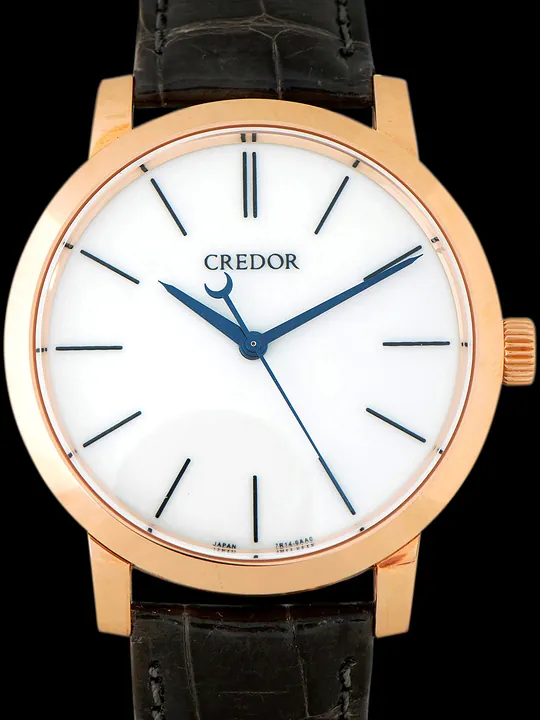
Credor Eichi II 18K RG (Ref. GBLT998) Noritake Porcelain Dial, 2020
Craft & Tailored (dealer), Los Angeles
Wristwatches · 2010
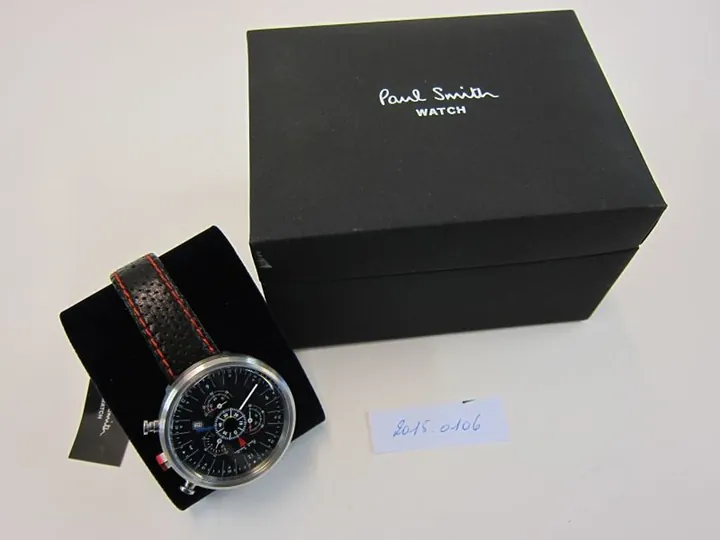
Wristwatch, 2010
Modemuseum Hasselt
Wristwatches · 2018 (Series 4 released in September 2018; '1977' in the source is the model number A1977)
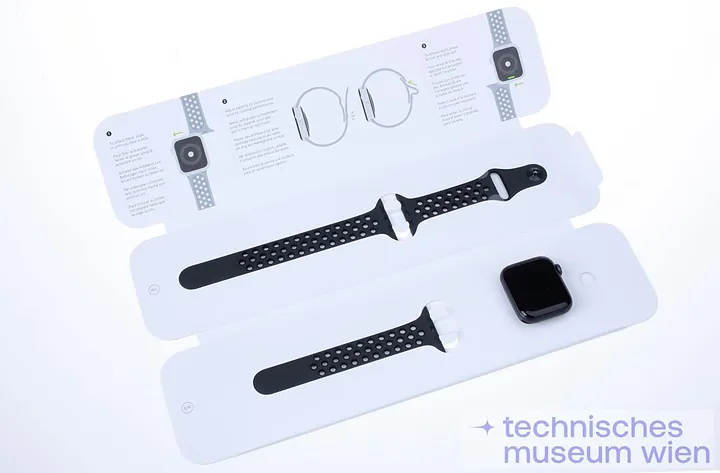
Apple Watch Series 4 (GPS, 40 mm, model A1977), 2018
Vienna Museum of Science and Technology
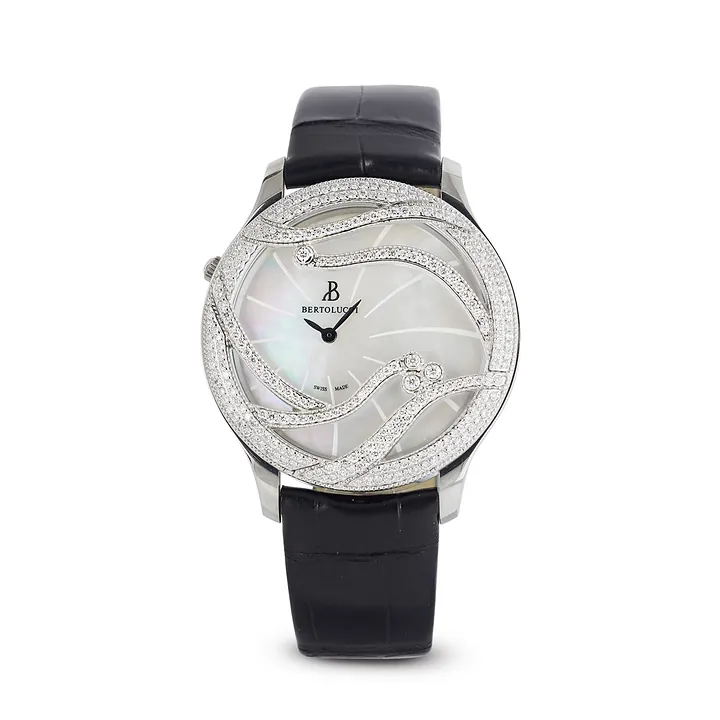
Wristwatches · c. 2010s
Bertolucci Stria III, ref. 11513.50.45.B88.6C1.501, c. 2010s
Antiquorum auction archive, Geneva
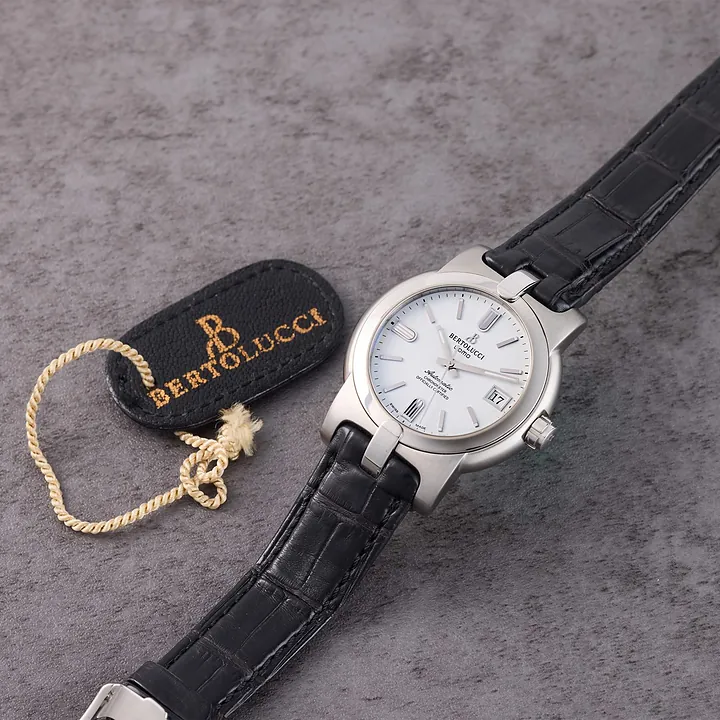
Wristwatches · c. 2010s
Bertolucci Uoma, ref. 824.51.41.10B, c. 2010s
Antiquorum auction archive, Geneva

Wristwatches · c. 2010s
Breguet Type XXI, ref. 3810, c. 2010s (Antiquorum Lot 381-24)
Antiquorum auction archive, Geneva

Wristwatches · c. 2010s
Breguet Type XXI, ref. 3810, c. 2010s (Antiquorum Lot 386-229)
Antiquorum auction archive, Geneva

Wristwatches · Sold in September 2010
Breitling Cosmonaute, ref. A 22322, Sold in September 2010
Antiquorum auction archive, Geneva