
Clocks · Clock
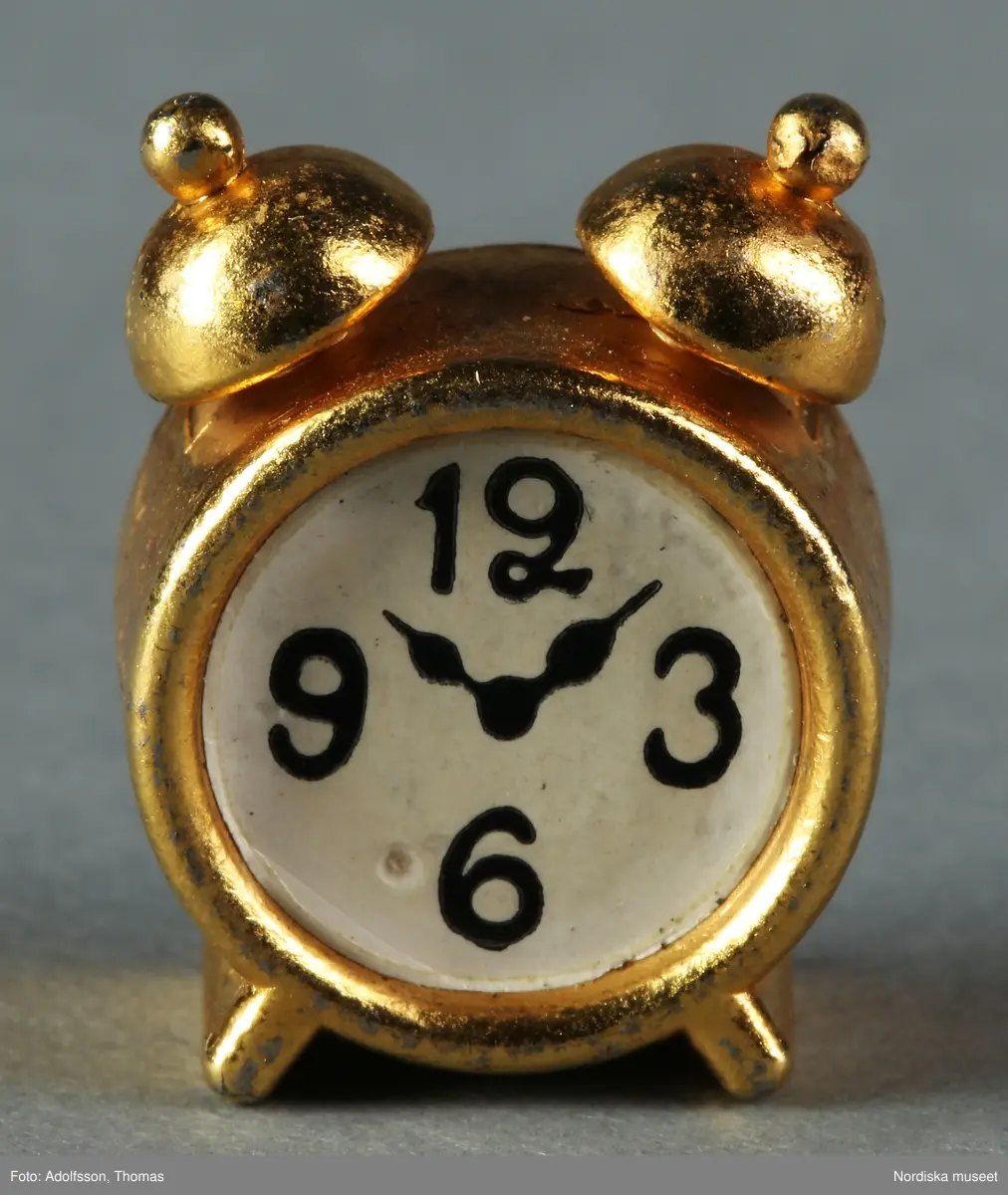
Clock, Sweden, 1970–1972
- Maker / attribution
- Unrecorded in source
- Date
- 1970–1972
- Historical period
- Quartz Revolution (1969 – 1990)
- Country of origin
- Sweden
- Place
- Sverige Sverige Stockholm Stockholm Stockholm Stockholm Stockholm Nockeby Stockholm
- Object type
- Clock
- Materials / technique
- Metall
- Dimensions
- Längd 2.0 cm
- Holding institution
- Nordic Museum Foundation
- Accession / object no.
- NM.0333257A-B
- Credit line
- Nordic Museum Foundation
- Catalogue title (original)
- Ur (Swedish)
View the source record ↗ (opens another website in a new tab)Suggest a correction
Record summary
Held and catalogued by Nordic Museum Foundation (object number NM.0333257A-B), this is a clock, made in Sverige Sverige Stockholm Stockholm Stockholm Stockholm Stockholm Nockeby Stockholm, Sweden, dated 1970–1972. The Atlas places it in the Quartz Revolution period (1969 – 1990) of its Clocks collection. Materials and techniques recorded by the source: Metall. Recorded dimensions: Längd 2.0 cm. The record is illustrated with 2 photographs.
Assembled from the source record's structured fields. Dates and attributions are given as the source states them; where a field is missing the Atlas leaves it blank rather than estimating.
Catalogue description
Catalogue description from Nordic Museum Foundation
a) Ett väckarur och b) ett armbandsur, guldfärgad metall. Båda har påmålad urtavla, den på väckaruret visar tiden 10:10 och den på armbandsuret 12:45. Armbandsuret ligger i en plastförpackning. Hör till inredningen i föräldrarnas sängkammare på andra våningen i dockskåpet. Uren är placerade på var sitt nattduksbord (nm.0333248 a-b). Uren tillhör inredningen i sängkammaren på andra våningen i dockskåp NM.0331721+. Dockskåpet är tillverkat av givarens far och avbildar familjens hem som det såg ut med inredning och allt, när de mellan åren 1960-1978 bodde i en villa i Nockeby. Huset byggdes på 1930-talet och finns fortfarande kvar. Det har källare, vind, två våningsplan och en liten trädgård. Pappan, som på den tiden var vice VD för Johnsonkoncernen, ägnade all fritid åt samvaro med sin förståndshandikappade son. Denne älskade att leka med husmodellen som pappan byggt och behöll den livet ut som ett kärt minne. För honom hade hemmiljön stor betydelse och han tyckte om att varje sak fanns på rätt plats. Dockskåpet kom att spela en viktig roll i kommunikationen mellan dem. Givaren hade redan flyttat hemifrån 1972 när dockskåpet blev färdigt, så hon har själv inte lekt med det. Hon förklarar: "Sedan mina föräldrar och Stellan flyttade till Skåne 1978 har min bror haft huset i sitt stora kök i Ängelholm. Där har han ägnat en stund varje helg åt att 'leka' med det som han kallade det. Med det menade han mest att han lyfte av de olika etagen och tittade in. Självklart var det värdefullt även för mig att ha detta minne av ursprungshemmet där jag växte upp. Även om det mesta av inventarierna och tillbehören är inköpta ser det ungefär ut som jag minns det från vår tid i huset." Dockskåpet har tidigare haft invändig belysning men denna har inte fungerat på senare år. Föräldrarna var födda på 1920-talet. Pappan avled 1997 och brodern 2011 i Ängelholm. Mot slutet av sitt liv hade han främst huset till prydnad och minne av sitt föräldrahem. /Karin Dern 2011-10-14
Shown in the original language of the source catalogue. An editor-reviewed English translation has not yet been published; we do not publish machine translations as authoritative text.
Historical context
Quartz Revolution (1969 – 1990)
Seiko's Astron begins mass quartz timekeeping; traditional industries contract sharply.
Quartz movements and digital displays made accurate clocks cheap and ubiquitous after the early 1970s. LED and LCD clocks, clock radios and radio-controlled clocks appeared, while traditional mechanical clockmaking contracted sharply in Germany, France and Britain.
Read the period in the timelineMore clocks from this periodEarlier: Modern Mechanical Horology
Atlas type guide
Domestic clocks
A clock combines four systems: a source of power (falling weight, coiled spring, or later electricity), a gear train that divides time, an escapement and oscillator that regulate it (foliot, pendulum or balance), and an indicating system of dial and hands or a bell. Its history runs from the large iron weight-driven clocks of the late thirteenth century to Renaissance spring-driven table clocks, the pendulum revolution of 1656, the factory clocks of the nineteenth century and electric and quartz clocks of the twentieth.
Domestic clocks also reflect regional furniture and decorative traditions — English longcase and bracket clocks, French pendules, Viennese regulators, Black Forest and American shelf clocks — and therefore record changing tastes as much as technical progress.
What to look for
- How the clock is powered: weights, spring barrel, fusee, electric coil.
- The oscillator: foliot, short pendulum, long seconds pendulum or balance.
- Whether it strikes: hour only (count wheel) or hours and quarters (rack striking).
- The maker or retailer's name on dial and movement, and any factory trademarks.
- Signs of alteration — replaced dials, converted escapements, 'married' cases.
Dating clues
- Before 1656 clocks used foliots or balances; after, most domestic clocks have pendulums.
- Anchor escapements spread after c. 1670; minute hands became common at the same time.
- Factory production in America and Germany transformed prices after c. 1840.
General guidance written by the Atlas editors about this kind of object. It is not a statement about this particular piece; for that, rely on the source record above and on physical examination.
Related records
Clocks · 1982
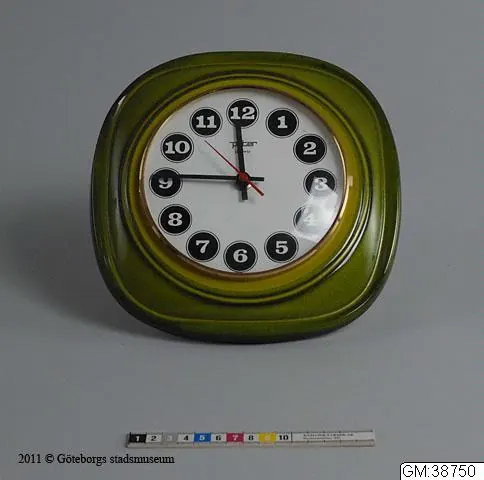
Wall clock, Sweden, 1982
Museum of Gothenburg
Clocks · 1970–1972
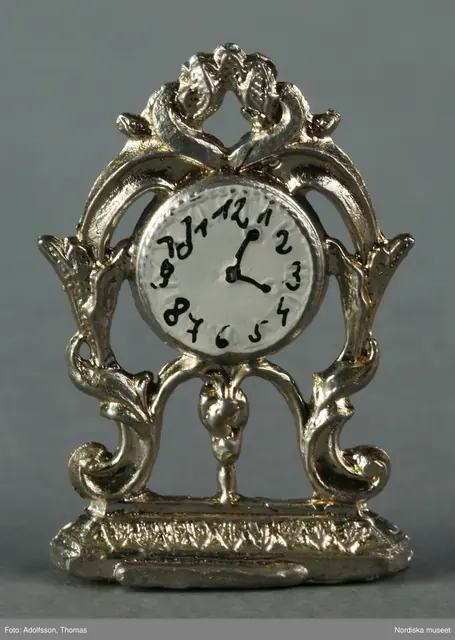
Table clock, Sweden, 1970–1972
Nordic Museum Foundation
Clocks · 1970–1972
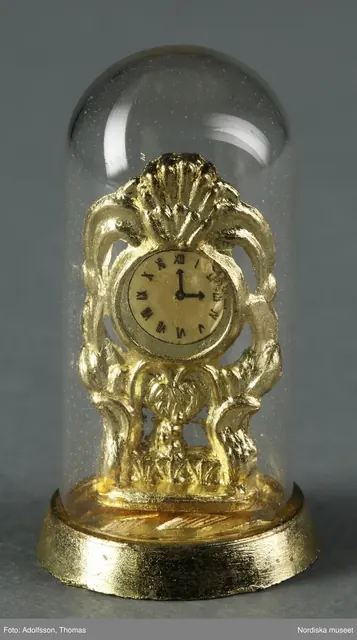
Table clock, Sweden, 1970–1972
Nordic Museum Foundation
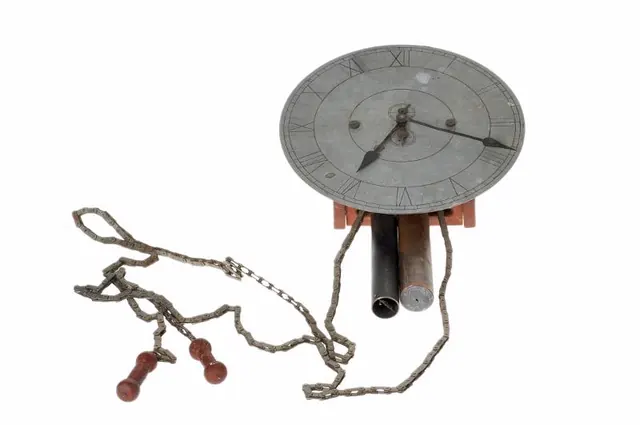
Clocks · 1988
Wall clock by Patient F, Sweden, 1988
Region Skåne's medical history collections
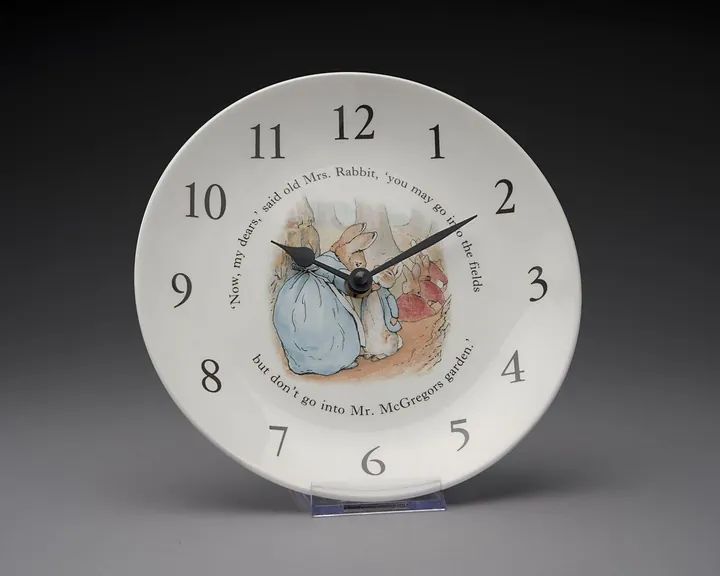
Clocks · late 20th century
Clock, 'Peter Rabbit', Queen's ware, transfer printing, Josiah Wedgwood and Sons, Barlaston, late 20th century (V&A WE.17466-2014)
Victoria and Albert Museum, London
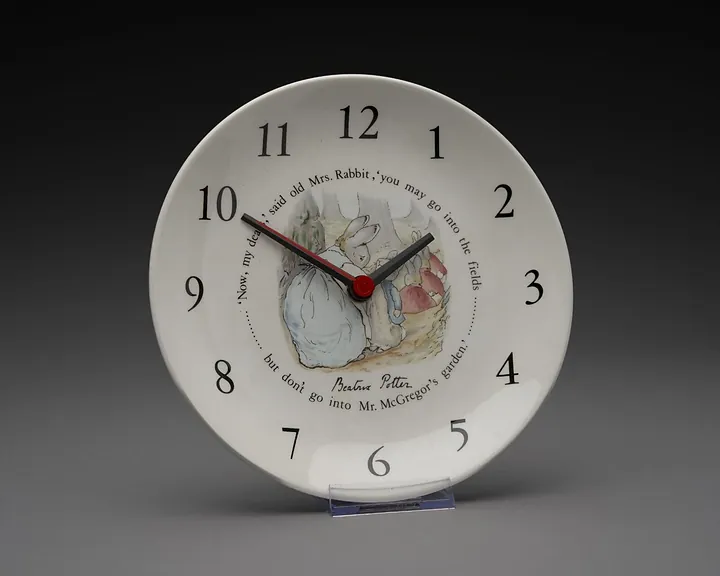
Clocks · late 20th century
Clock, 'Peter Rabbit', Queen's ware, transfer printing, Josiah Wedgwood and Sons, Barlaston, late 20th century (V&A WE.18029-2014)
Victoria and Albert Museum, London
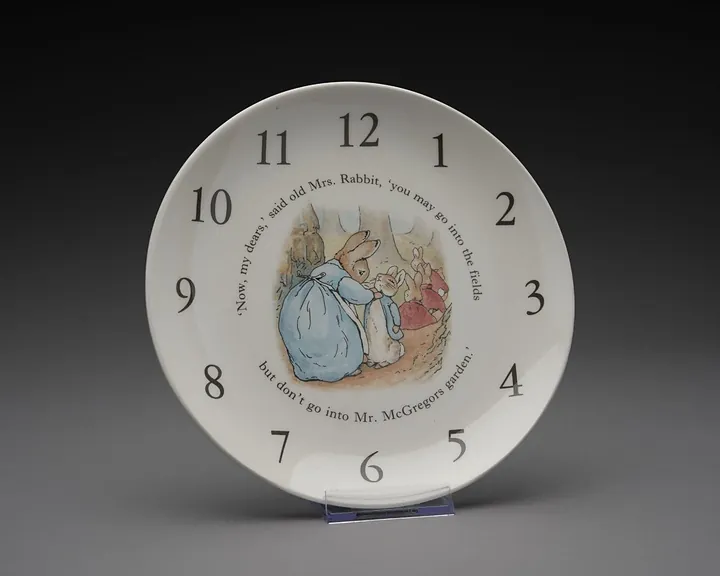
Clocks · late 20th century
Clock, 'Peter Rabbit', glazed earthenware, transfer printing, Josiah Wedgwood and Sons, Barlaston, late 20th century
Victoria and Albert Museum, London
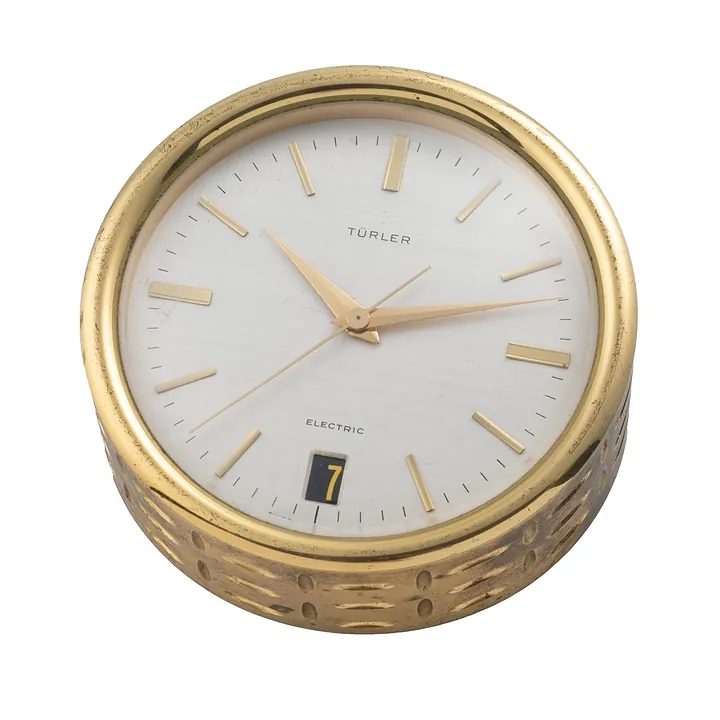
Clocks · c. 1960-1970s
Anonymous clock, c. 1960-1970s
Antiquorum auction archive, Geneva