
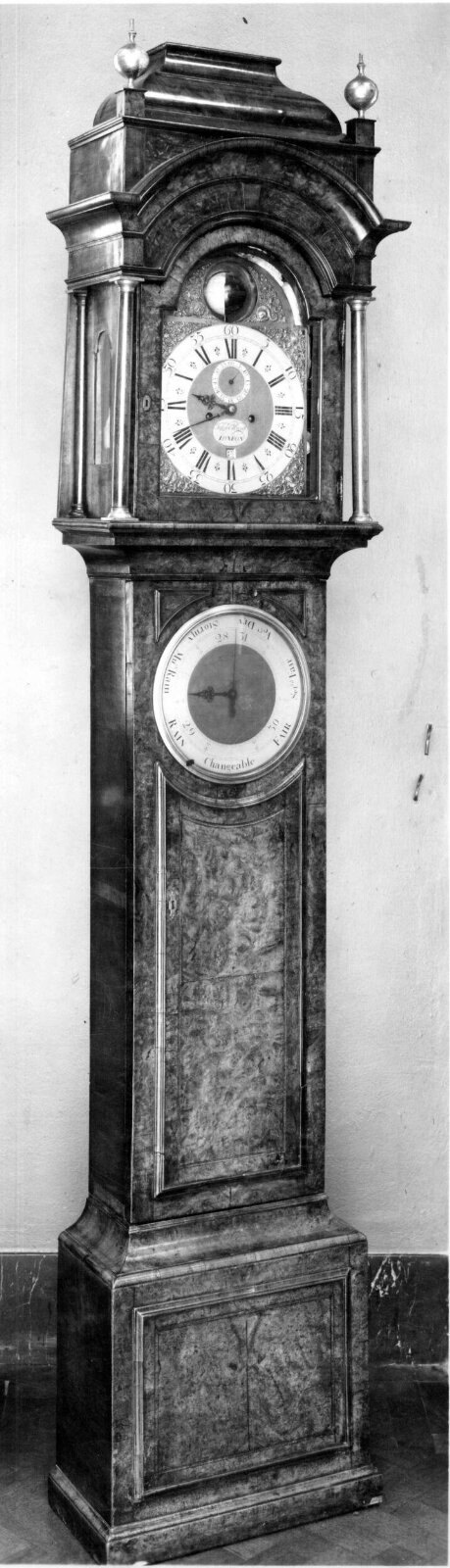
Clocks · Clock and barometer case
Clock and barometer case by John Ellicott, England, 1725–1750
- Maker / attribution
- John Ellicott (made)
- Date
- 1725–1750
- Historical period
- Early Modern Horology (1600 – 1750)
- Country of origin
- England
- Place
- London
- Object type
- Clock and barometer case
- Materials / technique
- walnut, oak, brass, veneering
- Dimensions
- Height: 253 cm; Width: 58 cm; Depth: 30 cm; Weight: 5.7 kg (W.107:5 weight 10/10/2025 NH); Weight: 3.95 kg (W.107:4 weight 10/10/2025 NH)
- Holding institution
- Victoria and Albert Museum, London
- Accession / object no.
- W.107:1 to 7-1962
- Credit line
- Bequeathed by C. D. Rotch
View the source record ↗ (opens another website in a new tab)Suggest a correction
Record summary
Held and catalogued by Victoria and Albert Museum, London (object number W.107:1 to 7-1962), this is a clock and barometer case by John Ellicott, made in London, England, dated 1725–1750. The Atlas places it in the Early Modern Horology period (1600 – 1750) of its Clocks collection. Materials and techniques recorded by the source: walnut, oak, brass, veneering. Recorded dimensions: Height: 253 cm; Width: 58 cm; Depth: 30 cm; Weight: 5.7 kg (W.107:5 weight 10/10/2025 NH); Weight: 3.95 kg (W.107:4 weight 10/10/2025 NH). The record is illustrated with 6 photographs.
Assembled from the source record's structured fields. Dates and attributions are given as the source states them; where a field is missing the Atlas leaves it blank rather than estimating.
Catalogue description
Summary — Victoria and Albert Museum
John Ellicott (1706-1772) of 17 Sweeting's Alley, Cornhill, was a Fellow of the Royal Society and served on its Council. He was one of the most eminent English makers and he was responsible for many technical improvements. The cases of many of his clocks are of great elegance. This example has a wheel barometer in the front of the case.
Physical description — Victoria and Albert Museum
Case: Walnut veneer on oak carcass. Full-width rectangular trunk door with moulded borders enclosing herringbone banding, the upper part containing the circular silvered dial and steel hands of a wheel barometer. Inside trunk door, barometer mechanism is concealed by a mahogany board. Concave moulding below hood. Sliding hood with break-arch glazed front door cornice and frieze, the whole surmounted by a caddy top, flanked by pedestal-mounted finials. Hood sides with free-standing brass-capped columns to front, wooden-capped quarter columns to rear. Rectangular break-arched glazed panels to hood sides. Rectangular base with moulding to front panel enclosing herringbone banding. Plain plinth. Dial: Brass, break-arch total height 16½ inches, central portion 12 inches square. Centre matted. Winding squares concealed by matted brass shutters. Square, bevelled calendar aperture located below a silvered, oval plaque pinned to the dial plate, engraved John Ellicott / London . Mask head spandrels located at corners of dial plate each located by a single screw. Flanking a globe moon in a circular aperture in the break-arch are arch spandrels of dolphin design. A pair of steel brackets one above the other are screwed to back of dial to locate the short, vertical globe moon arbor. Pinned to the dial plate is the silvered brass chapter ring with engraved minute band and opposed arrow heads and Arabic minute numerals at five minute intervals and Roman hour numerals. Engraved floating fleur-de-lis half-hour markers. Pinned to the dial plate below "XII" is the subsidiary seconds ring of silvered brass, with engraved seconds band and Arabic numerals at five seconds intervals; its diameter is such that it almost fully occupies space between it and central hole for hands. A silvered brass ring with engraved Arabic numerals for the date (1-31) runs behind the dial on brass pulleys. Four dial feet attached to the movement front plate by pinning. Hands: Pierced steel hour and minute. Plain seconds hand. Movement: Brass and steel, weight driven hour striking of 8-day duration, with dead beat escapement, pendulum regulated. Five pillars each with a central knop, riveted to backplate, pinned to front. Hour striking on bell controlled by snail, rack with sprung tail and deep tooth-type locking. Brass train wheels with four semicircular crossings. Where visible, single scribed line present at teeth roots, including hour and 24-hour wheels, except escape wheel. Three-spoked crossings on cannon pinion and minute wheel, latter being colleted onto minute pinion arbor, the whole being located on front plate by a cock. Double profiled wheel collets with short cylindrical section adjacent to wheel, merging into short tapered section along arbor. Steel arbors with slight barrel shape. Short pinion heads. Bolt and shutter maintaining power, actuated by decoratively shaped lever on proper left of movement, drives centre wheel teeth. The pair of shutters, pinned to front of bolt arbor, move as one. Steel dead beat pallets, with a short stalk connected to anchor-shaped frame, span 10½ teeth of escape wheel. Pallets attached to pallet arbor by brass collet. Escape wheel with slender teeth. Substantial backcock occupies half width of backplate. Little detailing on steelwork except striking side click; bell standard and separate hammer stop have some bevelling to edges. Globe moon drive is taken from 24-hour wheel which, in addition to working calendar, also meshes with separate gear wheel. This meshes with another gear carrying a flag. All these gears are mounted on movement front plate. Flag advances separate gear wheel located on back of dial at bottom of break-arch, having quasi-ratchet shaped teeth. Carried on this wheel, is a smaller gear wheel which meshes at right angles with a gear mounted on the vertical globe moon arbor. Thus moon is turned, thus indicating its phase in break-arch of dial. The trunk door barometer mechanism operates independently of clock movement. Description and notes by Francis Brodie, c. 2008
Brief description — Victoria and Albert Museum
EIGHT DAY LONG CASE CLOCK Walnut veneer on oak carcase Inscribed 'John Ellicott London', made in about 1725-1750
Provenance
Bequeathed by Claude Rotch Remarks : The break-arch to the hood was fully established after 1720-5, whilst free-standing hood columns were the predominant form on London clocks after 1730. The superstructure is of the caddy form, the pagoda top which although developed around 1730, did not become popular until the middle of the eighteenth century. Walnut was gradually supplanted by mahogany after c.1750. Regarding the dial, by about 1730 floating half-hour markers were common but tended to disappear by the end of this decade, along with the quarter hour band on London clocks. Both spandrel types (corner and arch) were introduced relatively early on in the eighteenth century but persisted, the mask head until c.1740, the dolphin style almost to the end of the century. The globe moon was fitted, albeit uncommonly on London clocks, between 1720-1750. A feature, perhaps more commonly associated with late seventeenth century clocks, was the presence of shutters over the winding squares, being a part of the maintaining power, although Ellicott did fit this type maintaining power quite late to his regulators. The design of hands seen here are not unlike those seen on other clocks by Ellicott. For the movement, finned pillars generally fell into disuse by the mid-eighteenth century to be replaced by plain pillars with knops, although Joseph Williamson was using the latter type by around 1725 (Robey, J.A., The Longcase Clock Reference Book, Ashbourne, 2001). Double-profiled collets ar
Historical context
Early Modern Horology (1600 – 1750)
Huygens' pendulum and balance spring transform accuracy; English makers develop the anchor and deadbeat escapements.
Huygens's pendulum (1656–57) improved clock accuracy from about a quarter of an hour to under a minute a day. The anchor escapement (c. 1670) and the long seconds pendulum created the longcase clock; London makers such as Fromanteel, Knibb, Tompion and Quare led European clockmaking, and French makers created the Boulle pendule.
Read the period in the timelineMore clocks from this periodEarlier: Renaissance Horology
Atlas type guide
Domestic clocks
A clock combines four systems: a source of power (falling weight, coiled spring, or later electricity), a gear train that divides time, an escapement and oscillator that regulate it (foliot, pendulum or balance), and an indicating system of dial and hands or a bell. Its history runs from the large iron weight-driven clocks of the late thirteenth century to Renaissance spring-driven table clocks, the pendulum revolution of 1656, the factory clocks of the nineteenth century and electric and quartz clocks of the twentieth.
Domestic clocks also reflect regional furniture and decorative traditions — English longcase and bracket clocks, French pendules, Viennese regulators, Black Forest and American shelf clocks — and therefore record changing tastes as much as technical progress.
What to look for
- How the clock is powered: weights, spring barrel, fusee, electric coil.
- The oscillator: foliot, short pendulum, long seconds pendulum or balance.
- Whether it strikes: hour only (count wheel) or hours and quarters (rack striking).
- The maker or retailer's name on dial and movement, and any factory trademarks.
- Signs of alteration — replaced dials, converted escapements, 'married' cases.
Dating clues
- Before 1656 clocks used foliots or balances; after, most domestic clocks have pendulums.
- Anchor escapements spread after c. 1670; minute hands became common at the same time.
- Factory production in America and Germany transformed prices after c. 1840.
General guidance written by the Atlas editors about this kind of object. It is not a statement about this particular piece; for that, rely on the source record above and on physical examination.
Related records
Clocks · 1740–1760
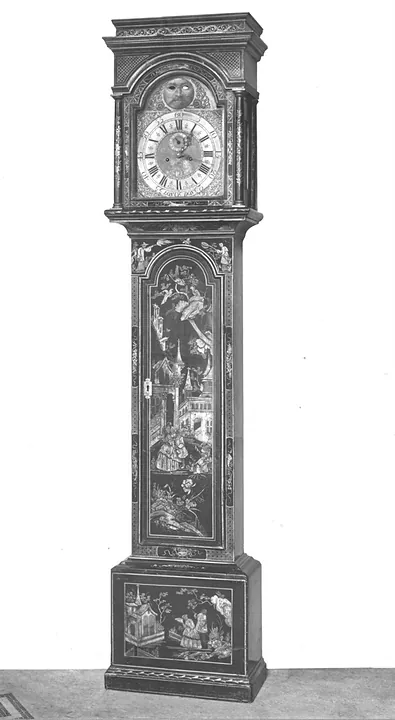
Longcase clock, English, 1740–1760, japanned wood, John Ellicott
Victoria and Albert Museum, London
Pocket Watches · c. 1753
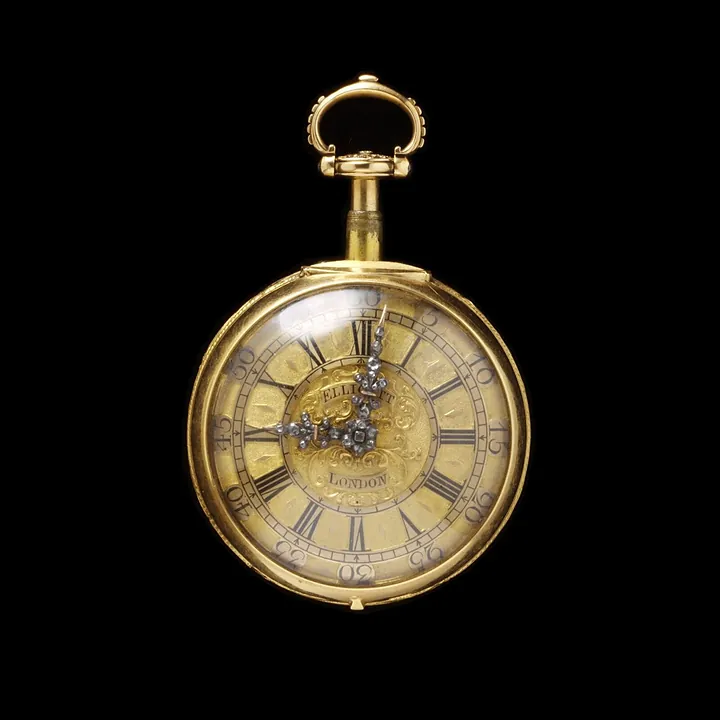
Gold watch, signed 'Jno. Ellicott, London, 3719', the inner case pierced and engraved, with a casemaker's mark 'JB', London, about 1753
Victoria and Albert Museum, London
Pocket Watches · c. 1760
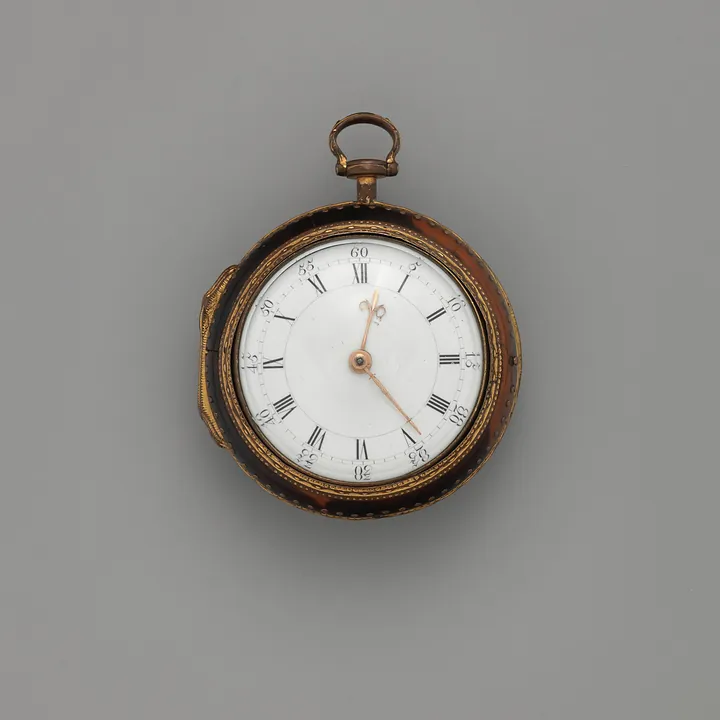
Watch by John Ellicott, England, c. 1760
The Metropolitan Museum of Art, New York
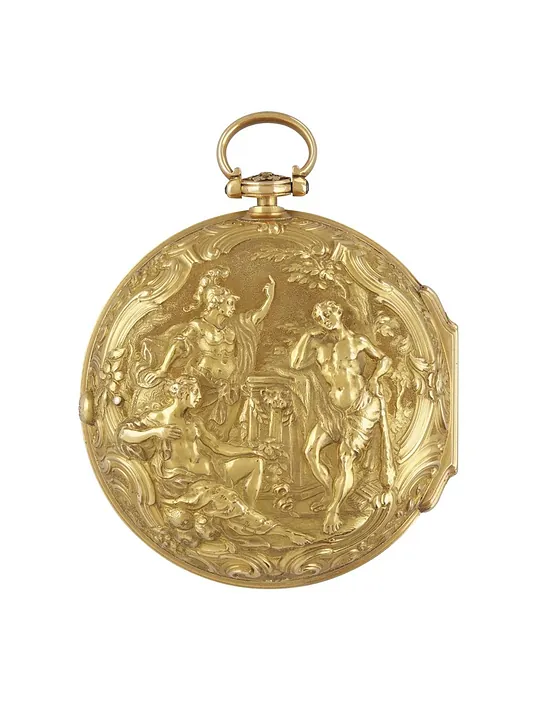
Pocket Watches · 1767
Pocket watch by John Ellicott, England, 1767
Science Museum Group, London
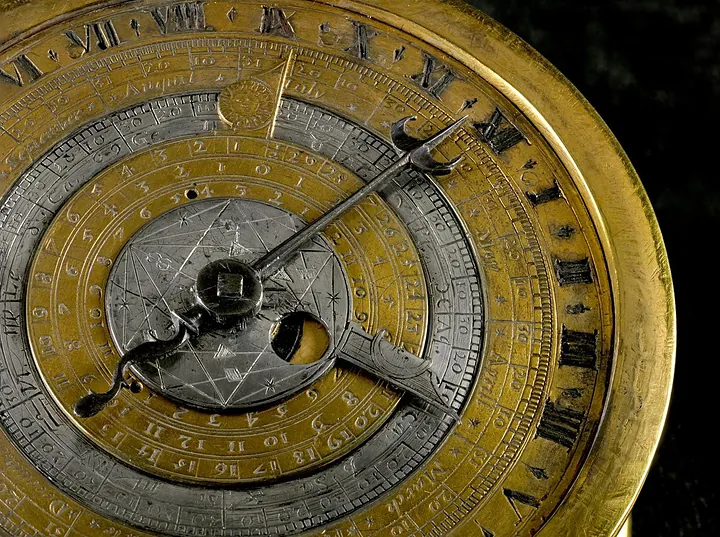
Clocks · 1598–1603
Circular table-clock with calendrical and lunar indications made by Nicholas Vallin in London between 1598 and 1603.
Science Museum Group, London
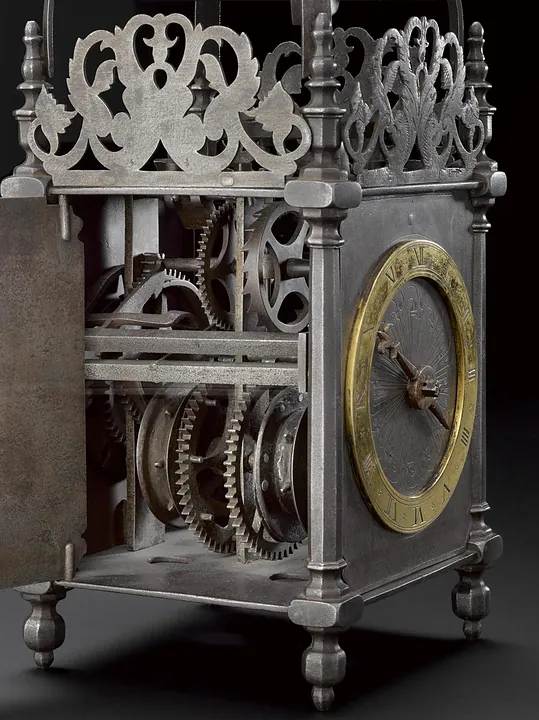
Clocks · 1611
English iron lantern clock, with wheel balance, by John Holloway, Market Lavington, Wiltshire, England, 1611.
Science Museum Group, London
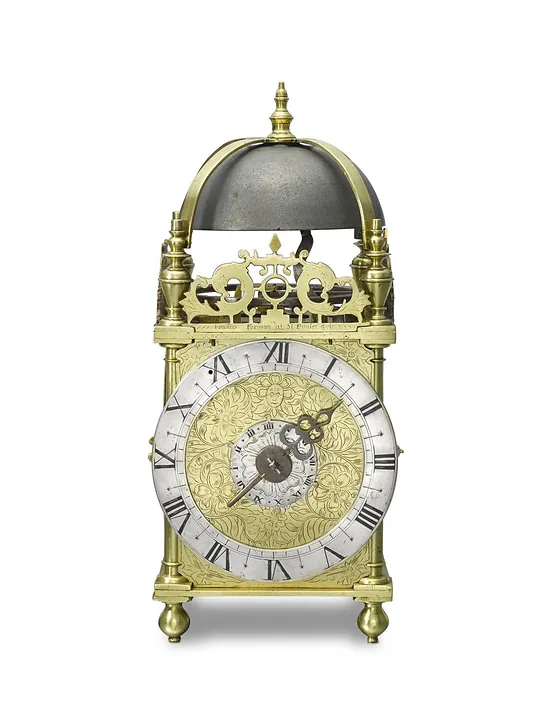
Clocks · 1630
Lantern clock by Francis Forman, England, 1630
Science Museum Group, London
Clocks · 1632–1640
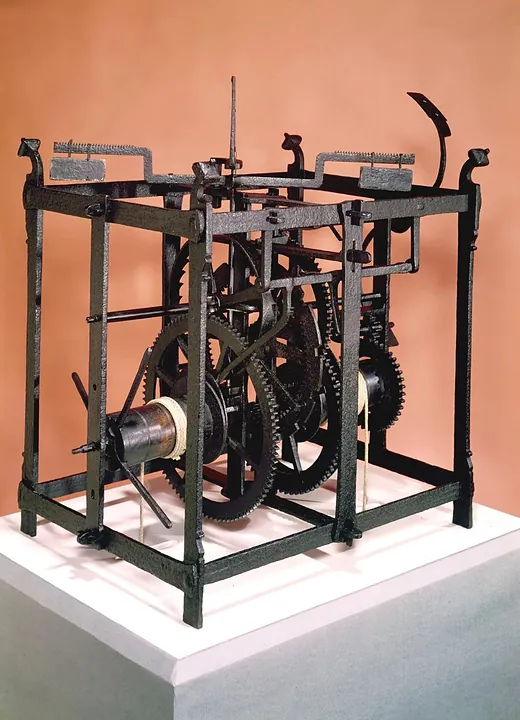
Turret clock, England, 1632–1640
Science Museum Group, London