
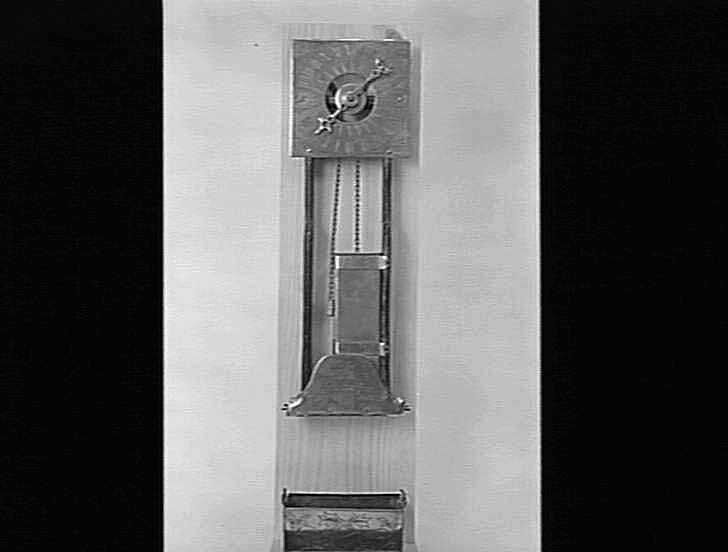
Instruments · Clepsydra replica
Reproduction of T. Cole's water clock (clepsydra) of 1680, probably early 20th century
- Maker / attribution
- Unrecorded in source
- Date
- Probably early 20th century (reproduction of an original made in Winchester, 1680)
- Historical period
- Golden Age of Mechanical Watchmaking (1900 – 1945)
- Country of origin
- Unrecorded in source
- Object type
- Clepsydra replica
- Dimensions
- 70 cm (Height)
- Holding institution
- Museums Victoria, Melbourne
- Accession / object no.
- ST 19390
- Catalogue title (original)
- Clepsydra Replica - T. Cole, Winchester, 1680 (English)
Editor's note
Museums Victoria describes this as a reproduction, probably early 20th century, of a clepsydra made by T. Cole in Winchester in 1680. It is dated and classified as the reproduction.View the source record ↗ (opens another website in a new tab)Suggest a correction
Record summary
Held and catalogued by Museums Victoria, Melbourne (object number ST 19390), this is a clepsydra replica, dated Probably early 20th century (reproduction of an original made in Winchester, 1680). The Atlas places it in the Golden Age of Mechanical Watchmaking period (1900 – 1945) of its Instruments collection. Recorded dimensions: 70 cm (Height). The record is illustrated with 1 photograph.
Assembled from the source record's structured fields. Dates and attributions are given as the source states them; where a field is missing the Atlas leaves it blank rather than estimating.
Catalogue description
Summary — Museums Victoria
Reproduction clepsydra or water clock, of a clock originally made by T. Cole, Winchester, 1680. Date of reproduction probably early 20th century. Wooden frame to hang on wall. Brass clock with square dial and single hand. Lower reservoir has two fish incised on front.
Inscriptions & marks
Inscription on brass plate at base 'T. Cole fecit of ye old town Winchester Anno Dom 1680.'
Provenance
Loan & Subsequent Bequest from Mr John Askew, 04 Jun 1931
Historical context
Golden Age of Mechanical Watchmaking (1900 – 1945)
The wristwatch displaces the pocket watch; waterproof cases, self-winding and grand complications.
Timing instruments became electrical and specialised: industrial time recorders, sports timers and aviation instruments.
Read the period in the timelineMore instruments from this periodEarlier: Industrial Revolution
Atlas type guide
Water, fire and incense clocks
Before the mechanical clock, intervals and hours were measured by flow and combustion. Outflow and inflow water clocks were used in Egypt, Mesopotamia, Greece, China and the Islamic world; Chinese and Japanese incense clocks burned powdered incense along a maze-like path; oil-lamp clocks with graduated glass reservoirs were popular in German-speaking Europe in the seventeenth and eighteenth centuries.
These timekeepers needed constant correction and could not keep the hour automatically for long periods, but they underpinned temple ritual, legal procedure, astronomy and the earliest monumental astronomical clocks such as Su Song's clock tower (1090s) and al-Jazari's designs (1206).
What to look for
- Graduated vessels or glass reservoirs with hour scales.
- Incense trays with stencils for laying the powder trail.
- Pewter oil-lamp clocks with a glass reservoir marked in Roman numerals.
Dating clues
- Oil-lamp clocks are mostly eighteenth century and often reproduced later.
- Incense clocks were made in China and Japan into the twentieth century.
General guidance written by the Atlas editors about this kind of object. It is not a statement about this particular piece; for that, rely on the source record above and on physical examination.
Read next:Su Song's astronomical clock tower
Related records
Instruments · Undated (20th century)
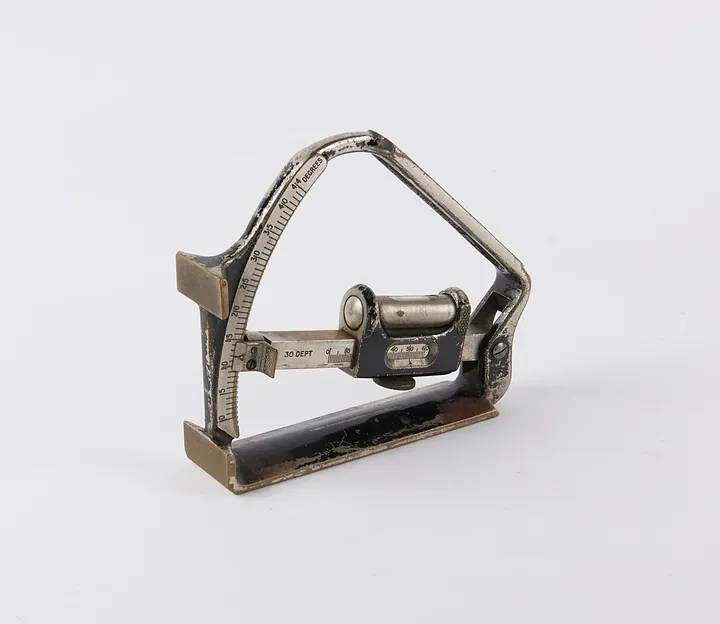
Field chronometer, Mark IV, no. 1621, by Taylor & Hobson Ltd.
Science Museum Group, London
Instruments · 1880–1920
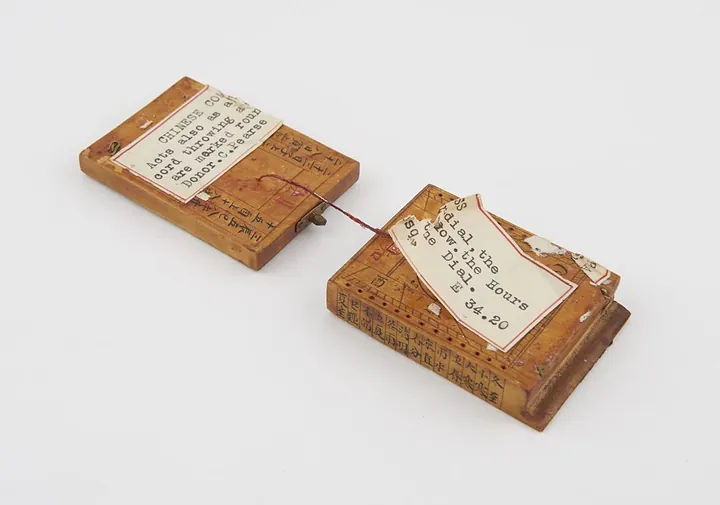
Compass and sundial, two hinged wooden blocks, compass needle set into one, covered with glass windows, painted with Chinese characters, Chinese, 1880–1920
Science Museum Group, London
Instruments · 1890–1930
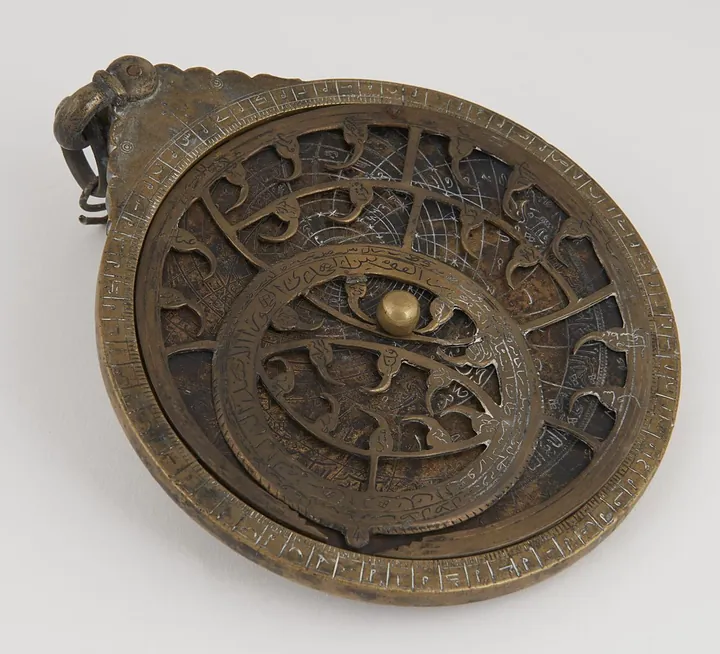
Decorative fake Islamic astrolabe with four plates and sightless alidade, pin missing.
Science Museum Group, London
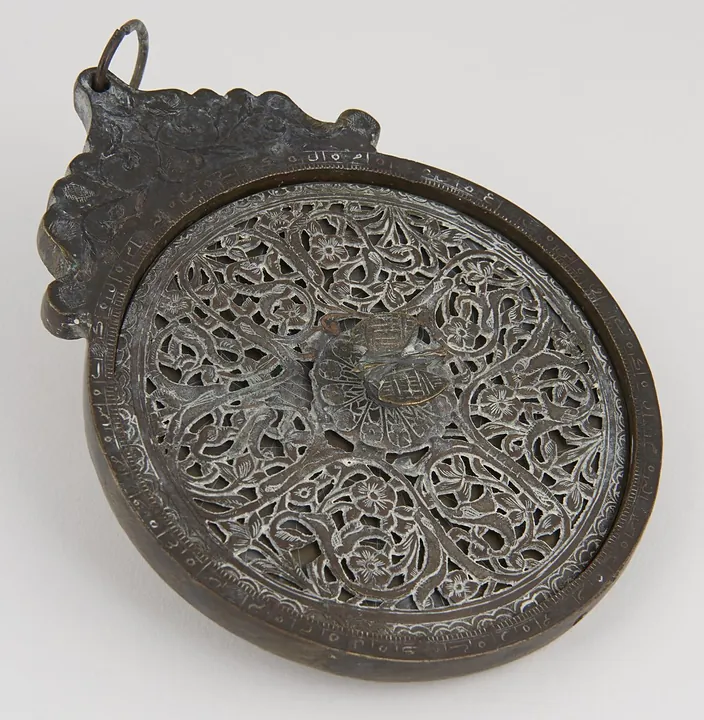
Instruments · 1890–1930
Decorative fake Islamic astrolabe, Arabic origin, brass, with four plates and foliate cover.
Science Museum Group, London
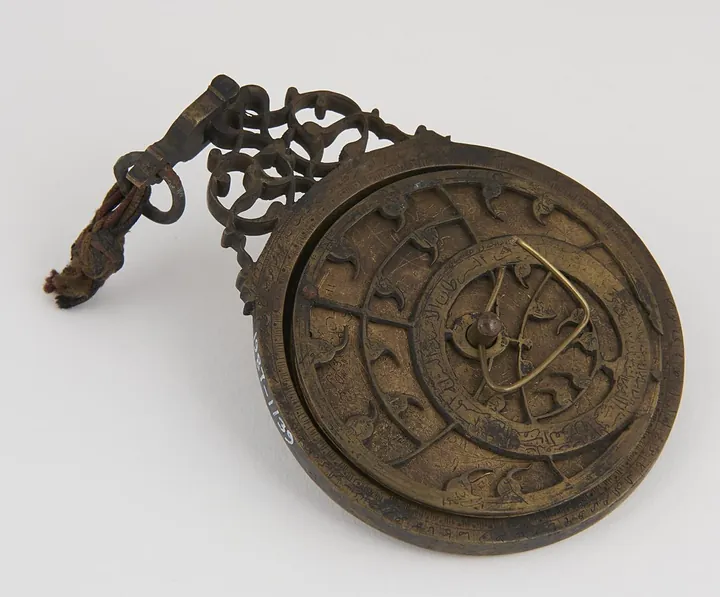
Instruments · 1890–1930
Decorative fake Islamic astrolabe, brass, with four plates, cursive kursi, and sightless alidade, pin missing.
Science Museum Group, London
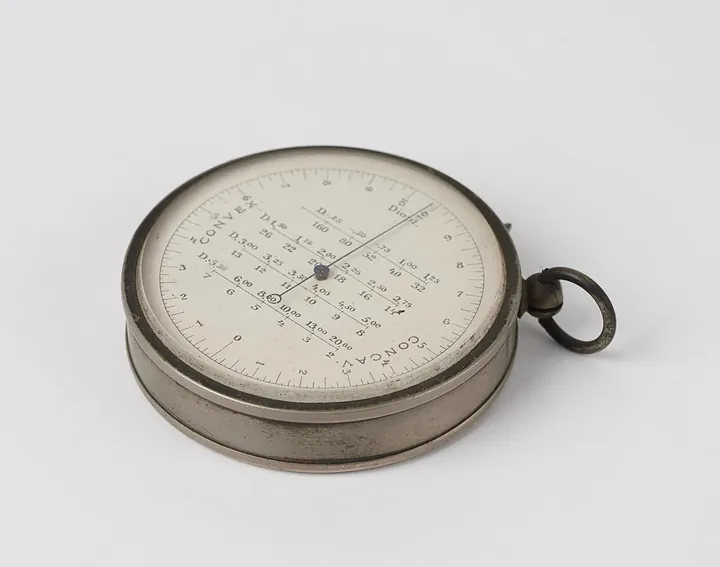
Instruments · 1890–1945
Optometer(?), stop-watch form, scaled circular face to measure concanity,[.........] of lenses, English, 1890–1945
Science Museum Group, London
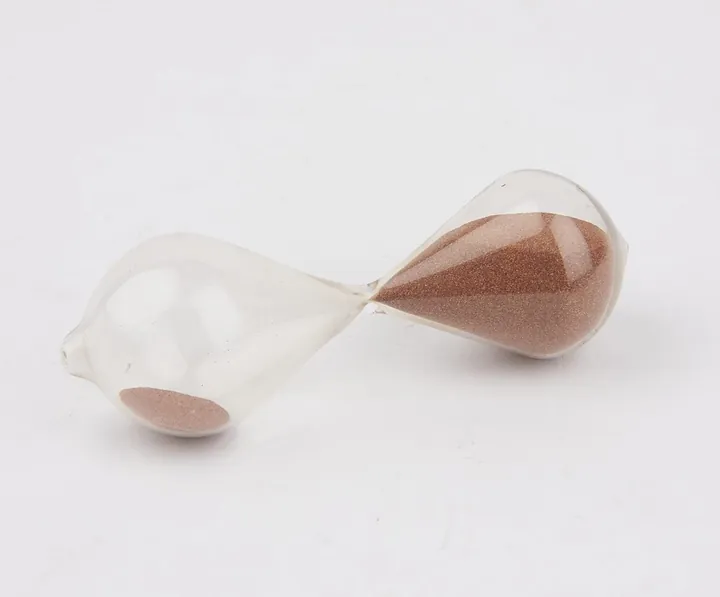
Instruments · 1890–1950
Single sand-glass unmounted, showing complete seal. 15 mins. Abbot Horne. No. Type C., 1890–1950
Science Museum Group, London
Instruments · 1890–1950
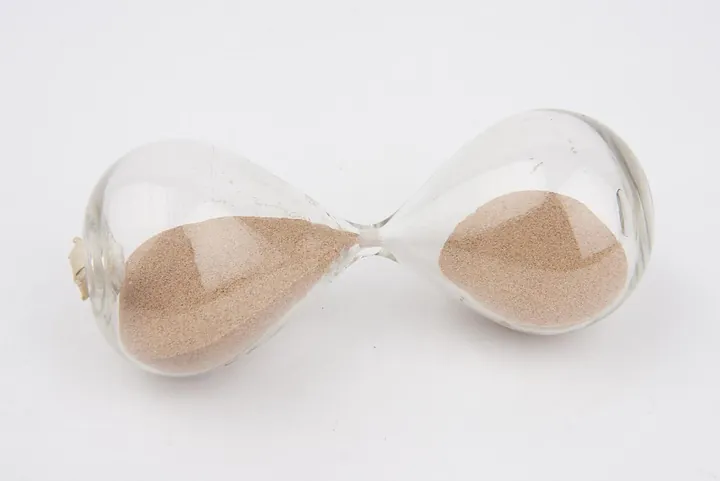
Single sand-glass unmounted, showing corked entry hole. 2 1/2 mins. Abbot Horne. Type B, 1890–1950
Science Museum Group, London