
Clocks · Ship's bell mantel clock
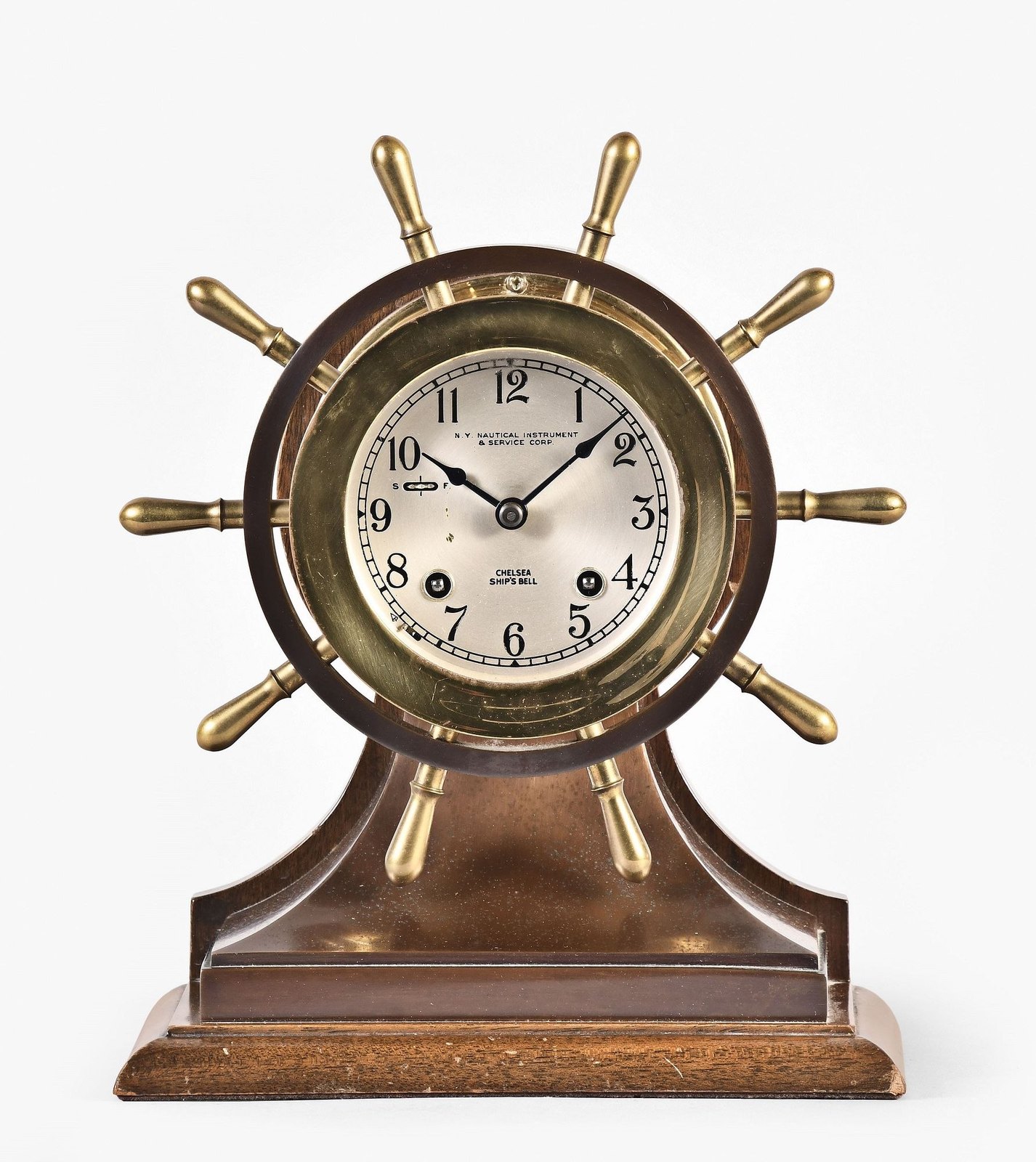
Chelsea Clock Co. 'Yacht Wheel' Ship's Bell Mantel Clock
- Maker / attribution
- Chelsea Clock Co. (source attribution)
- Date
- c. 1970
- Historical period
- Quartz Revolution (1969 – 1990)
- Country of origin
- United States
- Object type
- Ship's bell mantel clock
- Dimensions
- 11in x 8in x 4.5in
- Auction house
- Schmitt Horan & Co.
- Lot
- 318
- Credit line
- Schmitt Horan & Co.
- Catalogue title (original)
- Chelsea Clock Co. Yacht Wheel mantel clock sold at auction on 20th January | Bidsquare (English)
View the source record (auction lot) ↗ (opens another website in a new tab)Suggest a correction
Record summary
Catalogued by Schmitt Horan & Co. (lot 318), this is a ship's bell mantel clock attributed to Chelsea Clock Co., made in United States, dated c. 1970. The Atlas places it in the Quartz Revolution period (1969 – 1990) of its Clocks collection. Recorded dimensions: 11in x 8in x 4.5in. The record is illustrated with 1 photograph.
Assembled from the source record's structured fields. Dates and attributions are given as the source states them; where a field is missing the Atlas leaves it blank rather than estimating.
Catalogue description
Original object description
Dating to circa 1970 and manufactured in Boston, Massachusetts, this United States maritime-style timepiece by the Chelsea Clock Co. is an eight-day 'Yacht Wheel' ship's bell mantel clock. Measuring 11 inches high, 8 inches wide, and 4.5 inches deep, the brass and bronze casing is styled after a nautical helm, ringed by eight turned metal spokes on a hinged front door. The housing bears stamped case number 769084 and rests upon a flared mahogany foot, also characterized in records as a bronze-coated wood mount with spreading metallic uprights. The silvered brass face features an outer track for minutes, black Arabic hour numerals, and blued steel hands in a spade profile, showing some minor nicks and surface abrasion. A slow/fast regulation aperture is located between the numerals 9 and 10, while two winding arbors sit in the lower register. The dial is marked above the arbor with "N.Y. NAUTICAL INSTRUMENT &" Service Corp., and marked lower down with "CHELSEA SHIP'S BELL". Driven by springs, the brass movement carries serial number 721744 and utilizes a lever escapement alongside a traditional ship's bell striking train. Condition notes indicate that the striking works operated but the time train was not running; the brass surface exhibits uneven lacquer, spotting, and tarnished mounts, with no photographic records available for the back or interior.
Inscriptions & marks
721744
Historical context
Quartz Revolution (1969 – 1990)
Seiko's Astron begins mass quartz timekeeping; traditional industries contract sharply.
Quartz movements and digital displays made accurate clocks cheap and ubiquitous after the early 1970s. LED and LCD clocks, clock radios and radio-controlled clocks appeared, while traditional mechanical clockmaking contracted sharply in Germany, France and Britain.
Read the period in the timelineMore clocks from this periodEarlier: Modern Mechanical Horology
Atlas type guide
Mantel and French pendule clocks
The mantel clock — the French pendule de cheminée — is as much decorative art as timekeeper. From the late seventeenth century Parisian clockmakers worked with cabinet-makers, bronze founders and gilders (ciseleurs-doreurs) to create cases in Boulle marquetry, gilt bronze and marble, while the movements were often supplied by specialist makers. Clocks of the Louis XIV, Louis XV and Louis XVI periods, and Empire clocks with allegorical figures, set fashions copied across Europe.
The nineteenth century industrialised the type. The 'Paris movement', a standardised round movement with silk-thread or Brocot suspension and count-wheel striking, was made in huge numbers by firms such as Japy and Vincenti, and fitted into cases of every style and material.
What to look for
- Round 'Paris' movements with makers' stamps (e.g. Japy Frères, Vincenti, S. Marti) and medal marks from exhibitions.
- Suspension type: silk thread (earlier) or Brocot adjustable suspension (after c. 1840).
- Visible Brocot escapement on the dial in later clocks.
- Fire-gilt (mercury) gilding on bronzes versus later electro-gilding.
- Signed dials naming a retailer rather than the movement maker.
Dating clues
- Silk-suspension Paris movements: c. 1800–1850.
- Brocot suspension and visible escapements: after c. 1840.
- Exhibition medal stamps on movements give dates after the medal year.
General guidance written by the Atlas editors about this kind of object. It is not a statement about this particular piece; for that, rely on the source record above and on physical examination.
Read next:Anchor (recoil) escapement
Related records
Clocks · c. 1905
Chelsea Clock Co. Ca.1905-1909 Ship's Bell Clock
LiveAuctioneers auction archive
Clocks · c. 1940
Chelsea Bakelite ship's clock. circa 1940
LiveAuctioneers auction archive
Clocks · c. 1901
Chelsea Ship's Bell Clock Retailed by RIGGS & BRO., PHILADELPHIA Boston, circa 1901 Bezel
LiveAuctioneers auction archive
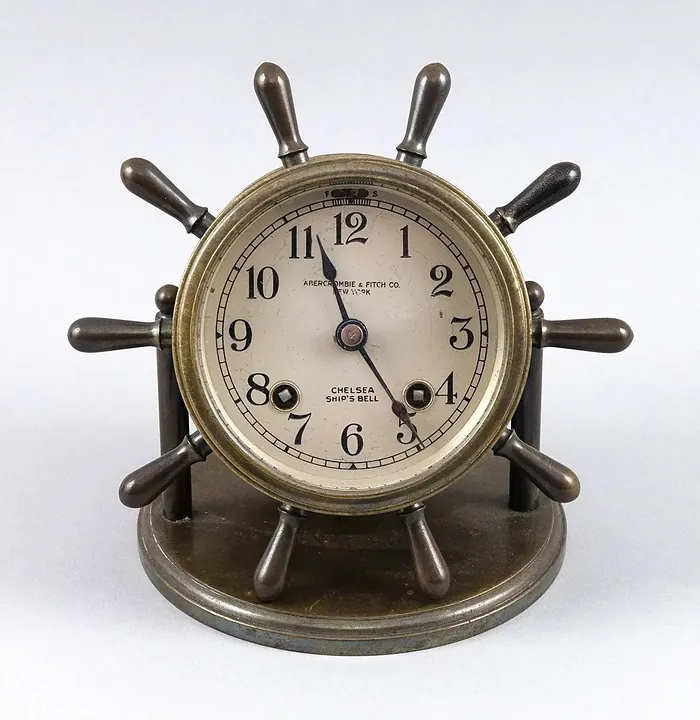
Clocks · c. 1940
Chelsea \"Vanderbilt\" Ship's Wheel Brass Desk Clock
Eldred's
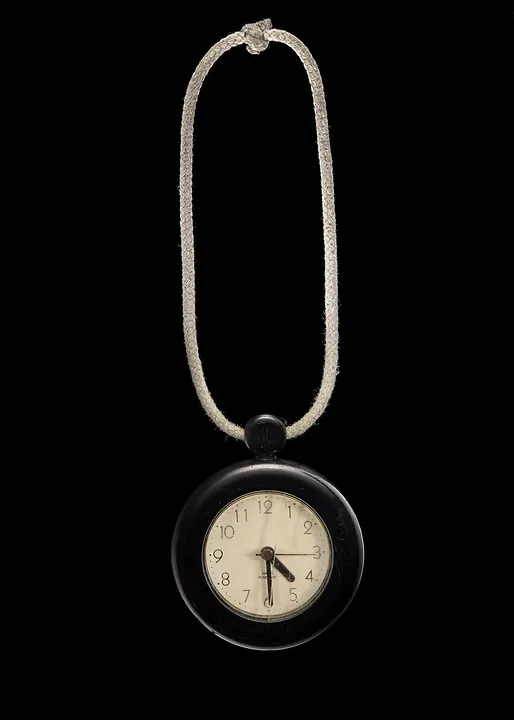
Clocks · mid 1980s
Clock necklace worn by Flavor Flav of Public Enemy, United States, mid-1980s
National Museum of African American History and Culture, Smithsonian Institution, Washington DC

Clocks · 1983
Clock by EMI, United States, 1983
Victoria and Albert Museum, London

Clocks · 1973
Wall clock by Waterbury Clock Co., United States, 1973
Museum of Gothenburg
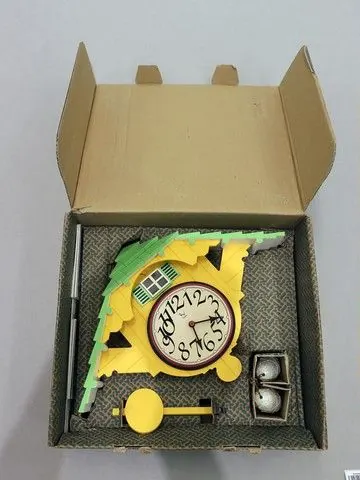
Clocks · 1988
Cuckoo Clock by Robert Venturi
Yale University Art Gallery, New Haven