
Wristwatches · Wristwatch
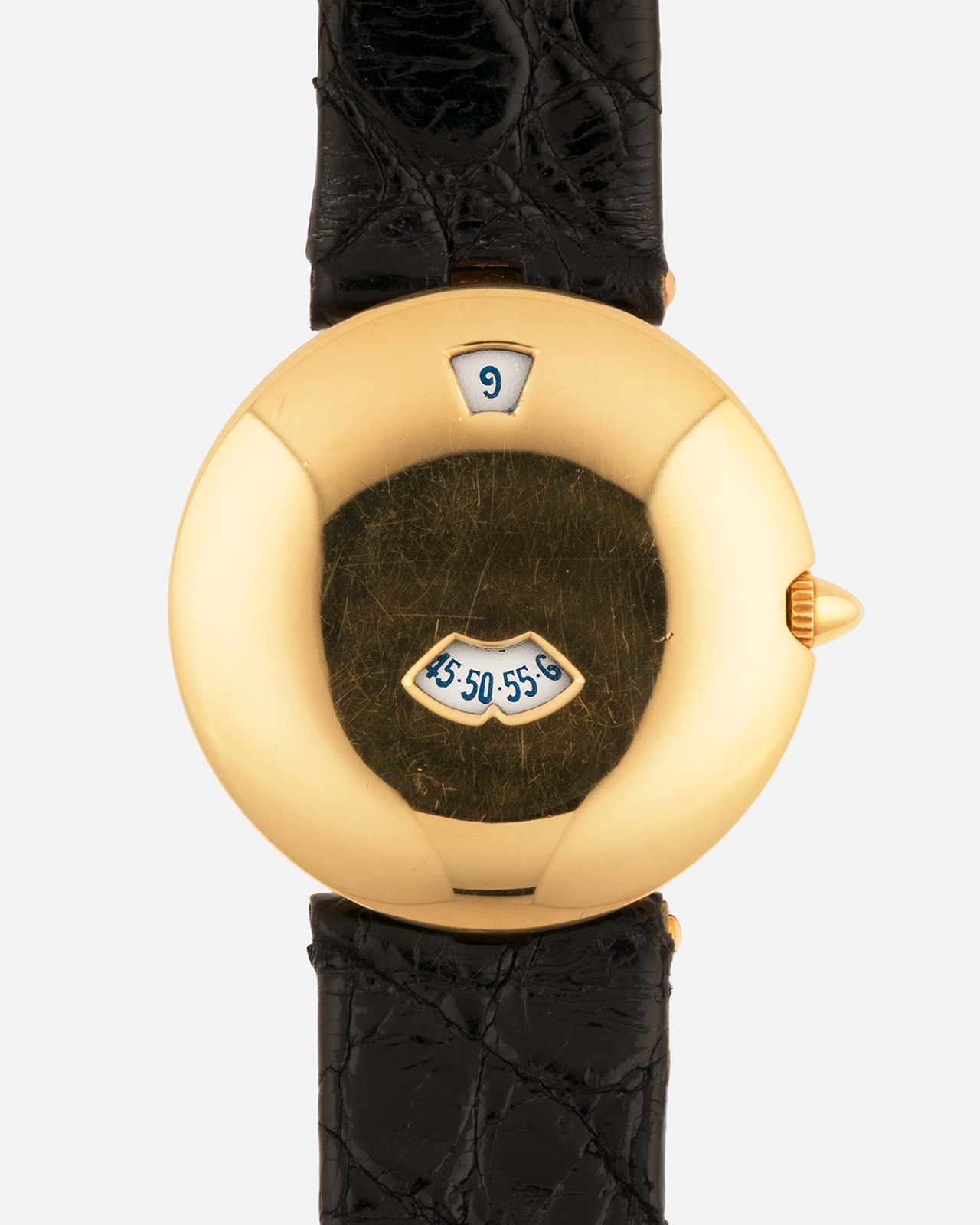
Chaumet Jump Hour 11A Les Pléiades, early 1990s
- Maker / attribution
- Chaumet (maker)
- Date
- early 1990s
- Historical period
- Mechanical Renaissance (1990 – 2010)
- Country of origin
- Unrecorded in source
- Object type
- Wristwatch
- Dimensions
- Case 30 mm
- Stock no.
- Product 7814538494039
- Credit line
- Dealer listing, S.Song Watches (product 7814538494039)
- Catalogue title (original)
- Chaumet Jump Hour 11A Les Pléiades (English)
View the source record (dealer listing) ↗ (opens another website in a new tab)Suggest a correction
Record summary
Catalogued by S.Song Watches (dealer), Seattle (stock number Product 7814538494039), this is a wristwatch by Chaumet, dated early 1990s. The Atlas places it in the Mechanical Renaissance period (1990 – 2010) of its Wristwatches collection. Recorded dimensions: Case 30 mm. The record is illustrated with 6 photographs.
Assembled from the source record's structured fields. Dates and attributions are given as the source states them; where a field is missing the Atlas leaves it blank rather than estimating.
Catalogue description
Dealer description — S.Song Watches
While Chaumet is best known as one of the great Parisian jewellery houses, its involvement in watchmaking runs considerably deeper than many realise. The Maison established a dedicated watchmaking department during the postwar period, and in 1970, brothers Jacques and Pierre Chaumet acquired Breguet. Under their ownership, Breguet was repositioned towards high-end complicated watchmaking, eventually bringing Daniel Roth into the manufacture and establishing a workshop in the Vallée de Joux. It is against this rather interesting period of Chaumet's history that the Les Pléiades was created. Introduced in the early 1990s, the collection is perhaps best known today for the mechanical reference 10A, whose unusual jumping-hour movement was developed with a young François-Paul Journe, years before he established his own manufacture. Here, however, we have its smaller sibling, the reference 11A. Measuring just 30mm across, it retains the wonderfully unusual 'Pebble' shape of the larger watch, but packages it into considerably more compact proportions. Crafted from 18-carat yellow gold, the case is essentially a smooth disc of gold, with almost no conventional bezel or visible lugs to interrupt its profile. The time display is equally unconventional. Rather than using traditional hands, the entire face of the watch is reduced to two small apertures, with the jumping hours displayed at 12 o'clock and the minutes below. Unlike the mechanical 10A, the 11A is powered by a thin quartz movement. While that naturally makes the 10A the more horologically significant of the two, the quartz construction allowed Chaumet to reduce the watch to just 30mm while retaining the same unusual architecture. On the wrist, the result feels less like a conventional wristwatch and considerably more like a piece of jewellery, something that perhaps makes sense given Chaumet's background. The mechanical Les Pléiades 10A understandably receives most of the attention today because of its connection to F.P. Journe, but the smaller 11A is fascinating in its own right. At just 30mm, its almost completely uninterrupted yellow gold case, unusual digital display and complete absence of branding from the front make it unlike almost anything Chaumet has produced before or since. Although exact production figures remain unknown, the reference is rarely encountered today, with relatively few examples appearing on the secondary market. This Chaumet is, in my opinion, an obscure and wonderfully unusual piece of early 1990s watch design.
Historical context
Mechanical Renaissance (1990 – 2010)
Mechanical watches return as cultural objects; independent watchmaking flourishes.
Mechanical watches returned as cultural and luxury objects. Complications, tourbillons and new materials proliferated; independent watchmakers such as George Daniels, F.P. Journe and Philippe Dufour revived artisanal watchmaking; collecting vintage watches became a major field.
Read the period in the timelineMore wristwatches from this periodEarlier: Quartz Revolution
Atlas type guide
Wristwatches
Bracelet watches were worn by women from the early nineteenth century — Breguet made one for Caroline Murat, Queen of Naples, in 1810–12 — but the wristwatch only became a man's instrument with military use and aviation in the early twentieth century. Between the World Wars it overtook the pocket watch; the 1920s and 1930s brought rectangular Art Deco cases, water-resistant cases and the first automatic winding systems.
After 1945 the wristwatch became a carrier of identity — dress watches, sports and dive watches, chronographs, calendars — produced by Swiss, American, Japanese, German, Soviet and Chinese industries. The quartz revolution after 1969 and the mechanical renaissance since the 1990s, including the rise of independent watchmakers, complete the story.
What to look for
- The reference number (between the lugs or inside the case back) and serial number, the starting point for dating.
- The calibre: its maker and number are often stamped under the dial or on the bridge.
- Originality of dial, hands and crown — refinished ('redial') dials are common.
- Case material marks: 18K/750, 14K/585, stainless steel, gold-filled, plated.
Dating clues
- Wire-lug cases: before c. 1925.
- Water-resistant screw-down cases: from 1926.
- Quartz movements: from 1969; sapphire crystals widespread after c. 1980.
General guidance written by the Atlas editors about this kind of object. It is not a statement about this particular piece; for that, rely on the source record above and on physical examination.
Related records
Wristwatches · c. 1990s
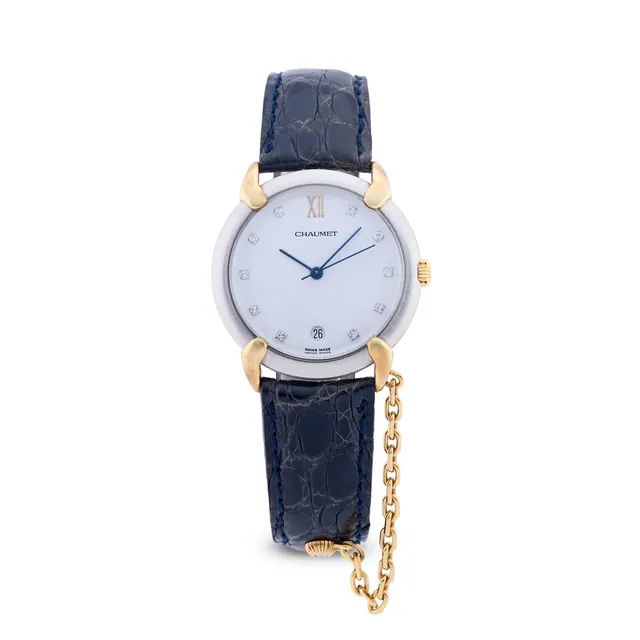
Chaumet wristwatch, Élysée, circa 1990s
Antiquorum auction archive, Geneva
Wristwatches · c. 1990s
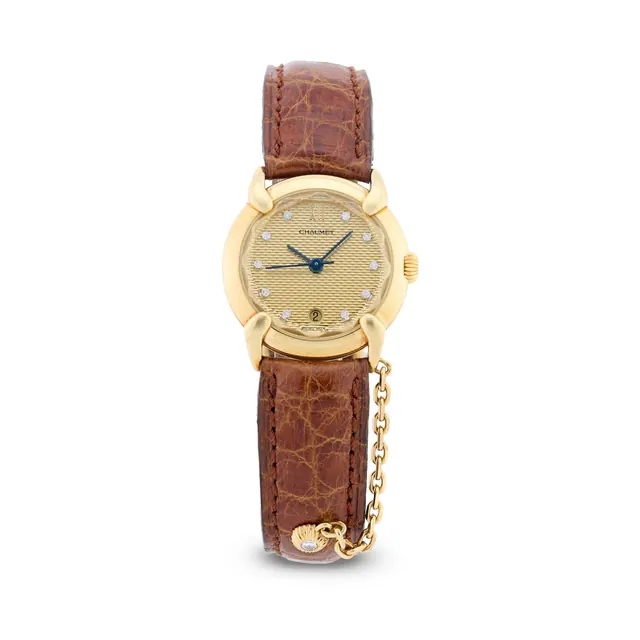
Chaumet wristwatch, Élysée, circa 1990s
Antiquorum auction archive, Geneva
Wristwatches · c. 2000
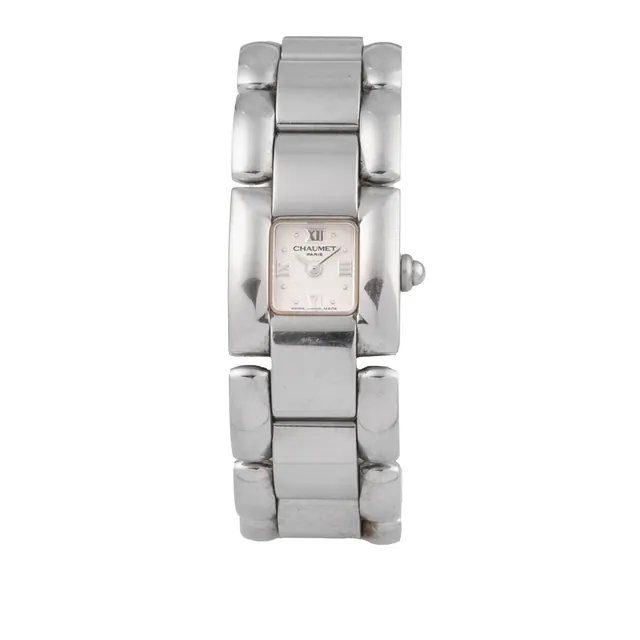
Chaumet wristwatch, ref. 821-1062, Swiss Made, circa 2000
Antiquorum auction archive, Geneva
Wristwatches · c. 2000
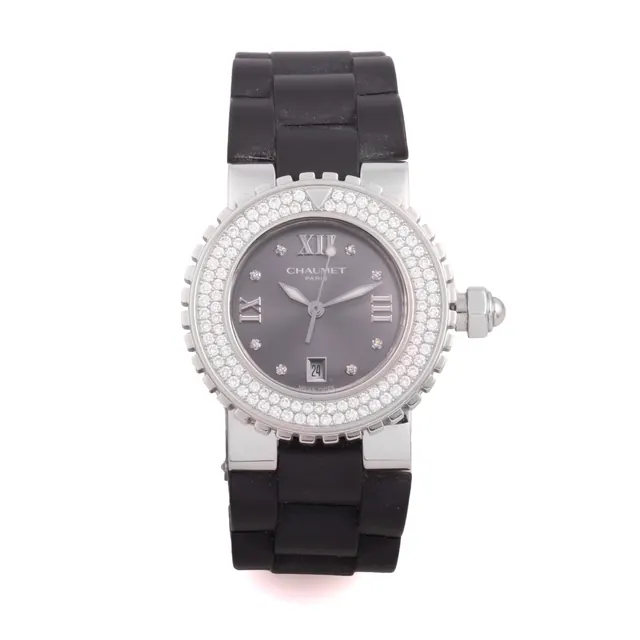
Chaumet wristwatch, France Daimonds Bezel, circa 2000
Antiquorum auction archive, Geneva
Wristwatches · 1999
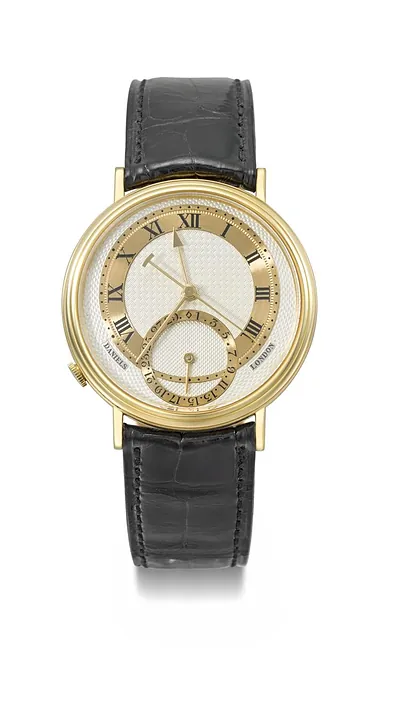
'Millennium' co-axial wristwatch by George Daniels and Omega, England, 1999
Science Museum Group, London

Wristwatches · 2008
Wristwatch by Breitling?, 2008
Museum Rotterdam
Wristwatches · 2008
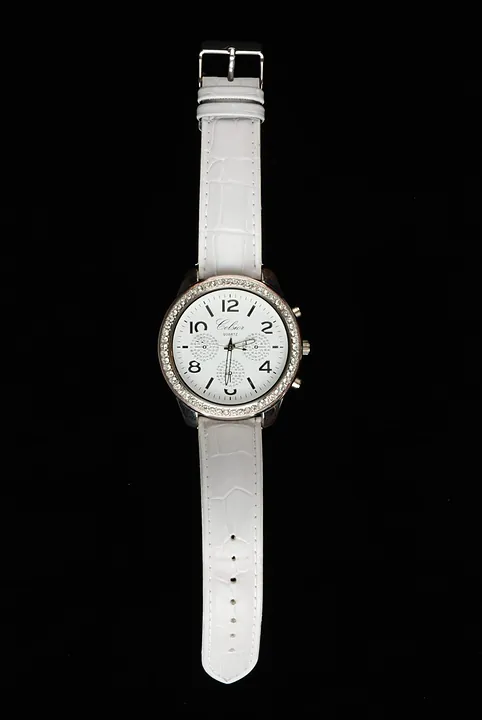
Wristwatch by Celsior Quartz, 2008
Museum Rotterdam
Wristwatches · 2008
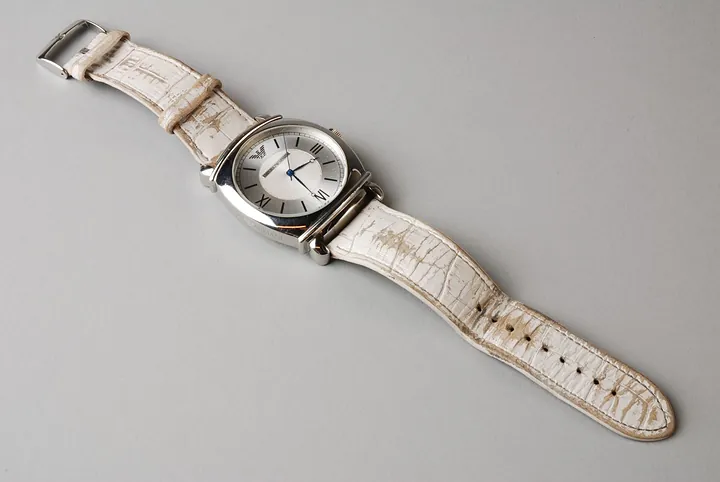
Wristwatch possibly by Emporio Armani, 2008
Museum Rotterdam