
Pocket Watches · Tourbillon openface pocket watch
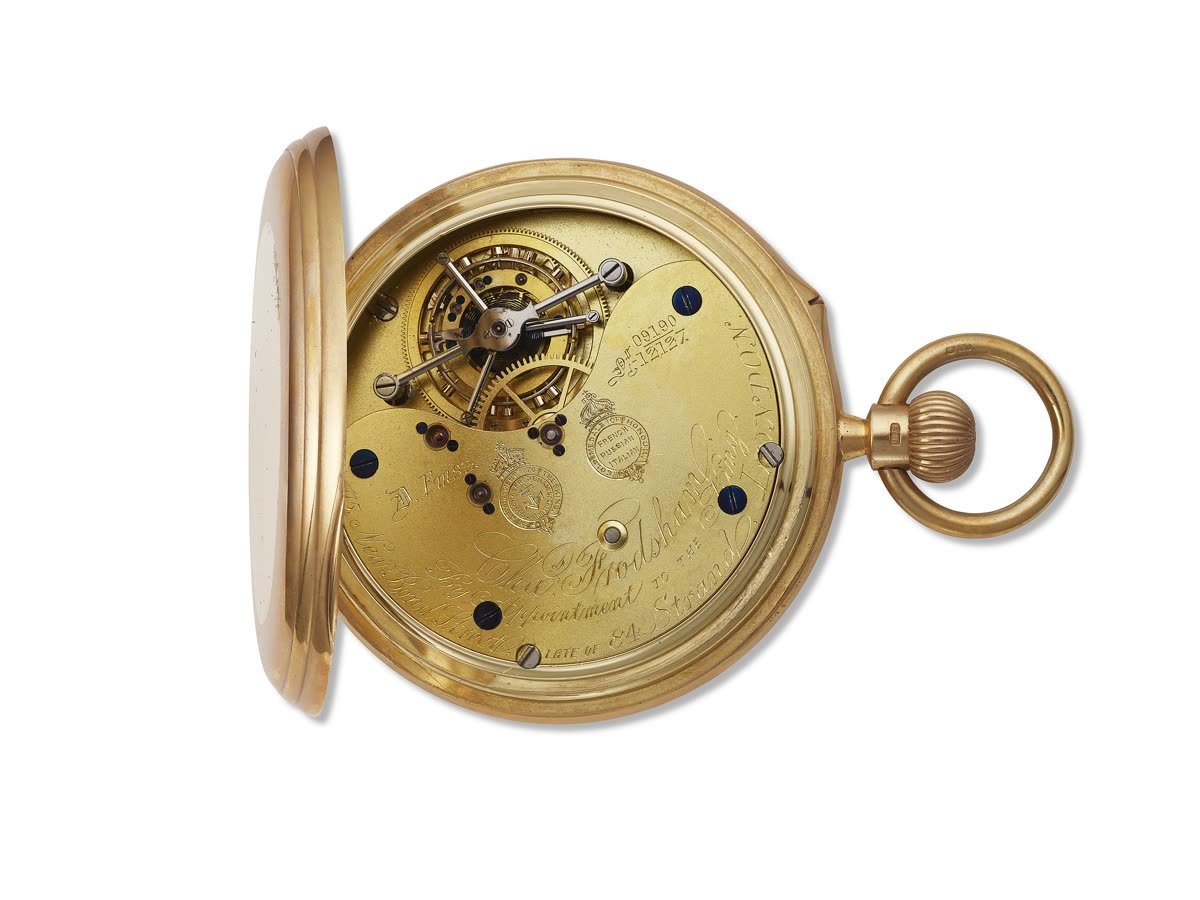
Charles Frodsham Gold Openface Six-Minute Tourbillon Pocket Watch
- Maker / attribution
- Charles Frodsham & Co. (source attribution)
- Date
- c. 1906-1907
- Historical period
- Golden Age of Mechanical Watchmaking (1900 – 1945)
- Country of origin
- United Kingdom
- Object type
- Tourbillon openface pocket watch
- Materials / technique
- 18K gold, by Harrison Mill Frodsham
- Dimensions
- 60 mm
- Auction house
- Christie’s
- Lot
- 480
- Credit line
- Christie’s
- Catalogue title (original)
- CHARLES FRODSHAM, GOLD OPENFACE SIX-MINUE TOURBILLON, AWARDED A CLASS A KEW OBSERVATORY CERTIFICATE IN 1906, NO. 09190/12127 | Christie’s (English)
View the source record (auction lot) ↗ (opens another website in a new tab)Suggest a correction
Record summary
Catalogued by Christie’s (lot 480), this is a tourbillon openface pocket watch attributed to Charles Frodsham & Co., made in United Kingdom, dated c. 1906-1907. The Atlas places it in the Golden Age of Mechanical Watchmaking period (1900 – 1945) of its Pocket Watches collection. Materials and techniques recorded by the source: 18K gold, by Harrison Mill Frodsham. Recorded dimensions: 60 mm. The record is illustrated with 1 photograph.
Assembled from the source record's structured fields. Dates and attributions are given as the source states them; where a field is missing the Atlas leaves it blank rather than estimating.
Catalogue description
Original object description
Bearing hallmarks from circa 1906–1907, this 60 mm openface pocket watch in 18-karat gold was retailed by Charles Frodsham & Co. and carries the dual references 09190 and 12127. Fabrication of the case is credited to Harrison Mill Frodsham, with a hallmark struck on the pendant beneath the winding stem and bow. Its manually wound movement, constructed by Nicole Nielsen, features a frosted gilt three-quarter plate, blued screws, a free-sprung balance, and an exposed six-minute tourbillon cage secured under a three-armed bridge. Caliber engravings include the firm's royal warrants, 'Chas. Frodsham', the numbers '09190' and '12127', and the code 'AD. Fmsz'—a cipher devised around the 1851 Great Exhibition using the letters of 'Frodsham' (with 'Z' representing zero) to indicate 1850 for top-tier work. The off-white enamel dial, not visible in catalog imagery, is attributed by documentation to Frederick Willis. According to a Certificate of Origin issued by Charles Frodsham & Co. Ltd. on 24 March 2021, number 09190 obtained a Kew Observatory Class A certificate in 1906 with 84.3 marks ('Especially Good'), entering firm stock in 1907 at a build cost of £52. Detailed in Reinhard Meis's 'Das Tourbillon' and Vaudrey Mercer's 'The Frodshams', this piece is one of only four six-minute tourbillons documented among roughly 66 tourbillons recorded by the maker between 1898 and 1934.
Inscriptions & marks
09190/12127
Historical context
Golden Age of Mechanical Watchmaking (1900 – 1945)
The wristwatch displaces the pocket watch; waterproof cases, self-winding and grand complications.
The pocket watch reached technical maturity and then began to give way to the wristwatch after the First World War. Complicated watches for collectors such as Henry Graves Jr. and James Ward Packard, railroad watches, and slim Art Deco dress watches are characteristic.
Read the period in the timelineMore pocket watches from this periodEarlier: Industrial Revolution
Atlas type guide
Pocket chronometers and precision watches
A pocket chronometer is a watch built to observatory standards, traditionally with a detent escapement like a marine chronometer. English makers such as John Arnold and Thomas Earnshaw made the first pocket chronometers in the 1780s. In the nineteenth century the term increasingly referred to any watch that had passed official rating trials at observatories in Kew, Neuchâtel, Geneva or Besançon, and the Swiss lever chronometer became dominant.
Tourbillon and karrusel watches belong to the same world of precision. Breguet patented the tourbillon in 1801 to average out positional errors; Bahne Bonniksen's karrusel (1892) was a cheaper English alternative. Rating certificates (bulletins de marche) that accompany such watches are historical documents in their own right.
What to look for
- Detent escapement (no pallets; a fine spring detent locks the escape wheel).
- Observatory certificates, competition results or 'Chronometer' marking on the dial.
- Tourbillon carriage visible through an aperture or on the movement.
- Fine finishing: jewelled holes in gold chatons, diamond endstones.
Dating clues
- English pocket chronometers: c. 1780–1900.
- Observatory trials at Neuchâtel from 1866, Geneva from 1873, Kew from 1884.
- Karrusels: 1892–c. 1915.
General guidance written by the Atlas editors about this kind of object. It is not a statement about this particular piece; for that, rely on the source record above and on physical examination.
Read next:Spring detent (chronometer) escapementDetached lever escapement
Related records
Pocket Watches · 1902 (hallmarked Chester)
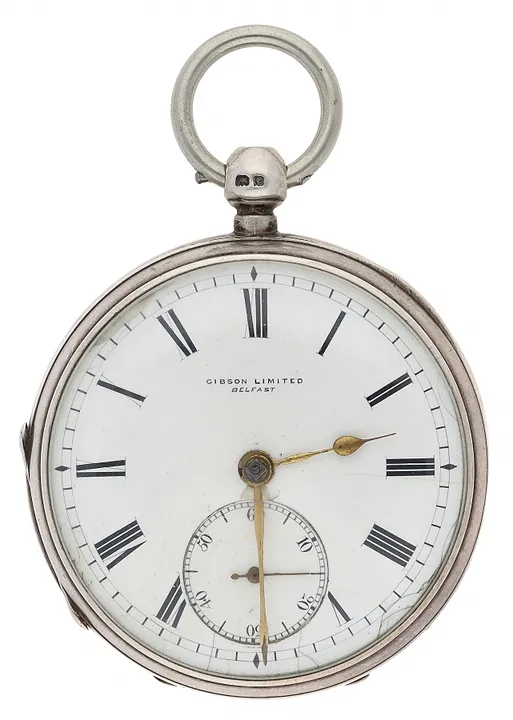
Edward VII silver fusee lever pocket watch by Gibson Limited, Belfast, hallmarked Chester 1902
Gardiner Houlgate (auction house), Corsham
Pocket Watches · 1918
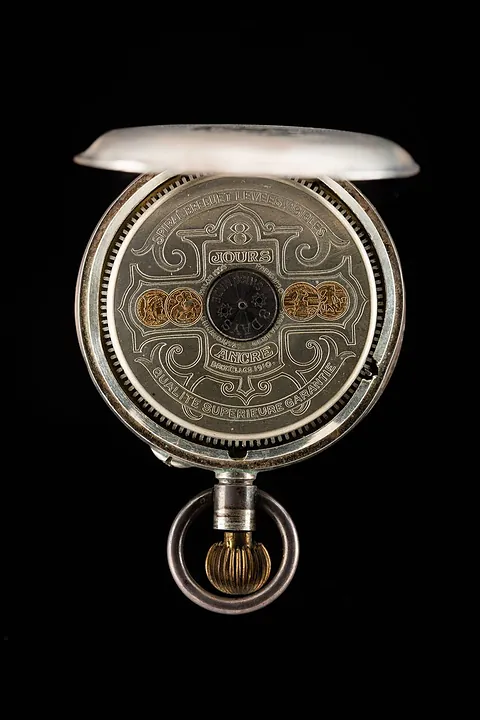
8-Day Pocket Watch
Auckland Museum Collections
Pocket Watches · c. 1912
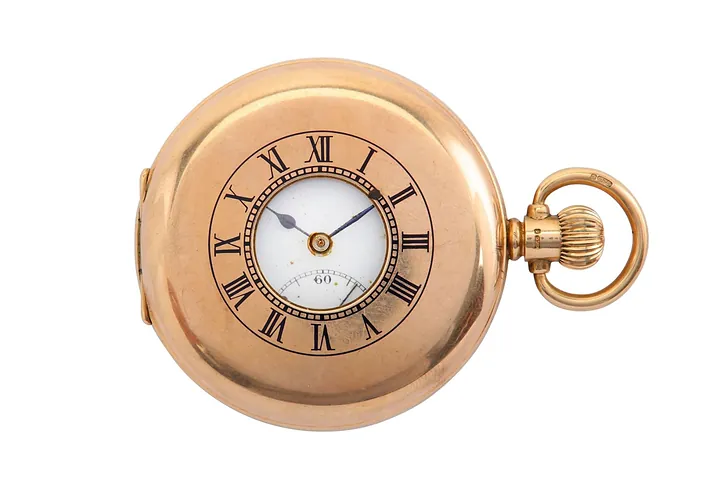
A 9K Gold Half Hunter Pocket Watch
Chiswick Auctions Ltd
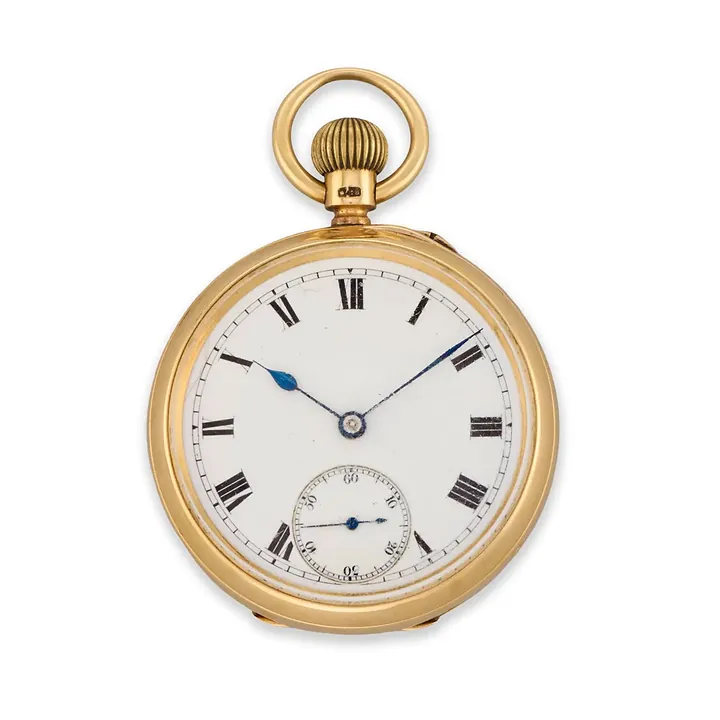
Pocket Watches · 1908
An 18k Gold Keyless Wind Open Face Pocket Watch
Bonhams
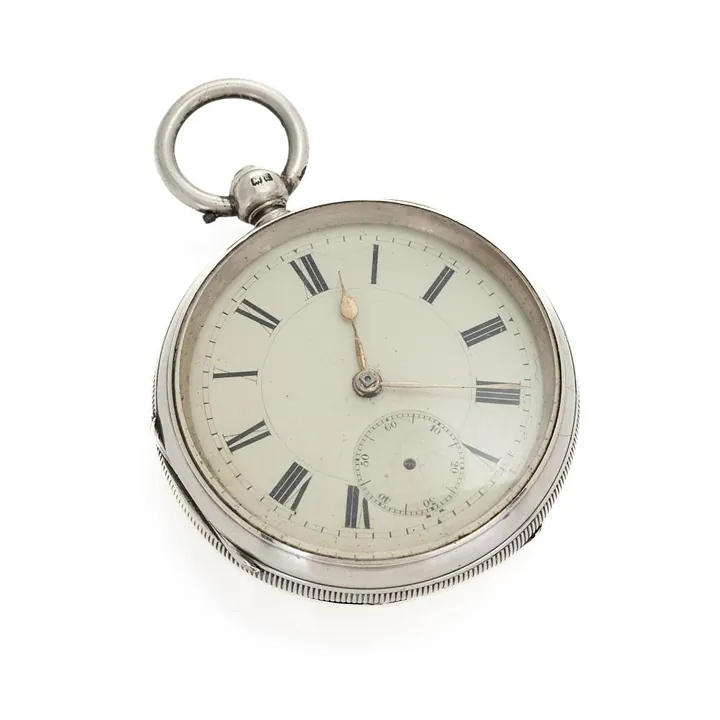
Pocket Watches · 1911
Antique Silver Open Face Pocket Watch
Lawsons
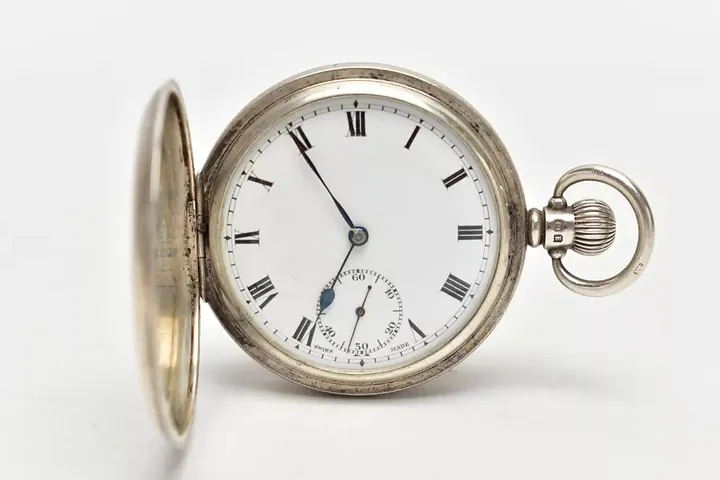
Pocket Watches · 1931
Early 20th Century Silver Full Hunter Pocket Watch
Richard Winterton Auctioneers
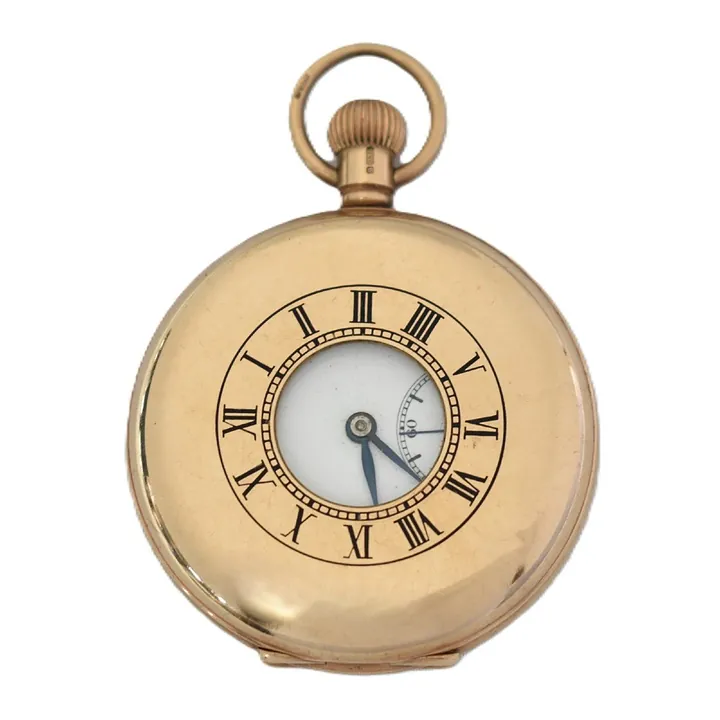
Pocket Watches · late 19th / early 20th century
Eastern Watch Case Co. 9ct gold half hunter pocket watch, Criterion movement
Bushells Antiques via Proantic
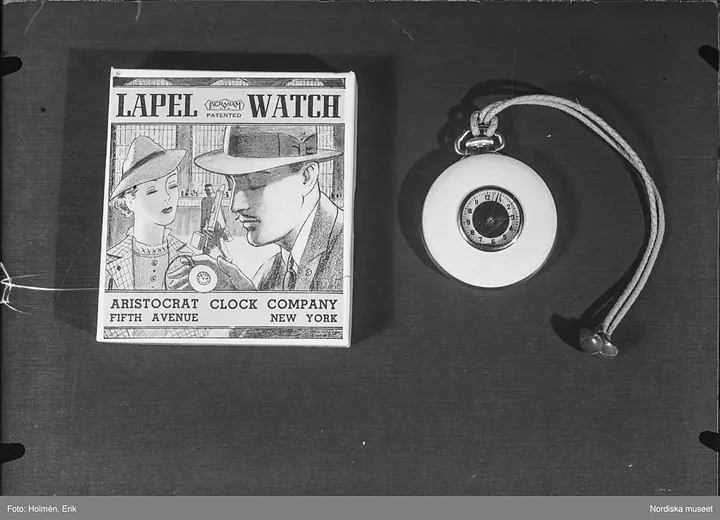
Pocket Watches · 1900–1999
Lapel watch by Erik Holmén, 1900–1999
Nordic Museum Foundation