
Wristwatches · Wristwatch
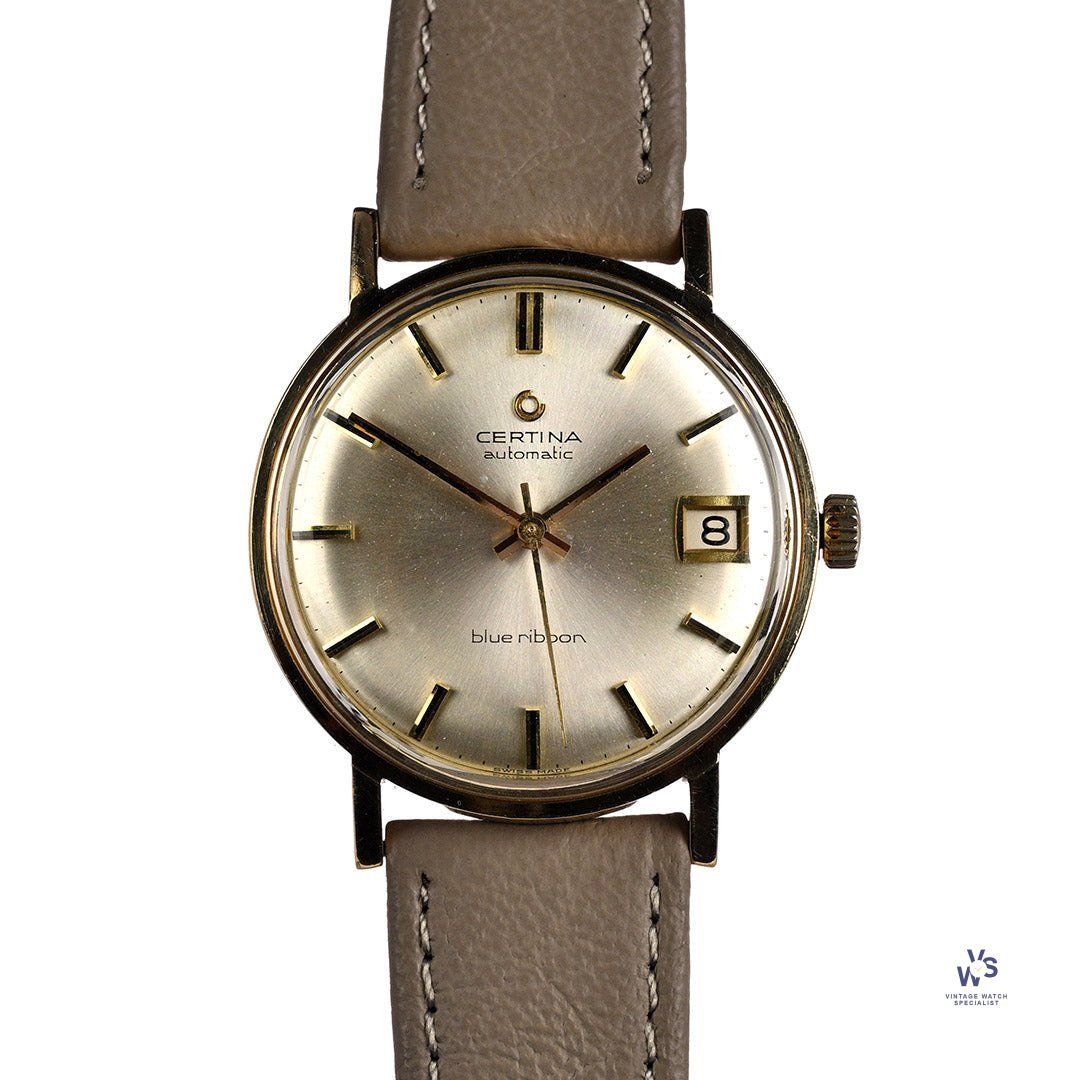
Certina Blue Ribbon, Automatic Calendar, 9ct Gold, circa 1970
- Maker / attribution
- Certina (maker)
- Date
- c. 1970
- Historical period
- Quartz Revolution (1969 – 1990)
- Country of origin
- Switzerland
- Object type
- Wristwatch
- Materials / technique
- gold
- Dimensions
- Case 34 mm
- Stock no.
- VWS3308
- Credit line
- Dealer listing, Vintage Watch Specialist (VWS3308)
- Catalogue title (original)
- Certina - Blue Ribbon - Automatic Calendar - 9ct Gold - c.1970 (English)
View the source record (dealer listing) ↗ (opens another website in a new tab)Suggest a correction
Record summary
Catalogued by Vintage Watch Specialist (dealer), United Kingdom (stock number VWS3308), this is a wristwatch by Certina, made in Switzerland, dated c. 1970. The Atlas places it in the Quartz Revolution period (1969 – 1990) of its Wristwatches collection. Materials and techniques recorded by the source: gold. Recorded dimensions: Case 34 mm. The record is illustrated with 6 photographs.
Assembled from the source record's structured fields. Dates and attributions are given as the source states them; where a field is missing the Atlas leaves it blank rather than estimating.
Catalogue description
Dealer description — Vintage Watch Specialist
Vintage Certina Automatic Blue Ribbon with Gorgeous Silver Sunburst Dial circa 1970 Certina S.A. was founded in 1888 when Adolf and Alfred Kurth opened their first movement and supplies factory for the watchmaking industry in Grenchen. At the start Certina's staff consisted of three employees working in a workshop that was connected to the family home. The Certina Blue Ribbon, introduced in the 1960s, quickly became renowned as a stylish and dependable timepiece, perfect for everyday wear. Its most notable feature was its slim and elegant design, characterized by a thin case and a simple yet stylish dial, making it ideal for dressier occasions. The Blue Ribbon was available in a variety of styles and materials, including stainless steel, gold-plated steel, and solid gold. Despite its refined appearance, the Blue Ribbon was also highly reliable, featuring a high-quality movement known for its precision and accuracy, as well as a shock-resistant design that made it suitable for everyday use. What's on Offer This beautiful 9ct Gold Certina vintage dress watch is charming. Hailing from the 1970s, it has been well preserved for the main part barring minor blemishes to the case and light scratches to the plexiglass. The hour indices are golden batons with Onyx inserts and the elegant ultra-slim pencil hands are also furnished with Onyx which is a subtle yet stylish touch - the devil is in the detail with watches! The dial is completed with a central seconds hand and an applied Certina motif and signature at 12 o'clock. Encased in yellow 9k gold with a slim bezel, this mid-size watch wears larger on the wrist than it appears at 34mm and is very comfortable. A beautiful all-rounder which would be at home as a day-to-day watch for more casual wear but which is also perfectly suitable for more formal occasions.
Historical context
Quartz Revolution (1969 – 1990)
Seiko's Astron begins mass quartz timekeeping; traditional industries contract sharply.
Quartz and digital watches transformed the market after 1969. Swiss employment collapsed, Japanese and Hong Kong production soared, and the Swatch (1983) helped the Swiss industry recover; mechanical watches survived as luxury goods.
Read the period in the timelineMore wristwatches from this periodEarlier: Modern Mechanical Horology
Atlas type guide
Calendar, moon-phase and perpetual calendar watches
Calendar complications range from a simple date to the perpetual calendar, which automatically allows for months of different lengths and leap years until 2100. Pocket watches with perpetual calendars were made in the eighteenth and nineteenth centuries; Patek Philippe made the first perpetual calendar wristwatch in 1925, and series production followed in 1941. The annual calendar (Patek Philippe, 1996) needs correction only once a year.
Moon-phase displays use a disc with two moons and 59 teeth advanced daily, approximating the 29.5-day lunation; more precise trains reduce the error to one day in over a century.
What to look for
- Apertures or subsidiary dials for day, date, month and leap year.
- Moon disc under a 'bosom' shaped aperture.
- Recessed correctors on the case band for setting the calendar.
Dating clues
- Triple-date wristwatches: popular c. 1940–1955.
- Perpetual calendar wristwatches: from 1925 (unique) and 1941 (series).
General guidance written by the Atlas editors about this kind of object. It is not a statement about this particular piece; for that, rely on the source record above and on physical examination.
Related records

Wristwatches · 1900–1999
Wristwatch by Certina, Switzerland, 1900–1999
Nordic Museum Foundation

Wristwatches · originally sold in December 2025 (per the lot record)
Certina DS-2 Chronograph Automatic, ref. C024.462.18.041.00, originally sold in December 2025
Antiquorum auction archive, Geneva

Wristwatches · originally sold in January 2026 (per the lot record)
Certina DS Super PH 500m, ref. C037.407.18.050.00, originally sold in January 2026
Antiquorum auction archive, Geneva
Wristwatches · c. 1965-1970
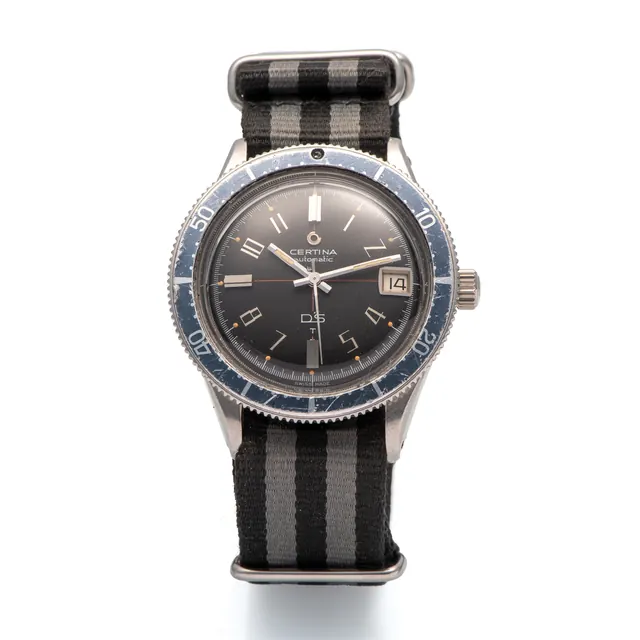
Certina wristwatch, ref. 5801, Ds, circa 1965-1970
Antiquorum auction archive, Geneva

Wristwatches · 1970
Wristwatch by Heno, Switzerland, 1970
Museum Rotterdam

Wristwatches · 1960–1986
'Tri-Compax' calendar chronograph wristwatch in gold case, by Universal, Geneva, Switzerland, 1960–1986.
Science Museum Group, London

Wristwatches · 1969–1970
Beta 21 Quartz wristwatch movement, made in Switzerland, 1970.
Science Museum Group, London

Wristwatches · c. 1969
Omega Speedmaster Moonwatch, ref. 145022-69st, c. 1969
Antiquorum auction archive, Geneva