
Wristwatches · Wristwatch
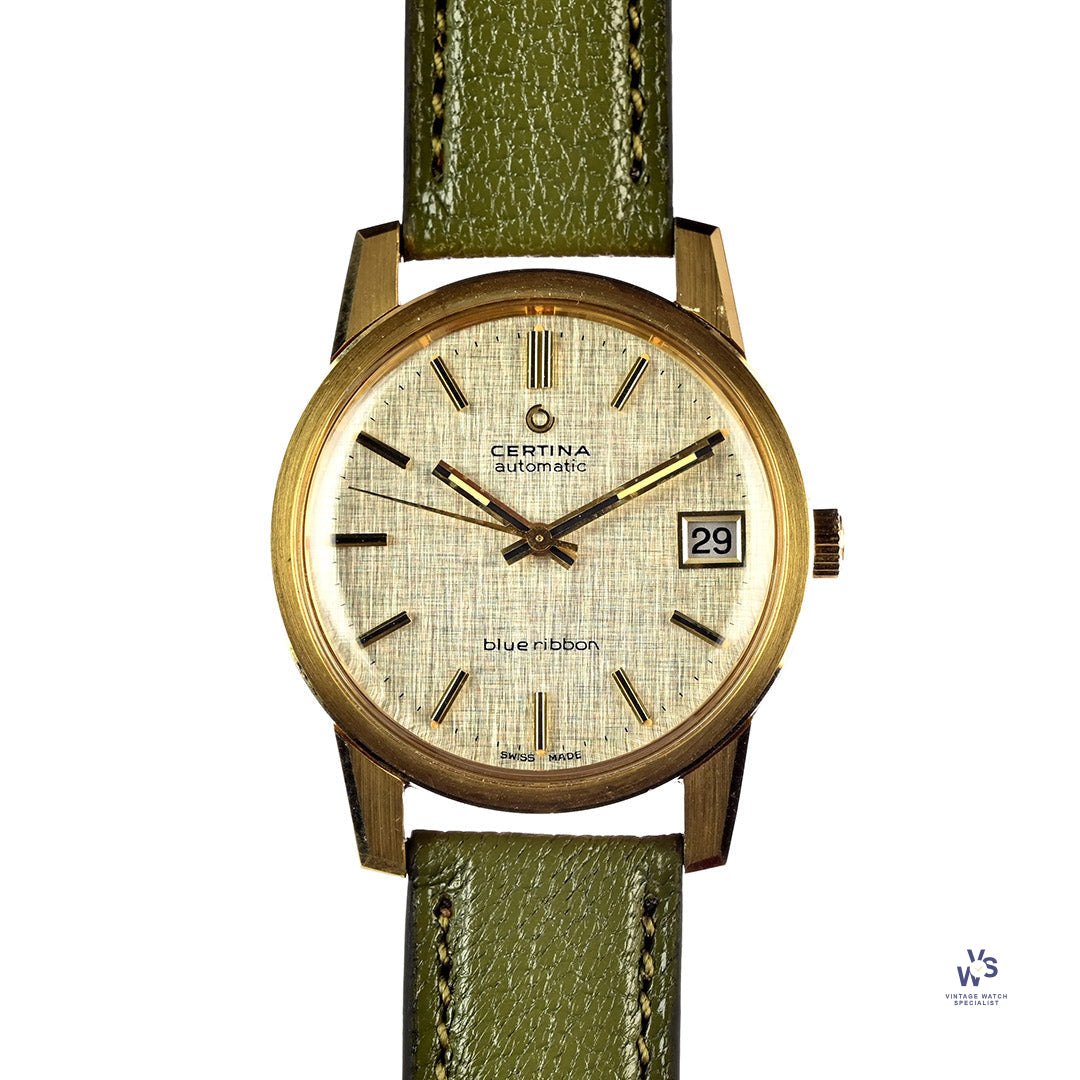
Certina Blue Ribbon Automatic, 18k Gold, circa 1977
- Maker / attribution
- Certina (maker)
- Date
- c. 1977
- Historical period
- Quartz Revolution (1969 – 1990)
- Country of origin
- Switzerland
- Object type
- Wristwatch
- Materials / technique
- gold
- Dimensions
- Case 34 mm
- Stock no.
- VWS3332
- Credit line
- Dealer listing, Vintage Watch Specialist (VWS3332)
- Catalogue title (original)
- Certina Blue Ribbon Automatic - 18k Gold - New Old Stock - Original Box & Papers - c.1977 (English)
View the source record (dealer listing) ↗ (opens another website in a new tab)Suggest a correction
Record summary
Catalogued by Vintage Watch Specialist (dealer), United Kingdom (stock number VWS3332), this is a wristwatch by Certina, made in Switzerland, dated c. 1977. The Atlas places it in the Quartz Revolution period (1969 – 1990) of its Wristwatches collection. Materials and techniques recorded by the source: gold. Recorded dimensions: Case 34 mm. The record is illustrated with 6 photographs.
Assembled from the source record's structured fields. Dates and attributions are given as the source states them; where a field is missing the Atlas leaves it blank rather than estimating.
Catalogue description
Dealer description — Vintage Watch Specialist
An Absolutely Stunning New Old Stock Certina Blue Ribbon with a Metallic Texture Dial and Opulent 18k Gold Case, Sold with Original Box and Papers, c.1977 Certina, a renowned Swiss watch brand, was founded in 1888 by brothers Adolf and Alfred Kurth in Grenchen, Switzerland. Initially named "Kurth Frères," the company started as a small family business producing high-quality movements for other watchmakers. By 1906, they launched their own line of watches under the name "Grana," derived from Granacus, the Latin name for Grenchen. In 1938, marking their 50th anniversary, the company adopted the name "Certina," inspired by the Latin word "certus," meaning "certain" or "sure." This change symbolized their commitment to reliability and precision. The 1950s saw Certina introducing groundbreaking innovations such as the DS (Double Security) concept in 1959, which significantly enhanced water resistance and shock protection. Throughout its history, Certina has maintained a reputation for durability and accuracy. Today, it remains an esteemed brand within the Swatch Group, continuing to produce timepieces that embody Swiss craftsmanship and innovation. What's on Offer The Certina Blue Ribbon is a distinguished timepiece known for its blend of classic elegance and contemporary craftsmanship. This new old stock Certina blue ribbon is in exemplary condition, just look at that absolutely stunning dial. The metallic linen texture boasts opulent applied gold furniture including baton hour markers with onyx inserts and stylish stick hands with luminous inserts. There is a framed date aperture at 3 o'clock and the dial is completed by the Certina and Blue Ribbon signature. The opulent 18k gold case is in superb condition and at 34mm the watch is mid-size and wears beautifully on the wrist - it is running perfectly and keeping excellent time. The watch is sold with its original box and paperwork, it would make a very worth addition to any collection but is also a very wearable watch and suitable for all occasions from everyday wear to more formal attire. Don't sleep on this one!
Historical context
Quartz Revolution (1969 – 1990)
Seiko's Astron begins mass quartz timekeeping; traditional industries contract sharply.
Quartz and digital watches transformed the market after 1969. Swiss employment collapsed, Japanese and Hong Kong production soared, and the Swatch (1983) helped the Swiss industry recover; mechanical watches survived as luxury goods.
Read the period in the timelineMore wristwatches from this periodEarlier: Modern Mechanical Horology
Atlas type guide
Automatic (self-winding) watches
Self-winding watches use the wearer's motion to wind the mainspring. Abraham-Louis Perrelet and Breguet made 'perpétuelle' pocket watches with oscillating weights in the late eighteenth century, but the principle only became practical in the wristwatch. John Harwood patented a bumper automatic in 1923; Rolex's Perpetual rotor (1931) winding in one direction, and later bidirectional rotors (Eterna, Felsa Bidynator), established the modern form. Micro-rotors (Universal Genève, Buren) and peripheral rotors made automatic watches thinner.
What to look for
- A semicircular rotor turning 360° over the movement, or a 'bumper' weight that rebounds between springs.
- 'Automatic', 'Perpetual' or 'Self-winding' on the dial.
- A sealed screw-back case, since automatic watches are wound less often by the crown.
Dating clues
- Bumper automatics: 1923–c. 1955.
- Full rotors: from 1931 (Rolex); widespread after c. 1950.
- Micro-rotors: from 1954–1958.
General guidance written by the Atlas editors about this kind of object. It is not a statement about this particular piece; for that, rely on the source record above and on physical examination.
Related records

Wristwatches · 1900–1999
Wristwatch by Certina, Switzerland, 1900–1999
Nordic Museum Foundation

Wristwatches · originally sold in December 2025 (per the lot record)
Certina DS-2 Chronograph Automatic, ref. C024.462.18.041.00, originally sold in December 2025
Antiquorum auction archive, Geneva

Wristwatches · originally sold in January 2026 (per the lot record)
Certina DS Super PH 500m, ref. C037.407.18.050.00, originally sold in January 2026
Antiquorum auction archive, Geneva
Wristwatches · c. 1965-1970
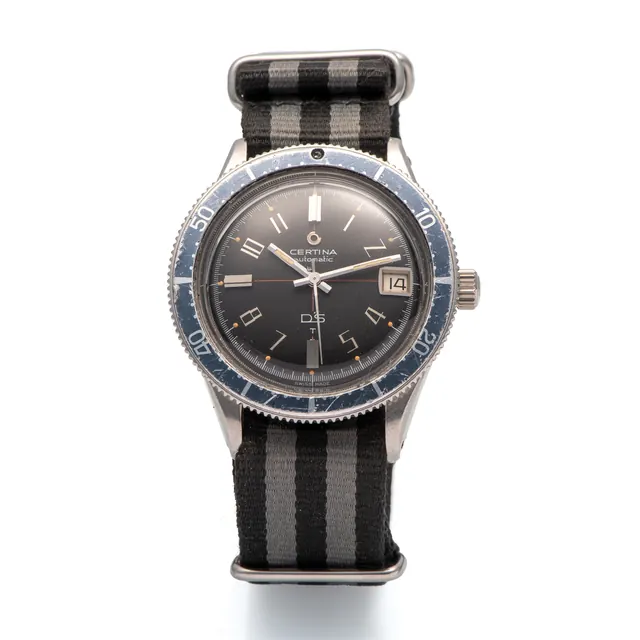
Certina wristwatch, ref. 5801, Ds, circa 1965-1970
Antiquorum auction archive, Geneva

Wristwatches · 1970
Wristwatch by Heno, Switzerland, 1970
Museum Rotterdam

Wristwatches · 1960–1986
'Tri-Compax' calendar chronograph wristwatch in gold case, by Universal, Geneva, Switzerland, 1960–1986.
Science Museum Group, London

Wristwatches · 1969–1970
Beta 21 Quartz wristwatch movement, made in Switzerland, 1970.
Science Museum Group, London

Wristwatches · c. 1969
Omega Speedmaster Moonwatch, ref. 145022-69st, c. 1969
Antiquorum auction archive, Geneva