
Clocks · Travel alarm clock
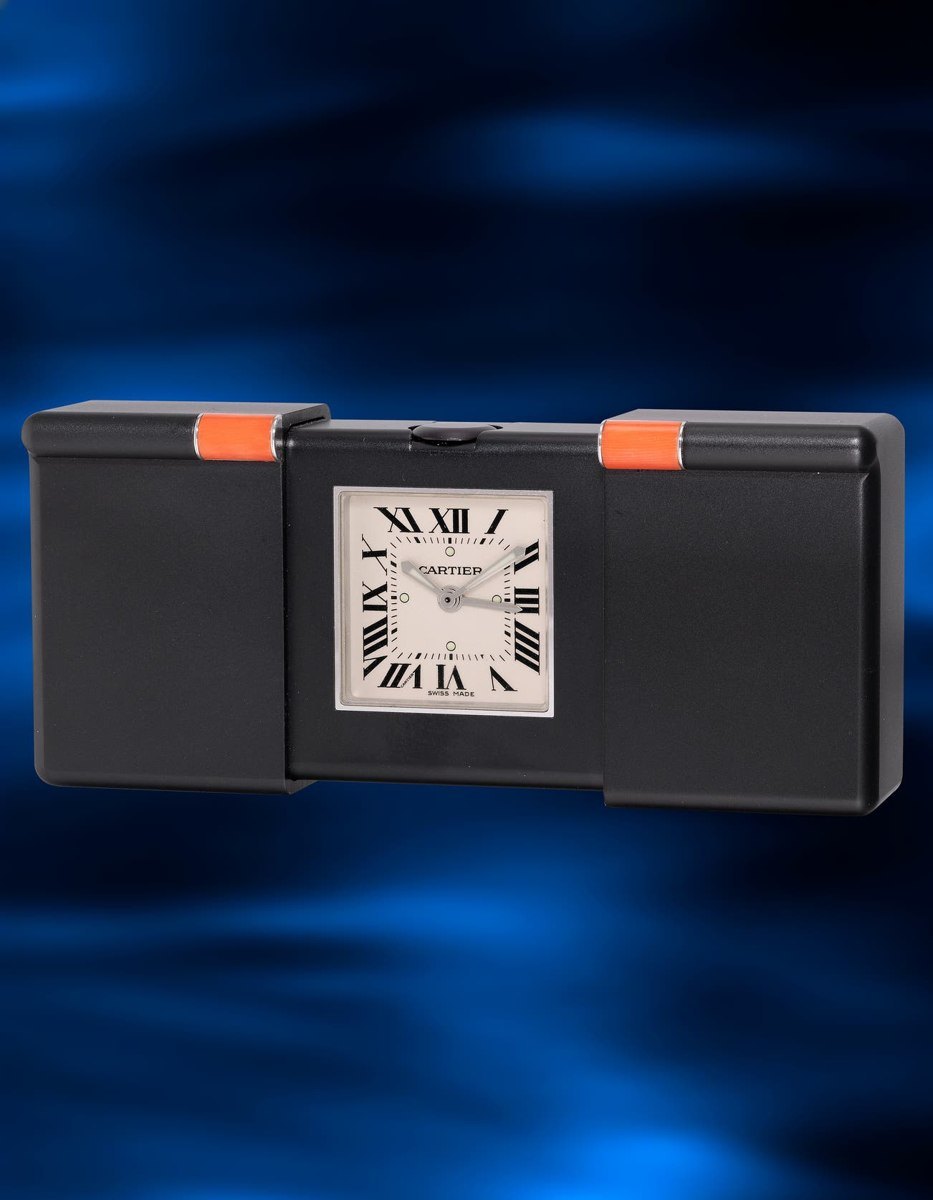
Cartier Ref. W0100034 Travel Clock
- Maker / attribution
- Cartier (source attribution)
- Date
- c. 2000
- Historical period
- Mechanical Renaissance (1990 – 2010)
- Country of origin
- Switzerland
- Object type
- Travel alarm clock
- Dimensions
- 58mm length (90mm when open) x 41mm height x 18 width
- Holding institution
- Phillips
- Accession / object no.
- 8133
- Credit line
- Phillips
- Catalogue title (original)
- Cartier Phillips Watches Online Auction: The Hong Kong Sessions, Fall 2025 (English)
View the source record ↗ (opens another website in a new tab)Suggest a correction
Record summary
Held and catalogued by Phillips (object number 8133), this is a travel alarm clock attributed to Cartier, made in Switzerland, dated c. 2000. The Atlas places it in the Mechanical Renaissance period (1990 – 2010) of its Clocks collection. Recorded dimensions: 58mm length (90mm when open) x 41mm height x 18 width. The record is illustrated with 1 photograph.
Assembled from the source record's structured fields. Dates and attributions are given as the source states them; where a field is missing the Atlas leaves it blank rather than estimating.
Catalogue description
Original object description
Manufactured in Switzerland around 2000, this Cartier travel alarm clock (reference W0100034) adopts the sliding Ermeto form, utilizing a matte black-coated steel case accented along its upper borders with coral trim. The rectangular body stands 41 mm tall and 18 mm deep, measuring 58 mm across when shut and extending to a width of 90 mm when pulled open to view the dial. The square white face is framed by a railway minute track, black Roman numerals, luminescent hands, and dot markers at the quarter hours, bearing the inscriptions "CARTIER" beneath twelve o'clock and "SWISS MADE" at the base, alongside maker marks on the case. Running on a quartz movement with an integrated alarm function, the clock is accompanied by its maker's presentation case.
Inscriptions & marks
540265UM 2705
Historical context
Mechanical Renaissance (1990 – 2010)
Mechanical watches return as cultural objects; independent watchmaking flourishes.
Mechanical clocks returned as luxury and craft objects, alongside radio-controlled and designer quartz clocks. Independent makers and restorers revived traditional techniques, and museums increasingly documented industrial and electric clocks as heritage.
Read the period in the timelineMore clocks from this periodEarlier: Quartz Revolution
Atlas type guide
Alarm clocks
Alarm work is among the oldest clock functions: monastic clocks woke monks for night prayers, and Renaissance table clocks often carried an alarm disc set by a pin. A separate spring or weight is released at the set time and drives a hammer against a bell. Some early alarms also lit a candle by striking a flint — the 'tinder pistol' alarm.
The cheap, mass-produced alarm clock arrived in the second half of the nineteenth century. American firms such as Seth Thomas and Westclox (the 'Big Ben' of 1910) and German makers such as Junghans and Kienzle made millions of drum-shaped alarms with pin-pallet escapements. Electric, quartz and digital alarm clocks followed in the twentieth century.
What to look for
- A separate alarm-setting dial or disc and an extra winding key.
- Twin bells on top (common after c. 1920) or a bell enclosed in the base.
- Pin-pallet escapements in inexpensive factory alarms.
- Trademarks and patent dates on dial or back.
Dating clues
- Renaissance alarm table clocks: sixteenth to seventeenth centuries.
- Drum alarm clocks: from the 1870s.
- Luminous dials with radium paint: c. 1910–1960.
General guidance written by the Atlas editors about this kind of object. It is not a statement about this particular piece; for that, rely on the source record above and on physical examination.
Related records
Clocks · 1863
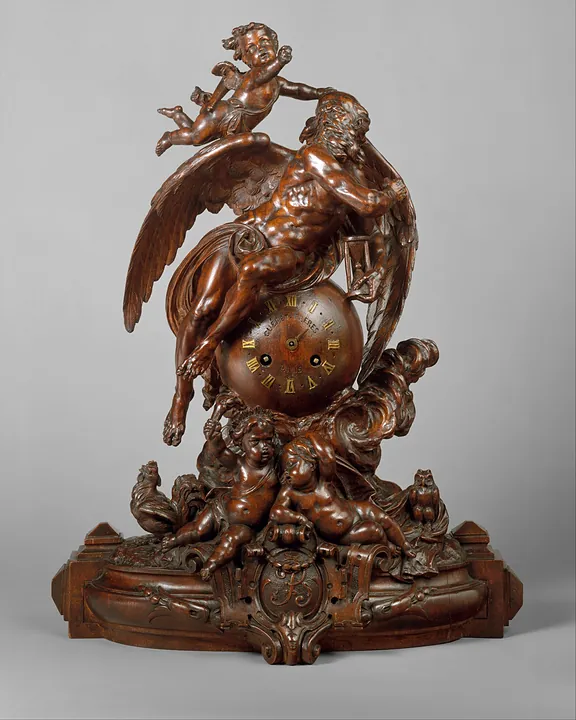
Clock by Albert-Ernest Carrier-Belleuse, France, 1863
The Metropolitan Museum of Art, New York
Clocks · c. 1980s
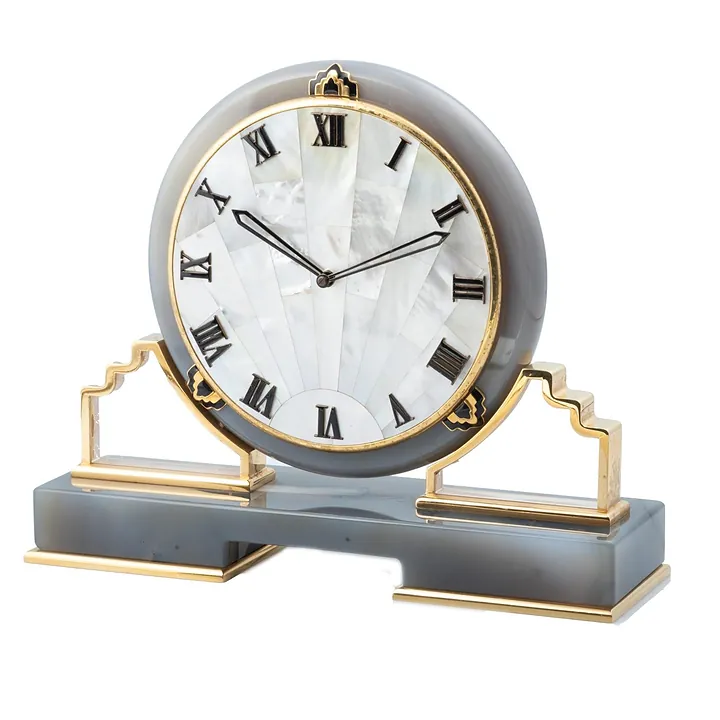
Cartier "art Deco", c. 1980s
Antiquorum auction archive, Geneva
Clocks · c. 2000s
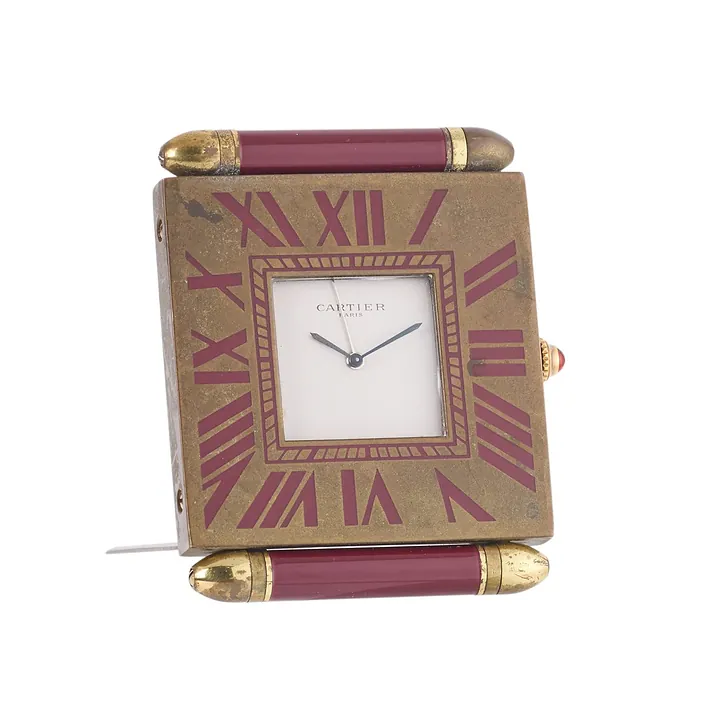
Cartier Desk Clock with Alarm, c. 2000s
Antiquorum auction archive, Geneva
Clocks · c. 2000s
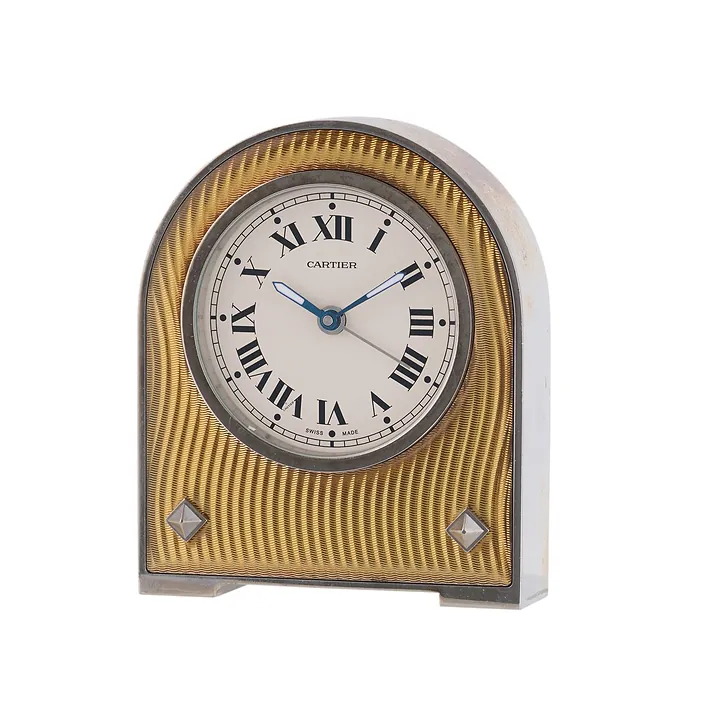
Cartier Lacquer Arched Desk Clock with Alarm, ref. W0100037, c. 2000s
Antiquorum auction archive, Geneva
Clocks · c. 1990s
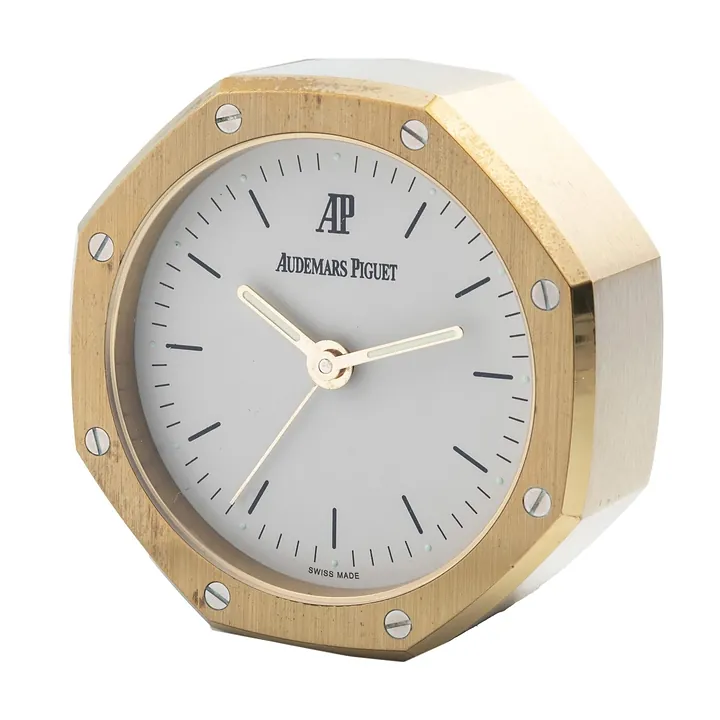
Audemars Piguet Royal Oak, c. 1990s
Antiquorum auction archive, Geneva

Clocks · c. 1990s
Breitling clock, c. 1990s (Antiquorum Lot 389-18)
Antiquorum auction archive, Geneva
Clocks · c. 1990s
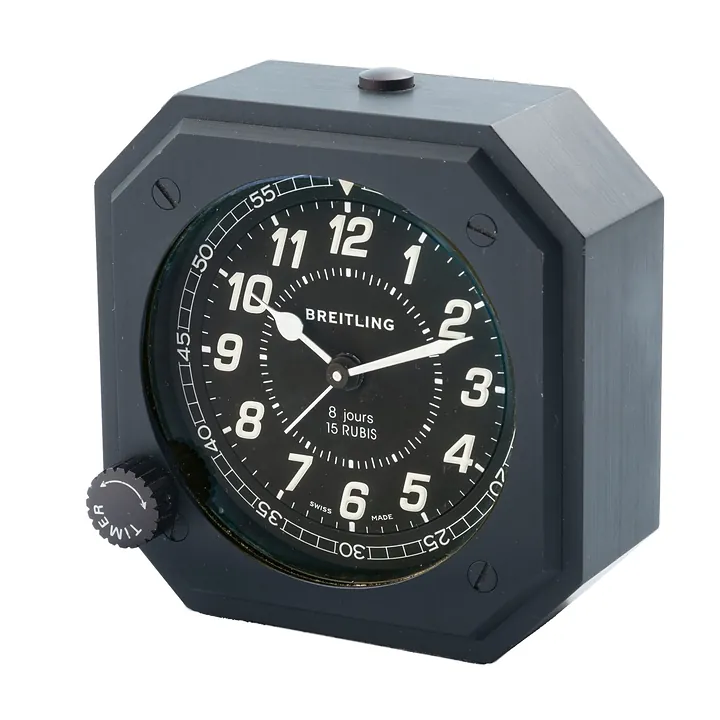
Breitling clock, c. 1990s (Antiquorum Lot 389-20)
Antiquorum auction archive, Geneva
Clocks · 2002
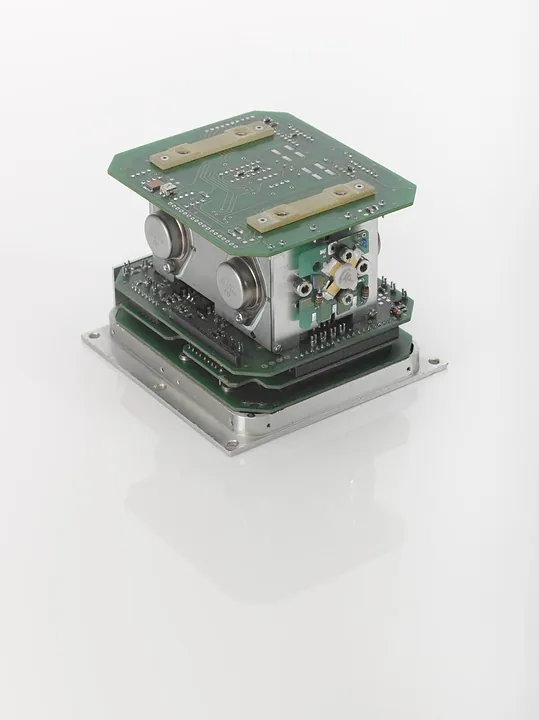
Prototype atomic clock for use with the Galileo communications satellite, manufactured by Temex Neuchâtel Time SA, Switzerland, 2002
Science Museum Group, London