
Wristwatches · Automatic moonphase wristwatch
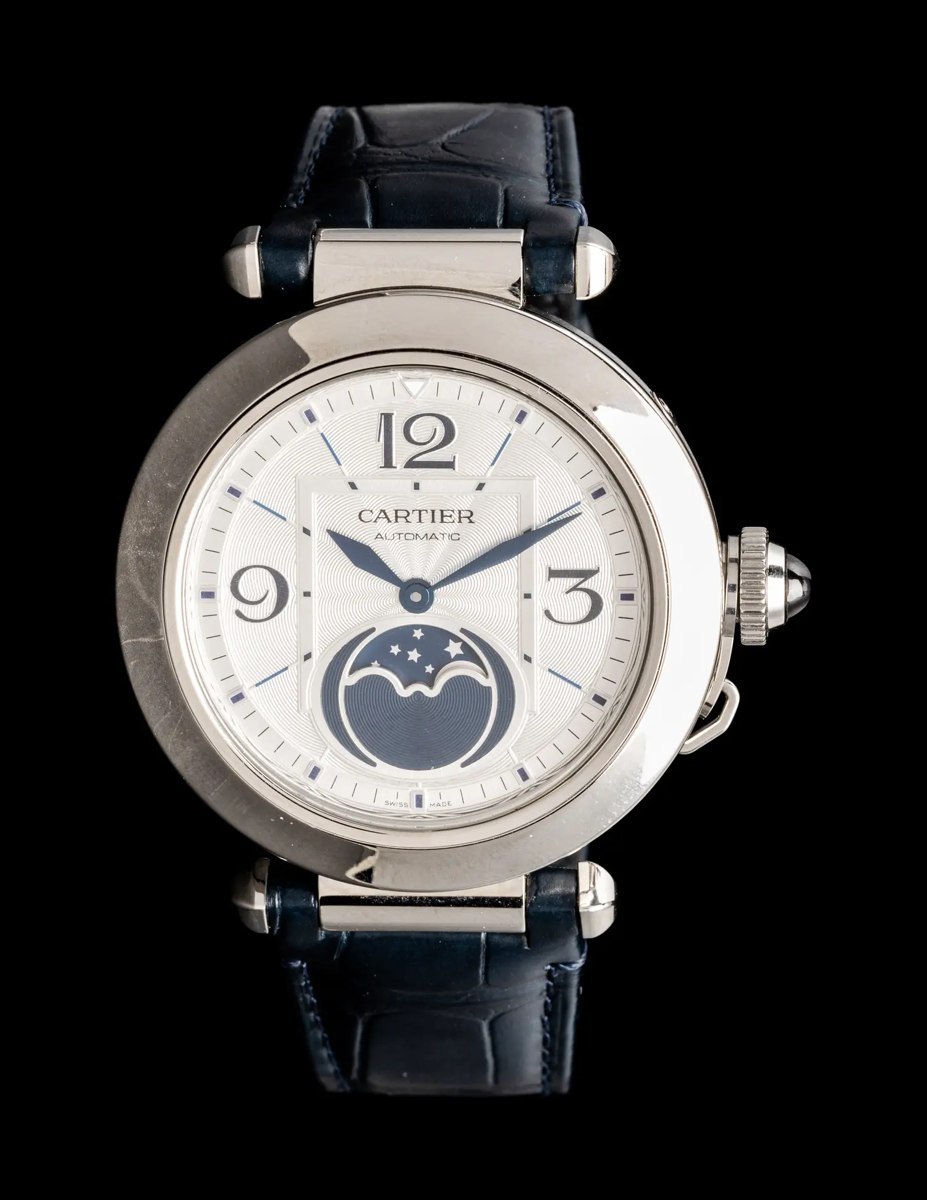
Cartier Pasha Moonphase Stainless Steel Wristwatch, Ref. WSPA0030
- Maker / attribution
- Cartier (source attribution)
- Date
- c. 2022
- Historical period
- Contemporary Horology (2010 – Present)
- Country of origin
- Switzerland
- Object type
- Automatic moonphase wristwatch
- Auction house
- Freeman's
- Lot
- 17
- Credit line
- Freeman's
- Catalogue title (original)
- CARTIER, REF. WSPA0030 STAINLESS STEEL 'PASHA' MOONPHASE... | Freeman's (English)
View the source record (auction lot) ↗ (opens another website in a new tab)Suggest a correction
Record summary
Catalogued by Freeman's (lot 17), this is an automatic moonphase wristwatch attributed to Cartier, made in Switzerland, dated c. 2022. The Atlas places it in the Contemporary Horology period (2010 – Present) of its Wristwatches collection. The record is illustrated with 1 photograph.
Assembled from the source record's structured fields. Dates and attributions are given as the source states them; where a field is missing the Atlas leaves it blank rather than estimating.
Catalogue description
Original object description
Dating to circa 2022, this automatic Cartier Pasha wristwatch, reference WSPA0030, features an approximately 41 mm stainless steel circular case fitted with signature Vendôme-style bar lugs and a tethered protective cap holding a blue cabochon over the crown. The guilloché silver dial features blued steel hands, printed Arabic numerals at the 12, 3, and 9 positions, and a circular moonphase indicator placed at 6 o'clock. Internal operations are powered by the 25-jewel automatic Cartier caliber 1904-LU MC. The watch is mounted on a blue leather band with a steel buckle and is accompanied by its inner and outer packaging, papers, and an extra gray leather band. Sold in 'as is' condition, the piece was documented as winding, setting, and operating at the time of review, though mechanical accuracy and the originality of interior components are not warranted, with a caution that operation might end before bidding concludes.
Inscriptions & marks
4443150395CX
Historical context
Contemporary Horology (2010 – Present)
Silicon components, connected watches, optical-lattice research clocks and a thriving independent scene.
Smartwatches became the world's best-selling watches, while mechanical watchmaking focuses on craft, innovation (silicon components, new escapements) and independent makers.
Read the period in the timelineMore wristwatches from this periodEarlier: Mechanical Renaissance
Atlas type guide
Calendar, moon-phase and perpetual calendar watches
Calendar complications range from a simple date to the perpetual calendar, which automatically allows for months of different lengths and leap years until 2100. Pocket watches with perpetual calendars were made in the eighteenth and nineteenth centuries; Patek Philippe made the first perpetual calendar wristwatch in 1925, and series production followed in 1941. The annual calendar (Patek Philippe, 1996) needs correction only once a year.
Moon-phase displays use a disc with two moons and 59 teeth advanced daily, approximating the 29.5-day lunation; more precise trains reduce the error to one day in over a century.
What to look for
- Apertures or subsidiary dials for day, date, month and leap year.
- Moon disc under a 'bosom' shaped aperture.
- Recessed correctors on the case band for setting the calendar.
Dating clues
- Triple-date wristwatches: popular c. 1940–1955.
- Perpetual calendar wristwatches: from 1925 (unique) and 1941 (series).
General guidance written by the Atlas editors about this kind of object. It is not a statement about this particular piece; for that, rely on the source record above and on physical examination.
Related records

Clocks · 1863
Clock by Albert-Ernest Carrier-Belleuse, France, 1863
The Metropolitan Museum of Art, New York

Clocks · c. 1980s
Cartier "art Deco", c. 1980s
Antiquorum auction archive, Geneva

Clocks · c. 2000s
Cartier Desk Clock with Alarm, c. 2000s
Antiquorum auction archive, Geneva

Clocks · c. 2000s
Cartier Lacquer Arched Desk Clock with Alarm, ref. W0100037, c. 2000s
Antiquorum auction archive, Geneva

Wristwatches · c. 2010s
Breguet Type XXI, ref. 3810, c. 2010s (Antiquorum Lot 381-24)
Antiquorum auction archive, Geneva

Wristwatches · c. 2010s
Breguet Type XXI, ref. 3810, c. 2010s (Antiquorum Lot 386-229)
Antiquorum auction archive, Geneva

Wristwatches · Sold in September 2010
Breitling Cosmonaute, ref. A 22322, Sold in September 2010
Antiquorum auction archive, Geneva

Wristwatches · c. 2010
Corum Bubble Chrono, ref. 396.150.20, c. 2010
Antiquorum auction archive, Geneva