
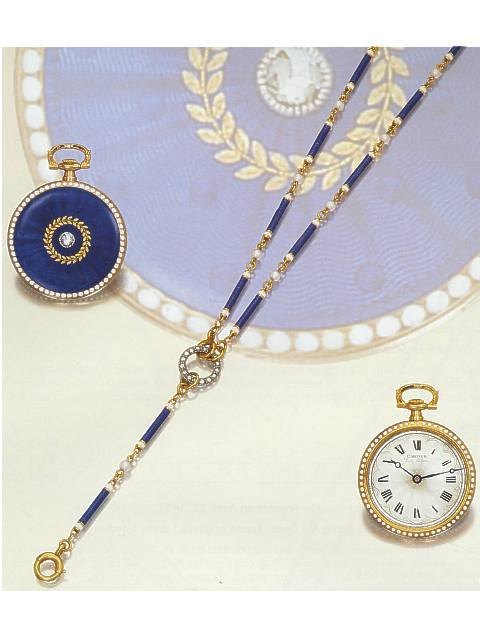
Pocket Watches · Fob watch
Cartier gold and enamel fob watch with chain
- Maker / attribution
- Cartier (source attribution)
- Date
- c. 1910
- Historical period
- Golden Age of Mechanical Watchmaking (1900 – 1945)
- Country of origin
- France
- Object type
- Fob watch
- Holding institution
- Antiquorum
- Accession / object no.
- 91
- Credit line
- Antiquorum
- Catalogue title (original)
- Cartier, Paris, Londres, circa 1910.\n\nVery fine 18K gold and enamel Art Deco diamond-set extra slim keyless fob watch, accompanied by a matching chain. (English)
View the source record ↗ (opens another website in a new tab)Suggest a correction
Record summary
Held and catalogued by Antiquorum (object number 91), this is a fob watch attributed to Cartier, made in France, dated c. 1910. The Atlas places it in the Golden Age of Mechanical Watchmaking period (1900 – 1945) of its Pocket Watches collection. The record is illustrated with 1 photograph.
Assembled from the source record's structured fields. Dates and attributions are given as the source states them; where a field is missing the Atlas leaves it blank rather than estimating.
Catalogue description
Original object description
Dating to circa 1910, this keyless, ultra-thin fob watch with an accompanying pearl and enamel chain was produced by Cartier using 18K gold, enamel, and diamonds. The reverse of the three-piece case is ornamented with translucent blue enamel applied over engine-turning, centering on a rose-cut diamond encased within a paillon laurel wreath; both bezels are bordered by opaque white enamel rendered to resemble split pearls. Engine-turned patterning continues onto the silver dial, which features radial Roman numerals, blued steel Breguet-style hands, and a Cartier signature linked in provenance documents to Paris and Londres. Its 10-ligne (23 mm) gilt brass bar-caliber movement is fitted with 15 jewels, a flat balance spring, an inline lever escapement, and a split bimetallic balance for temperature compensation. Long engine-turned links of translucent blue enamel alternate with small pearls throughout the chain. Past auction records grade the case at 3 (Good) and the dial at 3-01 (Good), while recording the hands as original to the watch.
Historical context
Golden Age of Mechanical Watchmaking (1900 – 1945)
The wristwatch displaces the pocket watch; waterproof cases, self-winding and grand complications.
The pocket watch reached technical maturity and then began to give way to the wristwatch after the First World War. Complicated watches for collectors such as Henry Graves Jr. and James Ward Packard, railroad watches, and slim Art Deco dress watches are characteristic.
Read the period in the timelineMore pocket watches from this periodEarlier: Industrial Revolution
Atlas type guide
Pocket watches
The pocket watch was the dominant personal timekeeper from the late seventeenth century until the First World War. Its development tracks the history of the escapement: verge watches with fusees until the late eighteenth century; Thomas Mudge's lever escapement (c. 1755) and the cylinder escapement popularised by George Graham and later by Swiss makers; and the Swiss and English lever watches of the nineteenth century. Lépine's bar-bridge calibre and keyless winding made watches thinner and easier to use.
Industrialisation transformed the trade: American factories such as Waltham (from 1850) and Elgin produced interchangeable parts by machine, and Swiss makers responded with their own mechanisation after the 1876 Philadelphia Exhibition. By 1900 a reliable watch was affordable to millions; the finest makers continued to produce complications and precision watches.
What to look for
- The escapement: verge (crown wheel), cylinder, duplex, English or Swiss lever.
- Key winding (a square arbor in dial or back) or keyless crown winding.
- Signatures and serial numbers on the movement, dial and inside case back.
- Hallmarks, case maker's marks and gold or silver standards stamped in the case.
- Dial material: enamel, silver, gold, later printed metal.
Dating clues
- Verge watches dominate before c. 1800; cylinder watches c. 1770–1900; lever watches after c. 1820.
- Keyless winding: increasingly common after c. 1860.
- Manufacturer serial number lists exist for Waltham, Elgin, Longines, Omega, Patek Philippe and others.
General guidance written by the Atlas editors about this kind of object. It is not a statement about this particular piece; for that, rely on the source record above and on physical examination.
Related records
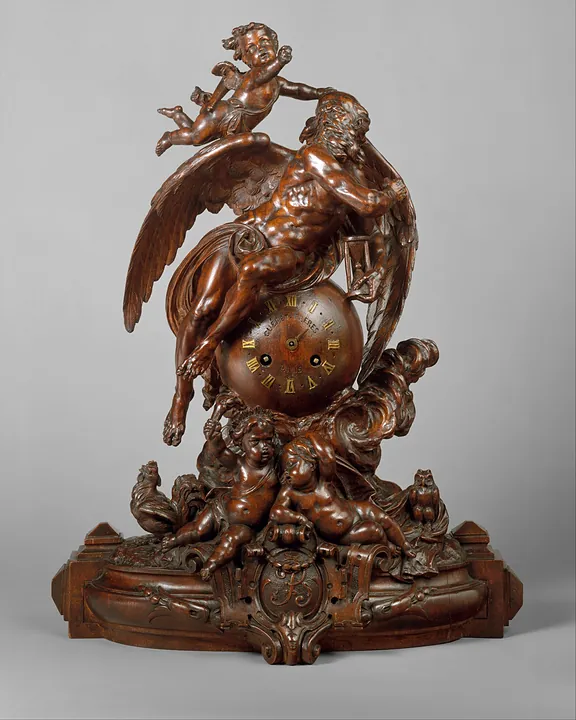
Clocks · 1863
Clock by Albert-Ernest Carrier-Belleuse, France, 1863
The Metropolitan Museum of Art, New York
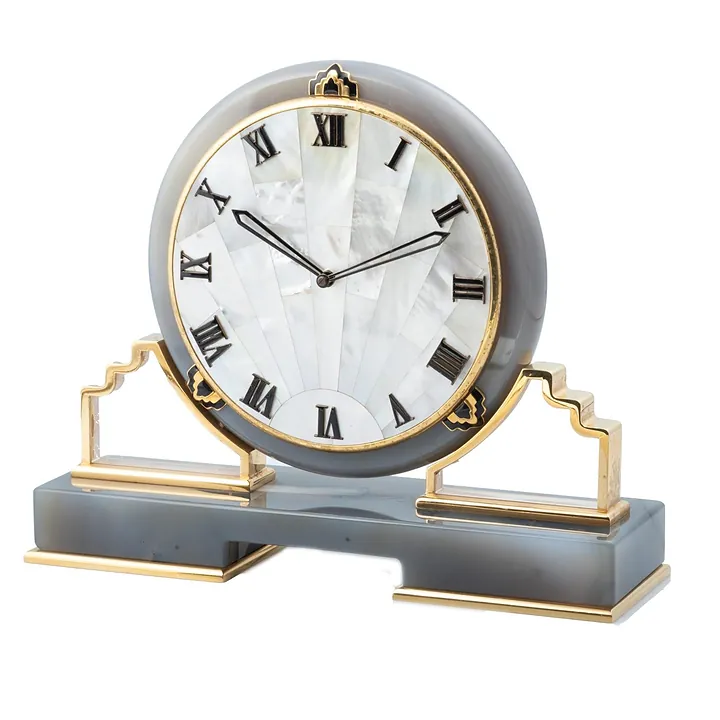
Clocks · c. 1980s
Cartier "art Deco", c. 1980s
Antiquorum auction archive, Geneva
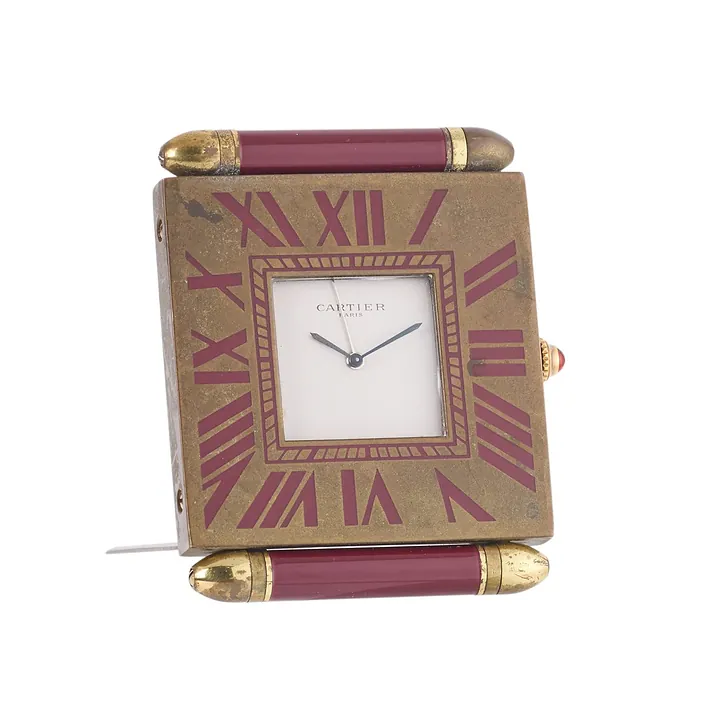
Clocks · c. 2000s
Cartier Desk Clock with Alarm, c. 2000s
Antiquorum auction archive, Geneva
Clocks · c. 2000s
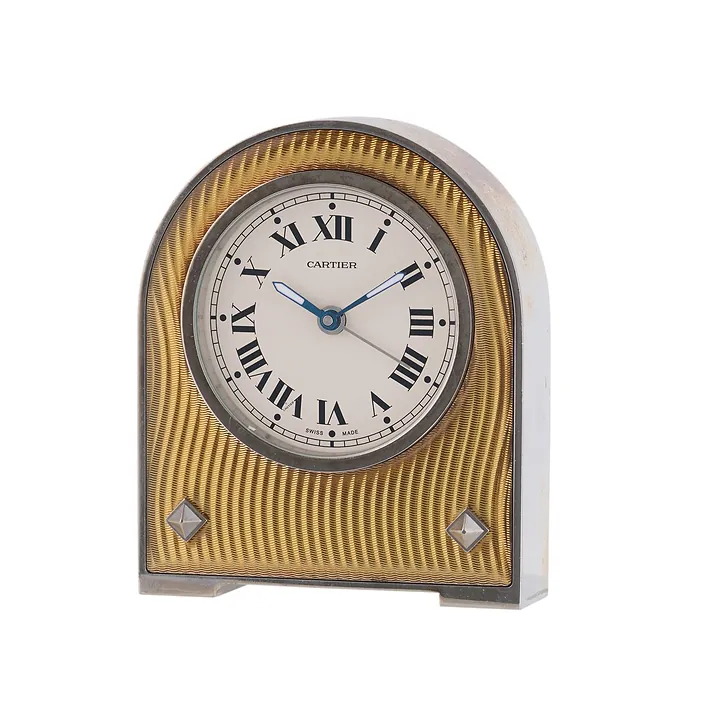
Cartier Lacquer Arched Desk Clock with Alarm, ref. W0100037, c. 2000s
Antiquorum auction archive, Geneva
Pocket Watches · 1890–1910
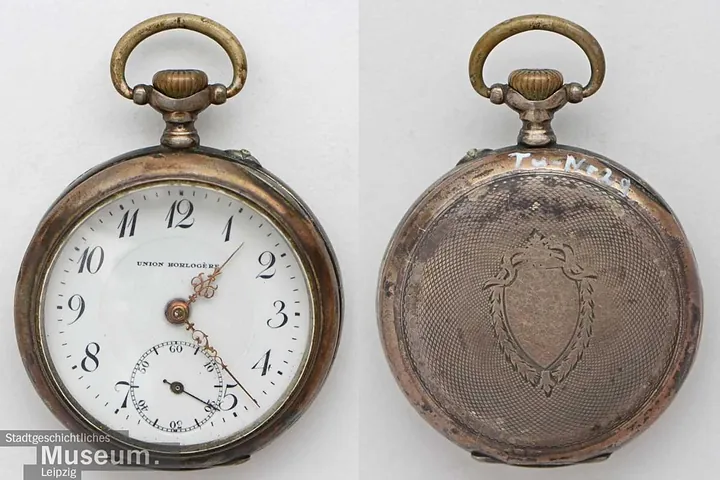
Pocket watch by Union Horlogère, France, 1890–1910
Museum of City History Leipzig
Pocket Watches · c. 1900
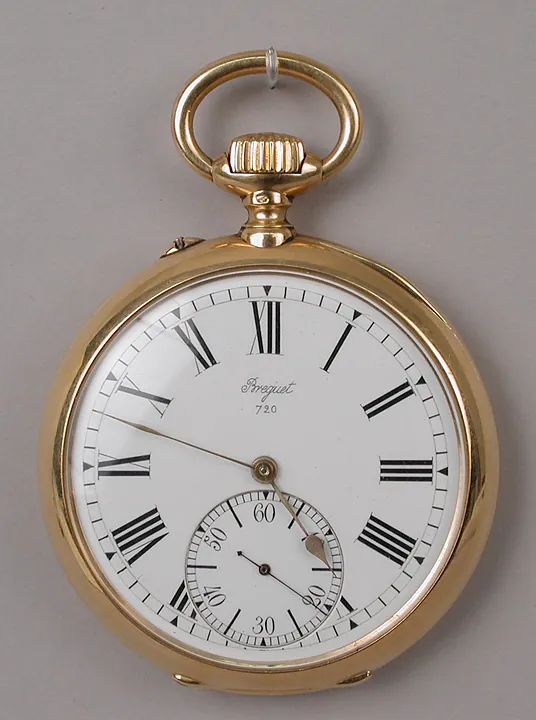
Pocket watch by Firm of Breguet et Fils, France, c. 1900
The Metropolitan Museum of Art, New York
Pocket Watches · 1900–1930
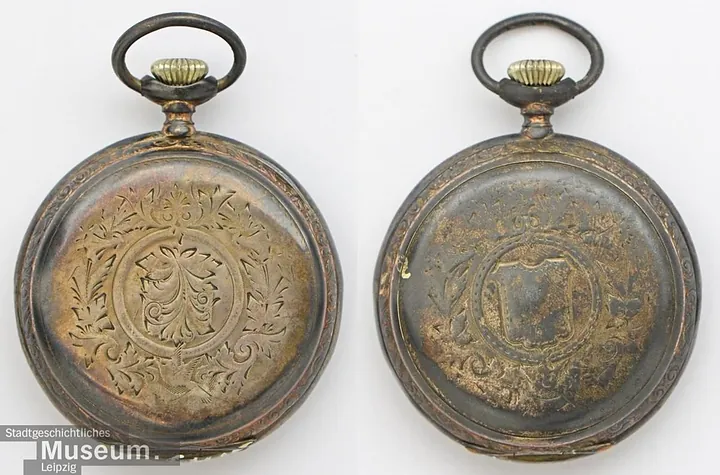
Pocket watch by Fabrique des Billodes, France, 1900–1930
Museum of City History Leipzig
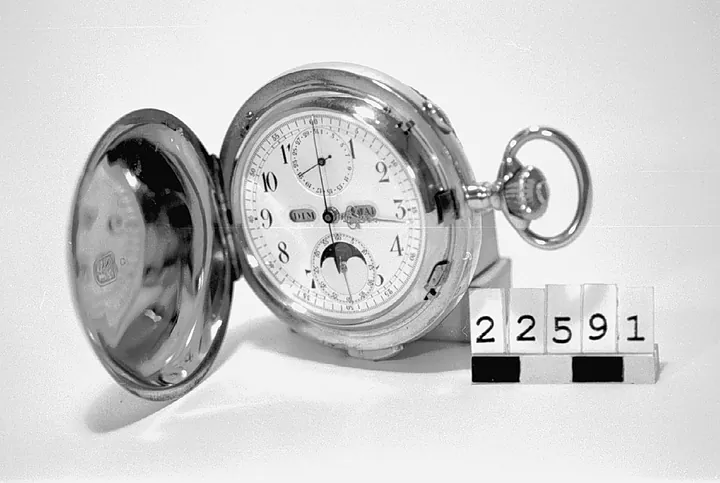
Pocket Watches · 1900–1999
Pocket watch by Surete, France, 1900–1999
Swedish National Museum of Science and Technology