
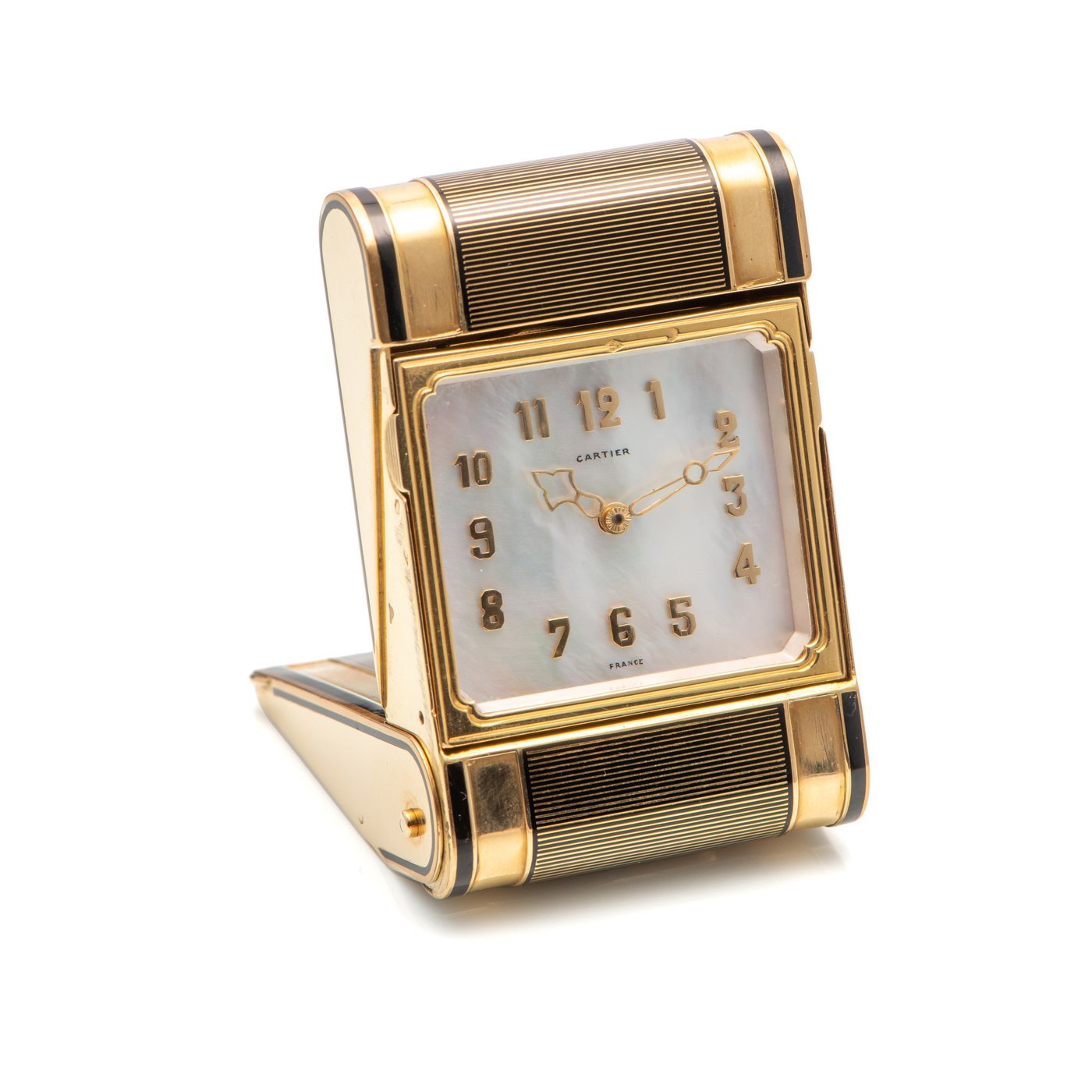
Clocks · Travel clock
Cartier European Watch & Clock Co. Travel Clock
- Maker / attribution
- Cartier / European Watch & Clock Co. (source attribution)
- Date
- c. 1930s
- Historical period
- Golden Age of Mechanical Watchmaking (1900 – 1945)
- Country of origin
- Switzerland
- Object type
- Travel clock
- Materials / technique
- 18k yellow gold and enamel
- Dimensions
- 64 x 42 x 15 mm (closed)
- Holding institution
- Antiquorum
- Accession / object no.
- 121
- Credit line
- Antiquorum
- Catalogue title (original)
- CARTIER/EUROPEAN WATCH & CLOCK CO., TRAVEL CLOCK, MOTHER-OF-PEARL DIAL, GOLD (English)
View the source record ↗ (opens another website in a new tab)Suggest a correction
Record summary
Held and catalogued by Antiquorum (object number 121), this is a travel clock attributed to Cartier / European Watch & Clock Co., made in Switzerland, dated c. 1930s. The Atlas places it in the Golden Age of Mechanical Watchmaking period (1900 – 1945) of its Clocks collection. Materials and techniques recorded by the source: 18k yellow gold and enamel. Recorded dimensions: 64 x 42 x 15 mm (closed). The record is illustrated with 1 photograph.
Assembled from the source record's structured fields. Dates and attributions are given as the source states them; where a field is missing the Atlas leaves it blank rather than estimating.
Catalogue description
Original object description
Constructed in 18k yellow gold with inlaid black enamel and a textured exterior of fine parallel ridges, this 1930s travel timepiece was created jointly by Cartier and the European Watch & Clock Co. The foldable housing, which measures 64 x 42 x 15 mm when shut, opens to serve as a tabletop stand and is stamped on the case with the numbers 4527/2551/0864/2562. Unlike standard sterling silver examples, executions in gold are considered rare. An intact mother-of-pearl dial presents Arabic hour markers, the 'Cartier' brand name, and the text 'FRANCE' positioned at the lower edge. It is driven by a 15-jewel, manually wound movement, with European Watch & Clock Co. signatures marked on the caliber, case, and movement. Sourced from a collection in the United Kingdom, auction condition notes record an unblemished dial, light handling marks and scratches on the gold exterior, and an internal mechanism currently in need of servicing.
Inscriptions & marks
4527/2551/0864/2562
Historical context
Golden Age of Mechanical Watchmaking (1900 – 1945)
The wristwatch displaces the pocket watch; waterproof cases, self-winding and grand complications.
Between 1900 and 1945 clocks were electrified: master-clock systems ran factories and offices, synchronous mains clocks entered homes, and the Shortt free-pendulum clock set new standards of accuracy before the first quartz clocks (1927). Art Deco design reshaped mantel and table clocks.
Read the period in the timelineMore clocks from this periodEarlier: Industrial Revolution
Atlas type guide
Carriage and travel clocks
The carriage clock is a portable spring clock with a balance-wheel escapement and a brass case with glass panels and a carrying handle. Abraham-Louis Breguet made early examples around 1800, and from the 1830s Paul Garnier and other French makers industrialised production, with the small towns of Saint-Nicolas-d'Aliermont and the Franche-Comté supplying movements for retailers worldwide.
Typical features include a platform escapement mounted horizontally on top of the movement (usually a lever, sometimes cylinder or Garnier's chaff-cutter), striking or repeating work, and alarms. English carriage clocks, generally larger and with fusees, were made by firms such as Frodsham and Dent. Travel clocks in folding leather cases became popular in the twentieth century.
What to look for
- A platform escapement visible through the top glass.
- Case styles: corniche, gorge, anglaise, obis or engraved cases.
- Repeat buttons on top and strike/silent levers.
- Stamps of movement makers (e.g. Drocourt, Jacot, Margaine, Richard & Co.) on the backplate.
Dating clues
- Early carriage clocks with Breguet or Garnier features: c. 1800–1850.
- Mass-produced French carriage clocks: c. 1850–1914.
- Folding travel clocks and alarm travel clocks: mostly 1920–1970.
General guidance written by the Atlas editors about this kind of object. It is not a statement about this particular piece; for that, rely on the source record above and on physical examination.
Read next:Detached lever escapement
Related records
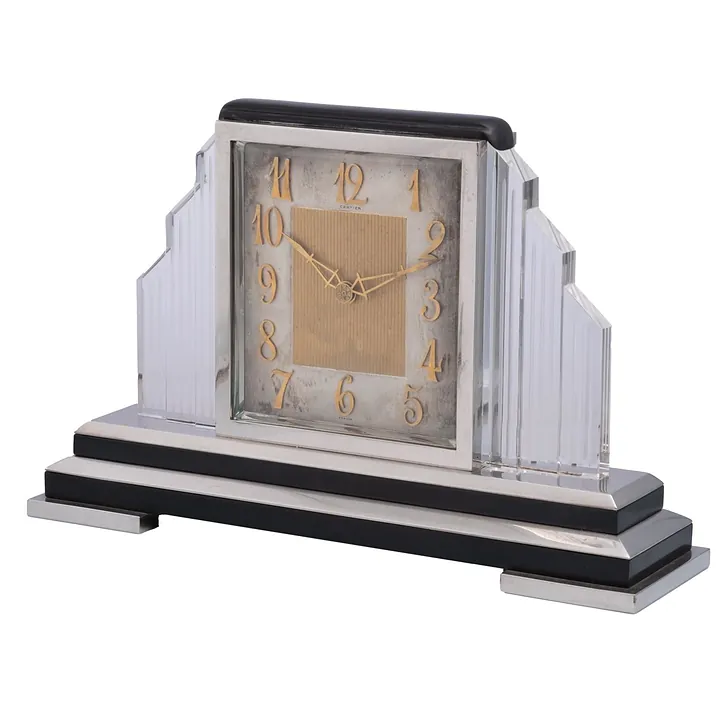
Clocks · c. 1930s
Cartier and European Watch & Clock Co. Desk Clock
Antiquorum
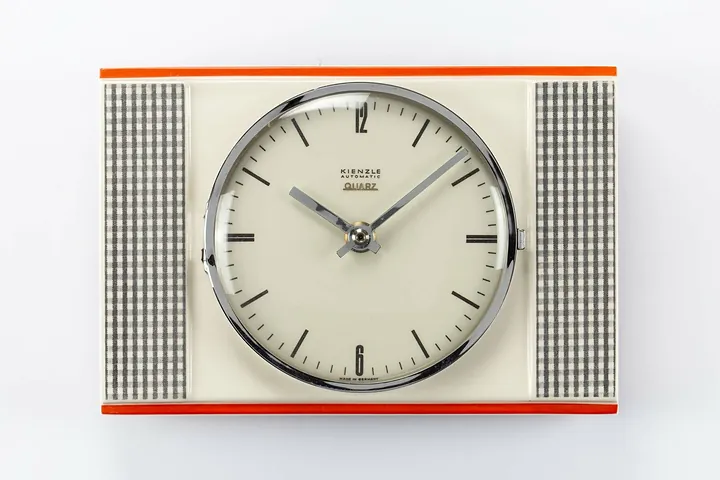
Clocks · 1900–1999
Clock by Kienzle - Uhrenfabrik, Switzerland, 1900–1999
German Clock Museum
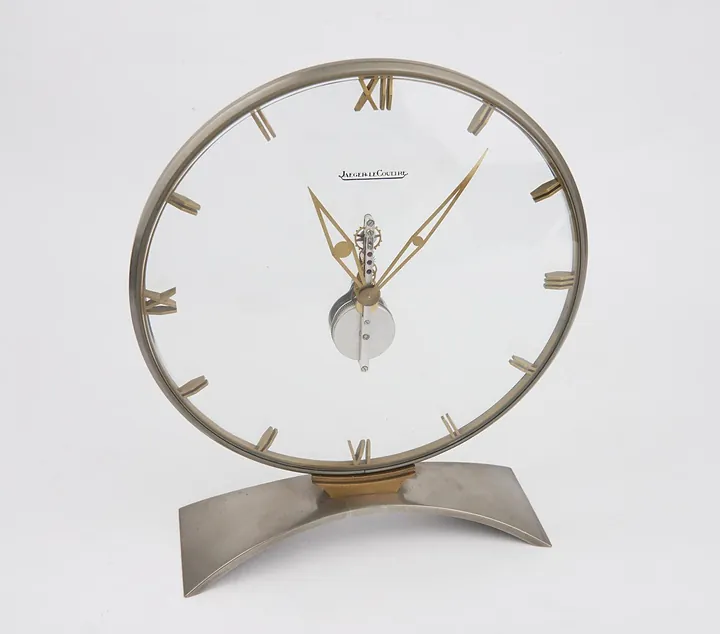
Clocks · 1937–1938
Skeleton clock by Jaeger-LeCoultre, Switzerland, 1937–1938
Science Museum Group, London
Clocks · c. 1930
Musical Clock - Didisheim-Goldschmidt Fils & Co, Switzerland, c. 1930
Museums Victoria, Melbourne
Clocks · 1910–1940
Alarm clock by Eterna, Switzerland, 1910–1940
Lusto – Suomen Metsämuseo
Clocks · 1900–1949
Wall clock, Switzerland, 1900–1949
Heinolan museot
Clocks · c. 1930s
Table clock, Switzerland, c. 1930s
HKM / Kulttuurihistoriallinen
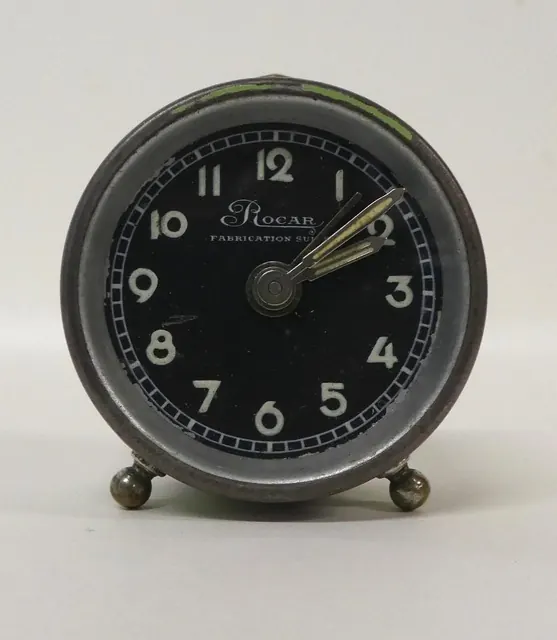
Clocks · 1942
Alarm clock, Switzerland, 1942
Lahden museot