
Clocks · Cartel Clock
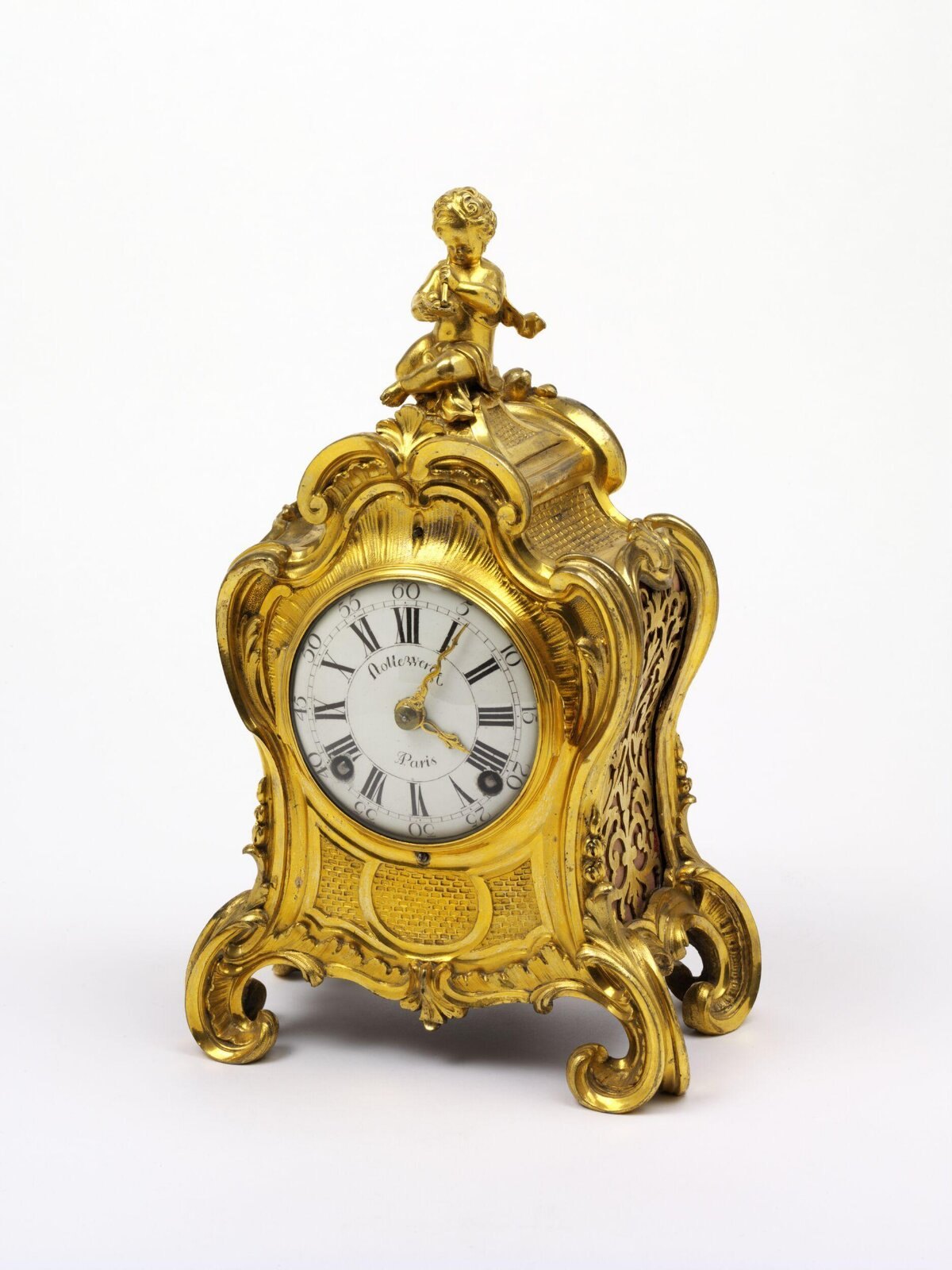
Cartel Clock by Michel Stollewerck, France, 1745–1750
- Maker / attribution
- Michel Stollewerck (clockmaker)
- Date
- 1745–1750
- Historical period
- Early Modern Horology (1600 – 1750)
- Country of origin
- France
- Place
- Paris
- Object type
- Cartel Clock
- Materials / technique
- Ormolu case retaining its original 18th century surface chasing. The side fret panels are later replacements. The dial and movement are contemporary but the back plate has been cut down to fit into the case. The dial plate has a greenish tinge to the edge characteristic of 18th century enamelling. Above the dial glass a small hole remains for the adjustment lever to raise or lower the pendulum so that the running speed could be speeded up or slowed down. The glass plate in the back is a later replacement as the back would originally have been entirely of metal. Originally lined with red silk t
- Dimensions
- Height: 30.5 cm (Base of feet to top of figure on top of clock); Width: 20 cm (Across feet at base); Depth: 11 cm (From front of clock across to back, including handle on door at back); Weight: 4 kg plus ? kg
- Holding institution
- Victoria and Albert Museum, London
- Accession / object no.
- 997-1882
- Credit line
- Bequeathed by John Jones
View the source record ↗ (opens another website in a new tab)Suggest a correction
Record summary
Held and catalogued by Victoria and Albert Museum, London (object number 997-1882), this is a cartel clock by Michel Stollewerck, made in Paris, France, dated 1745–1750. The Atlas places it in the Early Modern Horology period (1600 – 1750) of its Clocks collection. Materials and techniques recorded by the source: Ormolu case retaining its original 18th century surface chasing. The side fret panels are later replacements. The dial and movement are contemporary but the back plate has been cut down to fit into the case. The dial plate has a greenish tinge to the edge characteristic of 18th century enamelling. Above the dial glass a small hole remains for the adjustment lever to raise or lower the pendulum so that the running speed could be speeded up or slowed down. The glass plate in the back is a later replacement as the back would originally have been entirely of metal. Originally lined with red silk t. Recorded dimensions: Height: 30.5 cm (Base of feet to top of figure on top of clock); Width: 20 cm (Across feet at base); Depth: 11 cm (From front of clock across to back, including handle on door at back); Weight: 4 kg plus ? kg. The record is illustrated with 1 photograph.
Assembled from the source record's structured fields. Dates and attributions are given as the source states them; where a field is missing the Atlas leaves it blank rather than estimating.
Catalogue description
Summary — Victoria and Albert Museum
This cartel clock was originally supported by a matching bracket. The maker of the movement Michel Stollenwerck was of German birth but recorded in Paris by 1730. He first established his workshop in the precincts of the Abbey St Germain des Pres in 1739 but moved to the rue de la Comedie Française by 1747. Stollenwerck had exceptional mechanical talent and specialized in musical clocks. In 1776 Pere Marie-Dominique-Joseph Engramelle noted 'The carillons of Stollenwerck which have been transported to China, to the Grand Mogul, to Turkey, and to the Hurons, have enchanted the sovereigns of these vast countries'. The editors of the Encyclopedie chose one of Stollenwerck's clocks to illustrate the article on Carillon . Stollenwerck's movements were contained in cases by the best workers in ormolu including J.P.Latz, R.Osmond, Morlay and E.Roy. They were gilded by I.P.Gobert. This example, although relatively modest, incorporates, as finial a Cupid armed with fleche of arrows, his bow slung behind him. The presence of Cupid representing Love alludes to the celebrated clock model by André Charles Boulle in which Cupid is shown as the Conqueror of Time. Stollenwerck supplied clocks for the French nobility and the crowned heads of Europe including King Stanislas Leszczynski, Frederick II of Prussia and Augustus III of Saxony.
Physical description — Victoria and Albert Museum
Case: This cartel clock was originally supported on an ormolu bracket. Dial: White enamel dial, 8.9cm (diameter), of conventional layout. Winding hole piercing and signed in centre 'Stollewerk Paris'. There are gilt hands, the hour-hand being pierced, and there is another hole for regulation above the dial top. Movement: Going train with barrel at the bottom centre of the movement, the fusee of 9 turns to the right. Verge escapement, with crown wheel of 35T, crutch attachd to the verge. The pendulum is 13.6cm long, suspended from a wound-up cord, with a lenticular bob, 4.1cm diameter. The locking-plate striking mechanism to left, with giong barrel. An external count-wheel is numbered 1 to 12 with a second wheel of train, allowing a sngle stroke at half ours.
Inscriptions & marks
The movement is inscribed 'MStollewerck' and the dial bears the name 'Stollewerck a Paris'
Provenance
The clock features in an engraved view of John Jones's Dining Room at 95 Piccadilly, London. The side panels are thought to be later replacements. This clock was among a large collection of furniture, porcelain, metalwork, paintings and books owned by the tailor and businessman John Jones, and kept in cramped conditions at his Piccadilly house. In his will of 4 December 1879 and in a codicil of 22 January 1880, Jones bequeathed the objects to the South Kensington Museum, and they were transferred there after his death in 1882. The Handbook to the Jones bequest, published in 1883, marvels at the value of the gift, which seems still not to have been displayed to best advantage: 'Probably a large majority of those who visit the Jones collection will be indisposed to believe ... that so limited a space as three not large galleries in the Museum can contain furniture and decorative arts worth no less than a quarter of a million of money'. Jones' principal collecting interests lay in French eighteenth-century furniture and decorative arts, of which this clock is an example, as well as reflecting the late-Victorian love of rich, gilded surfaces and historical artistic styles. Acquired by John Jones before 1882; it is one of sixteen clocks he bequeathed to this museum.
Historical context
Early Modern Horology (1600 – 1750)
Huygens' pendulum and balance spring transform accuracy; English makers develop the anchor and deadbeat escapements.
Huygens's pendulum (1656–57) improved clock accuracy from about a quarter of an hour to under a minute a day. The anchor escapement (c. 1670) and the long seconds pendulum created the longcase clock; London makers such as Fromanteel, Knibb, Tompion and Quare led European clockmaking, and French makers created the Boulle pendule.
Read the period in the timelineMore clocks from this periodEarlier: Renaissance Horology
Atlas type guide
Mantel and French pendule clocks
The mantel clock — the French pendule de cheminée — is as much decorative art as timekeeper. From the late seventeenth century Parisian clockmakers worked with cabinet-makers, bronze founders and gilders (ciseleurs-doreurs) to create cases in Boulle marquetry, gilt bronze and marble, while the movements were often supplied by specialist makers. Clocks of the Louis XIV, Louis XV and Louis XVI periods, and Empire clocks with allegorical figures, set fashions copied across Europe.
The nineteenth century industrialised the type. The 'Paris movement', a standardised round movement with silk-thread or Brocot suspension and count-wheel striking, was made in huge numbers by firms such as Japy and Vincenti, and fitted into cases of every style and material.
What to look for
- Round 'Paris' movements with makers' stamps (e.g. Japy Frères, Vincenti, S. Marti) and medal marks from exhibitions.
- Suspension type: silk thread (earlier) or Brocot adjustable suspension (after c. 1840).
- Visible Brocot escapement on the dial in later clocks.
- Fire-gilt (mercury) gilding on bronzes versus later electro-gilding.
- Signed dials naming a retailer rather than the movement maker.
Dating clues
- Silk-suspension Paris movements: c. 1800–1850.
- Brocot suspension and visible escapements: after c. 1840.
- Exhibition medal stamps on movements give dates after the medal year.
General guidance written by the Atlas editors about this kind of object. It is not a statement about this particular piece; for that, rely on the source record above and on physical examination.
Read next:Anchor (recoil) escapement
Related records
Clocks · 1590–1610
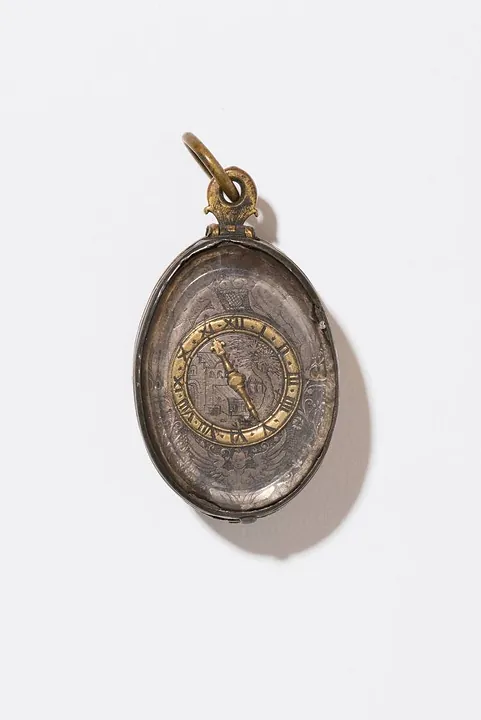
Clock, France, 1590–1610
MAK – Museum of Applied Arts
Clocks · c. 1600
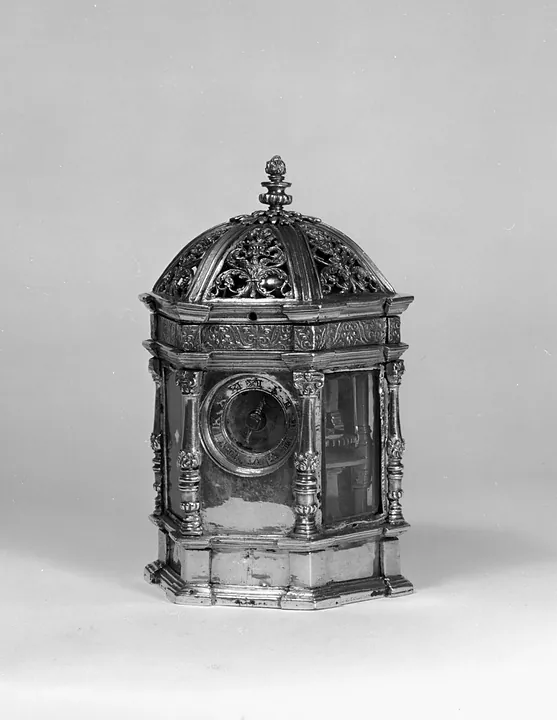
Table Clock, sheet brass, engraved, pierced and gilt, Paris, ca.1600, signed 'B(?) Pichard, à Paris'
Victoria and Albert Museum, London
Clocks · 1600–1699
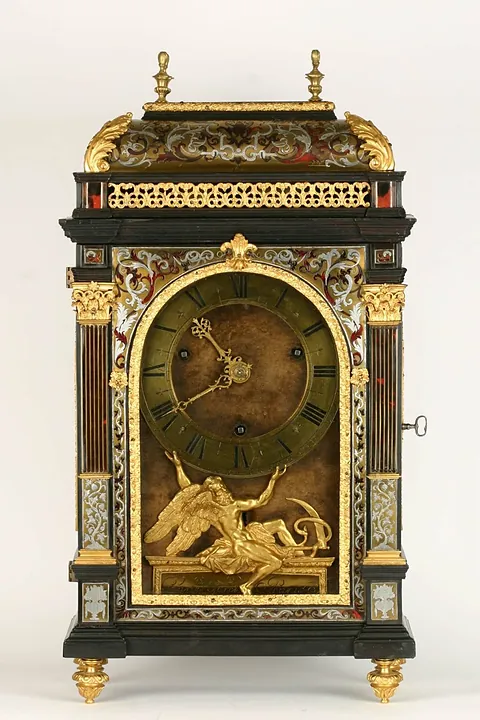
Table clock by Charles Goret, France, 1600–1699
German Clock Museum
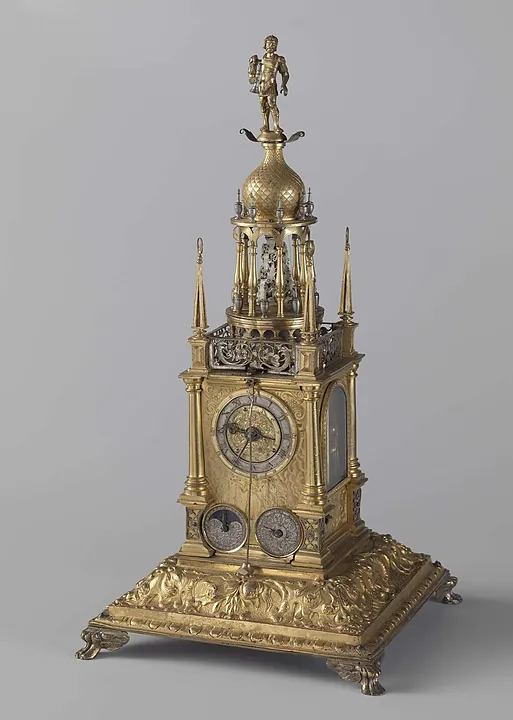
Clocks · 1640
Table clock, France, 1640
Rijksmuseum
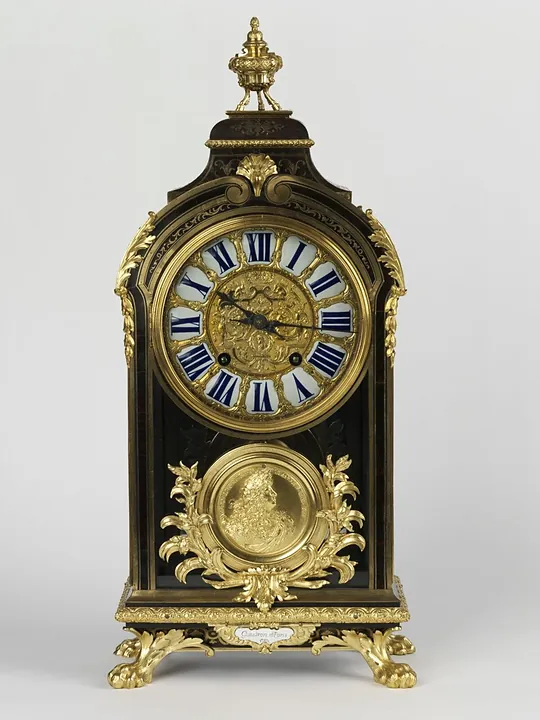
Clocks · late 17th century
Clock with case of tortoiseshell inlaid with brass, Paris, late 17th century
Victoria and Albert Museum, London
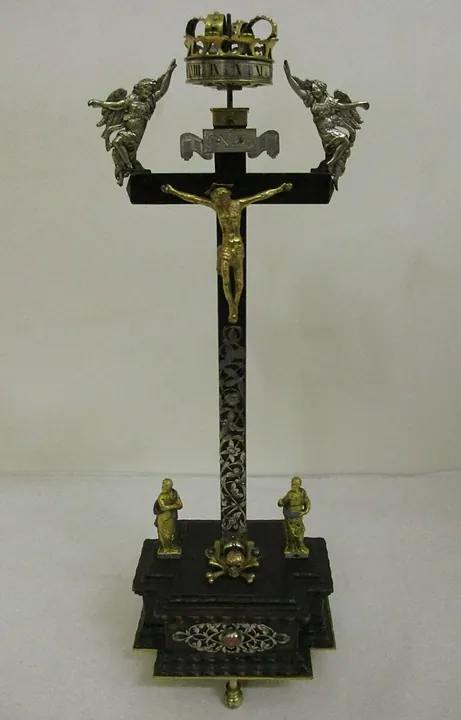
Clocks · 1650
Crucifix Clock, signed W. H. Arnstad, mid- 17th century.
Victoria and Albert Museum, London
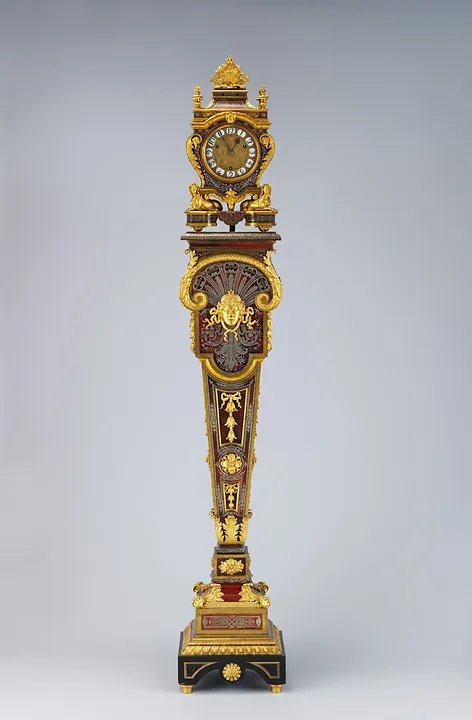
Clocks · c. 1690
Clock with pedestal, case attributed to André Charles Boulle, France, c. 1690
The Metropolitan Museum of Art, New York
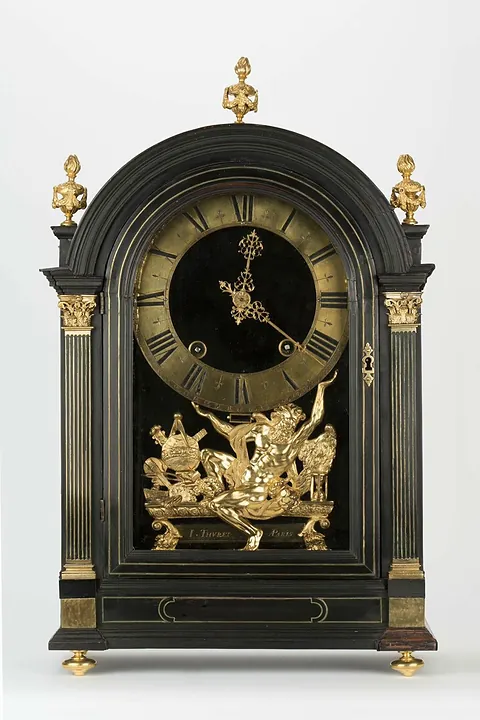
Clocks · c. 1690
Table clock by Marc Boucher, France, c. 1690
German Clock Museum