
Wristwatches · Wristwatch
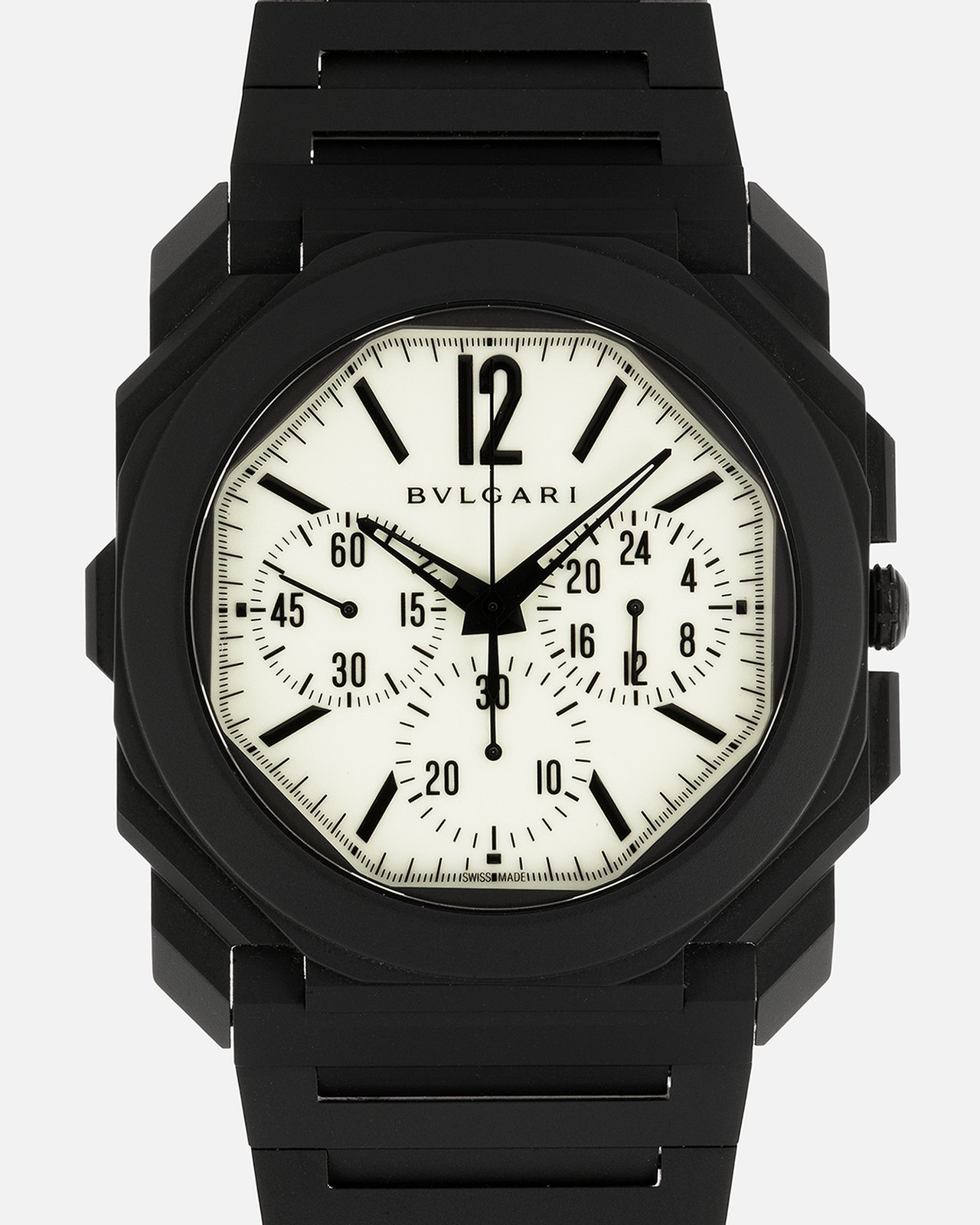
Bvlgari Octo Finissimo Nuclear Option Rake Revolution, 2021
- Maker / attribution
- Bvlgari (maker)
- Date
- 2021
- Historical period
- Contemporary Horology (2010 – Present)
- Country of origin
- Switzerland
- Object type
- Wristwatch
- Dimensions
- Case 43 mm
- Stock no.
- Product 6760675934295
- Credit line
- Dealer listing, S.Song Watches (product 6760675934295)
- Catalogue title (original)
- Bvlgari Octo Finissimo Nuclear Option Rake Revolution (English)
View the source record (dealer listing) ↗ (opens another website in a new tab)Suggest a correction
Record summary
Catalogued by S.Song Watches (dealer), Seattle (stock number Product 6760675934295), this is a wristwatch by Bvlgari, made in Switzerland, dated 2021. The Atlas places it in the Contemporary Horology period (2010 – Present) of its Wristwatches collection. Recorded dimensions: Case 43 mm. The record is illustrated with 6 photographs.
Assembled from the source record's structured fields. Dates and attributions are given as the source states them; where a field is missing the Atlas leaves it blank rather than estimating.
Catalogue description
Dealer description — S.Song Watches
Originally released in 2014, the Bvlgari Octo Finissimo burst onto the watchmaking scene as Bvlgari's latest entrant into the world of angular integrated bracelet timepieces inspired by Gerald Genta's signature design language. Since then, the Octo Finissimo has been Bvlagri's most often-used medium for horological innovation. In such a short span of time, Bvlgari focused all of its efforts in the field of ultra-thin watchmaking as it continues to break the “world’s thinnest” record, again and again, even to this very day. We do not mean to sound like a broken record, but it is simply near-impossible with what Bvlgari has been achieving. What we have here is a very unique watch that is guaranteed to turn heads – the Bvlgari Octo Finissimo Ceramic Chronograph GMT “Nuclear Option” for Revolution & The Rake. In our opinion, this is probably one of the more interesting models to come out of the Finissimo lineup to date. Prior to its conceptualization, Bvlgari’s main idea was to create a more rugged and “tool-ish” version of the original record-setting automatic chronograph, but there were some technical concerns with the coating of the indexes and hands with Super Luminova on a dial that is only 0.3mm thick. Designer Fabrizio Buonamassa then proposed an interesting solution to coat the entire dial with Super Luminova to allow the indexes to stand out in negative relief. According to Buonomassa, the design team at Bvlgari went through quite a number of dials to achieve this particular result, which he deemed it as the perfect balance where the dial would look like a normal white dial chronograph in daylight but as soon as you moved into darkness, it would glow with perfect legibility and remained luminous for a long time, almost like a LED screen on the dial itself. Now for the technical side of things, the watch is powered by Bvlgari’s very own ultra-thin BVL 318 movement, which boasts a respectable 55 hours of power reserve. Whilst the watch is a little on the larger side at 43mm and comes in a fully blacked out, 7mm thick, sandblasted ceramic case and bracelet, there is a certain elegance in its physical form and stealthy presentation that is quite difficult to describe in a mere few words. The watch is light but commands a presence on the wrist. It also features a modern horizontally coupled, column-wheel chronograph function, a 24-hour GMT function, a local time one-hour advance pusher, and a small seconds subdial, all within the 3.30mm thin BVL 318. Impressive, right?
Historical context
Contemporary Horology (2010 – Present)
Silicon components, connected watches, optical-lattice research clocks and a thriving independent scene.
Smartwatches became the world's best-selling watches, while mechanical watchmaking focuses on craft, innovation (silicon components, new escapements) and independent makers.
Read the period in the timelineMore wristwatches from this periodEarlier: Mechanical Renaissance
Atlas type guide
Wristwatches
Bracelet watches were worn by women from the early nineteenth century — Breguet made one for Caroline Murat, Queen of Naples, in 1810–12 — but the wristwatch only became a man's instrument with military use and aviation in the early twentieth century. Between the World Wars it overtook the pocket watch; the 1920s and 1930s brought rectangular Art Deco cases, water-resistant cases and the first automatic winding systems.
After 1945 the wristwatch became a carrier of identity — dress watches, sports and dive watches, chronographs, calendars — produced by Swiss, American, Japanese, German, Soviet and Chinese industries. The quartz revolution after 1969 and the mechanical renaissance since the 1990s, including the rise of independent watchmakers, complete the story.
What to look for
- The reference number (between the lugs or inside the case back) and serial number, the starting point for dating.
- The calibre: its maker and number are often stamped under the dial or on the bridge.
- Originality of dial, hands and crown — refinished ('redial') dials are common.
- Case material marks: 18K/750, 14K/585, stainless steel, gold-filled, plated.
Dating clues
- Wire-lug cases: before c. 1925.
- Water-resistant screw-down cases: from 1926.
- Quartz movements: from 1969; sapphire crystals widespread after c. 1980.
General guidance written by the Atlas editors about this kind of object. It is not a statement about this particular piece; for that, rely on the source record above and on physical examination.
Related records
Wristwatches · c. 1980
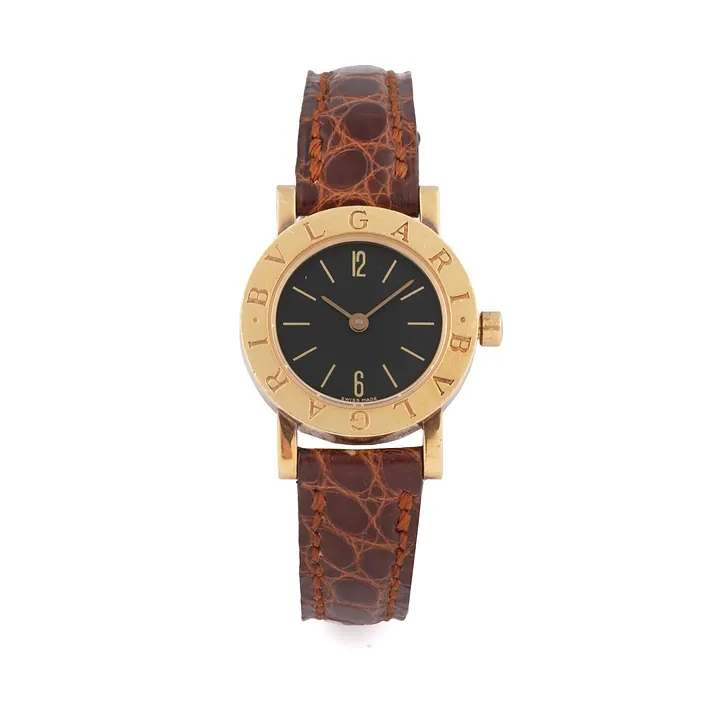
Bvlgari Bulgari, ref. bb23 gl, c. 1980
Antiquorum auction archive, Geneva
Wristwatches · 1993
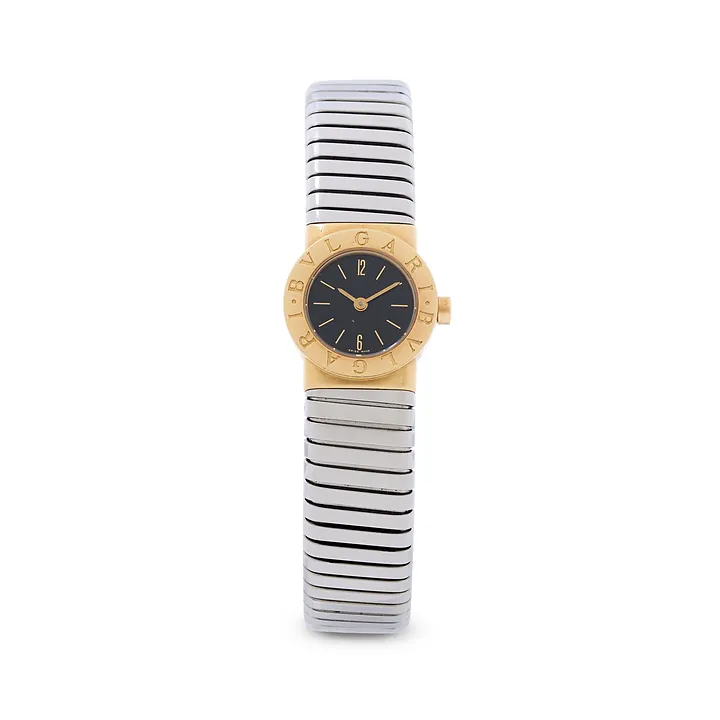
Bvlgari Tubogas, ref. BB 19 2T, 1993
Antiquorum auction archive, Geneva
Wristwatches · c. 2000
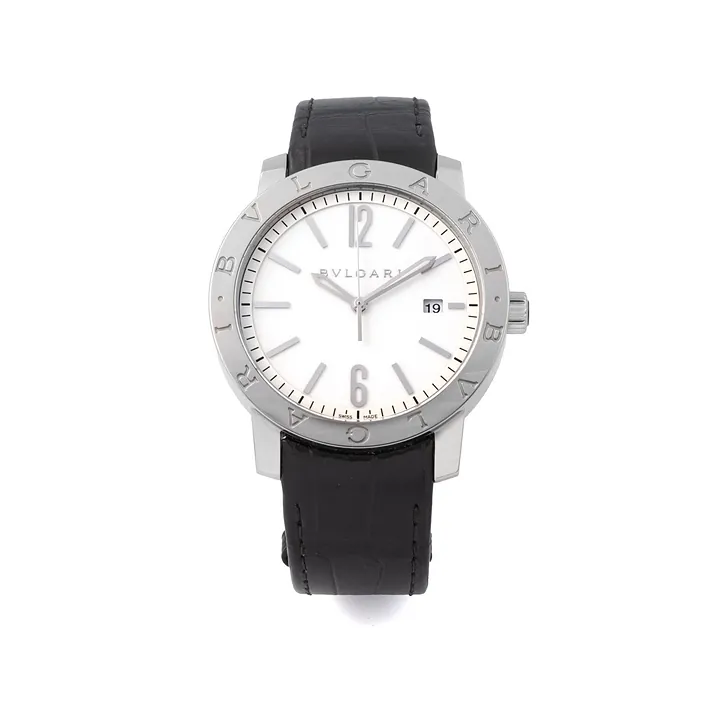
Bvlgari Solotempo, ref. BB141S, c. 2000
Antiquorum auction archive, Geneva
Wristwatches · originally sold on 22 December 2018 (per the lot record)
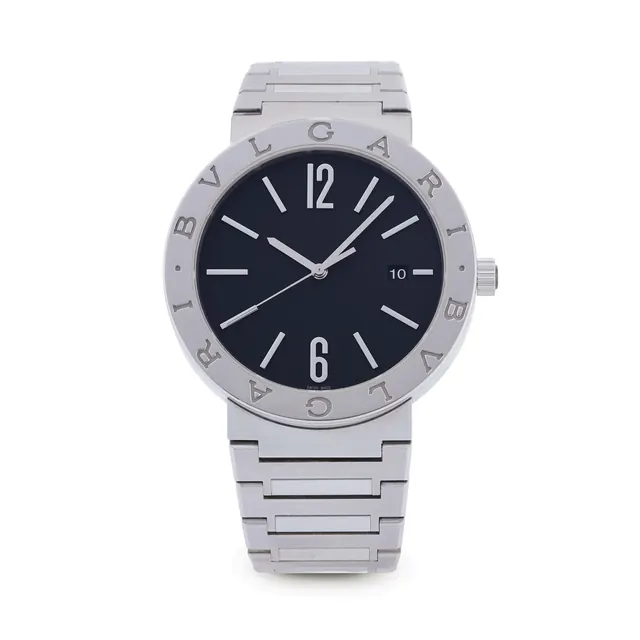
Bvlgari wristwatch, ref. 102928, Bvlgari Bvlgari, originally sold on 22 December 2018
Antiquorum auction archive, Geneva

Wristwatches · c. 2010s
Breguet Type XXI, ref. 3810, c. 2010s (Antiquorum Lot 381-24)
Antiquorum auction archive, Geneva

Wristwatches · c. 2010s
Breguet Type XXI, ref. 3810, c. 2010s (Antiquorum Lot 386-229)
Antiquorum auction archive, Geneva

Wristwatches · Sold in September 2010
Breitling Cosmonaute, ref. A 22322, Sold in September 2010
Antiquorum auction archive, Geneva

Wristwatches · c. 2010
Corum Bubble Chrono, ref. 396.150.20, c. 2010
Antiquorum auction archive, Geneva