
Wristwatches · Wristwatch
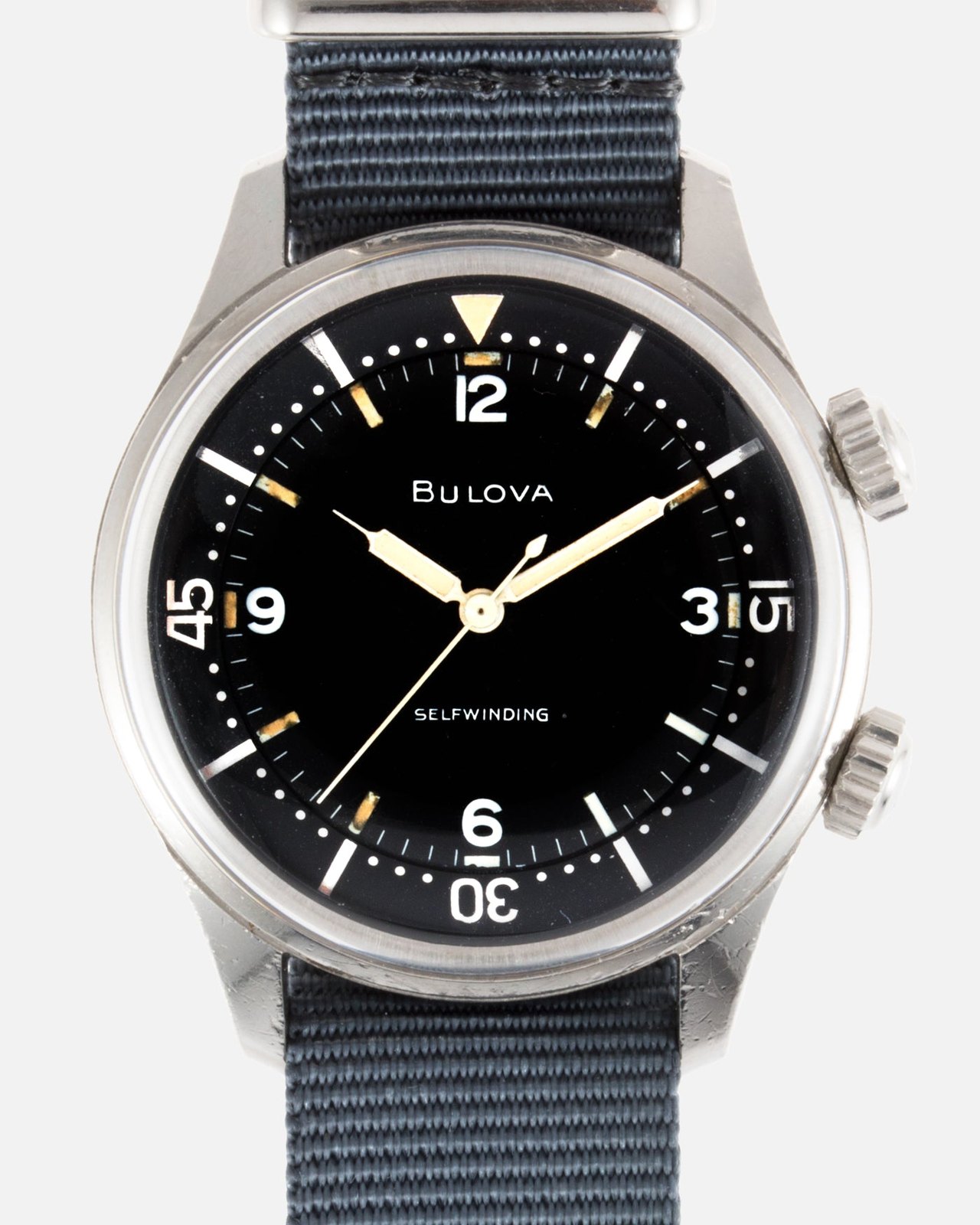
Bulova Supercompressor, 1970s
- Maker / attribution
- Bulova (maker)
- Date
- 1970s
- Historical period
- Quartz Revolution (1969 – 1990)
- Country of origin
- United States
- Object type
- Wristwatch
- Stock no.
- Product 1321333030999
- Credit line
- Dealer listing, S.Song Watches (product 1321333030999)
- Catalogue title (original)
- Bulova Supercompressor (English)
View the source record (dealer listing) ↗ (opens another website in a new tab)Suggest a correction
Record summary
Catalogued by S.Song Watches (dealer), Seattle (stock number Product 1321333030999), this is a wristwatch by Bulova, made in United States, dated 1970s. The Atlas places it in the Quartz Revolution period (1969 – 1990) of its Wristwatches collection. The record is illustrated with 6 photographs.
Assembled from the source record's structured fields. Dates and attributions are given as the source states them; where a field is missing the Atlas leaves it blank rather than estimating.
Catalogue description
Dealer description — S.Song Watches
The supercompressor case. Most recognisable through the use of double crowns at 2 and 4 o’clock, these are quintessentially 60’s/70’s in its design. Produced by a single company, Ervin Piquerez EPSA, compressor cases used a new technology at the time where it used pressure to guarantee a watch’s water resistance. As you go deeper, the pressure gets higher, in theory, creating a tighter seal. Many brands from Jaeger-LeCoultre, Universal Geneve, Longines all made supercompressor watches. Because of the iconic design and overall wearability, there is a real cult following for supercompressor watches as many brands used EPSA cases. As a result, you are able to find a whole variety of supercompressor watches with many different dial and hand designs. This is Bulova’s take on the supercompressor. All brands while using the same EPSA case, inputted their own design in regards to the dial and the Bulova is one of the nicest. It has simple black glossy dial with Arabic numerals at 12,3,6 and 9 and luminous syringe hands. The Bulova script is simple and somehow this restraint in design really creates a deep black dial that draws you in. Oh, and they are fairly rare too.
Historical context
Quartz Revolution (1969 – 1990)
Seiko's Astron begins mass quartz timekeeping; traditional industries contract sharply.
Quartz and digital watches transformed the market after 1969. Swiss employment collapsed, Japanese and Hong Kong production soared, and the Swatch (1983) helped the Swiss industry recover; mechanical watches survived as luxury goods.
Read the period in the timelineMore wristwatches from this periodEarlier: Modern Mechanical Horology
Atlas type guide
Wristwatches
Bracelet watches were worn by women from the early nineteenth century — Breguet made one for Caroline Murat, Queen of Naples, in 1810–12 — but the wristwatch only became a man's instrument with military use and aviation in the early twentieth century. Between the World Wars it overtook the pocket watch; the 1920s and 1930s brought rectangular Art Deco cases, water-resistant cases and the first automatic winding systems.
After 1945 the wristwatch became a carrier of identity — dress watches, sports and dive watches, chronographs, calendars — produced by Swiss, American, Japanese, German, Soviet and Chinese industries. The quartz revolution after 1969 and the mechanical renaissance since the 1990s, including the rise of independent watchmakers, complete the story.
What to look for
- The reference number (between the lugs or inside the case back) and serial number, the starting point for dating.
- The calibre: its maker and number are often stamped under the dial or on the bridge.
- Originality of dial, hands and crown — refinished ('redial') dials are common.
- Case material marks: 18K/750, 14K/585, stainless steel, gold-filled, plated.
Dating clues
- Wire-lug cases: before c. 1925.
- Water-resistant screw-down cases: from 1926.
- Quartz movements: from 1969; sapphire crystals widespread after c. 1980.
General guidance written by the Atlas editors about this kind of object. It is not a statement about this particular piece; for that, rely on the source record above and on physical examination.
Related records
Wristwatches · c. 1969
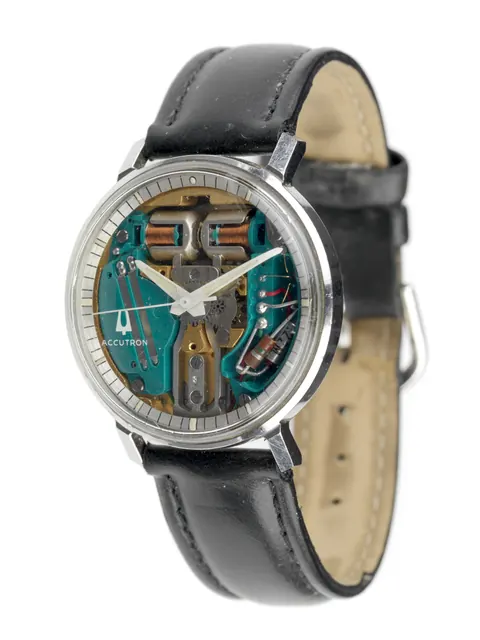
Bulova 'Accutron' tuning-fork wristwatch by Bulova
Royal Museums Greenwich
Wristwatches · c. 1965
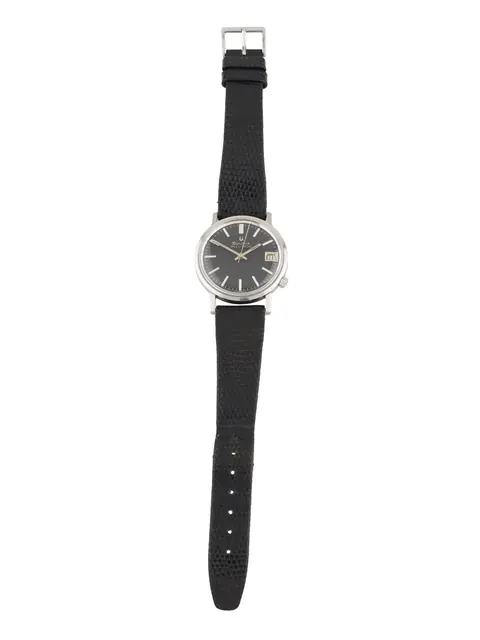
Wristwatch Accutron by Knud Geelmuyden Bull
Royal Museums Greenwich
Clocks · c. 1960s
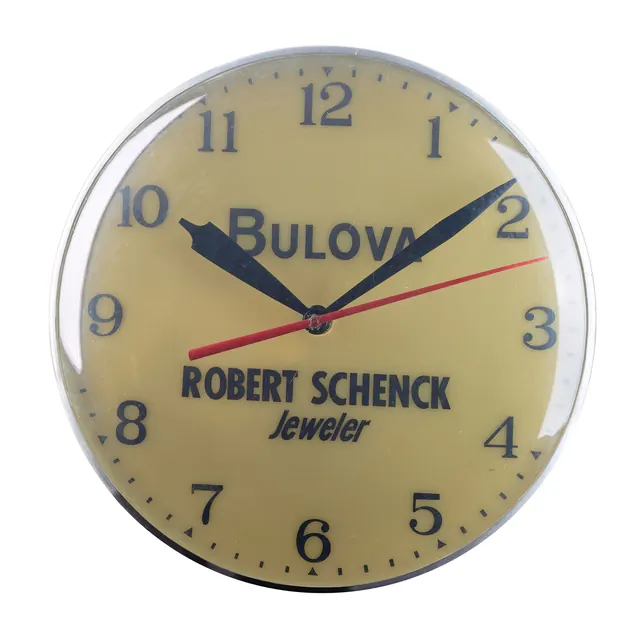
Bulova wall clock, Lighted Advertising Wall Clock for Robert Schenck Jeweler, circa 1960s
Antiquorum auction archive, Geneva
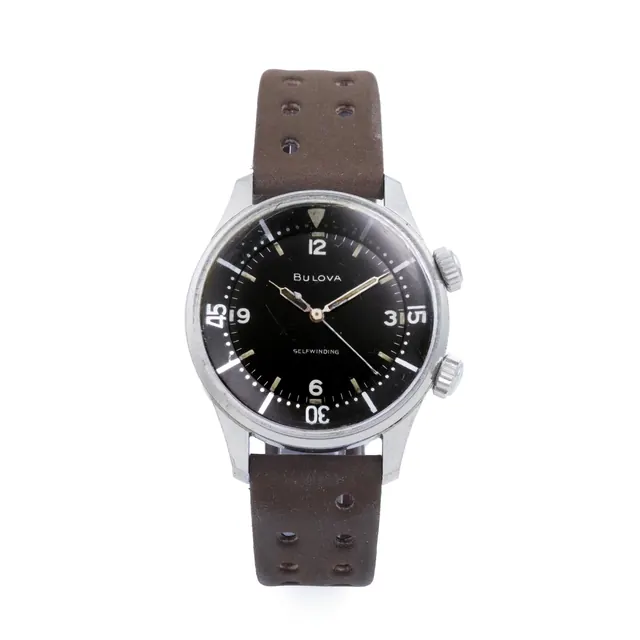
Wristwatches · 1963
Bulova wristwatch, ref. 314, Diver Super Compressor, 1963
Antiquorum auction archive, Geneva
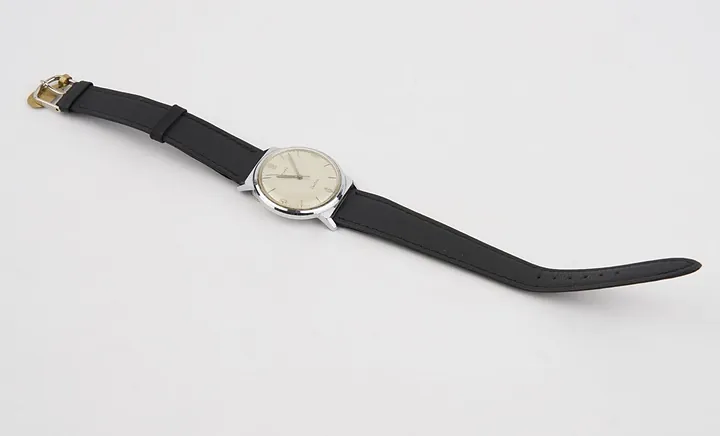
Wristwatches · 1949–1992
Timex `Electric' wristwatch, with electrically operated balance wheel mechanism, United States, 1949–1992
Science Museum Group, London
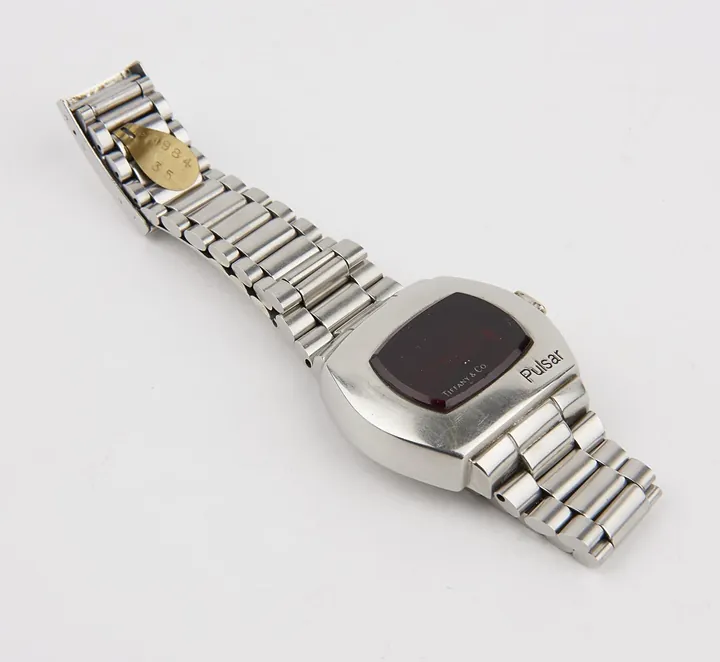
Wristwatches · 1972
Wristwatch by Hamilton Watch Company and Electro-Data Inc, United States, 1972
Science Museum Group, London
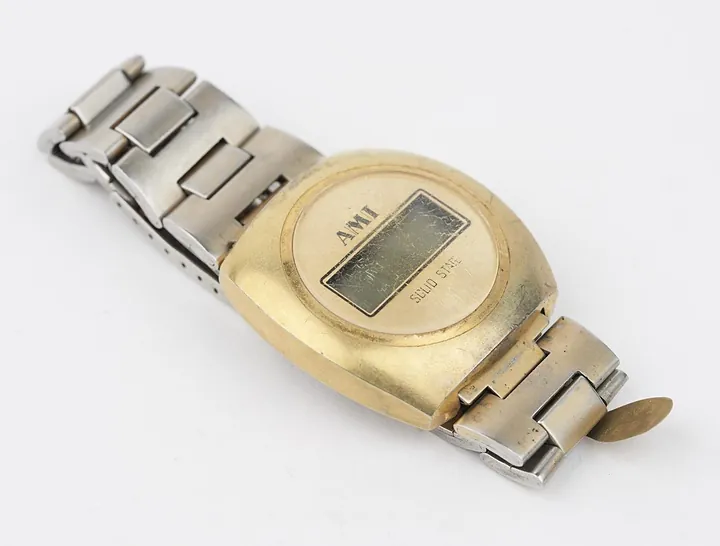
Wristwatches · 1973–1974
Quartz watch with liquid crystal digital display, made by American Microsystems Inc. (AMI) . 1973/74
Science Museum Group, London
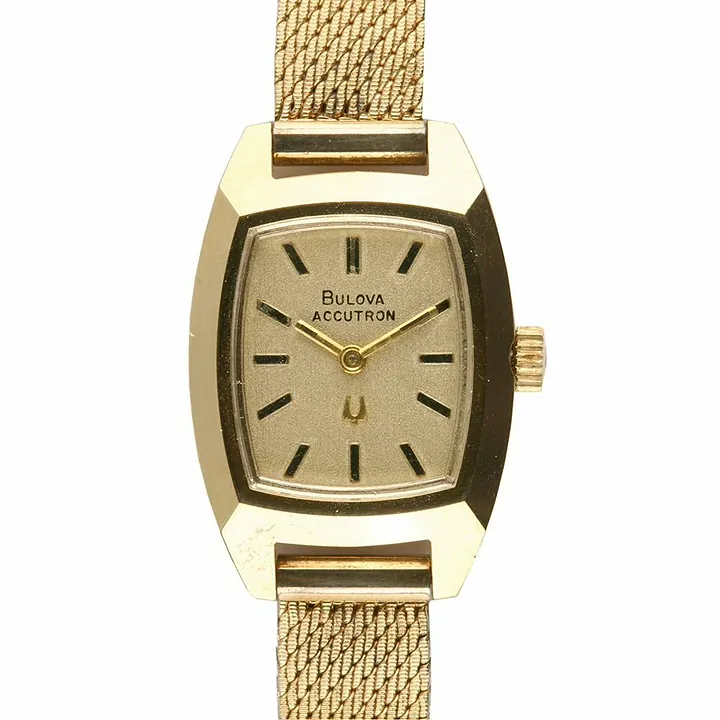
Wristwatches · c. 1973
Wristwatch by Josef Bulova, United States, c. 1973
German Clock Museum